October 16th is a special day for mathematics and physics in Ireland. On this day, we commemorate the discovery of quaternions by William Rowan Hamilton, the great Irish mathematician and astronomer. Essentially, his insight was to postulate three distinct roots for the number -1, thus generalising complex numbers to four dimensions. It can be said that this discovery marks the birth of modern algebra, as quarternions opened the door to non-commutable algebra. Quaternions have found great application in modern technology, notably in compter algorithims for animation in films and computer games.
William Rowan Hamilton made a great many other contributions to mathematics and physics. For example, his formulation of a mathematical operator for the energy of a body – the Hamiltonian – is a vital tool in quantum mechanics, the mathematical description of the quantum world. Open any modern textbook on quantum physics and you will encounter the word ‘Hamiltionian’ on almost every page.
As regards quaternions, we know exactly when Hamilton had his Eureka moment. According to his own writing, inspiration struck on the 16th october in 1843, as he was walking with his wife from Dunsink Observatory in County Dublin (where he was Astronomer Royal) along the Royal Canal towards the city centre, in order to attend a meeting of the Royal Irish Academy, of which he was President. He was so pleased with the breakthrough that he used his penknife to carve the new equation onto Broom bridge as they passed. The carving no longer exists but the bridge does, and the occasion is celebrated with a plaque. Every year, mathematicians and friends of mathematics congregate at Dunsink Observatory at 3pm and re-enact Hamilton’s famous walk along the canal to the bridge.


William Rowan Hamilton; the plaque displays the famous equation i2 = j2 = k2 = ijk = -1
This year, October 16th fell on a Sunday, so mathematicians and the general public arrived from far and near. The day started in Dunsink Observatory, with a brief description of Hamilton’s life and work by Fiacre O Cairbre, event organiser and lecturer in mathematics at NUI Maynooth. There followed a lovely walk along the canal in perfect weather conditions, all the way to Broom bridge to view the plaque. The outing finished with a short description of Hamilton’s breakthrough by another Maynooth mathematician, Anthony O’ Farrell, and a chorus of ‘Happy birthday, quaternions’ by all present. I think it’s great to remember our scientific heros like this; it’s curious that even our very best scientists and mathematicians receive far less public attention that writers and musicians.

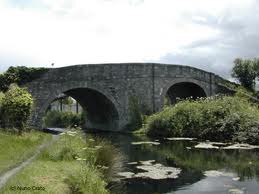
Dunsink Observatory and Broom Bridge on the Royal Canal
Each year, the Hamilton Walk is soon followed by a prestigious lecture on mathematics presented by the Royal Irish Academy and The Irish Times. Previous speakers have included Andrew Wiles, Steven Weinberg, Murray Gellman and Lisa Randall. This year, renowned string theorist Ed Witten will give a talk on quantum knots, see here.
The Hamilton walk is one of the core activies of Maths Week Ireland, an initiative to raise awareness of maths in Ireland with events and lectures all around the country. Co-ordinated by CALMAST, a science outreach group at Waterford Institute of Technology, Maths Week has grown larger every year – you can find the program of events here. I will give a talk in Dublin on Wednesday evening, on relativity and the recent ‘faster than the speed of light’ experiment, see here .








 Antimatter