The God particle at Trinity College

On Monday evening, I gave a public lecture on the Higgs boson at Trinity College Dublin. The talk was organised by Astronomy Ireland and I think it was quite a success; 200 tickets were sold and quite a few people had to be turned away.

In the Joly lecture theatre at Trinity College Dublin

How to explain the basics of particle physics to a public audience? As always, I presented the material as a short history of discovery: from the atom to the nucleus,  from protons and neutrons to Gell-mann’s quarks. I also included some theory on the fundamental interactions, right up to the Standard Model,  electro-weak unification and the role of the Higgs field in electro-weak symmetry breaking. Not for the first time, I came away with the impression that the Standard Model isn’t as intimidating for the uninitiated as you might expect. As for physics beyond the Standard Model, the audience seemed to take the hypothesis of grand unification in their stride, and the connection between particle experiments and the early universe struck a chord, as always.

The results  It was a pleasure to present the fantastic results of the ATLAS and CMS teams, first announced at CERN last July. Giving such talks is a lot easier now that the data are publicly available in two beautiful papers on the ArXiv here and here. I gave an overview of the main findings in the context of previous experiments at CERN and at the Tevatron,  and I think the audience got a feel for the historic importance of the result. Certainly, there were plenty of questions afterwards, which continued in the pub afterwards.

The famous bumps ( excess decay events) seen by both ATLAS and CMS at around 125 GeV in the di-photon decay channel

Combined signal (all decay channels) for both ATLAS and CMS

So what about that title? Yes, I did agree to the title ‘The God particle at last’? I am aware that most physicists have a major problem with the moniker; it is sensationalist, inaccurate and incurs a completely gratuitous connection with religion. (Some religious folk consider it blasphemous,  while others misunderstand the term as evidence for their beliefs).

A poster for the talk; naughty

All of this is true, yet I must admit I’ve got to like the nickname; it is catchy and just mysterious enough to cause one to think. I imagine a tired lawyer catching sight of the poster as she walks home after work;  ‘God particle’ might cause a moment of reflection, where ‘Higgs boson’ will not. At least the former expression contains the word ‘particle’, giving the reader some chance to guess the subject. Of course the ‘God’ part is hubris, but is hubris so bad if it gets people thinking about science? Also, I disagree with commentators who insist that the Higgs is ‘no more important than any other particle’. Since all massive particles are thought to interact with the Higgs field, finding the particle associated with that quantum field is of great importance.

So is it found?  CERN Director General Rolf Heuer stated in Dublin, “As far as the layman is concerned with have it. As far as the physicist is concerned, we have to characterize it”. Such characterization has been going on since July. Without question, a new particle of integer spin (boson) and mass 125 +- 0.5 GeV has been discovered. So far, the branching ratios (the ratio of various decay channels to lighter particles) match the prediction of a Standard Model Higgs boson very well. So it looks and smells like a Higgs, and we are all getting used to the idea of the Higgs field as reality rather than hypothesis. (That said, there is still the possibility of spin 1 or 2 for the new particle, but this is not very likely).

All in all, a very enjoyable evening. The slides and poster I used for the talk are available here.  No doubt, some Trinity professors may have been none too pleased to see ‘God particle’ posters in the Hamilton building. Me, I’ve decided I can live with the name if that’s what it takes to get the public excited about particle physics…

Update

Some bloke called Zephyr is upset and accuses me of misleading the public (comments). His point is that I refer to the Higgs as a particle, instead of a quantum field. There is a valid point here; what were once thought of as elementary ‘particles’ of matter are now considered to be manifestations of quantum fields. However, in the business of communicating physics to the public, each physicist must find their own balance between what is accurate and what is comprehensible. My own experience is that people grasp the idea of the Standard Model reasonably well if it’s told as a story of particle discovery (phenomenology). A small amount on quantum theory is ok, but too much soon leaves ’em bewildered. For this reason, I much prefer books like Particle physics: A Very Brief Introduction by Frank Close to books like Higgs: The Invention and Discovery of a Particle  (Jim Baggot)
39 Comments

Filed under CERN, Particle physics, Public lectures, Uncategorized

Frontiers of Physics 2012 at Trinity College Dublin

I spent last weekend at the Frontiers of Physics conference at Trinity College Dublin. This is an annual meeting hosted by the Institute of Physics in Ireland; the aim is to establish links with secondary schools all over the country and to present the latest developments in physics and physics teaching. This year it was Trinity’s turn to host the conference and it was excellent, not least due to the superb organisation of IoP teaching coordinators Paul Nugent and David Keenahan.

Saturday morning featured some great lectures in the historic Schrödinger lecture theatre, located in the Fitzgerald building of Trinity’s School of Physics. Visiting this building always feels like coming home for me, as I did my PhD in one of the labs downstairs and gave tutorials in the Schrödinger theatre as a postgrad. The library on the second floor of the Fitzgerald building is becoming a notable science museum, with exhibits for many great scientists associated with Trinity such as Preston, Joly, Fitzgerald and Walton. (Schrödinger himself was a Professor at the Dublin Institute for Advanced Studies, not Trinity, but the theatre is named after the famous ‘What is Life? ‘ series of public lectures he gave there there).

The Schrödinger lecture theatre on the top floor of the Fitzgerald building

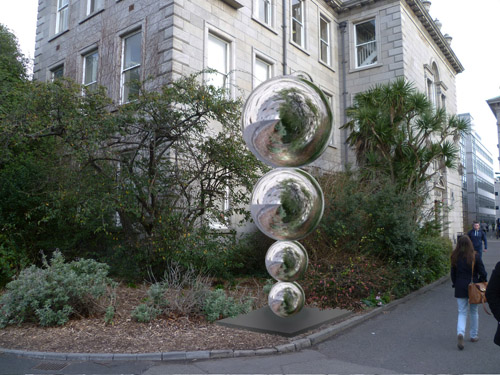
The Fitzgerald building, home to the physics department at TCD. The bubbles are a mockup of a sculpture that will honour the department’s Nobel laureate Ernest Walton

I won’t describe the lectures in detail, but three stood out for me:  ‘Tuning in the radio sun’, a description of solar astronomy at Birr Castle by Prof Peter Gallagher, head of the solar physics group at Trinity: ‘Tiny but mighty’ , a superb introductory lecture on nanotechnology by Prof Jonathan Coleman, head of the low-dimensional nanostructures group at Trinity: and ‘CERN, the LHC and the Higgs boson’  by Steve Myers, director of accelerators and technology at CERN.

Yes, that Steve Myers, the Belfast-born director of accelerators at CERN. Steve gives great talks on the nuts-and-bolts of the Large Hadron Collider and this was the main reason I was at the meeting. I’m scheduled to give yet another talk on the Higgs boson next month, so it’s important to catch lectures like this whenever I can. There’s nothing like hearing details of the experiment from the horse’s mouth and Steve certainly didn’t disappoint.

Steve Myers in action at the conference

On the teaching of physics, Dr Karen Bultitude of University College London gave an interesting lecture on ‘Gender Aware Teaching Practice’. As everyone in the discipline knows, a marked gender imbalance persists amongst students choosing physics; Karen’s main point was that all of the research done in this area indicates that making physics more ‘girly’ simply does not work, and she had some important tips for making physics more approachable for both genders. (Once more, it raises the question how a certain video at the European Comission ever saw the light of day, but let’s not go there).

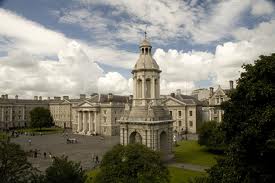
After the lectures, we were treated to lunch in Trinity Dining Hall;  I think those who had not visited the college before were blown away by the Hall and by the walk across Front Square. Maybe I notice this sort of thing more after another trip to the US (see previous post), but the best was yet to come..

The Dining Hall at Trinity

Front Square at Trinity College

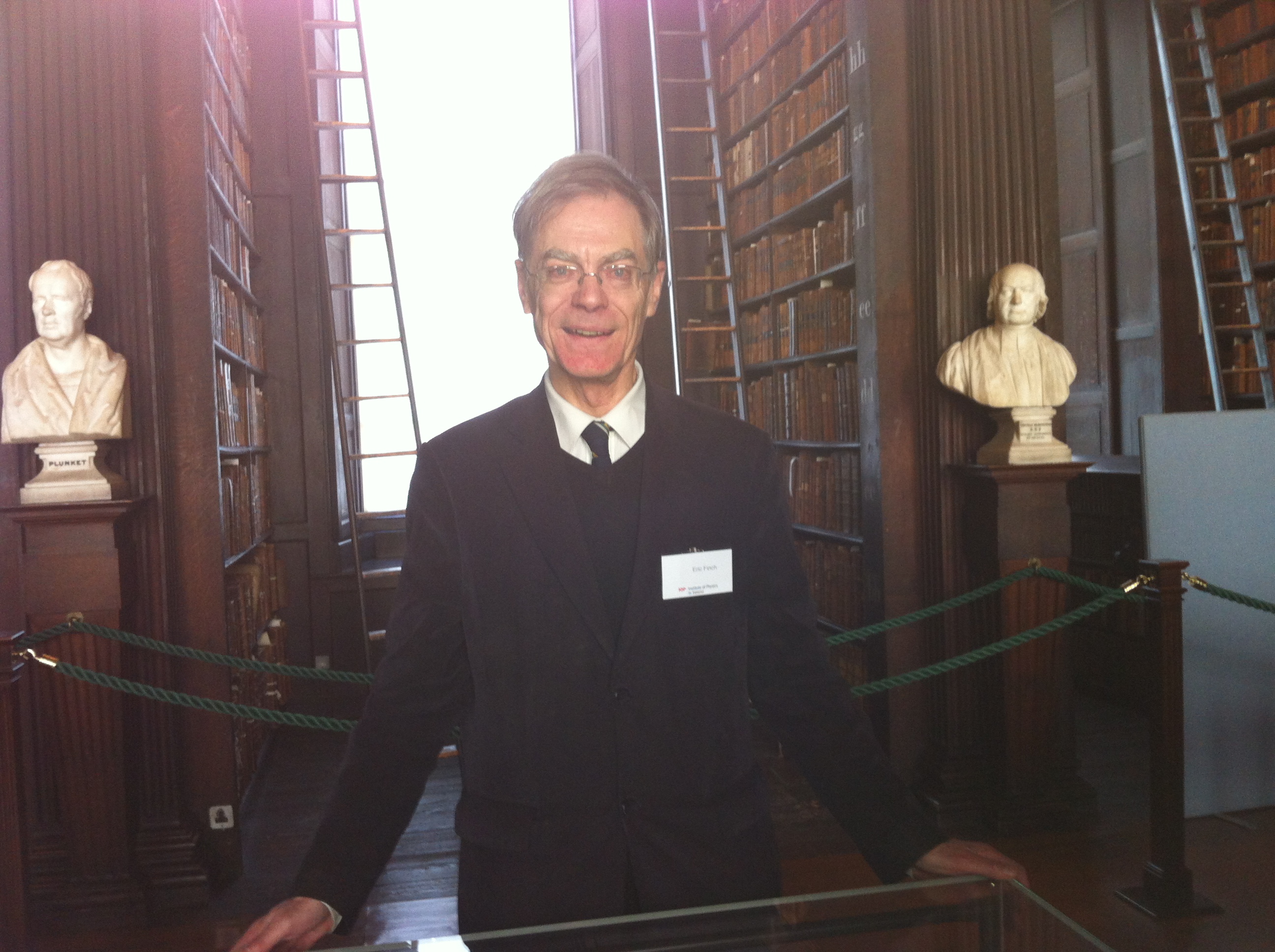
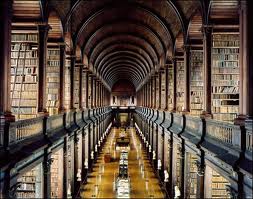
After lunch, we were treated to an exhibition of Walton memorabilia by  Dr Eric Finch. (Ernest Walton, a former Head of Physics at Trinity, won a Nobel prize for splitting the atomic nucleus with Cockroft in 1932). Eric had many fascinating things to show us, not least the famous letter where the brilliant young scientist describes his ‘red-letter day’ to his fiancee. Best of all, the exhibition is currently situated in Trinity’s Long Room, one of the most famous libraries in the world and a sight well worth seeing in it’s own right.

Dr Eric Finch at the Walton exhibit in the Long Room

The Long Room at TCD – it really is like this

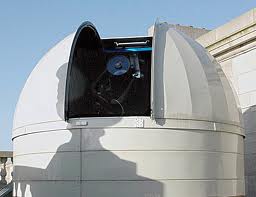
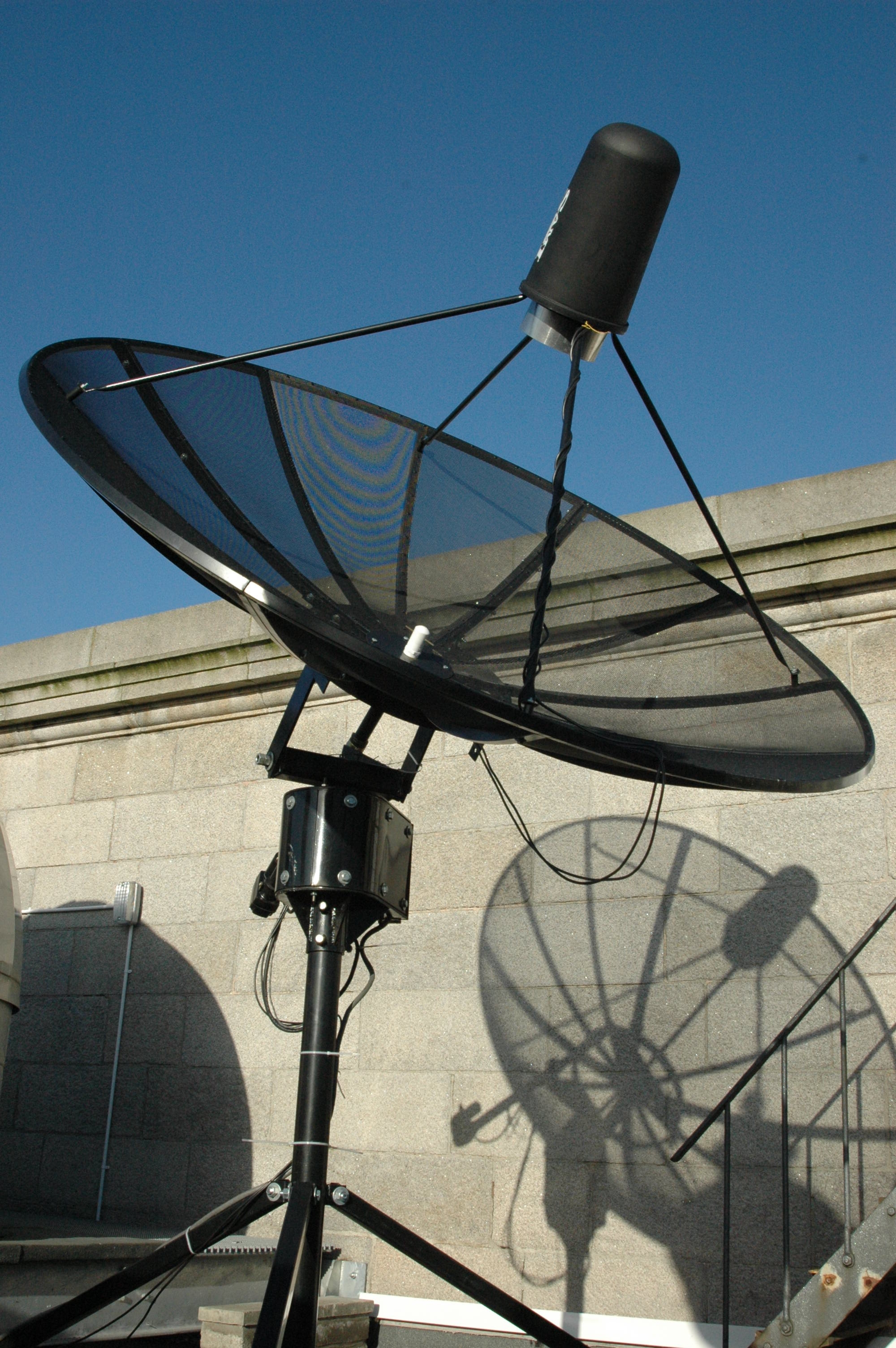
Finally, we all trooped back to the physics department to see the Monck observatory. Since my time at the college, an observatory has been installed on the roof of the Fitzgerald building, consisting of an Atmospheric and Space Weather Monitor (outside radio antenna) and a Schmitt reflecting telescope (inside the dome, see below). Brian Espey, Professor of astrophysics at TCD,  described the operation of the telescope and we each had a peep. The observatory must be one of the most centrally located telescopes anywhere in the world- however, apparently the light pollution is not as bad as you might expect because the college is a quiet island in the centre of the city at night. I’m told the main problem is the use of floodlights for rugby practice!

The new dome on top of the Fitzgerald building

The Schmitt reflector inside the dome

The radio antenna for atmospheric measurements

All in all, a great meeting in a superb setting. The Frontiers conference takes place in a different venue each year, but it’s hard to compete with 400 years of history…

1 Comment

Filed under History and philosophy of science, Institute of Physics, Teaching

VM Slipher and the expanding universe

In an earlier post, I mentioned an upcoming  conference in Arizona to celebrate the pioneering work of the American astronomer Vesto Slipher. As mentioned previously, 2012 marks the centenary of Slipher’s observation that light from the Andromeda nebula was Doppler shifted, a finding he interpreted as evidence of a radial velocity for the nebula. By 1917, he had established that the light from many of the distant nebulae is redshifted, i.e. shifted to lower frequency than normal. This was the first  indication that the most distant objects in the sky are moving away at significant speed, and it was an important step on the way to the discovery of the expanding universe.

Vesto Melvin Slipher (1875-1969)

The conference turned out to be very informative and enjoyable, with lots of interesting presentations from astronomers, historians and science writers. It’s hard to pick out particular talks from such a great lineup, but three highlights for me were Einstein, Eddington and the 1919 Eclipse Expedition by Peter Coles, Georges Lemaitre: A Personal Profile by John Farrell and Slipher’s redshifts as support for de Sitter’s universe? by Harry Nussbaumer. The latter compared the importance of the contributions of Slipher, Hubble, Einstein, De Sitter, Friedmann and Lemaitre (to mention but a few) and was a focal point for the conference. My own talk ‘Who discovered the expanding universe? – an open bus tour’ was quite similar to Harry’s , with some philosophy of science thrown in, while Micheal Way’s talk Dismantling Hubble’s Legacy? also touched on similar ground.  However, there was little danger of overlap since viewpoints and conclusions drawn from the material varied quite widely! You can see the conference program here.

A slide from Peter Cole’s talk on the Eddington eclipse experiment

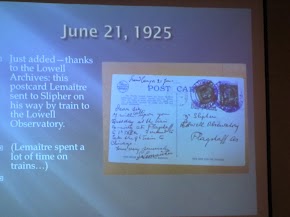
A slide from John Farrell’s talk showing a postcard from Lemaitre to Slipher, announcing the former’s visit to the Lowell observatory

Harr Nussbaumer, author of ‘The Discovery of the Expanding Universe’,  in action

Front slide of my own presentation

The best aspect of the conference was the question and answer session after each talk. There was quite a divergence of opinion amongst the delegates concerning the relative importance of the various scientists in the story, which made for great discussions (though I suspect that much of the argument arises from differing views concerning the role of the theoretician vs the role of the experimentalist). You can see a list of speakers and abstracts for the talks here and the slides for my own talk are here.

There was plenty of material here for the relativist; indeed, quite a bit of discussion concerned the relative contributions of Friedmann and Lemaitre (told you it was a good conference). In particular, the Israeli mathematician Ari Belenkiy gave a defence of Friedmann’s work in his talk Alexander Friedmann and the Origin of Modern Cosmology, pointing out that the common assertion that Friedmann took no interest in practical matters is simply untrue, given his work in meteorology, and that the relevant astronomical data was not widely available to Europeans at the time. I must admit I share Ari’s view to some extent; I’m always somewhat in awe of a theoretician who describes all possible solutions to a problem (in this case the universe), as opposed to one solution that seems to chime with experiments of the day.

Title slide of Ari’s talk on Friedmann

The conference also included a trip to the Lowell observatory, including a view of the spectrograph used by Slipher for his groundbreaking measurements and a peep through the famous 24-inch Clark telescope which remains in operation to this day. We were also treated to a few scenes from Dava Sobel’s upcoming play based on her book on Copernicus, read by Dava herself and the eminent Harvard science historian Owen Gingerich.

The famous spectograph, perfectly preserved

Slipher’s telescope remains in use today

Dava Sobel and Professor Owen Gingerich reading from her new play at the Lowell observatory

All in all, a superb conference, definitely worth the long trip (Dublin-Chicago-Phoenix-Flagstaff). Earlier in the week, I gave a longer version of my talk at the BEYOND centre at Arizona State University in Phoenix; I was afraid some of the theoreticians in Larry Krauss’s  group might find it a bit equation-free, but they seemed to enjoy it. Larry and Paul Davies have a fantastic operation going on at the BEYOND centre, but I have to say the ambience and surroundings  at Flagstaff are probably more suitable for a European – much nicer weather!

Many thanks to Ari Belenkiy for the photographs. You can find more descriptions of the conference on John Farrell’s Forbes blog, and on Peter Coles’s  In The Dark blog.

2 Comments

Filed under Astronomy, Cosmology (general), Travel

Mozart and the stars

I had a lovely evening on Thursday playing Mozart piano trios in Castalia Hall in Ballytobin, Co. Kilkenny. My fiddle doesn’t come out of retirement that often these days but I always try and make an exception for chamber music, especially if it’s Mozart. (Note: a piano trio means a piano, violin and cello playing together, not three pianos!)

Castalia hall, Ballytobin

The hall was a big surprise; tucked away at the foot of a large property belonging to the Camphill community of Ballytobin, it is a beautiful building, highly original in style and with a fantastic acoustic. The Camphill community was set up as a therapeutic centre for children and adults with physical or mental disabilities and there is a really nice atmosphere there. Several of the young guests wandered into the hall while we were playing, clearly well used to visiting musicians.

And what musicians. One of the great advantages of teaching at Waterford Institute of Technology is that I occasionally get to play music with renowned harpsichordist Malcolm Proud. Malcolm lectures in music in our college and just happens to be a world authority on period music. When he’s not away on solo recitals around Europe or touring with the Irish Baroque Orchestra, he likes to relax by playing chamber music of a different era – which is where amateurs like me come in.

Malcolm at the piano at Castalia hall

Of course, I’m not the only violin-playing physicist, it’s well-known that Einstein played the violin to to quite a serious level. Actually, an extraordinary number of mathematicians and physicists play classical music, I’ve often wondered about the connection. It’s hard to judge just how good a player Einstein was from his biographers; however, he must have ben reasonably competent as he performed celebrity chamber concerts with outstanding musicians such as Rubenstein. I read somewhere that Mozart was his favourite composer, that’s something else we have in common.

Einstein in concert with a piano trio

On Thursday, we played through the G major (K496) and C major  (K548) trios. Although I have played the piano quartets many times, the trios were new territory for me.  Looking at the score in advance, I thought the C major would be the more challenging of the two – in fact it was absolutely beautiful to play, a lovely opening movement followed by a fantastic slow movement. Another Mozart discovery, can’t wait to try the other five trios.

After the session, we climbed up the tower at Castalia to inspect the new observatory. John Clarke, the director of the community, had the tower built with a view to mounting a telescope on top; he has done a fantastic job, it’s a superb location for an observatory. Then we all went back to Malcolm’s house to inspect a telescope that has been misbehaving. Our cellist Ian McShane is a keen astronomer and it took him about three minutes to find the problem , whereupon we all had a good look at the beautiful night sky one sees on clear nights in rural Ireland.

4 Comments

Filed under Music

September conference: origins of the expanding universe

A conference next month will celebrate the pioneering work of the American astronomer Vesto Slipher. On September 13-15th, the Lowell Observatory in Flagstaff, Arizona, will host the conference The Origins of the Expanding Universe to commemmorate the hundredth anniversary of Slipher’s measurements of the motion of the distant nebulae; see here for the conference website.

As readers of this blog will know, Slipher observed that the light from many of the distant nebulae was redshifted, i.e. shifted to lower frequency than normal. This was the first  indication that the distant nebulae are moving away at significant speed and it was an important hint that some nebulae are in fact distinct galaxies far beyond our own Milky Way (see cosmology 101 section). A few years later, Edwin Hubble combined Slipher’s redshift results with his own measurements of distance to establish that there is a linear relation between the distance to a galaxy and its rate of recession; the relation became known as Hubble’s law although it probably should be called the Hubble/Slipher law.

The Hubble/Slipher discovery of the recession of the galaxies  was a key step along the road to the discovery of the expanding universe, but the two are not quite the same thing; for the latter, one needs to situate the phenomenon in the context of the general theory of relativity (according to relativity, the galaxies appear to be moving away from one another because space is expanding). The Belgian physicist Georges Lemaitre was the first to make the connection between the relativistic universe and the observed recession of the galaxies, although his contribution is often overlooked. A major thrust of the conference is to explore exactly such distinctions; looking at the lineup, it looks like an intriguing mixture of cosmologists, astronomers and historians.

All this is highly relevant to my yet-to-be-completed book so after a long, wet summer at WIT, I’m off to sunny Arizona next month!  My own talk is titled ‘Who discovered the expanding universe?’ and I intend to compare and contrast the contributions of various pioneers such as Slipher, Hubble, Humason, Friedmann and Lemaitre. You can see a list of speakers and abstracts for the talks here.

Many thanks to Peter Coles of In the Dark for drawing the conference to my attention.

Update

Going on holiday just as classes start back? Nice job – Ed.

Sigh. I haven’t had a day off all summer and this is not a holiday.

8 Comments

Filed under Astronomy, Cosmology (general), Third level

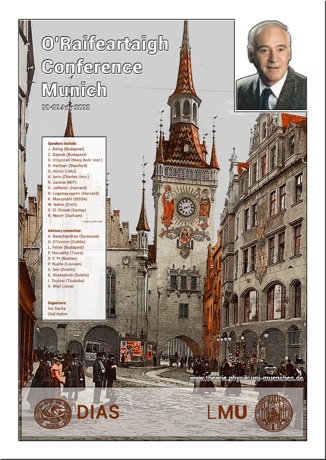
O’Raifeartaigh Conference in Munich

I’m in Munich this weekend, at a physics conference in honour of my late father. The 2012 O’Raifeartaigh Conference is taking place in Munich’s Ludwig Maximilians Universität (LMU) and there are speakers here from Harvard, MIT, Stanford, the University of Tokyo, the Niels Bohr Institute (DK), the Eugene Wigner Institute (HN) and the Dublin Institute for Advanced Studies.

It sounds rather grand, but such memorial conferences are a good way for researchers who work in related fields to meet and present their latest work to each other. Many of the speakers worked with Dad at one stage or another and I think he would be very pleased to be remembered in this way. There are also some really sharp young scholars here and he would have liked that too. It’s the third memorial conference in Lochlainn’s memory, see here for the programme and other details.

Munich itself is fantastic – the university is right in the middle of the city and the neighbourhood is full of bookshops, coffee-houses, museums and beer gardens. The teaching term is not yet finished in Germany so there are students everywhere (don’t tell Minister Quinn!). In fact, I have never seen so many bicycles and bookshops in one place. The conference talks are in the University’s Arnold –Sommerfeld Centre for Theoretical Physics and the building has a Museum for Modern Art on one side and a music conservatoire or Musik Hochshule down the block. I could get used to this.

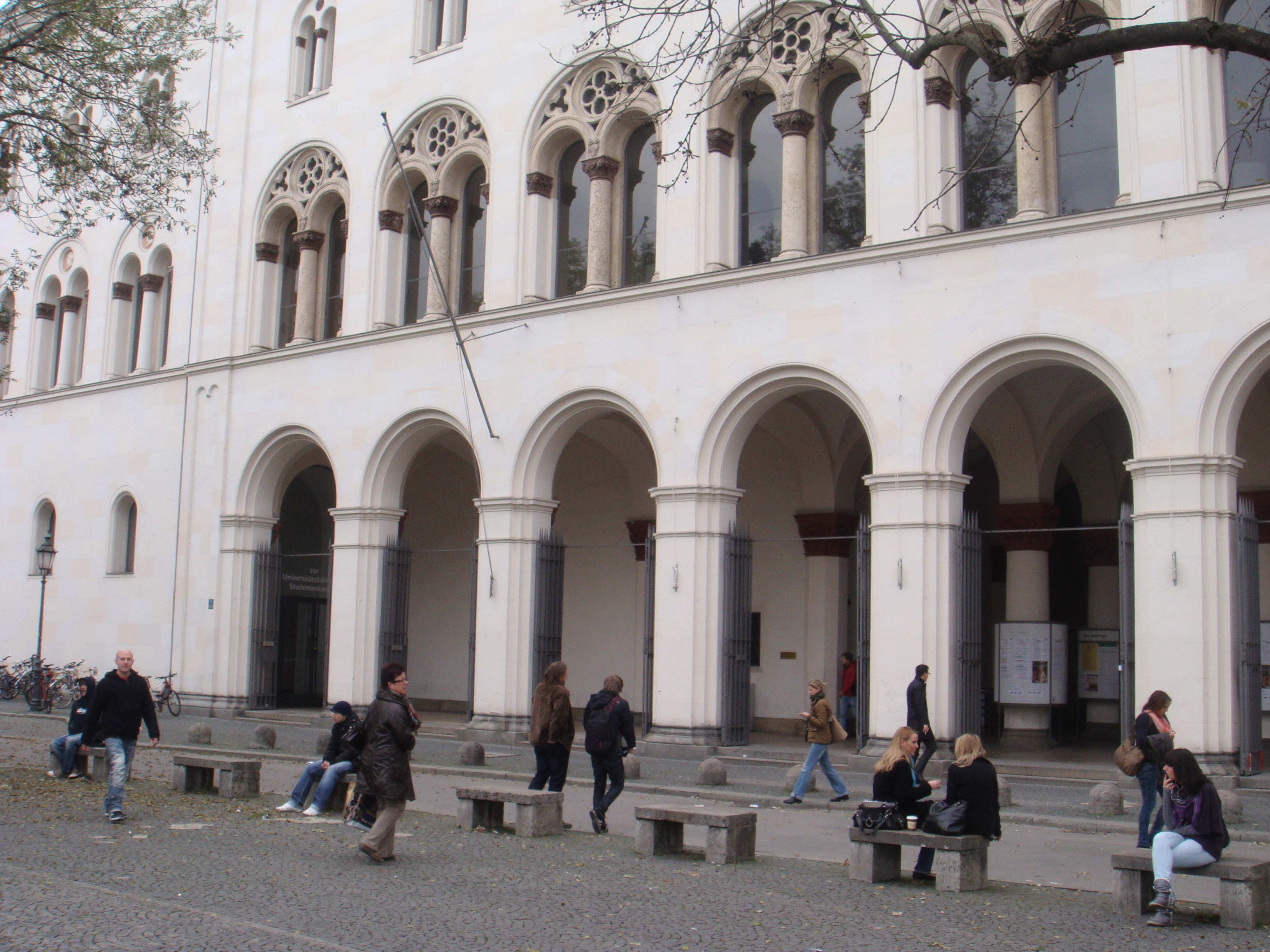
LMU University Munich (Main Entrance)

Lochlainn’s work concerned the use of mathematical symmetry methods to describe the physics of the elementary particles. Throughout his career at the Dublin Institute for Advanced Studies, he was considered a leading expert in the field. He is probably best known for his contributions to a radical theory known as ‘supersymmetry’, a theory that is currently being tested at the Large Hadron Collider at CERN. You can read more on his career by clicking on the tab Lochlainn on the top of the page.

There are some great talks here although some are are far beyond the comprehension of yours truly (an experimentalist). As always, I’m impressed by the style of presentation in theoretical physics; there are no polite powerpoint lectures here, but chalk-and-blackboard sessions with searching questions from the audience every few minutes. ‘‘Does that function even have a ground state?’, a speaker was asked within the first two minutes of his talk. ‘‘Well, it doesn’t in anti-deSitter space, but I hope to convince you that it does in deSitter space”, was the response. Answers to the frequent questions are tackled at the board until everyone in the room is satisfied. No-one gets away with anything here, from the youngest postdoc to the most eminent physicist. I think it’s a style of presentation that helps both lecturer and audience and I wish the humanities would adopt it – my pet hate is listening politely to a philosopher or historian for an hour before one gets to question a statement made in the first three minutes.

I gave a short talk myself on Friday. This was a ‘life-in-science’ presentation where I used pictures of people and places that influenced Lochlainn during his career: from his early work on general relativity with JL Synge  at the Dublin Institute for Advances Studies to his work on quantum field theory with Walter Heitler at the University of Zurich, from his use of group theory to prove his famous no-go theorem at Syracuse University in New York State to his work on the history of gauge theory at L’Institut des Hautes Etudes in Paris. I was worried I might have got some things wrong (e.g. “No, that work was completely incidental!’’), but thankfully it didn’t happen. In fact, I think the audience enjoyed the presentation as many of them had known the people and places mentioned at firsthand. You can find the photos and slides I used here.

Update

The conference is over today so Mum and I took an open bus tour of Munich. I find this a great way to get to know any city and it didn’t disappoint. Munich may not be as large as Berlin or Hamburg, but it is the capital of Bavaria and is an extremely impressive city. I’m amazed by the huge number of parks, wide boulevards and splendid buildings – clearly, it was did not suffer as much as so many other German cities from bombing in the war. This is one of the great privileges of being an academic – you get to see the most interesting places, all in the line of work.

The ‘heroes’ monument on Leopoldstrasse

And finally

On the way back to the hotel, I was intrigued to see a huge banner draped over the main university entrance; the legend’ STRINGS 2012′ is leaving the whole city in no doubt that a major conference on string theory is about to take place here! Such a civilised country..

4 Comments

Filed under Particle physics, Third level, Travel

Schrödinger, Heuer, the Higgs boson and a European science festival in Dublin

Last week, I attended the ESOF science meeting in Dublin. The Euroscience Open Forum is a science festival held in a European city every two years; Dublin won the contract for 2012 (and built a year-long science festival around it, see here for details of the Dublin City of Science).  The stated aims of ESOF conferences are

  • to showcase the latest advances in science and technology
  • to promote a dialogue on the role of science and technology in society
  • to stimulate and provoke public interest in science and technology

I think the Dublin meeting achieved these aims in spades. It was a superb conference with a large number of interesting events, from top-level keynote talks (speakers included 5 Noble laureates) to smaller interactive seminars. The main venue was also a pleasant surprise -a beautiful light -filled and airy convention centre with a multitude of auditoria, lecture theatres and smaller conference rooms.

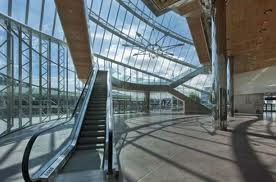
The new convention centre in Dublin, the main venue for ESOF 2012

One of the most interest events was ‘What is Life?- A 21st Century Perspective‘, presented at Trinity College Dublin by the Royal Irish Academy. This was a revisiting of the famous public lectures given by Schrödinger in Dublin in 1942 during his tenure at the Dublin Institute of Advanced Studies. Craig Venter, celebrated for his contribution to the sequencing of the human genome, gave an overview of Schrodinger’s influence on the work of Crick and Watson in their search for the structure of DNA, and how their work led in turn to the modern science of genetics and genomics. Even the booklet accompanying the lecture contained some fascinating information, from a superb account of Schrödinger’s life and career (by Prof Luke Drury of the Dublin Institute for Advanced Studies), to a copy of a letter from Francis Crick to Schrödinger thanking him for his inspiration!

Craig Venter

For physicists, the big event was a lecture by Rolf-Dieter Heuer, director-general of CERN, on the recent discovery of a Higgs-like particle at the Large Hadron Collider. This was quite a coup for Dublin as it was one of Heuer’s first public lectures since the landmark discovery. In fact, he took part in three events; an evening lecture at Trinity College Dublin (hosted by Astronomy Ireland), a Q&A workshop at the Royal Irish Academy and a keynote lecture at the conference centre. All the events were packed out and deservedly so. It is not an easy task to explain almost a century of particle physics in 45 minutes, yet Heuer does it time and again with ease, whilst simultaneously conveying the excitement of the experimental work at the Large Hadron Collider. His constant emphasis on the teamwork of experimentalists, engineers and analysts gives a direct view of just why this unique inter-european project has become the NASA of the particle world. (He has a great quote on the work of the giant detectors: “it’s like looking for a needle in a field of haystacks, all made of similar needles”). Last but not least, Prof Heuer took the time to draw a connection with the groundbreaking accelerator work of the Irish physicist Ernest Walton, a connection that is often forgotten when the LHC is discussed in Ireland.

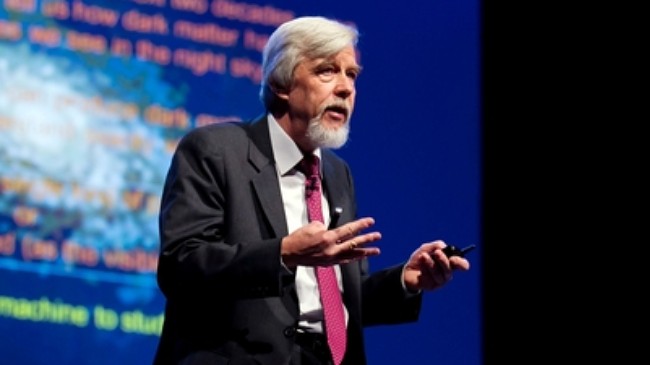
Profess0r Rolf-Dieter Heuer, DG of CERN, in Dublin at ESOF 2012

There were many other great events; Brian Greene’s lecture ‘The State of String Theory‘ was a superb performace, I don’t know another scientist who puts on quite such a show. Other highlights were Jocelyn Bell’s ‘We are made of star stuff’ and Lisa Randall’s ‘High Energies and Short Distances’. Truly, an embarrassment of riches. If you like a strong mix of brilliant physics and clear philosophy of science, get Lisa’s fabulous new book Knocking on Heaven’s Door. On a different theme, President Robinson’s lecture ‘Equity and climate science‘ described how climate change will impact on the poorest nations of the world, and reminded every scientist in the room of one of the most important scientific issues of all.

Like all conferences, the networking was almost the best part; I met colleagues I haven’t seen since my undergraduate days, not to mention a great many of my former professors. This is the real importance of such events; it’s very interesting discussing the latest developments in science with one’s former teachers! All in all, it was a superb conference for anyone with an interest in science and I hope to attend the next meeting in Copenhagen in 2014.

Taking a break with Peter Mctchell of UCD (who taught me low-temperature physics) and Lisa Randall, the Harvard string theorist

8 Comments

Filed under Science and society, Third level

Hawking, Walton and O’Raifeartaigh

I was surprised and delighted by the photograph below, prominently displayed in this week’s Irish Times magazine. In the accompanying article, journalist Arminta Wallace makes the point that the central figure in the photo is recognizable anywhere in the world, and challenges the reader to name the two Irish scientists flanking him (they are identified later in the piece).

This photo appeared in Saturday’s Irish Times under the caption Science Superstars

The scientist on Hawking’s right is the Irish physicist Ernest Walton, famous for splitting the atomic nucleus in 1932. The Cockroft-Walton experiment was the first successful accelerator experiment (and the first demonstration of E = mc2) and led to a well-deserved Nobel prize. As the prototype of all ‘atom-smashing’ experiments, Walton’s work is extremely relevant to this week’s discovery of the Higgs boson at the Large Hadron Collider (LHC).

The scientist on the left is my late father, Lochlainn O’Raifeartaigh. A senior professor in the School of Theoretical Physics at the Dublin Institute of Advanced Studies (DIAS), Lochlainn was a well known theorist in the field of elementary particle physics. The photo was taken at a conference at DIAS in 1983. I think it’s quite nice – it is not at all staged and one has the impression that the three physicists are enjoying a rare meeting. One sad aspect of the photo is that, even twenty years ago, there is already a marked deterioration in Hawking’s condition. That said, he has outlived the other scientists in the picture…

What would the trio have discussed? What do a leading particle theorist, a cosmologist and a Nobel experimentalist talk about over coffee? My guess is the newly-minted theory of cosmic inflation might have come up. Inflation is a theory that concerns the behaviour of the entire universe in the first fraction of a second, but it borrows heavily from ideas in particle physics. Hence it represents a convergence of cosmology ( the study of the universe at large) with particle physics (the study of the world of the extremely small). Given that the theory had only recently been posited, it’s highly likely that it was discussed by the trio with some excitement. (Of course Walton was an experimentalist but he had a lifelong interest in theory; it is often forgotten that he had a first class degree in mathematics as well as physics and he attended many conferences at the Institute over the years).

Ms Wallace draws a nice connection between the photo and the upcoming Dublin City of Science Festival. There is also a connection with science’s latest triumph, the discovery of a Higgs-like particle. First, Walton’s pioneering accelerator work laid the foundations for today’s experiments at the LHC (see above). Second,  Lochlainn made several important contributions to a theory now known as ‘supersymmetry’.  Supersymmetry is currently being put to the test at the LHC, as experimenters search for the ‘supersymmetric’ particles predicted by the theory. Thus the work of both Irish physicists remains relevant today.

You can read the Irish Times article here and more on Lochlainn’s work here. By coincidence, Lochlainn’s work will be celebrated at an international conference on theoretical physics in Munich next week.

3 Comments

Filed under CERN, Particle physics, Science and society

Discovery of the Higgs vs the discovery of the atom

Most people on the planet will hear sometime today that scientists at CERN, the particle physics laboratory in Switzerland, have announced the discovery of a new particle, almost certainly the Higgs boson. ‘Discovery’ is shorthand for 99% confidence level, so this is a great result, coming from two independent experiments at CERN. But what does it all mean?

Below is a script I used for interviews on tv (RTE 1 Six One News) and radio (RE 1 Drivetime); you can see the tv interview here

Q: How important is the discovery, what does it compare with?

It’s not unexpected, but it’s very important. I think it is quite similar to the discovery of the first experimental evidence for atoms by Jean Perrin in 1908 (following a suggestion by the young Einstein). Scientists had long suspected that matter is composed of tiny entities known of atoms but they had never been observed directly. Perrin demonstrated their existence by showing that the random motion of tiny grains of gum in water could be explained in terms of the collisions of the particles with the atoms of the liquid.

Q:What exactly is a Higgs boson, is it like an atom?

We now know that the atom consists of a minute nucleus, with tiny, sub-atomic particles called electrons orbiting the nucleus. The nucleus itself contains other sub-atomic particles of matter called proton and neutrons, themselves made up of even smaller entities called quarks. The full list of the elementary particles of matter is described by the ‘Standard Model of Particle Physics’, the modern theory of the structure of the atom and the forces that hold it together. The Higgs particle doesn’t live inside the nucleus, it is a ‘messenger particle’ predicted by the Standard Model; while all other particles predicted by the model have been detected in experiments in particle accelerators, the Higgs has remained outstanding until now.

Q: And that’s why it’s so important?

Not only that. The Higgs is also of central importance in our understanding of the atom. According to the Standard Model, particles acquire mass as a result of their interaction with the Higgs – or to be specific, their interaction with a certain type of quantum field named the Higgs field (after theoretician Peter Higgs of Edinburgh University). The Higgs particle is simply the ‘messenger particle’ associated with this field.

Q: Why is it sometimes called the God particle?

Most physicists dislike the name, but it is somewhat apt since the field associated with the Higgs particle is thought to endow all other particles with mass. Another reason is that the particle has become something of a Holy Grail in particle physics because it has proved remarkably hard to find over five decades. The discovery of the Higgs boson is an important confirmation that our view of the fundamental structure of matter is on the right track.

Q: How was the particle observed?

At the LHC, two beams of protons are slammed into each other at extremely high energy. Exotic particles are created out of the energy of collision, just as predicted by Einstein (E = mc2). These unstable bits of matter quickly decay into other particles, including Higgs bosons. The Higgs particles themselves then decay into lighter particles in a number of different ways or ‘decay channels’. These particles are detected at the giant particle detectors attached to the beam at CERN – two independent detectors  (ATLAS and CMS) have detected two different decay channels of the Higgs, hence the excitement.

Q: How definite are the results?

Each group is quoting a sigma level of 5, corresponding to 99% certainty. This certainty reflects that a new particle has been found with mass 125 GeV, consistent with a Higgs. However, further work is required to determine whether the particle has other properties consistent with a Higgs.

Q: What comes after the Higgs?

The Higgs particle closes one chapter, but opens another.This is because the Standard Model is known to be incomplete. The properties of the new particle should give great insights into new physics beyond the Standard Model. For example, evidence of more than one type of Higgs particle would be a strong hint of the existence of a whole new family of particles known as supersymmetric particles. The detection of these particles is an important test for unified field theories, theories that suggest that the four fundamental forces of nature once comprised a single force in the infant universe. Indeed, the next round of experiments should give us many important insights into the very early universe because the high-energy conditions resemble those that existed when our universe was very young.

Q: Does the Higgs have a technological application?

No. However, the technologies developed in particle experiments find important application in society. A good example is the use of accelerators in modern medicine. Another is the world-wide web, a software platform first developed at CERN in order to allow scientists to share collision data. The latest innovation is the GRID, the networking of thousands of computers worldwide in order to facilitate the analysis of huge amounts of data emerging from the LHC. Today’s result is a great triumph for the GRID, it is quite amazing that the data was analyzed so fast.

Q: To wrap up; an exciting discovery?

Huge. Expected, but huge. Compares with the discovery of the atom, or putting a man on the moon. The morale of the story is that scientists are like the Mounties – they always get there in the end.

There is a good summary of today’s result in the Guardian here

12 Comments

Filed under CERN, Particle physics, Science and society

How about Higgs particle instead of Higgs boson?

Like so many of us physicists, Micheal has a problem with the name ‘God particle’. Scientists have a healthy dislike of hubris (not to mention the needless antagonizing of religious-minded folk) and I am inclined to agree with a ‘do-er’, e.g. a researcher from CMS. Happy Higgs day Micheal, you and yours have done us proud!

Yet as someone who spends a lot of time attempting to engage the public’ s interest in science, I think there are several points worth examining here:

1. The name ‘Higgs boson’ isn’t great either, at least when dealing with the public. It is a classic case of over-specialization, as one immediately has to explain what a ‘boson’ is. Surely ‘Higgs particle’ would be better, as the audience immediately gets a pointer to the area of science under discussion, namely the world of the elementary particles (and whoever heard of the electron fermion?)

2. There is also the problem of priority; as every physicist knows, Professor Higgs was not the only theorist involved in the development of what is now known as the Higgs field (and he predicted the field, not the particle, as he often points out). Many theorists played a part in developing the theory, something that will create something of a Nobel headache – the name won’t help!

3, I still think the moniker ‘God particle’ has some good features; at least it contains the word ‘particle’,  and it is reasonably apt given that (i) the particle is an outstanding piece of the Standard Model (ii) it has an associated field that plays a crucial role in the acquisition of mass and (iii) it has proved remarkably hard to pin down. To put it another way, I suspect the moniker has been helpful in getting across the importance of the particle; without the nickname, I suspect it would have been harder to sustain the media’s attention in the search (how many members of the public were aware of the long search for the top quark?)

4. Could it that the hubris, which we physicists find so annoying, is exactly what it takes to get the public interested? Perhaps science journalists know more than we give them credit for.

Finally, there is the problem of religion/theology. Granted, there are some amongst the devout who take grave offence. Actually, I have never heard a serious theologian criticize or applaud the moniker – they understand the concept of a nickname. Those who can’t see past this may not be worth appeasing.

One obvious comparison here is the nickname ‘big bang’. However, cosmologists hate this moniker for a different reason;it is technically misleading because the theory says nothing about a bang (the name was originally coined by Hoyle as reductio ad absurdum). Yet the expression has been enormously useful at getting across a crude version of the theory. I would much prefer the expression ‘ evolving universe’, but I wonder would the theory have captured the imagination of the public to the same extent. Truth is, I suppose we’ll never know…in the meantime, I think I’ll compromise with ‘Higgs particle’ if I’m interviewed tomorrow!

Update

In the comments section, Sean raises an important point I should have mentioned. A second disadvantage of the term ‘God particle’ is that it encourages those who are inclined to see their particular God in everything. At a time when science is under attack from ultra-conservative religious all over the world (note in particular the attacks on evolution, big bang cosmology and climate science in the US), it is a huge mistake to encourage this sort of sloppy writing. I agree absolutely so, again, I think ‘Higgs particle’ is a reasonable compromise

5 Comments

Filed under CERN, Particle physics