Young Scientist Exhibition

I spent last Friday and Saturday at the BT Young Scientist Exhibition in Dublin.  The CALMAST group at our college do a great job of communicating science to young people and I took a day out to go up and help out with physics demonstrations at their stand at the exhibition. They had super demonstrations covering all the sciences, including a robot that moves and talks, a show on Robert Boyle and simple demonstrations of the science of first aid . My own job was to demonstrate the physics of magnets, plasma balls and the like. It’s fun to do and great see the interest in young people, some kids find it utterly fascinating.
2p1080526

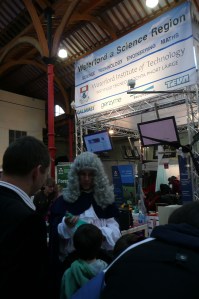
Robert Boyle (Eoin Gill) at the WIT stand (Boyle was born in Waterford)
p1080665

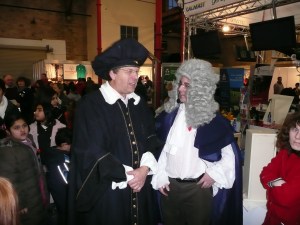
Galileo (Astronomy Ireland)meets Boyle (WIT)
3p1080366

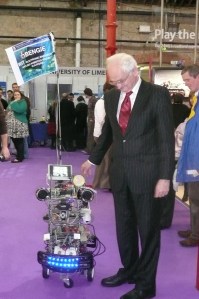
The WIT robot BENJI meets the Minister for the Environment

Such stands are really a sideshow to the main event. The Young Scientist is a highly successful science competiton for Irish secondary schools, where students from hundreds of schools submit detailed science projects. I didn’t get a chance to see all the projects, but there were some very interesting physics projects, ranging from a study of the surface brightness of disc galaxies to a mathematical model of the human face using factals. Two maths projects that caught my attention were a suggested new avenue for the solution of the Riemann Hypothesis via the Robin formulation and ‘ efficient numerical tests of of Robin’s reformulation of the Riemann hypothesis’ (the latter won 1st prize for individual project). Both these projects were from the same school – extraordinary what inspiration good secondary teachers can give. The overall winner of the competition was an ingenous method of determing the health of cattle using washing-up liqud, you can read about it here.

Of course, the real question is whether such projects and the whizz bang demonstrations next door motivate young people into choosing science as a career. I think they do to some extent as inspiration outside the classroom is often the key to a choice of career. Even if not, a lifelong curiosty about the subject can be fostered.  However, I admit it’s a difficult thing to prove..

Comments Off on Young Scientist Exhibition

Filed under Uncategorized

New Year resolution:book

My main NY resolution is that I’m thinking of changing the topic of my book. Last semester, I gave a few public talks on particle physics to mark the opening of the LHC at CERN (see ‘My Seminars’ tab for slides). More used to giving talks on the Big Bang, I couldn’t help noticing that it is definitely easier to explain the physics of the universe than the physics of the sub-atomic. Also, there seems to be that bit more interest in cosmology..I guess this is because the study of the origin of the universe has implications for religion and philosophy and so has a wide appeal.

Everybody wants to know whether the Big Bang model is just theory or established fact. And what exactly happened at time zero? (good question). There are also all those sexy topics like Black Holes, Dark Matter, the Arrow of Time etc. Of course A Brief History of Time (Hawking) catapulted cosmology into the public imagination, but I think the interest was always there…

So possibly a change of direction in the New Year. Perhaps‘The Puzzling Universe”, a short, succinct book on the origin of the universe, might be a better seller than “The Story of Atoms”. (I have no interest in writing a popular book that is not popular). Also, I can imagine a spinoff newspaper column on the subject, always a good sign..It’s true there are now lots of books on this subject at the popular level, but that’s no harm. Anyway, many of them either cover far too much (Hawking, Bryson) or are by authors who have little experience of teaching the subject at elementary level. Must ask the students, see which subject they think will sell…

One thing that worries me is that some of the best science books for the public remain relatively unknown, not sure why this is.  For example, I really enjoy the books of Paul Davies, but they are not as wide selling as they should be. Another example is Marcus Chown – I read Quantum Theory Cannot Hurt You over Christmas , a really excellent book. Really good explanations of quantum physics, general relativity and whatnot, all with highly original analogies. Hmm..we’ll see.

16 Comments

Filed under Uncategorized

The best skitrip

Now that was a holiday. I just got home from one of the best snow holidays ever, a trip to Switzerland with the Frankfurt Ski Club. The club consists of American, British, French and Germans ski enthusiasts who work in Frankfurt and take a coach south to the mountains at every possible opportunity. (Yours truly got involved through a very good friend – I go as often as I can as the trips are always really well organised).

The trip got off to a great start with a gala dinner on New Year’s eve in our hotel on the shores of Lake Geneva. Although I moaned about having to bring a full tuxedo in my ski baggage, I must admit it was nice when I arrived from Zurich to find everyone at the hotel reception dressed to the nines and quaffing champagne. It really added to the occasion and it was great talking to old friends over dinner and making new acquaintances..

ski-club-montreux-11

ski-club-montreux-2

Next day we were bussed to Villars, the nearest ski resort. The conditions were fantastic, lovely deep snow from a recent snowfall and beautiful sunshine. One of the best day’s skiing I ever had. Incredibly, these conditions continued for the next four days as we visited resorts like Verbier and Portes du Soleil. I hooked up with some other off-piste skiers in the club and we had some very challenging skiing, including the famous Wall on the Franco-Swiss border in Portes du Soleil.

ski-club-montreux-8ski-club-montreux-5

ski-club-montreux-91

ski-club-montreux-15

More FSC photos at http://www.facebook.com/home.php?#/album.php?aid=71716&id=587171690

At the end of the trip I  took the club coach back to Frankfurt – a first as I’ve never been there! I’d heard it said that the coach journeys are one the best features of the FSC trips and it was certainly true on this occasion – it was more like a mobile bar full of friends than a normal bus journey. When we finally got back to Frankfurt, a few close friends decided to celebrate my arrival in their city, so the party went on til late..

This morning, I woke up in a strange city covered in snow. I made my way into the city center to meet a friend for lunch and then took myself on a mini-sightseeing tour of the city. Frankfurt city centre seemed surpisingly nice – an interesting mixture of beautiful old buildings and impressive new skyscrapers, not unike a large version of the financial district in London. Fantastic public transport of course, like everywhere in Germany.

Frankfurt in snow by Max Heidenfelder

Then it was on to the airport and back to reality. There’s no snow in Waterford and it’s too cold to surf. Sigh. Why can’t I live in a civilised country like Germany? Maybe I should apply for a job at CERN – I’d settle for Geneva alright…

4 Comments

Filed under Skiing

Pesky exams

Since Christmas Day I’ve been busy correcting exams, but I just finished today yipee! I like to get them out of the way early so I can get back to the snow-world for a few more days before college starts up again…

Most academics hate correcting exams more than anything, but I don’t really mind that much – it always takes less time than expected (unlike research) and I like any job that has a definite beginning, middle and end (with room for targets, breaks and treats along the way). I also learnt years ago that it’s easier to stay focused if I correct exams script by script. Some lecturers dislike this method and claim it makes more sense to mark in parallel – i.e. correct all the first questions, then all the second the questions etc. I have never adopted this method as I’m terrified of making a mistake when the marks are totted up at the end. I feel there’s much less chance of this happening if one goes through the script question by question, as you get a feel for how a particular student is getting on…

Anyway, I finished at midday today and celebrated by going shopping. First thing I saw was a good skisuit for €99 and snapped it up (I used to be so proud of my ski instructor jacket, but have finally tired of being slagged over my gimpy outfit!). So it’s not all work and no play. Oh no. How’s this for cool – I’m off on Wednesday to some posh hotel in Montreux (Swiss riviera) to join friends from the Frankfurt Ski Club for their annual New Year’s Ball – after which we’re all staying over for a few days’ skiing in the nearby resort. Yipee.

Lake Geneva in winter- Viola Stockinger

And yes, I’m flying into Zurich again (see post below), more gorgeous train journeys through the snow..

That said, I do feel a bit guilty about all this flying, the main reason I hope one day to convert from being a good skier to a good surfer (a sport I can do at home). Unlike Lubos Motl, I don’t have the excuse of being a global warming skeptic – I find it hard to believe that the majority of the world’s climate scientists are fools or knaves. So sorry about those polar bears…

7 Comments

Filed under Teaching, Uncategorized

Winter wonderland

Last week was exam week for our students, so I took the opportunity for a week’s skiing in St Anton in the Austrian Alps. The snow conditions were pretty good as winter came early this year. I also got plenty of off-piste skiing as I was staying with a ski crony who is a guide for the Ski Club of Great Britain. That said, I find a week’s skiing more than enough these days – although I love the snow and the winter atmosphere, skiing itself doesn’t really give me the same rush as surfing, even off-piste

St Anton am Arlberg

As ever, what I enjoyed most was the travel. I flew into Zurich and took the train along the main Zurich-Innsbruck route. You simply haven’t experienced the beauty of winter until you’ve taken this train. The spectacular route through the snow-laden alps has few equals and should be listed as one of the wonders of the world. In fact, it still forms part of the route of the famous Orient Express. If that weren’t enough, I got 3 hours of uninterrupted conversation in my school German with a lovely young Austrian returning from Switzerland to visit her family. That’s why I love to travel in Europe, it’s the people you meet, the languages you hear and the places you see…

Ein Zug im Winter

Even Zurich Hauptbahnhof was a sight to behold, with snow falling heavily outside and the famous Christkindlmarkt in full swing in the great hall. I managed to get quite a good bit of present shopping done before boarding the train.

I read somewhere that the whole White Christmas thing in fact comes from the Alps, got imported to the United States by European immigrants in 19th century, and then got redistributed all over the planet like most American culture. It makes sense, as no-one does Christmas carols, Christmas trees and snow like the German-speaking countries!

After all that, St Anton could only be a let down and it was in a way. There were so many British tourists, I heard remarkably little German. Still, the skiing was good and the journey back a pleasure. Now, I’m back in rainy little Ireland and getting ready to start exam corrrections…groan

P.S. Lisa Lorenz has a nice description of a similar week in St Anton over at her blog Happy Hour. However, I was fascinated to read that she and her party had a totally different experience of the Zurich-St Anton journey. I guess travelling alone is always that bit easier…or maybe I’m the sort of sad person who is never in a rush to arrive at the destination.

4 Comments

Filed under Skiing

New evidence on black holes

This week, the media are giving great coverage to a study that confirms the existence of a super-massive Black Hole at the centre of our galaxy. The 16-year study has given new evidence of the size and distance (from us) of the BH, by tracking the movement of stars circling the centre of the Milky Way.

Undoubtedly the most spectacular aspect of our 16-year study is that it has delivered what is now considered to be the best empirical evidence that super-massive black holes do really exist,” said Professor Reinhard Genzel, head of the research team at the Max Planck Institute for Extraterrestrial Physics in Garching, Germany.

The black hole is 27,000 light-years from Earth and four million times more massive than the Sun, according to a paper submitted to The Astrophysical Journal. Observations were made using the 3.5m New Technology Telescope and the 8.2m Very Large Telescope (VLT) in Chile. Both are operated by the European Southern Observatory (ESO).

According to Dr Robert Massey of the Royal Astronomical Society, the results suggest that galaxies form around giant black holes in the way that a pearl forms around grit.

Black holes  may have a role in helping galaxies to form

You can read more on this story in today’s Irish Times or on the BBC website.

Interestingly, the BBC originally ran the story as ‘BH found at center of the Milky Way, and have now changed it to ‘BH confirmed at centre of Milky Way’, reflecting the fact that the new study presents new evidence rather than first evidence of the phenomenon.

In any case, it’s exciting news – yet another phenomenon that was once thought to be a totally unrealistic prediction of theory (general relativity in this case).

P.S. It should be pointed out that Ireland is not a member of ESO – between that and CERN we’re not doing too well are we?

10 Comments

Filed under Uncategorized

Outside the universe

What is outside the universe?

A colleague asked me this question on Friday. Good to see college leaders take the time to ponder the important questions.

The stock answer is nothing – or rather, there is no outside, simply because the technical meaning of the word ‘universe’ is  all of matter, energy, space and time. So ‘outside the universe’ is a bit of an oxymoron – like asking what is north of the north pole, or what happened before the beginning of the universe.

It’s an important question and at the root of many misconceptions in cosmology. Consider for example the expansion of the universe. There is very strong evidence that our universe is expanding (see post on Hubble graph). However, this expansion is not really like the expanding balloon so beloved of science writers, because the universe is not expanding into space in the manner of a balloon inflating in a room. Instead it is space itself that is expanding (really spacetime). This is also why the theory of cosmic inflation can posit an exponential expansion of the universe (many times faster than the speed of light) in the first fraction of a second, without contradicting relativity (which forbids travel faster than the speed of light in space).

That said, the question has got more complicated recently. If inflation is right, it seems we have to accept the possibility that a great many universes may have been spawned in the first fractions of an instant – the multiverse. Hence might one ask about ‘outside a particular universe’? I think this is essentially the same question, except it is now ‘what is outside the mulitverse?’. A question which has the same answer, which is nothing .Or better, there is no outside. We think. So far.

Artist’s impression of the mulitverse

19 Comments

Filed under Uncategorized

Scientists are dull

Modern scientists are ‘dull and getting duller” according to Bruce Charlton, Professor of theoretical medicine at the University of Buckingham. His views have been summarized in the Times Higher Education Literary Supplement, or you can read the original article on his blog here.

Essentially, Charlton’s thesis is that the selection and training process of science weeds out any interesting people. In his own words

“In particular the requirement for around ten to fifteen years of postgraduate training before even having a shot at doing some independent research of one’s own choosing (but more likely with the prospect of functioning as a cog in somebody else’s research machine) is enough to deter almost anyone with a spark of vitality or self-respect.
…nowadays there is an always-expanding need for advanced planning, committee permissions, and logistical organization; combined with a proliferation of mindless and damaging bureaucracy. The timescale of scientific action and discourse has gone up from days and weeks to months and years.”

The result of all this is plain to see according to Charlton:

The editors and journalists running even the premier journals – those having the pick of modern science – themselves find science too dull to bother writing about. And they are too often correct. We can only conclude that science is dull mainly because its requirements for long-term plodding perseverance and social inoffensiveness have the effect of ruthlessly weeding-out too many smart and interesting people.”

Hmm. Some of this is undoubtably true. In a profile of yours truly in SPIN Science magazine (due next month) I myself comment that I eventually found the business of communicating scientific ideas a lot more fun than the actual getting of results, mainly because of the specialisation and patient measurement required to achieve anything specific  nowadays.

However, I disagree with Charlton in his deification of journalism:

“The smart and interesting people instead gravitate to fast-moving fields like journalism (or finance, or management, or entrepreneurship of many types) where they get hourly or daily stimulus, and have a chance of following their own inclinations and making their mark before reaching their mid forties”.

Except that a lot of journalists are irritating opinion merchants who care not a jot whether they are right or wrong. Which would you prefer –  a dull plodder who considers the evidence carefully before reaching a tentative conclusion , or a loud attention-seeker wedded to his own opinion and oblivious to scientific evidence to the contrary? There are plenty of such journalists, with opinions on everything from climate change to stem cell research and all they do is add noise to important debates.

Give me a dull plodder any day. Indeed, this is the great fallacy of the great climate change ‘debate’. Politicians and journaists state their fixed opinions on both sides with great passion, while scientists quietly go on gathering evidence. As a result, the population at large imagines there is a great debate that in fact is long over.

Finally, Charlton concludes with

“One thing is for sure, the answer is not going to come from within science.”

I disagree. I like to think the only hope is that we scientists  can persuade young people that science asks the right questions about the world, and seeks answers in the most logical manner…if that means changing the way we do research, let’s do it.

Meanwhile, me and my surfboard are off for a dull weekend on Inch beach in Co. Kerry. Wonder what excitement Professor Charlton has lined up?

That’s me in the corner – finding my religion

Comments Off on Scientists are dull

Filed under Uncategorized

Last week of term!

There’s a great atmosphere around the college this week as it’s the last week of teaching term for the first semester. As one who strongly opposed the introduction of short semesters, I have to admit there’s a great sense of closure as staff and students  reach the end of taught courses.

This morning I finished the course with 1st science and went through last year’s paper with 1st engineering. This afternoon it’s the turn of 3rd year solid-state physics – a lot more serious as we revise all the major concepts the hapless students will need to know for their exam.

Meanwhile, I’m preparing yet another public lecture (slides here) on the LHC, this time as the keynote address for our careers day in physics at the college tomorow . What careers? Well, mathematicians and theoreticians have been kept busy calculating collision events and decay schemes. Engineers and experimentalists designed the detectors and experiments. Civil engineers build the major construction projects. Last but not least, computer scientists and software engineers have been working hard on constucting new methods for dealing with the petrabytes of data – not least the latest in distributed computing – the GRID. There’s a great article on this, the Large Hadron Computer, in the November issue of Physics World.

The GRID – National nodes at tier 2, universities at tier 3.

It’s often forgotten that the world wide web was orignally developed at CERN in order to facilitate the analysis of data from particle experiments at CERN . It’ll be interesting to see if the GRID has similar application to the world at large.

P.S. No teaching next week, and I can finally get down to some writing. After, that I’m going skiing yipee.

Comments Off on Last week of term!

Filed under Teaching, Uncategorized

Atoms of light: Book launch at UCD

I drove up to Dublin yesterday evening for a book launch at University College Dublin. Two of my former professors, Alex Montwill (who taught courses in formal quantum theory and particle physics) and Ann Breslin (special relativity and experimental high-energy physics) have just written a popular science book Let there be light: The Story of Light from Atoms to Galaxies‘ published by Imperial College Press. Both were among the best teachers I ever had, as well as outstanding researchers in the field of particle physics. In fact, Alex was Ireland’s foremost experimental particle physicist for many years, but is probably best known for a series of lectures on modern physics on national radio.

I’ve never been to a physics book launch before, it was great fun. All the great and the good from the world of Irish physics were there, including just about everyone who taught me as an undergraduate! Talk about a trip down memory lane. One big difference – I couldn’t believe how beautiful Belfield campus is now with tons of landscape gardening and new buildings.

The book was launched with great aplomb by Dick Ahlstrom, science editor of The Irish Times. Dick has played a huge role in the communication of science to the public in Ireland, mainly through writing and editing a full page on science every week in The Irish Times (you can see an example here). As far as I know, there is a fairly unique example of a full page on science in a quality newspaper, and is now an integral part of that great paper.

I have yet to have a good read of the book but it looks superb, as you might expect of the culmination of a lifetime’s reflection on physics by two highly respected physicists and teachers. The book is pitched at a level slightly above most popular science books, somewhere between undergraduate and the layman, and is an introduction to pretty much all of modern physics from the perspective of the study of the nature of light – from optics to wave theory, from astronomy to quantum theory, from electromagnetism to special relativity. An unusual feature is the essay-like style of the presentation – you can start reading anywhere (though it’s hard to put down). Another unique feature are the illustrations; a huge number of really helpful small illustrations, from well-known images to sketches and cartoons. A lot of the concepts are illustrated via an owl character, which reminds me of the books of George Gamow, an old hero of mine.

If you want to know more, buy the book. I’m looking forward to reading it at the weekend

Update: You can get it at discount at the World Scientific site, and there is a very nice overview of the book there

3 Comments

Filed under Public lectures