Festival Interceltique de Lorient

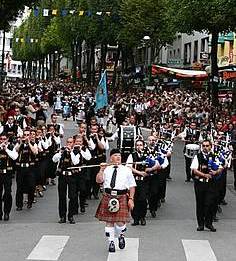
I spent last week in Brittany, France at the Festival Interceltique de Lorient, the largest celtic music festival in the world. The festival was as good as ever, with parades, concerts and performances from pipe bands, music groups and dance troupes from all the great celtic nations.

Le grand defile interceltique

The sheer scale of the celtic world could be seen from the number of delegations – from Asturias (Spain), Galicia (Spain), Brittany (France), Cornwall (England), Scotland, Wales, Ireland, Acadia (Canada), Australia and the Isle of Man. There were concerts every day in the afternoons and evenings, not to mention the Nuit Magiques, chereographed performances on a giant scale in the local football stadium – some say the Lorient Nuit Magiques were the inspiration for Riverdance.

https://i0.wp.com/www.adelaidepipeband.com/images/photographs/lorient001.jpg
Nuit magique at the Stade Moustoir

Best of all were the sessions in some of the local pubs, with Irish, Bretons and others swapping tunes into the early hours (this is where where yours truly comes in). The sessions were a treat for any musician, with tunes in Quay St orThe Galway Inn, not to mention monster sessions with performers fresh from their gigs at the Pub Glen late into the night. This was the best part for me, as I enjoy playing music with musicians from slightly different traditions. I think folk music has an edge over other types of music when it comes to this sort of jamming – and if there is one thing better than a lively Irish session, it’s a session where there is a mix of cultures and traditions. Also, it’s very moving to hear a tune/song you’ve known your whole life played in a more minor, modal key – an older, deeper version that makes your version seem like a pale modern echo.

Fast tunes and sad songs with Brian Coombe in Quay St

In the thick of it in the Pub Glen.

This year I was asked to do a short solo gig, in a beautiful old mill by the river. It was really good fun to do, and the practice I had to do left me on top form for the sessions. Nothing quite like sitting in a session with friends new and old when it suddenly goes supernova. Not to mention the wired social life when the musicians finally down their instruments…

Overall, this is a great international music festival – a feeling of an inheritance that is shared, yet different. I’m constantly amazed at the sheer diversity of European culture and its effect on the world…there’s a nice discussion of this on the festival website

4 Comments

Filed under Uncategorized

Faraday Institute summer school

I spent all of last week at a summer school on science, philosophy and religion hosted by the Faraday Institute of St Edmund’s College, Cambridge. I found the course absolutely excellent and have tried to summarize most of the talks on a daily basis as the conference progressed (see last four posts below). You can also find a list of speakers and talks on the conference website .

All that is left to do is to make a few general observations. I found the school quite exceptional, a real treat for anyone with an interest in the history and philosophy of science, and its impact on religion (and vice versa). A different topic was tackled each day, from historical and philosophical interactions between science and religion on Tuesday to Big Bang cosmology on Wednesday, from the theory of evolution on Thursday to ethical challenges in contemporary science on Friday.  Each day would begin with an introductory overview of the basic science (or history), followed by talks on slightly more specific subjects. Each talk would finish by exploring the philosophical and theological implications of the science.

All the speakers kept good time, leaving 30 minutes of question/answer session after each talk. This definitely made for good audience participation. This was followed by a panel discussion every evening on questions raised during the day.

Note: videos of the talks will be available on the multipage  multimedia page of the Faraday website from mid-September only, apologies for misinformation in earlier posts.

St Edmund’s college, Cambridge

Other reasons for the success of the conference were

1. Fantastic environment; it’s hard to beat Cambridge on this, especially with everyone staying in the same college

2. All the talks were in the same venue, a nice small conference room that holds about 50.

3. Interdisciplinary nature; since the subject matter spanned science, history of science, philosophy and theology, none of the talks were too specialised, the bugbear of most scientific conferences

4. All the talks were by world-class researchers, well used to giving public talks on their subject – a treat for anyone interested in the communication of science.

5. No parallel sessions; since everyone was at the same talk, it made for great discussions over dinner.

Coffee time outside the conference room

A number of my colleagues have expressed reservations about the course, pointing out that it is funded by the Templeton Foundation. All I can say is that all of the speakers presented the science or history in an unbiased way. The week was a treat in the history and philosophy of science, even for those with no interest in religion. That said, it was fascinating hearing renowned theologians criticizing the fundalmentalist positions taken by some religions (and atheists). No-one can demolish the Intelligent Design argument quite as comprehensively as an eminent theologian! Another good example of the impartiality of the conference can be seen in the fact that the scientific work of Richard Dawkins was cited on several occasions and two of his books were on sale  on the conference table..

Update

Speak of the devil! About 10 minutes after writing the above, I walked right past Richard Dawkins himself. He was walking up the back drive into Clare College just as I was wandering out. I wonder if he is giving a talk here in Cambridge? I was dying to ask, but he looked a bit tired and had luggage with him. Possibly not a good moment for questions from random strangers..

8 Comments

Filed under History and philosophy of science

Last day at Cambridge conference

Today was the last day of the Faraday Institute summer school (see posts below) and it was devoted to ethical challenges in contemporary science.

The day started with an excellent overview of the whole area of ethics by Dr Cherryl Hunt of the University of Exeter. Dr Hunt set the stage for the day by explaining concepts such as ethical relativism, ethical objectivism and ethical absolutism. She then went on to discuss the differences between naturalistic, utilitarian and deontological positions in an ethical context.
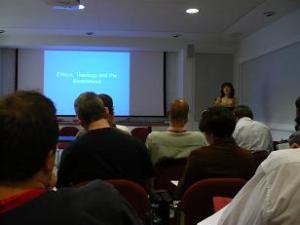
Dr Cherryl Hunt on ethics

Commenting on why ethic challenges are often involved the biological sciences in particular, Dr Hunt explained that the biosciences tend to throw up interesting questions such as

– human improvement: do we need it?

– the mixing of animal and human genes; should we do it?

– genetically modifying plants and animals: is it dangerous?

Dr Hunt  addressed each of these in turn. She also discussed another dilemma, the ethics of environmental challenges. Going over the different positions of many religions, she contrasted the ‘dominion over the earth’ viepoint with that of the ‘stewardship of the natural world’.  This was a fascinating talk and you should be able to get the slides and video on the Faraday Institute website in a few days.

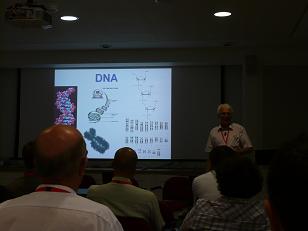
The second talk, given by Prof Keith Fox, Professor of Biochemistry at the University of Southampton, dealt with the specific topic of ‘Genetic engineering: How Far Should We Go?’

Keith started with a great overview of  DNA, genes and genetic code, making some simple points :

– the same copy of DNA exists in every cell

– genes make up 2% of DNA

– the genetic code is universal

– there is no such thing as a human gene

– all life clearly arises from a single source

This was followed by a quick review of landmarks in modern genetics such as recombinant DNA (1972), transfer into E-coli (1973), first genetically modified animals (1976), first genetically modified plants (1983) etc. Then followed a detailed discussion of animal-animal and human-animal gene transfer. I won’t give details, but I particularly enjoyed a discussion of GM foods. A familiar issue here is the pubic misunderstanding of science: the public distrust of GM foods is in marked contrast to the scientific consensus, making it very difficult for GM technology to progess.
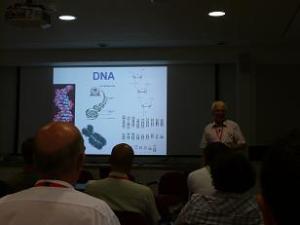
Dr Keith Fox on the podium

After lunch, we were treated to a very different sort of lecture:, a lecture on the nature of personhood and the ethical challenges raised by medical technology, given by Professor John Wyatt, Professor of Neonatalogy at University College Hospital London.

Prof Wyatt started with a wonderful slide, a picture of a tiny, prematurely-born baby hooked up to an astonishing number of tubes in ICU at his hospital. Having brought the audience to the human side of things he gave a few interesting statistics:

– about 50% of such babies will be absolutely normal

– about 20% suffer severe mental and physical difficulties

– society values such lives, given the investment in medical treatment

On the other hand, Prof Wyatt explained that, in the same hospital , many parents are offered the option of abortion for babies with handicaps or deformities. In particular, about  90% of unborn babies with Down’s Syndrome are aborted, a truly shocking statistic. Given that it is often the same doctors, you can see the ethical maelstrom. This issue is set to get worse, with the onset of pre-natal tests which may give a full analysis of the DNA of unborn child..

There followed a detailed discussion of the nature of personhood, starting with the views of the philosopher Peter Singer. Dr Wyatt showed the weaknesses of the Singer position by considering examples from brain-damaged adults to dementia. He also emphasised the issue of dependence – how it is intrinsically human to be dependent, from the youngest infant to the oldest person-our natural condition far from an abherration.( ‘We are designed to be burdens!) This was an outstanding talk but I won’t attempt to summarize it further..you can see the video on the conference website or go and buy his book!

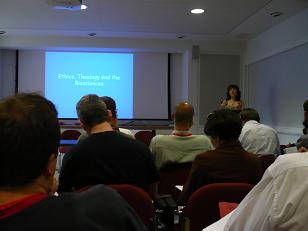
The last talk of the day was another talk by Dr Cherryl Hunt (see above), this time on the particular subject of the ethics of stem cell research. Starting with simple definitions such as totipotent cells (can make all cell types, can grow into embryo), pluripotent cells (can make many cell types  but can’t grow embryos) and multipotent cells (can make few cell types), Dr Hunt explained the huge advantages of embryonic stem cells. She went on to describe the ethical challenges concerning the use of these cells, contrasting the utilitarian to deontological viewpoints discussed this morning.

I won’t give a proper review here, but in the discussion afterwards, I was struck by the common sense approach adopted by the speaker and most of the audience, representatives of many religions and none. Essentially, many felt that the fact that nature disposes of about 80% of fertilized eggs for a variety of reasons implies that we should probably not be too absolute in our view of the status of embryonic stem cells. There was also the issue of spares: in IVF, unused embronic cells are routinely disposed of, so  is it not better to use them for the good of mankind?

That was the last talk of the conference; again a recording will soon be available on the Faraday website. As on other days, the day’s presentations were followed by a plenary panel discussion of questions raised by the talks. Overall, this was a fantastic week of highly interesting talks, see review tomorrow. Right now, it’s time for the conference dinner at High Table!

Note: videos of the talks will be available on the multipage  multimedia page of the Faraday website from mid-September only, apologies for misinformation in earlier posts.
2 Comments

Filed under History and philosophy of science

Evolution at Cambridge

Today was evolution day at the Faraday summer school (see posts below), with a number of fascinating talks on the theory of evolution.

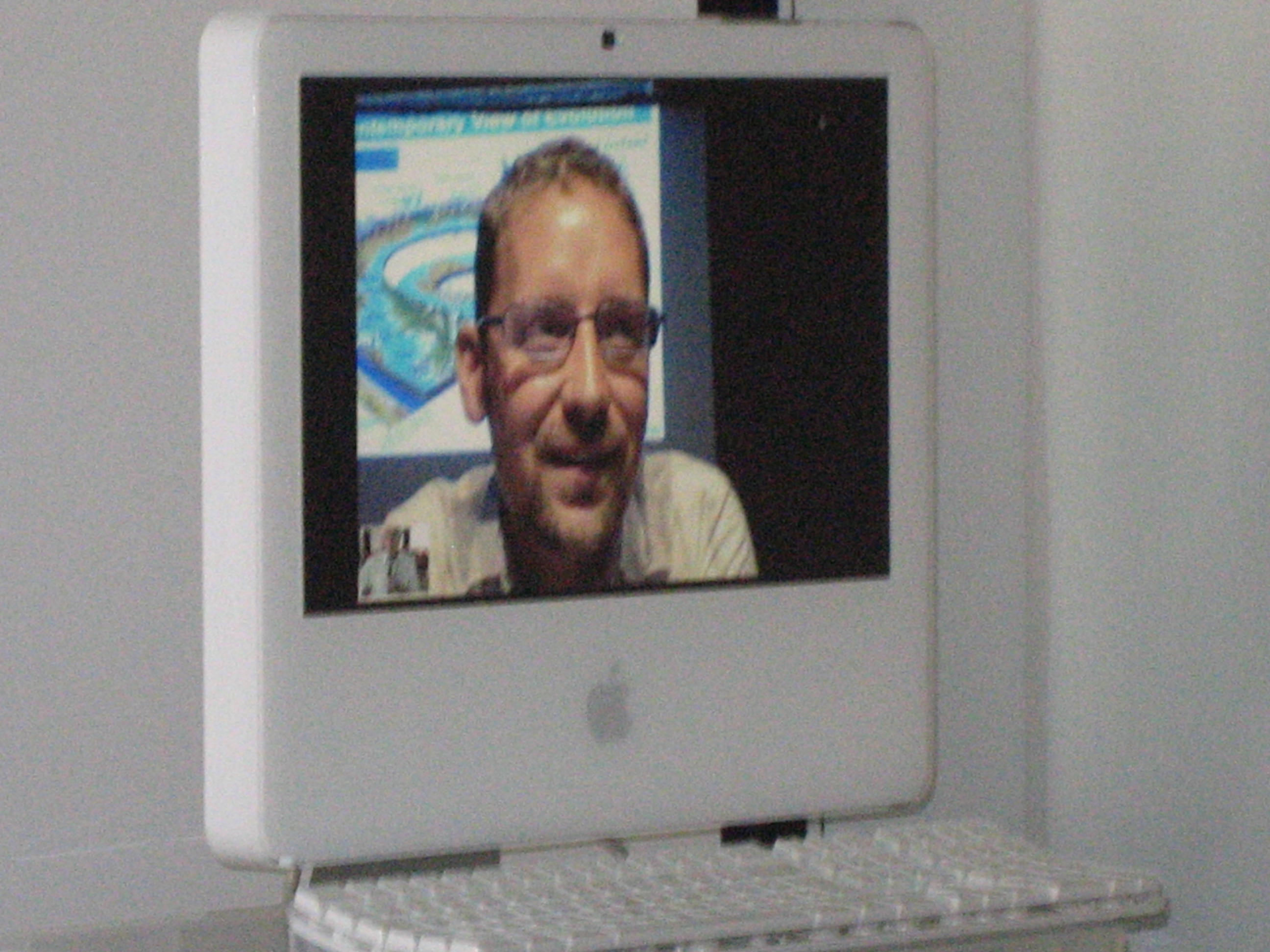
First up was Professor Stephen Freeland of the University of Maryland. An interesting aspect of Stephen’s talk was that it was delivered in realtime (by Skype) from Hawaii! With his slides projected on the conference screen and his voice and image on a nearby computer, one quickly forgot he was not actually in the room.

Stephen’s first talk was a super overview of the modern status of the theory of evolution by natural selection, explaining how advances in microbiology and genetics have strengthened and deepened the theory. One interesting aspect of this talk was Stephen’s belief in the fallacy of human supremacy: he sees humans as far from the top of the chain of life,  as often depicted. Indeed, he showed that a great deal of the common portrayal of man at the pinnacle of the evolutionary tree really arises from pre-Darwinian theory!

Stephen also gave a talk on astrobiology, the study of life on other planets. Much of astrobiology is concerned with the study of the emergence of life in the earliest years of earth, but there was a fascinating overview of the factors need for life elsewhere. I particularly enjoyed his discussion of attempts to quantify the Drake equation, an equation that attempts to describe the probability of there being intelligent life on other planets (more on this later).

Denis Alexander in conversation with Stephen Freeland

Next up was a fascinating talk by Simon Conway Morris on ‘Evolution and the Inevitability of Man’. This was a superb overview of the theory of convergence in evolution, a theory Simon has pioneered. Essentially, it concerns the fact that many complex organs such as the camera eye have evolved not once, but several times. Simon went on to explain why he evolutionary convergence may render the emergence of intelligent life not just likely but inevitable, and sees the evolution of intelligent life as an ultimate and inevitable result of the process, in marked contrast with the previous speaker.

This was followed by a superb talk by Keith Fox, Professor of Biochemistry at Southampton University on ‘Creation and Evolution’. Essentially, Professor Fox gave a detailed exposure of scientific flaws in young earth creationism, and in intelligent design. He finished with a description of theistic evolution. In a way, this talk was the most archetypal of the week – a careful rebuttal of the literal positions of fundamentalists by a highly educated scientist and theologian.

The final talk of the day was a salutary lesson in biblical studies by Dr Ernest Lucas. Dr Lucas gave an outline of the challenge for interpreters of any text: when does one need a literal interpretation and when does one need a figurative one?  These are normally decided on factors such as

What kind of language is used in the text?

What kind of literature?

What kind of audience?

What is the purpose of the text?

There followed a detailed discussion of the interpretation of the Book of Genesis, with Dr Lucas concluding that a figurative rather than literal interpretation is clearly called for.  Again, this was a strong attack on fundamentalism by a renowned theologian, absolutely fascinating.

The day finished with a planary question-and-answer session chaired by Dr Denis Alexander, with Stephen participating by Skype link. Again, I was astonished how well it worked.

Simon, Stephen and Dennis in panel discussion

4 Comments

Filed under History and philosophy of science

Cosmology day at Cambridge

Today was cosmology day at the Faraday conference (see above). Due to a mishap in scheduled speakers, course director Rodney Holder gave an impromptu talk on ‘God, the multiverse and everything’. Essentially, this was two talks: an introduction to Big Bang theory, inflation and the multiverse, followed by a discourse on the philosophical and theological implications of the multiverse model. It was a super overview and highlighted many of the limitations of the proposition of the multiverse.

That said, it must be remembered that the mutiverse model is at a very early stage of development (indeed, it seemed to me that a separate introductory talk on the status of inflation and the mutiverse might have been helpful for non-physicists in the audience). You can find Rodney’s excellent book on the subject here

Rodney’s talk was followed by a presentation by the renowned Irish philosopher Ernan McMullin on ‘Fine tuning and the ‘The anthropic principle’. This was an excellent talk which I won’t attempt to summarize (it will be soon be available on the Faraday website). It culminated in an outline of 4 main explanations for fine tuning

1.Chance

2. Almost all fine-tuning constants found to be related by future theories (bearing in mind that we know GR and qt are incomplete)

3. Anthropic argument

4. Arguments from natural theology

Ernan in full flight

Later in the day, we had a fascinating talk on ‘Habitable exoplanets and the implications for human significance’ by Jennifer Wiseman, director of the search for exo-planets at NASA. This was a super overview of the methods of the search for earth-like planets orbiting suns, either our own or in other solar systems and the recent successes. The talk finished with a brief overview of the philosophical implications of the discovery of life on other planets.

This was a fascinating talk, but I can’t help thinking that there is a fundamental paradox here: given the size of the universe, it may well be that there are lots of planets in the right zones, all teeming with life – but we will probably not find them, due to the same size of the universe! Jennifer answered this by pointing out that the rate of discovery is very exciting – just think of the excitement if we did find one in the right zone and it did have life!

As ever, the day finished with panel discussion, where the speakers answered a variety of questions based on all the talks.

Comments Off on Cosmology day at Cambridge

Filed under History and philosophy of science

Science, philosophy and religion at Cambridge

I’m spending this week in St Edmund’s College of the University of Cambridge, attending the Faraday Institute summer school on science, philosophy and religion. So far, the course is a feast in the history and philosophy of science, just as last year (see posts on last year’s summer school in July 2008 section).

This morning started with an excellent talk on ‘The Reception of Darwinism’ by renowned historian Prof John Hedley Brooke that posed three main questions. What shifts in attitude resulted from Darwin’s work? What information exists to add to conventional accounts of debates such as the Huxley-Wilberforce debate? Does it make sense to say that Darwin’s theory led to the death of God? I won’t attempt to summarize the talk here, but a video of it will be available on the Faraday website in a few days.

Next we had a talk on ‘Rationality in Science and Religion’ by Roger Trigg, followed by a talk on ‘Islam and Science Yesterday’ by Prof Nidhal Guessom of the University of Sharjah, UAE. Roger’s talk was a highly appropriate for the first day, setting the stage with definitions of concepts such as realism, materialism, relativism, naturalistic methodology etc. Nidahl’s talk was a fascinating account of the history of Islamic science, not merely as curators of Greek classicism but as innovative scientists – accompanied by a careful discussion of the reasons for the gradual decline of Islamic science.

For me, the tour- de-force of the day was a fantastic talk on the history of mediaeval science by the Oxford historian Allan Chapman: ‘Mediaeval cosmology and the Church’. Essentially, Chapman’ s thesis was that the ‘Dark Ages’ is a misnomer, created by a revisionist Protestant view of Catholic science in the middle ages (‘those dark and monkish times’ – Hooke). Chapman made his case by giving a superb overview of science from 600 AD to 1400, describing the advances made from optics to astronomy, and the contributions of figures such as William of Ockham, d’Oresmene,  Nicholas of Cusa and Bernhardt Walther.

Of course, this thesis leads to an obvious question – if the Dark Ages were not so dark, why did it take so long for the heliocentric model to emerge? (my question). Chapman had a great answer – because no-one suspected the Ptolemy model was wrong! After all, most of the predictions of Ptolemny’s geocentric model were more or less accurate!!

I love this theme, and I’m sure it’s typical in science. The most difficult scientific theories to refute are those that are almost correct -or make predictions that re almost correct – simply because no-one suspects they need fixing! True from the limits of Newton’s gravity to the discovery of the elctroweak interaction!. Thought for the day…

Al in all, a super first day. As usual, each talk is a superb example of how to communicate science. After each talk, there is 30 mins of Q&A after every talk, leading to great discussions. After tea, there is a plenary panel discussion, with questions raised during the day discussed.

Course director Rodney Holder (far left) chairs a panel discussion with Allan, Niddaahl and Ernan (L-R)

Comments Off on Science, philosophy and religion at Cambridge

Filed under History and philosophy of science

It´s hot in Barcelona

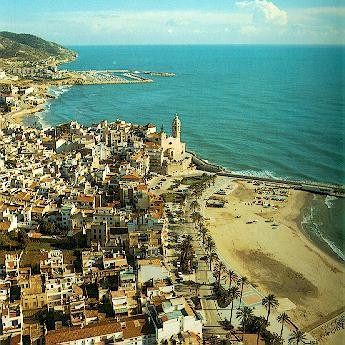
This week I´m spending a few days with friends in Sitges, a summer resort just outside Barcelona. Its a lovely resort, but one thing the trip has confirmed for me is that I´m just not made for sun holidays.

I spend much of the time avoiding the Spanish sun, as it is just too severe for Irish skin from the hours of 12 -4. Even out of the sun, the temperature is bothersome – the shortest walk saps huge amounts of energy. That said, the swimming is superb and I´m getting plenty of it. The rest of the time I´m wandering around the town swaddled up in sunhat, shades, silly clothes and shoes – much like a toddler on a skitrip!

The resort of Sitges

We took the train in to Barcelona yesterday. What a fantastic city. Absolutely beautiful – quite a bit like Paris in its buildings and splendour, but more relaxed somehow. Again, a lot of walking around in the heat – it nearly killed me, but defnitely worth it. Next time, we´ll take the open-top bus tour, like normal people.

Then back to Sitges in the evening. Another aspect of sun culture I don´t get is having huge meals late at night that go on for hours. I just feel tired and unfit. I need something to do – gimme a surf holiday anytime.

Ah well, back to Dublin on Wednesday. I hear it´s raining there . Oh heaven.

Update

Less sun today, thank God, so we´re just lazing around the resort in between swims. According its wikipedia entry, Sitges is the Spansih equivalent to St Tropez. Hmm. It is beautiful, but very laid back. Not that big a buzz around last night that I could see  – no doubt the weekends are crazy.

Comments Off on It´s hot in Barcelona

Filed under Travel

150th anniversary of Tyndall’s greenhouse effect

Every scientist knows that this year marks the 150th anniversary of the publication of Darwin’s ‘On the Origin of Species’, but not so many may be aware that another scientific breakthrough occurred that year. In 1859, the Irish physicist John Tyndall discovered that certain gases – carbon dioxide and water vapour in particular – absorb infra-red radiation. The discovery was established over a few short weeks, but it provided an explanation for the greenhouse effect, one of the great puzzles of science.

The Irish Times have accepted a piece I have written on Tyndall for their Irishman’s Diary slot next month. I like this column- it is a unique feature of The Irish Times, comprising an 800-word essay prominently displayed on the op-ed page, written by the house journalist 3 days a week and by a freelance writer on other days. I have written a few diaries on various Irish scientists in the past (see My Articles) and I hope one day to publish the ‘Science Diaries’ as a collection of essays.  Below is a draft of what I intend to say on Tyndall:

**********************************

John Tyndall: celebrated Irish scientist who discovered the greenhouse effect

Many readers will know that this year marks the 150th anniversary of the publication of Darwin’s ‘On the Origin of Species’. Another breakthrough occurred in science that fateful year, this one with an Irish connection. The discovery attracted much less attention than Darwin’s theory of evolution at the time, but it has become one of the hottest topics in science today (literally).

In July 1859, the Irish physicist John Tyndall, one of the great scientists of the 19th century, established that certain atmospheric gases absorb heat quite strongly. This innocuous-sounding discovery was established over a few short weeks, but it provided the solution to one of the great riddles of science: the famous ‘greenhouse effect’.

The greenhouse effect was first proposed by the French polymath Joseph Fourier, almost a century before Tyndall’s experiments. Fourier had wondered how the earth maintains its warm temperature, and he speculated that while heat from the sun passes easily through our atmosphere on the way to earth, heat radiated outwards by the warm earth must somehow be trapped in the atmosphere. The hypothesis was highly controversial, as it was widely assumed that gases are transparent to heat.

Tyndall, a fierce proponent of the new experimental method of science, devised a series of simple experiments to test Fourier’s hypothesis.  Working in the dusty basement of the Royal Institution in London in the summer of 1859, he soon established that, while most gases are indeed transparent to light and heat, some gases – carbon dioxide and water vapour in particular – can absorb heat energy at certain wavelengths. As traces of each gas were known to exist in the earth’s atmosphere, the puzzle of the earth’s temperature was solved.

How did an Irish scientist come to make such an important discovery? John Tyndall was born in Leighlinbridge, County Carlow in 1820, the son of an RIC officer and land agent. On completing his schooling under renowned local teacher John Conwill, he started his professional career as a surveyor for the Ordinance Survey of Ireland.  He was soon transferred to a position with the Ordinance Survey in Lancashire, England, but became interested in the new experimental sciences of physics and chemistry emerging in Germany. He moved to Germany in 1848 to study under the famous experimentalist Robert Bunsen at the University of Marburg, returning to England with a PhD in experimental science in 1851. By 1853, he had been appointed Professor of Natural Philosophy at the Royal Institution, a position previously held by the renowned scientist Micheal Faraday.

Tyndall remained at the Royal Institution for the rest of his career, making important discoveries in diverse areas of science, from magnetism to optics, from the physics of sound to the behaviour of bacteria. He is probably best known for ‘Tyndall scattering’, the scientific explanation for why the sky is blue. A keen mountaineer, he became interested in the science of glaciers and made several important discoveries concerning their behaviour. He became extremely well-known in Victorian England as a public communicator of science and was a prominent member of the ‘X Club’, an influential group of prominent scientists who defended evolution and other new scientific theories from religious dogma.

Tyndall’s verification of the greenhouse effect was accepted by the scientific establishment, but not regarded as a matter of vital importance. He and his colleagues were aware of the output of Victorian England’s factory chimneys, but no-one drew a link between this pollution and the greenhouse effect.

Nowadays, evidence has emerged that the average temperature of the earth and its oceans has been gradually rising since the industrial revolution. Despite many uncertainties, the scientific consensus is that this global warming is associated with an increase in carbon dioxide in the atmosphere, an increase that has been produced by human activities such as industry and transport. The discovery has led to concerted international efforts to agree on targets for reducing carbon emissions worldwide, a process that is only just beginning.

What would Tyndall make of today’s climate problems? Like most scientists of his era, he would probably find it difficult to grasp that humans could have such a global effect on nature. On the other hand, he would be greatly depressed by the shrinking of his beloved glaciers. Above all, he would be astonished to find that, of all the scientific discoveries he made, the work he did in the summer of 1859 has become a major preoccupation of 21st century science.

Today, the work of this great Irish scientist is commemorated by the annual Tyndall lecture of the Institute of Physics, the Tyndall Centre for Climate Change Research in the UK, the Tyndall National Institute in Cork, Mount Tyndall in California and the Tyndall glacier in Chile.

*********************************

John Tyndall: celebrated Irish scientist who discovered the greenhouse effect

Many readers will know that this year marks the 150th anniversary of the publication of Darwin’s ‘On the Origin of Species’. Another breakthrough occurred in science that fateful year, this one with an Irish connection. The discovery attracted much less attention than Darwin’s theory of evolution at the time, but it has become one of the hottest topics in science today (literally).

In July 1859, the Irish physicist John Tyndall, one of the great scientists of the 19th century, established that certain atmospheric gases absorb heat quite strongly. This innocuous-sounding discovery was established over a few short weeks, but it provided the solution to one of the great riddles of science: the famous ‘greenhouse effect’.

The greenhouse effect was first proposed by the French polymath Joseph Fourier, almost a century before Tyndall’s experiments. Fourier had wondered how the earth maintains its warm temperature, and he speculated that while heat from the sun passes easily through our atmosphere on the way to earth, heat radiated outwards by the warm earth must somehow be trapped in the atmosphere. The hypothesis was highly controversial, as it was widely assumed that gases are transparent to heat.

Tyndall, a fierce proponent of the new experimental method of science, devised a series of simple experiments to test Fourier’s hypothesis. Working in the dusty basement of the Royal Institution in London in the summer of 1859, he soon established that, while most gases are indeed transparent to light and heat, some gases – carbon dioxide and water vapour in particular – can absorb heat energy at certain wavelengths. As traces of each gas were known to exist in the earth’s atmosphere, the puzzle of the earth’s temperature was solved.

How did an Irish scientist come to make such an important discovery? John Tyndall was born in Leighlinbridge, County Carlow in 1820, the son of an RIC officer and land agent. On completing his schooling under renowned local teacher John Conwill, he started his professional career as a surveyor for the Ordinance Survey of Ireland. He was soon transferred to a position with the Ordinance Survey in Lancashire, England, but became interested in the new experimental sciences of physics and chemistry emerging in Germany. He moved to Germany in 1848 to study under the famous experimentalist Robert Bunsen at the University of Marburg, returning to England with a PhD in experimental science in 1851. By 1853, he had been appointed Professor of Natural Philosophy at the Royal Institution, a position previously held by the renowned scientist Micheal Faraday.

Tyndall remained at the Royal Institution for the rest of his career, making important discoveries in diverse areas of science, from magnetism to optics, from the physics of sound to the behaviour of bacteria. He is probably best known for ‘Tyndall scattering’, the scientific explanation for why the sky is blue. A keen mountaineer, he became interested in the science of glaciers and made several important discoveries concerning their behaviour. He became extremely well-known in Victorian England as a public communicator of science and was a prominent member of the ‘X Club’, an influential group of prominent scientists who defended evolution and other new scientific theories from religious dogma.

Tyndall’s verification of the greenhouse effect was accepted by the scientific establishment, but not regarded as a matter of vital importance. He and his colleagues were aware of the output of Victorian England’s factory chimneys, but no-one drew a link between this pollution and the greenhouse effect.

Nowadays, evidence has emerged that the average temperature of the earth and its oceans has been gradually rising since the industrial revolution. Despite many uncertainties, the scientific consensus is that this global warming is associated with an increase in carbon dioxide in the atmosphere, an increase that has been produced by human activities such as industry and transport. The discovery has led to concerted international efforts to agree on targets for reducing carbon emissions worldwide, a process that is only just beginning.

What would Tyndall make of today’s climate problems? Like most scientists of his era, he would probably find it difficult to grasp that humans could have such a global effect on nature. On the other hand, he would be greatly depressed by the shrinking of his beloved glaciers. Above all, he would be astonished to find that, of all the scientific discoveries he made, the work he did in the summer of 1859 has become a major preoccupation of 21st century science.

Today, the work of this great Irish scientist is commemorated by the annual Tyndall lecture of the Institute of Physics, the Tyndall Centre for Climate Change Research in the UK, the Tyndall National Institute in Cork, Mount Tyndall in California and the Tyndall glacier in Chile.

Dr Cormac O’Raifeartaigh is the author of the science blog ANTIMATTER

9 Comments

Filed under History and philosophy of science, Science and society

Free speech, AIDS and the HIV virus

Johnny Steinberg has a depressing article on skepticism and the HIV virus in this week’s edition of New Scientist.

The article starts with the story of Christine Maggiore, a 52-year old who died in 2008 from infections typical of AIDS. Apparently, she had tested positive for HIV 16 years ealier, but shunned anti-retroviral therapy (ART), the therapy that is known to hinder AIDS developing from the virus. Her choice, you  might say; until you read that she also denied the treatment to her infant daughter, who died of AIDs-related illnesses at age 3.

Steinberg then goes on to describe the HIV denial movement, starting with arch-skeptic Peter Duesberg. Duesberg’s work with retroviruses – the class to which HIV belongs – led him to conclude that all such viruses are essentially harmless. In fact, many scientists shared Duesberg’s skepticism of the HIV- AIDS link in the late 1980s, but support rapidly fell away as clinical evidence linking HIV to AIDs mounted. In Duesberg’s case, rather than revise his views in the face of emerging epidemiological evidence, he chose to hang on to his old theory – a position he has stuck to ever since.

Professor Peter Duesberg of the University of Berkeley

The publicity afforded to Duesberg and other skeptics has had serious consequences for society. According to the New Scientist, a recent survey suggested that 25% of the US population currently question the link between HIV and AIDS. Even more seriously, NS cites the case of South Africa, a country where AIDS has made devastating inroads. Because President Mkebe chose to believe the skeptics, he strongly resisted the use of ART therapy in South Africa – it is now estimated that over 300,000 AIDS victims died unnecessarily there.

So what is at the root of this sort of skepticism? I have to agree with Steinberg when he states that “no amount of evidence will overturn the entrenched beliefs of some”. Combine this with the tendency of the media to highlight studies that show unorthodox results and you are well on the road to the public misunderstanding of science.

Perhaps we scientists are partially to blame. It seems to me that we do a poor job of communicating the consensus position – and how it is achieved – on important issues, from global warming to the MMR vacinne. There will always be scientists who question the mainstream, even in the face of overwhelming evidence; such is human nature and we cannot censor such views in a free society. Not to mention the fact that science progresses by asking the unthinkable. Perhaps the solution is to convince the media not to allow ‘maverick’ scientists disproportionate publicity – and for the elders of science to take the communication of science to the public more seriously. In Ireland, there isn’t a single university that has a Professorship for the Public Understanding of Science..

Update

In the same issue, New Scientist have an excellent editorial on the importance of scientific heresy. There is no contradiction here – the questioning of ‘accepted science’ from within is a vital part of scientific discovery and long may it continue. It is the misrepresentation in the media of the scientific consensus on a given topic that is of concern..you can find more information on this topic on Seth Kalichman’s ‘s blog denyingaids.blogspot.com

4 Comments

Filed under Science and society, Uncategorized

The Alchemist Cafe

I gave a talk on Wednesday evening at the Science Gallery in Trinity College Dublin, as part of the Alchemist Cafe series. It was great to be back at the Gallery, I’ve fond memories of participating in the RAW debates there last year (see blog posts on the debates here).

The Alchemist Cafe is the Irish branch of the international Cafe Scientifique movement: the idea is to get a scientist or engineer to give an informal talk on a scientific topic in a cafe/bar setting, with plenty of questions and discussion afterwards. You can find abstracts and videos of previous talks on their website above.

I gave a short spiel titled ‘The Big Bang: Fact or Fiction?”. I thought it would be fun to go over the three basic planks of evidence for the model and then discuss some modern results (from the accelerating universe to WMAP measurements of the cosmicrowave background). The rest of the session was given over to questions and discussion.

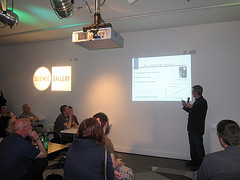
It seemed to work well, I thought the Science Gallery cafe a particularly good setting. One whole side of the cafe is a glass window onto the street and we projected the images I used onto the opposite wall, with the audience in between. It made for a nice relaxed atmosphere.

The Naughton Institute and the Science Gallery at Trinity College Dublin

al caf 1

Photos courtesy of The Alchemist Cafe


There were plenty of good questions, on topics as diverse as unified field theory and dark energy. I wish I’d taken note of the questions, must check with the organisers if someone did. Turnout was a big surprise – a few friends turned up at 8.05 and couldn’t get in! It’s amazing the public interest in cosmology, I guess everyone has heard of the Big Bang and Hawking’s A Brief History of Time.

All in all, it was a great experience. There will be a video of the event on the Alchemist Cafe site in a few days and I’ve uploaded the slides I used on the My Seminars page.

P.S. The Gallery is currently exhibiting INFECTIOUS, an excellent show on the spread of infectious diseases: well worth seeing and highly relevant given the news on swine flu…

7 Comments

Filed under Public lectures, Science and society