Tyndall conference in Ireland

This weekend, I caught the last day of a climate conference honouring the memory of the great Irish scientist John Tyndall. Born in County Carlow, Tyndall became a key member of the Royal Society around the time of Charles Darwin. He studied under Robert Bunsen in Germany and did much to promote the idea of experimentation in science. Among his many contributions are the discovery of the Tyndall effect (an explanation for the colour of the sky in terms of the scattering of light) and pioneering works in optics.

Tyndall’s most important contribution was his experimental demonstration of the greenhouse effect. He was the first to show that certain gases – notably carbon dioxide and water vapour – absorb radiation of infra-red wavelength, thus trapping heat reflected from the earth. This discovery forms the bedrock of the modern climate science. Today’s phenomenon of global warming (measured as an increase in global temperature, glacier-melt and sea level rise over the last few decades) has been attributed to an increased concentration of greenhouse gases in the atmosphere caused by the burning of fossil fuels.


The 2011 Tyndall climate conference was sponsored by the EPA and the Royal Irish Academy

The conference celebrated the 150th anniversary of the publication of Tyndall’s landmark paper On the Absorption and Radiation of Heat by Gases and Vapours and took place in Dublin castle, a superb venue in the heart of Dublin’s vibrant city center (and the seat of British rule in Ireland only a century ago). Day one was an overview of Tyndall’s life and work, with a keynote lecture by eminent climatologist Richard Sommerville. The next two days featured slightly more technical talks on climate science. You can find the conference program and book of abstracts here.

I caught several excellent talks on Friday, including a talk on climate sensitivity and feedback mechanisms by John Mitchell of the UK Hadley Centre, and a talk on tipping points and their predictability by Peter Ditlevensen of the Center for Ice and Climate at the Niels Bohr Institute in Copenhagen. Another talk, by George Moore of the University of Toronto, suggested that we may already have passed such a tipping point. The lecture  ’20 years of IPCC projections’ by Ulrich Cubasch of the Free University of Berlin, demonstrated how well IPCC projections have stood the test of time. This is a point often overlooked in discussions of climate science in the media. The public are wary of theoretical models, and climate scientists sometimes forget to point out that we have had twenty years to test predictions – so far, the projections have turned out to be all too accurate.

Possibly the most advanced talk of the day was by Professor Ray Bates of the Meteorology and Climate Centre at University College Dublin, a former professor of meteorology at the Neils Bohr Institute. In his talk, Ray presented a new global climate model, contrasting it with the recent model of Dick Lindzen. The Lindzen model is quite controversial as it suggests that conventional climate models overestimate the contribution of an enhanced greenhouse effect on climate. In good scientific fashion, Ray outlined the basic physics underpinning the two models, steering clear of polemics and concentrating on the science. You can Ray’s paper on his, and other, models here .

All in all, a great conference, I was sorry to miss the first two days. One of the aspects the increased teaching workload in the Institute of Technology sector is that there is almost no time left over for conferences – someone’s idea of increased productivity.

Update

Richard Sommerville did a very nice interview on the Pat Kenny show, a flagship radio show on RTE radio 1. Pat raised almost every point favoured by climate skeptics, while Richard provided clear and cogent answers to each. Well worth a listen, you can download a podcast here.

1 Comment

Filed under Global warming, History and philosophy of science

Faster than the speed of light

So. A respected experimental group, doing respected work, the OPERA neutrino experiment at Grand Sasso in Italy, have reported a startling result; they have measured a velocity for neutrinos that is in excess of the speed of light (a fractional increase of about of 1 in 100,000). The result is getting a huge amount of publicity because it appears to be in conflict with Einstein’s theory of relativity. ‘Einstein wrong‘ always makes headlines. I’m certainly getting a lot of calls and emails on the subject, not least because I had an article on relativity in Thursday’s Irish Times (see here).

In the OPERA experiment, a beam of neutrinos travels underground from CERN travel to Gran Sasso in Italy

The OPERA paper has been posted on the ArXiv here. Most physicists (including the participants) are calling the result an ‘anomaly’ and expect to find a hidden error, for two reasons

1. Thousands and thousands of experiments on elementary particles suggest that the speed of light represents a natural speed limit for material bodies, no matter how much energy you whack them with

2. There are deep mathematical reasons for believing that the speed of light in vacuum represents an absolute limit, from arguments of symmetry to the principle of least action. Basically, all sorts of mathematics suggests that the speed of photons- massless particles –  is the highest speed achievable. In addition, the principle underlies a great deal of observed physics, far beyond the remit of relativity.

So what is going on?

Science is a skeptical activity and scientists are slow to throw out a successful theory at the first sign of trouble -especially a theory as successful and as central as special relativity. Most scientists adopt a ‘wait and see’ approach when an experiment like this is reported.

For example, we know a great deal more about relativity than we do about neutrinos. It is only a few years since it was discovered that neutrinos have mass, and the phenomenon of neutrino oscillation – the transformation of one type of neutrino to another – is still not well understood. So it is possible that this experiment is an artefact of some unknown neutrino process.

A more prosaic possibility is that there is a systematic error in the extremely precise time/distance measurements necessary for the experiment. For example, the time of flight of the neutrinos is measured using a sophisticated version of GPS – perhaps there is a hitherto undetected error lurking in this method that is affecting the measurement. A few years ago, it was discovered that the moon has an effect on the curvature of the LHC tunnel, as does the TGV arriving at Geneva – these effects only show up because of the unprecedented precision involved in the experiments.

Finally, it is always possible that this result may turn out to be a real effect. In this case, we could be looking at some exciting new physics; not a violation of relativity, but the first evidence of hidden dimensions. String theorists have long mooted the possibility that the three familiar three dimensions of space may be accompanied by other dimensions, tiny ones that are curled up so that they are undetectable at normal energies. In principle, a particle that takes a shortcut through such a dimension could arrive early! This may sound like a rather fantastic explanation, but it is possible that an experiment at the unprecedented energy and precision of OPERA could see this effect for the first time. Certainly, it would not contradict any previous theory or experiment.

So an exciting wait, but my money is on a systematic error in the measurement of distance or time

Technical note

I keep hearing in the media that ‘relativity forbids travelling at speeds faster than the speed of light in vacuum.’ Actually, it doesn’t, as Einstein was fond of pointing out. Special relativity suggests that it is impossible for  body to be accelerated from subluminal to superluminal speed. Thus particles that travel faster than light are possible in principle so long as they always travel at that speed (known as tachyons). However, such behaviour has implications for time (it would run backwards) and for causality, and is therefore thought unlikely. Also, no such particles have been observed  in five decades of experimentation in particle physics .

Last weekend, I was quoted (well misquoted) in The Irish Times, making the last point above; you can read it here, it’s quite a good article.

Update

If it is a systematic error, what could it be?  Looking at the paper, my own guess is that it is significant that the group do not measure the time-of-flight of individual neutrinos, but massive bunches of the particles. Essentially they measure the beginning and end of a bunch, and apply statistics to get the mean time. A messy enough procedure, considering the accuracy required..

Update II

I have a letter on the experiment in The Irish Times today, you can read it here

31 Comments

Filed under Particle physics, Science and society

Back to school in Ireland

I finally left Harvard in the last week of August, having had a wonderful summer working quietly on The Book during the day and sailing on the Charles in the long summer evenings.

It’s nice to be back home too – no more going around in silly shorts, suncream and shades. Back at Waterford Institute of Technology in the southeast of Ireland, we are already in the second week of teaching term. The bad news is that thanks to the recession, teaching loads have been increased (increased productivity!) leaving almost no time at all for frivolous activities such as research. On the other hand, there is much discussion of the college being upgraded to full university status, mainly because the government thinks that an upgrade ay help attract industry to a region badly hit by the recession. So after all the valiant efforts of WIT researchers, it seems an upgrade may occur for political reasons…

How does the college seem after Harvard? Colleagues keep asking me this. Yes, I miss the beautiful Harvard campus, the incredible libraries and the superb seminars. However, the main day-to-day difference is one of organization. There seems to be a problem of chaotic timetabling in WIT for the first few weeks of every semester, at least in my department. It’s very stressful and leaves no time over for prep or research. I’ve never understood why this happens every year, as our staff and courses change relatively little. One reason might be that lecturers are left to decide who teaches what amongst themselves, pitting Alice against Bob. Give me a didactic Head of Department any day…

Waterford Institute of Technology

On the other hand, it’s great to be in a job with an influx of Hopeful Young People every year. I always think that academics are v lucky in this regard, it doesn’t really matter which college you are in. Another change is that I am moving to a smaller, quieter office yipee. There is a special place in hell reserved for managers who believe that academics work well in large open-plan offices. With students coming to the door and phones continually ringing, it’s impossible to get any work done between classes. Hopefully I’ll have some quiet evenings in my nice new office….

9 Comments

Filed under Teaching, Third level

Harvard vs Trinity College Dublin

I was recently invited to write a short piece on my impressions of Harvard for the Irish university blog University Diary. The piece is published today and can be read here

Update; here it is in full

[I’m fast approaching the end of my year as a research fellow at Harvard – what an experience! ‘So what was it like?’, a great many colleagues in Ireland have asked. Actually, Harvard reminded me very much of Trinity College Dublin, where I did my PhD – but on a larger-than-life scale.

First, the main Harvard campus is not unlike Trinity. Although the architecture dates from a different period, the campus consists of one large quadrangle, with other quadrangles branching off. All of these beautiful quads boast fine old buildings that serve as lecture halls, libraries, dining halls and student housing. This centralization gives Harvard a great ‘lived-in’ feeling; in this respect, it is resembles a large version of Trinity, in contrast with the dispersed, collegiate system of Oxford and Cambridge.

However, Harvard is situated in the quiet district of Cambridge, Boston, not Dublin city centre. As a result, it has been able to situate its growing graduate schools in the immediate area surrounding the main campus, unlike Trinity. Indeed, much of the area between the main campus and the Charles river is filled with Harvard buildings, from graduate schools in business, law and government to student housing; the whole area is now known as Harvard Square.

What about the academic side of things? Apart from a high number of staff who are stars in their field, it doesn’t feel all that different from other universities. What strikes one most is the sheer diversity of scholarship. Consider science; as well as world-renowned departments in mathematics and physics, Harvard also boasts a famous centre for astronomy and accompanying observatory. As well as prestigious departments in traditional disciplines such as chemistry, biology and the medical sciences, Harvard has a huge History of Science department and accompanying museum. Not many universities can boast these, or Harvard’s well-known programs in Science, Technology and Society.

Academic standards are sky high, as you might imagine. Although I have my doubts about some university ranking systems, there is no denying Harvard comes in at no.1 or 2 in almost every poll. So while TCD comes in at the top of the Irish rankings, Harvard comes in at the top of the world! For my money, this is not just a question of its ability to attract the very best because of its prestige and massive endowment (and yes, they do buy in top professors). It is also the close proximity of MIT and other Boston colleges that makes for a highly competitive, interactive academic environment, at least in the sciences. This is quite a unique situation; there is a daily level of intervarsity interaction that is far beyond that of Oxford and Cambridge, or Trinity and UCD say. Most physics seminars I attended had an even mix of MIT/Harvard personnel, irrespective of where the seminar took place. Indeed, regularly trotting off to MIT was a great treat; it’s a beautiful college where any scientist feels instantly at home, not to mention the awe-inspiring number of spin-off companies ringed around the college. Indeed, MIT’s success at innovation currently far surpasses that of Harvard. Of the ‘Nobel possibles’ I was made aware of (quite a few of those over here), at least as many were MIT. So there’s not much complacency amongst the Harvard scientists. Given the relatively small size of Dublin, it’s a pity this sort of daily interaction between the colleges doesn’t happen much.

What about undergraduate life at Harvard? Here, there is a huge difference with Trinity, and indeed between the American system and the situation in Ireland and Europe. Undergraduate fees at Harvard are in the region of 40-50 thousand dollars per annum, with few scholarships. This is true of a great many of the top colleges in the US and it has major implications for society. May we never go down this road, however bad the funding situation gets. You can also see how corporate jobs that cover kids’ health insurance and college fees have an urgent appeal.

As regards tuition, class sizes can be large (> 50), but there is a huge diversity of modules offered. Students typically have 2 plenary lectures per week, with smaller sectionals run by teaching assistants. There is great emphasis on continuous assessment, with corrections done by teaching assistants rather than the Prof (nice!). Sitting in on some classes, I couldn’t help noticing that a great many students spend precious class-time fooling around on the web, so I think I will ban internet connections in my lectures when I return home.

At postgraduate level, the financial situation is very different. While competition to get into the Harvard postgraduate program is intense, once accepted, the stipends for postgraduates are quite generous. I found the difference between the undergraduate and postgraduate populations quite noticeable; while the general student population is mainly made up of well-heeled young Americans, the postgraduate population seemed to be comprised mainly of Europeans and Asians. I had plenty of time to observe this in one my favourite venues, the Harvard Graduate School of Arts and Sciences. With its own building, dining hall, library and common room, this was a great place to meet scholars of all nationalities and a wide variety of disciplines. A great idea for any college! But isn’t it interesting that the research output of the great Ivy League colleges may rest on students who have in fact been trained in European and Asian universities? We should remember this before we adopt every fashionable trend in U.S. undergraduate education.

I’ve decided to stay in Boston for the summer, writing up my research before returning to WIT in September. I’ll certainly miss Harvard, MIT, and Cambridge, I don’t think I’ve ever been in such a vibrant academic environment. More generally, Cambridge Boston is a great place for a European; a liberal, highly-educated bastion of American society, blessedly free from the right wing ideology so increasing pervasive in the US. Back at home, it’s nice to think that the Irish IoTs may someday play MIT to our universities, but I think we have some way to go. More pragmatically, I find it a great drawback being too far from Dublin/Cork to interact with university colleagues on a daily basis…]

11 Comments

Filed under Third level

Gravity probe B experiment does not ‘prove Einstein right’

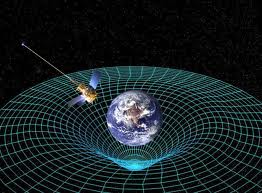
A good example of the problems of science journalism we discussed in the last post can be seen in this month’s media treatment of the important results from the NASA Satellite Gravity Probe B. After many years of frustration, the experiment has reported important evidence in support of two distinct predictions of the general theory of relativity – the geodesic effect (a distortion of spacetime by the earth) and frame dragging (caused by the rotation of the earth). See here for details of the experiment.

The result is a fantastic achievement. It offers important support for general relativity, a theory that underpins a great deal of modern physics, from our view of the origin of the universe to our understanding of black holes. It’s worth noting that such tests are rare and notoriously difficult (unlike the case of special relativity) and sincere congratulations are due to Principal Investigator Francis Everitt and all the team who worked so hard and so long to produce this important result.

The NASA Gravity Probe B Satellite

However, I was quite disappointed at the way the result was portrayed in newspapers and in science magazines. Almost without exception, the experiment was described as  ‘Einstein proven right‘ – see for example this article in the prestigious journal Science.

What’s the problem? The statement ‘Einstein proven right’ is deeply problematic for two reasons
1. As Einstein (and later Karl Popper) frequently pointed out, it is a basic tenet of the scientific method that no experiment can ‘prove’ a theory right. An experiment can offer supporting evidence but the case is never closed, because we do not know what new evidence may emerge in the future to cast doubt on other predictions of the theory
2. The constant personalization of the theory of relativity with Einstein creates the impression that the theory depends upon one scientist only, and devalues the work of hundreds of relativists since.
For the above two reasons, most physicists would have framed the result as ‘general relativity passes two important tests’.

It seems to me that such shorthand reportage does science no favours, as it misrepresents the result and plays into the hands of doubters and anti-science commentators. I wrote to Science to make this point; they have declined to publish my letter, so I am free to reproduce it here

***************************************************************************

Re: At Long Last, Gravity Probe B Satellite Proves Einstein Right

News Section, Science, May 5

As a physicist and a science writer, I was surprised by your headline ‘At Long Last, Gravity Probe B Satellite Proves Einstein Right’ (News Section, Science, May 5).

To be sure, the Gravity Probe B experiment is a fantastic achievement that offers spectacular evidence in support of two distinct predictions of the general theory of relativity. This is important support for a theory that underpins a great deal of modern physics, from our view of the origin of the universe to our understanding of black holes. It’s also worth noting that such tests are rare and notoriously difficult (unlike the case of special relativity) and sincere congratulations are due to the team who worked so hard and so long to produce this important result.

However, your headline is problematic for anyone with a knowledge of the scientific method or an interest in the philosophy of science.

In the first instance, it is a fundamental tenet of science that no experiment can ‘prove a theory right’, as Einstein himself (and Karl Popper) frequently acknowledged. Even the most ingenious experiment can only offer evidence in support of a theory –‘right so far’ (and this is leaving aside the difficult question of the interpretation of scientific data). The error is not simply a question of headline shorthand as it is repeated in the opening sentence of the article;  ‘..a ..NASA spacecraft has confirmed general relativity’.

Second, it is a pity that relativity is so often portrayed as the work of one great scientist. Granted, it is a matter of historical record that the general theory of relativity was first formulated by Einstein singlehandedly. However, a great many mathematicians and theoretical physicists have explored, deepened and refined the theory since that time (obtaining solutions to the field equations and deriving concrete predictions from these solutions, for example). Framing the story in terms of Einstein alone ignores this work, and implies that the entire edifice of relativity is dependent upon one scientist.

In sum, it is no easy task to summarize a groundbreaking scientific experiment in a brief article, but most physicists would frame this important result as ‘general relativity passes another experimental test’ rather than ‘Einstein proven right’.

Yours sincerely

Dr Cormac O’Raifeartaigh

Visiting Fellow, Program on Science, Technology and Society, Harvard Kennedy School

*******************************************************************************

14 Comments

Filed under Science and society

Refuting Einstein: a media controversy in Ireland

I had a very sobering conversation about science communication with an eminent climate scientist at MIT yesterday, and it got me thinking about the incident that first prompted my interest in writing science for a wide audience.

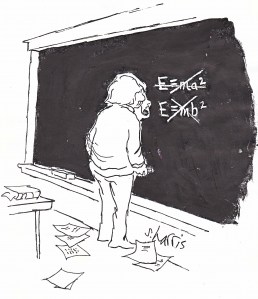
In the late 1990s, I had just returned from a postdoctoral research position at the University of Aarhus in Denmark, and was embarking on a similar stint at Trinity College Dublin. After all that training, I had the smug feeling that I was finally evolving into a scientist; and right at that moment, a scientific ‘controversy’ broke in the British and Irish media. A distinguished Irish engineer, Dr Al Kelly , published a number of papers that claimed to show that Einstein’s special theory of relativity (SR) was fundamentally unsound, work that received a great deal of media attention. I was intrigued by the story and set about getting my hands on the publications.

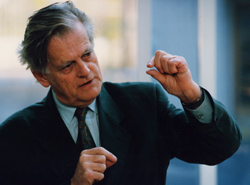
Dr Al Kelly, a highly respected engineer

The first surprise was that the papers were not published in a well-known peer reviewed journal, but in the monthly Journal of the Institute of Irish Engineers. This is a respectable magazine (now known as The Engineers Journal), but not a natural forum for technical papers on fundamental physics – yet the work had already received far more media attention than any other physics research in Ireland. [Dr Kelly himself complained publicly that the more established journals refused to consider his papers on special relativity on point of principle! A great many journals do in fact refuse to consider papers on SR, simply because the subject is such a favourite target of cranks and skeptics with little scientific training].

The second surprise was that, on reading the Kelly papers, it seemed to me that the author did not have a good understanding of the basic theory of SR (for example, his definition of an inertial frame seemed strange). In addition, there was no reference to the vast amount of experimental evidence supporting the key predictions of SR – time dilation, mass increase and the universality of the speed of light in vacuum (routinely observed in particle accelerators around the world). Instead, the author attempted a refutation of SR on the basis of the  Sagnac effect, a complicated effect that pertains to rotating bodies.

The Sagnac effect: coherent light travels around a rotating loop in opposite directions and the phases of the two signals are compared at a detector

Now, an effect concerning rotating bodies is not where one would normally start with a refutation of special relativity, because a rotating body is accelerating while SR pertains to inertial frames i.e. frames moving at constant velocity relative to one another. An additional problem is that the two light beams do not in fact travel the same distance relative to an observer in the centre of the frame (see reference above). A proper relativistic treatment of the Sagnac effect is quite complicated, and involves terms from General Relativity, the theory of relativity that deals with accelerating bodies. Most importantly of all, relativistic effects do not show up as first- or second-order effects in the Sagnac effect, making it an unsuitable effect for experimental tests of relativity.

Media reaction

It was not the work itself that shocked me. Any physicist regularly receives refutations of SR in the post, ranging from the completely crazy to the highly aggressive. What shocked me was the media reaction to Kelly’s work; the story immediately became a media ‘controversy’, with feature articles in The Irish Times (Ireland’ s paper of record), the Sunday Times (a respected UK paper), the Japan Times and many others. There were regular bulletins on TV and radio, with few journalists treating the story with even a small degree of skepticism. The internet also played a role in the affair, with hundreds of blogposts by writers who knew nothing about the subject. (It put a great many Irish physicists off blogs for life). The Irish Times set the tone for the affair by using the headline ‘Refuting Einstein’ for all articles and letters on the subject, thus framing the debate as plucky Kelly vs establishment Einstein.

Professional physicists paid very little attention to the story at first. In the few instances where their opinion was sought, the ‘debate’ was portrayed as one voice against another, not as the overwhelming consensus of 100 years of scientific evidence against one engineer. Most of all, the debate was portrayed as Kelly vs Einstein – I do not recall a single journalist draw attention to the fact that physicists’ belief in relativity stems not from a belief in Einstein, but from the mountain of experimental evidence that supports the theory (a confusion of the context of discovery with the context of justification). Finally, just as the story was beginning to die down, a French physicist cited one of Kelly’s papers and Irish journalists declared Kelly ‘vindicated’. [I read the French paper and the reference was not to Kelly’s theory at all, but to an experiment he suggested].

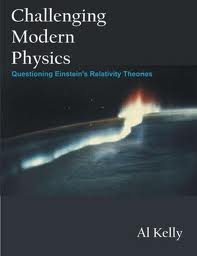
Not long after all this, Al Kelly sadly passed away. I should stress that he was a very nice man and an accomplished engineer. His papers on the subject were published posthumously as a book, which is available on Amazon.

Lessons

You rarely see a reference to the Kelly debate nowadays, but I learnt several things from the incident

1. In the eyes of science journalism, ‘Einstein wrong’ constituted a story. None of the journalists I contacted privately expressed any confidence in Kelly’s theory, but they thought it was an ‘interesting story and a good way of raising science awareness’.

2. In the few instances where professional opinion was sought, a ‘balanced’ media debate was achieved by pitting one voice against another, with no mention of scientific consensus

3. The reaction of the public was firmly anti-science. The affair dominated the letters page of The Irish Times for months and the general tone of the letters was a distrust of the establishment. All sorts of people jumped to defend the plucky Kelly, while the professionals were accused of ‘believing in relativity like a religion’.

Science journalism

All in all, the affair left me with a very skeptical view of science in the media, a view which has not changed much over the years. It seems to me that there are several problems in science journalism that are rarely aired;

motivation: the primary motivation of a journalist is to get the story, not the truth; a difference of opinion v quickly becomes a ‘controversy’

expert opinion: journalists can be quite hazy on what constitutes expert opinion; the Kelly story would only have been controversial if he was a Professor of relativity (or even a physicist)

scientific knowledge: journalists often have quite a low level of understanding of the science in question, and even of the scientific method. In particular, a great many journalists fail to grasp the difference between discovery (initial theory etc) and justification (evidence)

scientific consensus: this remains a mystery to many journalists; how it is achieved and why it is important yet never unaminous

As a result, I have become convinced that there is a need a new sort of science journalism – science communicated by scientists, not by journalists. Of course it is difficult to train scientists to write in a manner suitable for public consumption, but I suspect this is less difficult than training journalists to think like scientists. From debates on global warming to alternative medicine, there is an urgent need for scientists to be trained to speak for themselves.

A neutral debate

The one good thing about the ‘controversy’ above is that it was a neutral debate – neither business nor politics had a stake in the outcome, nor was there a prospect of Joe Citizen paying extra at the pump. This is not the case in areas such as climate science, which makes media coverage of the topic a great deal more complicated. All of the above concerns apply to media coverage of climate change – but in addition, much climate science in the media consists of op-eds by writers whose motivations are complex and whose portrayal of the subject is highly questionable. We’ll look at the communication of climate science in the next post.

Postscript

I just found a copy of my own letter to The Irish Times on the controversy above; my first media publication on science! It is co-authored with astrophysicist Lorraine Hanlon, now Head of Physics at UCD.

Update

The writer John Farrell, who wrote a very nice biography of Lemaitre, has a good article  on relativity cranks on the Salon website here.
34 Comments

Filed under Science and society

MIT, the LHC and a royal wedding

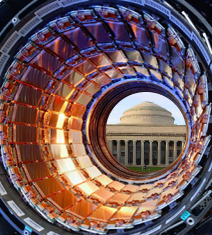
It’s always a pleasure to pop over to MIT for the afternoon, and on Friday I attended a seminar titled ‘MIT and the World’s Largest Science Experiment: Hunting the Higgs Boson”, given by Markus Klute, Assitant Professor of Physics at MIT and member of the CMS (compact muon solenoid) collaboration at CERN. It seems MIT has quite a big involvement with the LHC, with a large group working at the CMS detector and a smaller group at ATLAS; about 40 researchers overall.

MIT and the World’s Largest Experiment: Hunting the Higgs Boson

The talk was aimed at a wide audience, and much of it was a fairly standard introduction to particle physics and the experiments at the Large Hadron Collider. I always try and attend such talks whenever I can, partly to pick up any new information but also to see how the real players present the story.

Starting with a review of the nucleus and its particles, Markus gave a succinct overview of the Standard Model. I liked the way he linked the theory to today’s news; in describing the way particles are believed acquire mass (the Higgs mechanism), he invited the audience to imagine Charles and Kate entering the auditorium, how people would interact (i.e. cluster around them) to different degrees, thus acquiring different masses. This is a nice twist to a common analogy and it never hurts to connect with current events. (Being Irish, I’d be a neutrino with almost zero interaction, though I wish the couple well).

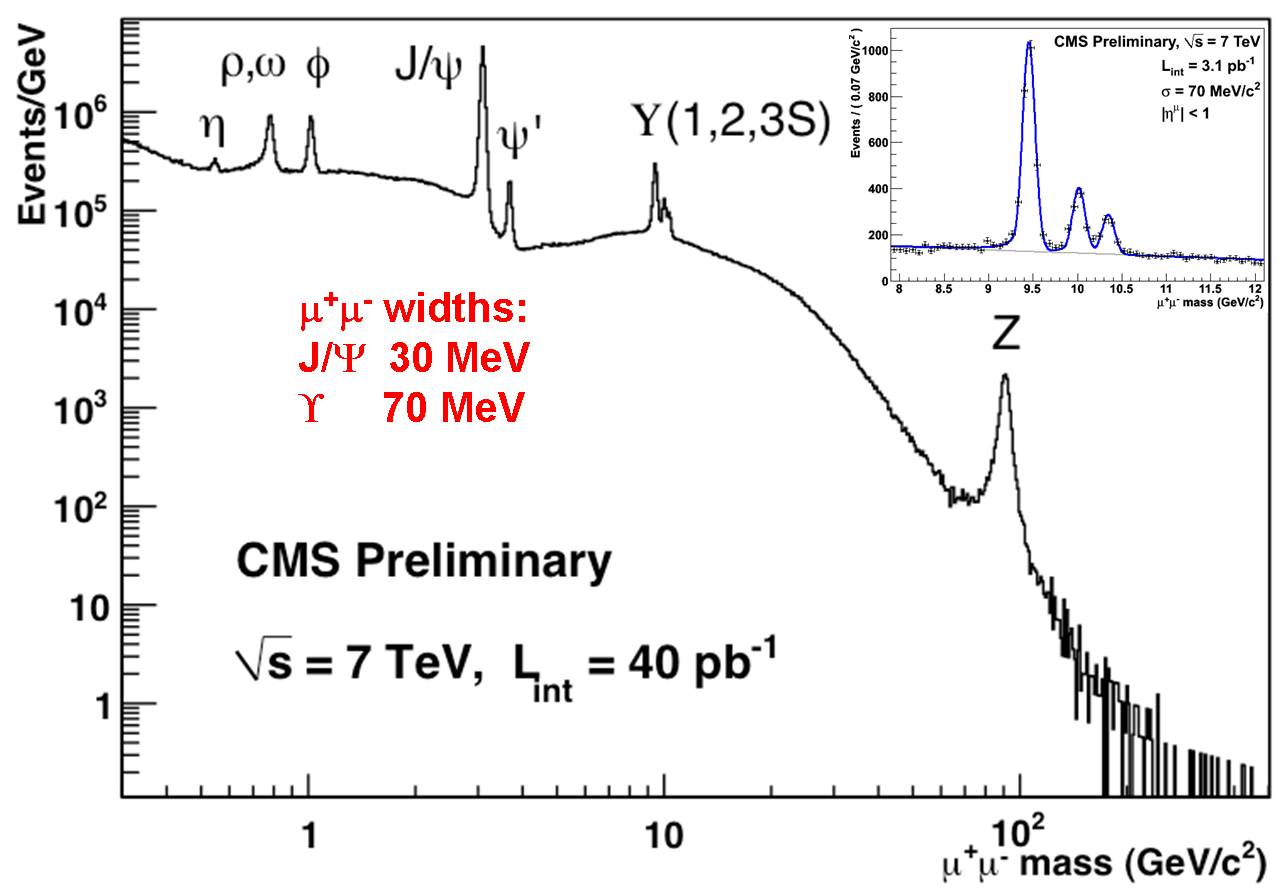
Professor Klute then gave a nice overview of the four main detectors at the LHC, and then some details about his group’s contribution to the CMS experiment, particularly in the area of building the tracking system. I won’t repeat the details but you can find a good review of US involvement at the CMS detector here. I particularly enjoyed the emphasis on the ‘rediscovery’ of the particles of the Standard Model at CMS, beautifully summarized in the plot below. I think particle physicists should emphasize this chart more, it gives great confidence in the methods of particle physics (and shows how sociologists such as Shapin and Schaffer underestimate the reproducibility of big science experiments, see ‘Leviathan and the Air Pump’).

Summary chart of particles rediscovered at CMS

I liked the speaker’s simple description of particle detectors: a camera with a hundred million pixels and a shutter speed of 400 million times per second – not to mention the filtering. He also placed great emphasis on the computing challenges thrown up by the data, giving a nice overview of the Worldwide LHC Computing Grid. I also liked the way he described particle physics experiments  in terms of four components: accelerators, detectors,  computing and people!

Finally, there was a nice overview of the challenge of the hunt for the Higgs, explaining that

– it is rarely produced

– decays almost immediately

– its mass is not known, hence neither are the main production or decay channels

Professor Klute then gave a very quick review of the main production and decay channels for the Higgs and explained how CMS will look for them.

Higgs production via gluon fusion; a dominant process for a range of mass

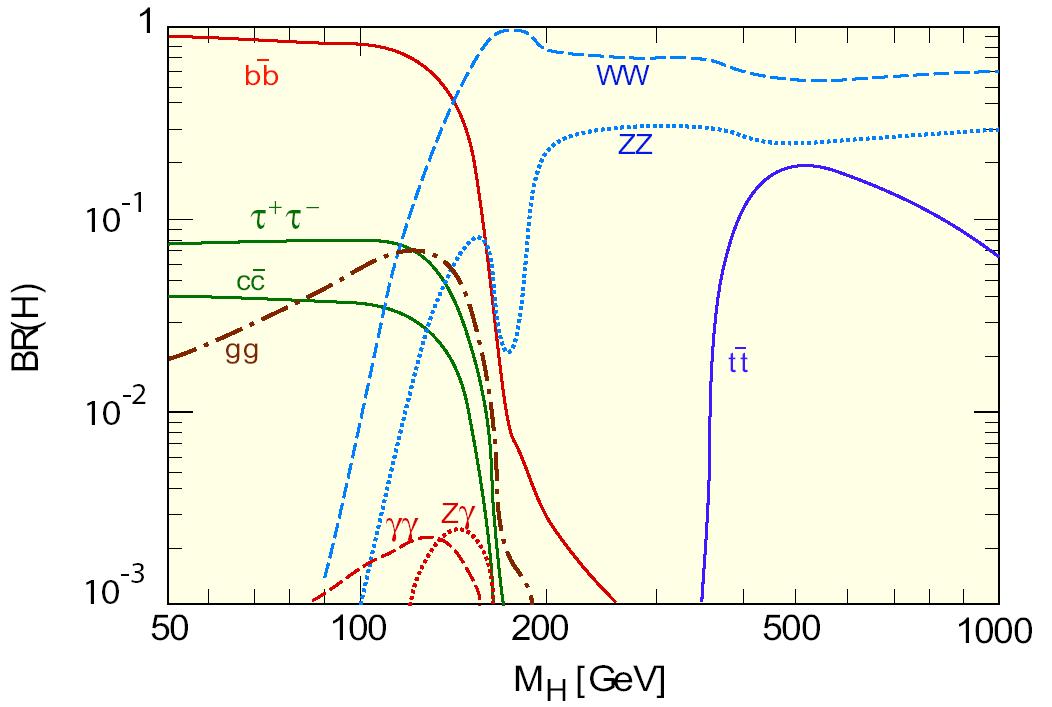
The decay channel depends on the Higgs mass

Another nice plot was a summary slide showing the masses already ruled out by previous accelerator experiments.

The window is closing

Finally, the speaker gave a quick synopsis of the possibility of observing physics beyond the Standard Model, concentrating on the possibility of the detection of supersymmetric  particles, in particular the possibility of supersymmetric Higgses. After questions and answers, there was a poster session and reception, with some very impressive posters by MIT postgrads at CMS.

All in all, a very enjoyable LHC talk with a useful description of US participation in the project. If you want to more about this, the US LHC blog is well worth following.

Update

Markus points out I said Charles and Kate instead of William! This is such a whopping error (of planetary magnitude) I think I’ll leave it. Re Higgs production and decay channels, there is an really nice overview here by a group at Imperial College also involved with the CMS experiment. This week there was a big meeting at Notre Dame concerning US participants in the CMS experiment, you can link to it here

8 Comments

Filed under Particle physics

The co-production of knowledge

In his last lecture on the history and sociology of science for sophomores at Harvard, Alex Wellerstein brought the class up to date with the latest thinking in Science and Technology Studies (STS) with an overview of the idea of co-production.

The idiom of co-production aims to get away from both the deterministic view of science as divorced from social context, and from social determinism. Instead, scientific knowledge is seen to be produced in an integral process that involves both the scientific method and the social context. Hence, the idea of co-production engages with questions that are both metaphysical and epistemological – how the world is, and how we find out about it – but blurs the boundaries between the two. This is slightly different to previous theories such as the sociology of scientific knowlege (SSK) of the Edinburgh group; a key difference is that co-production does not claim that social context ‘trumps’ the scientific method, but sees both as integral to scientific knowledge.

The figure most associated with the idiom of the co-production of knowledge is Sheila Jasanoff, the brilliant Professor of Science, Technology and Society at Harvard (my current boss!). Sheila has long been a leading light in the field of STS, and her articulation of the idea of co-production is considered one of her main contributions to the field.

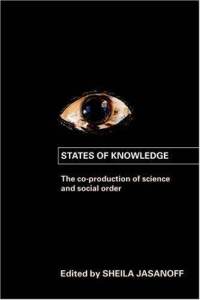
In her seminal book, “States of knowledge: the co-production of science and social order”, a collection of essays by diverse authors on the subject, Sheila gives an overview of the idiom of co-production in the first chapter and a summary in the last. She describes the objectives of co-production in terms of four components

description: a view of science in society and society in science
explanation: how co-production mitigates against linear and mono-causual stores about scientific progress
normativity : the analysis of emerging orders
prediction : prediction, prescription and action

There is a great deal to the concept of co-production, including concepts such as causality loops, positive feedback and co-evolution. I won’t attempt to summarize them here but you can find a very good review of the main themes in the last chapter of the book above.

Reception

The articulation of co-production in its current form is relatively recent, and I am not aware of major reactions against it from philosophers or scientifists. One obvious benefit is clarity; a common criticism (and misunderstanding) of the social constructivists is the idea that scientific knowledge is entirely socially constructed. This is not really what most constructivists argue, and I think the idiom of co-production clarifies this a lot.
Also, it is rather hard to argue against co-production- how can one argue that scientific knowledge (or any other sort) is not co-produced to some extent? I think this is the cleverest part of the concept, and I suspect it will help convince scientists of the importance of social context, and go some way towards mending fences between the scientists and the sociologists of science.

That said, it seems to me that while co-production helps to  clarify how knowledge is created, it doesn’t say much about another part of the scientific process, i.e. how good scientific theories survive the passage of time (this the context of discovery vs the context of justification we’ve met before). You might argue that the subsequent testing is also co-produced, and so it is; but where a given scientific theory is produced in one place and one context, it is subsequently tested over time all over the world in different contexts by people specialize in proving each other wrong! Hence, many scientists argue that social context arguments ultimately fade away.

A good example of this is the famous argument by historian Paul Forman concerning the indeterminacy of quantum physics. Scientists in Germany were heavily criticized after WWI for predicting that science would win the war; according to Forman, the indeterminacy of quantum physics may be attributed – at least to some degree – to an attempt to appease the population (we are happy to admit the limits of science etc). However, most physicists strongly disagree with Forman’s hypothesis for three reasons

  • the postulate of wave properties for the electron was first made by de Broglie (a Frenchman), and the first observation of electron diffraction was by Davisson and Germer (Americans). The latter forces you to quantum duality and thus to indeterminacy – whether you like it or not
  • many other non-German scientists (Niels Bohr, Paul Dirac etc) played a major role in the development of the theory
  • the theory survived over time worldwide because, although crazy, it matched experiment

2 Comments

Filed under History and philosophy of science

Heuer at Harvard

Rolf Heuer, the Director General of CERN, gave a talk on the Large Hadron Collider at the weekly physics colloqium at Harvard this week. The talk, “The Large Hadron Collider: Entering a New Era of Fundamental Science“, was aimed primarily at undergraduates and postgraduates in the physics department and it certainly lived up to expectation.

Professor Rolf-Dieter Heuer

The talk was roughly structured in 4 parts:

– a brief introduction to quarks and the standard model of particle physics

– a brief description of the LHC experiment; the four main detectors and their main purposes

– a brief review of results so far: luminosity successes, top quark production, quark gluon plasma using heavy-ion collision etc

– a  brief overview of possible new territory; from the Higgs boson to physics beyond the Standard Model (supersymmetric particles  etc)

What struck me most was the speaker’s emphasis on the link between the world of the sub-atomic and the universe at large. From the very first slide, Prof Heuer explained the symbiosis between particle physics, astrophysics and cosmology, pointing out that the Standard Model of particle physics addresses just 5% of the the universe (since it is now thought that dark matter and dark energy make up the rest). This theme came up many times and is indicative of how much has changed in the world of particle physics in the last few decades. Another major theme was how the individual detectors overlap and complement one another, giving a result that is greater than the sum of its parts.

The big news is that due to its excellent performance to date, the LHC is to run through until the end of 2012 (and not to go into a long technical upgrade at the end of 2011 as perviously planned). This means there will be enough data collected (albeit at 7 TeV) that some exciting new physics may have been discovered by 2013.  This is very good news for particle physics, given that the Tevatron is due to cease operations in September.

Schematic of the four main detectors of the LHC

Overview of the 27-km LHC ring

Heuer also introduced a historical perspective, pointing out that this year is the centenary of the Rutherford’s discovery of the atomic nucleus, the first public announcement of this I’ve heard so far. There was also a reference to the fact that 2011 is also the centenary of the discovery of superconductivity, without which the LHC would not be possible (superconducting materials are used in the giant magnets that guide the proton beams in the LHC).  On the experiments, I particularly liked that he payed special attention to the LHCb experiment; although it is on a much smaller scale than ATLAS and ALICE, this is my favourite of the four detectors, because of the connection with antimatter (LHCb will seek to answer why matter predominates in our universe by probing the asymmetry between matter and antimatter decay in beauty quarks, see website here or a nice blogpost on it here). It is also the only major CERN experiment that has an Irish connection, see here.

Event display of a pp collision in the LHCb detector producing two b-hadrons.

Some quotes I really liked were

We know everything about the Higgs boson, except whether it exists”

Within the next 2 years, we will have found a Higgs boson between 114 and 200 GeV, or ruled it out”

“Ruling things out is important, but we hope to have some discoveries too” (on supersymmetry)

At question time afterward, questions were deftly handled, with clear and succinct answers. I asked a question on dark energy; what did Prof Heuer have in mind when he said he hoped that LHC experiments could shed light on dark energy? His answer was that if the Higgs boson is found, it will be the first scalar boson observed (the W and Z bosons are vector bosons). Hence the idea of  a scalar field, required by cosmologists for dark energy, while not the same field, becomes more tangible. On string theory, he declined to dismiss the theory as philosophy (as suggested by someone in the audience), pointing out that the detection of supersymmetric particles at the LHC could offer some support for ST.

All in all, it was a great talk, pitched at exactly the right level for students and really conveying the excitement of discovery. I was slightly surprised the speaker didn’t call more attention to the international aspect of CERN, that an inter-european project involving a motley collection of sparring nations has emerged as the world’s premier centre for experimental particle physics (perhaps he was being polite). Just as the detectors complement one another and offer a result that is greater than the sum of its parts, so can genuine co-operation of individual nations working in harmony (and all the more reason for Ireland to join, as I have said many times in public and in the press).

7 Comments

Filed under Particle physics

STS Conference Summary

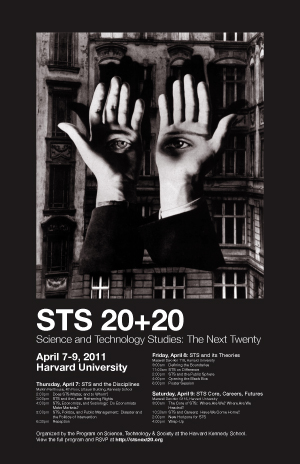
Yesterday was the last day of the Science and Technology Studies conference at Harvard, STS 20+ 20:  Science and Technology Studies: The Next Twenty. As said in the previous post, the conference was hosted by the Program on Science , Technology and Society (STS) at Harvard, the group I am spending this year with. The theme of the conference was “A Meeting Reflecting on the Past Twenty Years of STS Graduate Study, and Looking Ahead to the Next Twenty” and it was terrific. I  haven’t posted on the individual sessions (wanting to spend the time meeting so many people whose work I have been studying this year) but I found the meeting really stimulating, a real treat for anyone with an interest in the field of science and technology studies.

As said previously, each day was broadly based around a different theme; Day One on the theme of disciplinarity (Does STS Matter, and to Whom?), Day Two on STS theory and Day Three on the future of the discipline. In fact, all of these themes arose in almost every session. There were 3-4 sessions per day, with a panel consisting of Chair, provocateur and discussants, each of whom gave a short overview, followed by an hour of questions and comments from the audience. The ‘audience’ of course consisted of other STS practitoners from around the world – there’s something very nice about a conference where all the participants are all very familiar with one another’s work, it’s more like a big family meeting than the traditional type of conference. It’s also great to go to a meeting where, instead of participants presenting their latest work, the delegates discuss the field itself, its past present and future (at physics conferences, there are rarely more than 3 or 4 talks that I find relevant to me, or can even understand, something many scientists complain about nowadays).

The first session yesterday dealt with a discussion of the core of STS (what constitutes the core of the discipline, from research to pedagogy). After the break a younger panel discussed STS careers – their own experiences of opportunities available to emerging PhDs and postdocs currently and in the future. After lunch, the topic was New Horizons for STS , where a panel considered the future of STS  in terms of academic institutions. This last is a very serious topic indeed. Since STS deals specifically with the analysis of the intersection of science, technhnology and society, it’s hard to imagine a topic of more immediacy; yet it has struggled to establish its own place within the academy, partly because the subject straddles so many traditional disciplines (sociology, politics, law, history and philosophy to name but a few). Just recently, it was announced that the existing STS program in Penn State University is to be dismantled, with consequent loss of positions for some academic staff. You can find a list of exisiting STS programs and undergraduate courses in US unversites and around the world here.

All in all, a great conference – I wish there were more conferences where delegates discuss the field itself, it made for great discussions and a superb overview. From my point of view,  it was great to meet so many figures whose work I have been studying. (A highlight was discussing Trevor Pinch’s work on neutrinos with him, and his work with Harry Collins on the Eddington experiment). I was lucky to be at Harvard the year this unique meeting took place.

You can see the conference program here and slides of talks will be available in the next few days.

2 Comments

Filed under Science and society