Category Archives: History and philosophy of science

Popper’s philosophy of science

I attended the second of Alex Wellerstein’s lecture series on the history and philosophy of science for Harvard sophomores today (see last post for Alex’s response to my comments on Kuhn, in particular his excellent explanation of Kuhn’s ‘normal science’).

This week, Alex dealt with the views of science of Karl Popper and Robert Merton, contrasting them with those of Paul Feyerabend. Popper is an extremely influential figure in the history and philosophy of science, so I’ll concentrate on him today and consider Feyerabend ‘s alternate views in the next post.

Karl Popper

Karl Popper was an earlier philosopher of science than Kuhn. He was born in Vienna in 1902 and lived until 1994. Hence he experienced a great deal of 20th century political upheaval in Europe at first hand. As a young man, he was greatly interested in developments such as Marxism and psychoanalaysis, but he soon became seriously disenchanted with both. At the same time, he retained a great respect for science and his view of science came to be informed by the simple question: in what way is science different to other movements? (this is often known as the problem of demarcation of science and non-science).

Popper addresses the question of demarcation in his seminal paper ‘Conjecture and Refutations; The Growth of Scientific Knowledge.’ In a nutshell, his view is that scientific knowledge progresses by guesses or conjectures; these conjectures are then subjected to severe critical tests, which they may or may not survive. A crucial point is that conjectures can never be verified; those conjectures that turn out to be highly resistant to testing are not proven ‘true’, but they are a better approximation to the truth than others. Hence, science progresses as a process of elimination (or falsification). In addition, the argument about whether a given conjecture solves problems better than its competitors constitutes the core rationality of science.

[Note on philosophy: Popper’s view of science is a bit different to the earlier philosophy of logical positivism; the Vienna Circle of logical positivists believed that science progresses by verification, the determining of a correctness of a theory by comparison with experiment. Popper’s point is that one can never know if a ‘verified’ theory will later be refuted by experiment (philosophers call this the problem of induction; we should not make assertions about what we have not measured based on what we have). Instead, Popper believed that science works by falsification i.e. a gradual weeding out of incorrect theories. In this view of science, the emphasis moves from induction to deduction, a much stronger process. Further, the notion of falsification gives Popper a very neat answer to the demarcation problem; a theory is only scientific if it is falsifiable i.e. if there is a possibility that it can someday be disproved by experiment].

Among scientists, Popper’s view of science is still popular today; many feel it captures the essence of the scientific method in a very simple way and that it is a good approximation of how science actually works in practice. After all, your typical lab slave carries out experiments and then uses the data to rule out models that conflict with observation. Note that Popper’s view of science as a process of deduction also resembles how a detective works; police talk about ‘eliminating someone from their enquiries’, a process that resonates with scientists. Note also that the current controversy about String Theory is exactly centered on the notion of falsifiability; ST critics point out that since current versions of ST make no predictions that can be tested by experiment, it is not falsifiable and is therefore not (yet) a scientific theory.

Criticisms

1. Nowadays, there is much criticism of Popper’s view of science from historians and philosophers of science.  One major strand of criticism is that the notion of falsifiability is simply too narrow. In fact, almost all scientific theories are initially in conflict with data; it is only by a certain amount of tailoring and adjustment of theory and/or data that agreement is reached. [A good example of this is the case of Uranus;  it was known for a long time that the observed orbit of the planet Uranus was in conflict with Newton’s theory of gravity. Rather than throw out the theory (which explained the orbits of the other known planets v nicely), astronomers postulated the existence of a hidden planet that was affecting the motion of Uranus (a very convenient explanation, if you like). In fact, just such a planet was later discovered (Neptune), and the prediction of Neptune is regarded as a great triumph of Newtonian mechanics].  However, here is the problem; how far should one go with such ad-hoc adjustment in order to preserve the theory? This is a serious problem and it immediately leads back to the issue of demarcation; at what point does the theory become non-science?

The problem of ad-hoc adjustment that arises in the Popperian view of science was a major item of interest to Thomas Kuhn; as we saw in the last post, Kuhn’s resolution of the problem was to view science as being conducted within a dominant paradigm that endures quite a few challenges over time, during which scientists resolve conflict with experiment by adjusting the theory (or sometimes the data). Eventually, a point is reached when there are simply too many phenomena the theory cannot explain, and a shift to a new paradigm occurs.

2. A second major criticism of Popper (and Kuhn) comes from sociologists of science, who suggest that Popper’s view is how science should be done, rather than how it is actually done. This is because of the contingency of knowledge; our knowledge of theory and experiment, and our interpretation of each, can never be entirely objective but is driven by social context at least to some extent. This idea, that scientific knowledge is socially constructed, is a very important theme in the field known as Science and Technology Studies. In particular, we will consider the views of sociologist Paul Feyerabend in the next post.

4 Comments

Filed under History and philosophy of science

Was Kuhn more wrong than right?

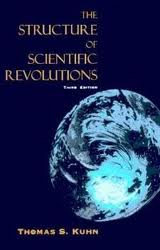
Today, I sat in on a fascinating lecture on Thomas Kuhn, the noted historian of science, given by Alex Wellerstein to Harvard sophomore students as part of a module in the History of Science. Kuhn is quite possibly the best-known product of Harvard University, famed for his extremely influential book on the history and philosophy of science The Structure of Scientific Revolutions.

Thomas Kuhn and his famous book

It was an excellent lecture, outlining the fundamentals of Kuhn’s work in exemplary fashion, as well as setting him in historical context. I particularly enjoyed the lecturer’s emphasis on graphics and explanatory images (I take a keen interest in the methods other academics use to present material). However, as so often when this Kuhn is discussed, I left the room feeling dissatisfied. I had re-read the book in anticipation of the lecture and found myself faced with the same old questions. Just what is it about Thomas Kuhn that bothers me? It’s probably a bit ridiculous to attempt a thorough critique of Kuhn’s seminal work in a blog post, but below are three key objections from an ODS (ordinary decent scientist):

*****************************************************

1. The Aristotle question. Kuhn (who trained to PhD level as a physicist) always claimed that much of his approach to the history and philosophy of science was informed by the simple question “How could Aristotle, one of the world’s greatest philosophers, be so wrong about so much of physics?” His answer to this question that Aristotle was not wrong. A. was simply exposed to knowledge that is different to what we have now and therefore simply perceived the world differently to modern scientists. Indeed, much of what A. believed was perfectly reasonable in terms of evidence at the time and we must beware of judging the past through the lens of today’s knowledge.

So far, so fairly standard. But what is more radical is that Kuhn then goes on to assert that different perceptions can be equally valid. There is no right or wrong view. This relativism quickly becomes very problematic for practising scientists. First, it ignores the fact that Aristotle was famously disinterested in evidence; he believed the ideas of the mind were far superior to any physical observation. More importantly, today’s science places great emphasis on the concept of wrong; it is only by comparison with observation that we make progress i.e. select between theories that describe the world reasonably accurately and theories that don’t. This process of elimination is a fundamentally different starting point to that of Aristotle et al. and it has driven all the major breakthroughs of modern science. There is surprisingly little discussion of this simple point (now known as Popperian falsification) in Kuhn’s book.

2. A second problem concerns Kuhn’s idea of the paradigm shift in science (considered to be his major contribution). According to Kuhn, all of scientific theory and experiment takes place within a given paradigm. From a theory of gravity to particle physics, experiment and theory generally occur within an agreed overarching sets of beliefs. If enough contradictory evidence builds up that cannot fit the paradigm, a new paradigm then arises which replaces the old i.e. a paradigm shift occurs. So far, this is a perfectly reasonable description of how science is done (if a bit simplistic as it ignores competing models within paradigms etc).

But it is what comes next is problematic. According to Kuhn the new paradigm completely replaces the old, rendering the old effectively redundant. Time and again in his book, the new paradigm is portrayed as a new world-view, entirely replacing and invalidating the old, much like a shift in philosophy. This view amazes me, particularly coming from a physicist. First, it is very, very difficult for a paradigm to become established in the first place: it has to provide an adequate explanation for hundreds of measurements in different, but related, fields. This skeptical aspect of science should not be understated. For the same reason, it is difficult for a new paradigm to emerge; this is because it the old paradigm explained a tremendous amount and is not lightly overthrown. If the old is overthrown , it is only on the emergence of startling new evidence, usually gradually accepted over long periods of time. Even then, there are periods of time during which time the new and old coexist and compete (like two records being mixed). Pick any revolution you like, from relativity to quantum physics. The new can only replace the old if it explains all the old did, plus a whole lot more (because as new evidence is uncovered, old evidence also remains). This view of science as a cumulative process (as opposed to alternate views) is criticized by Kuhn, but it matches 20th century science very well. For example, it took quantum physics at least thirty years to emerge; it was the slow accumulation of experimental observation and theory (not Planck’s quantum, as Kuhn asserts). Hence, the new is very much an extension (however radical) of the old and the old paradigm is not discarded. We still use no-relativistic and non-quantum physics to this day, where we always used it; where the limitations do not apply.
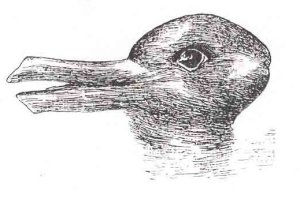
The duck-rabbit illusion: in Kuhn’s view, a paradigm shift is a change of perception rather than a cumulative process

3. Most problematic of all for scientists is Kuhn’s notion of ‘normal science‘. In his view, when a paradigm shift is not occurring, scientists are engaged in ‘normal research’, essentially dotting the is and crossing the ts of known knowledge. Indeed, this is how most of science is done, in Kuhn’s view.

I see this as a serious distortion of scientific practice. For starters, who knows when ‘extraordinary evidence’ is going to turn up? If scientists spent their time in the lab engaged in the collation of routine measurements, revolutions would never happen, because we would not be receptive to extraordinary evidence when it emerges. There is no such thing as ‘normal’ science for the good scientist; one takes equal care in all experiments, for the simple reason that we never know when surprising evidence will emerge. To divide science into arbitrary epochs of ‘normal’ and ‘revolutionary’ seems to me to be the worst sort of revisionism. Far more reasonable is the modern view: that all paradigms are temporary and it is the scientist’s job to test them to their limits. [To give a contemporary example, the Large Hadron Collider was NOT built to ‘find’ the Higgs boson: the LHC was built to investigate whether or not the Higgs particle exists at certain energies (among other things), a very different question. In other words, the paradigm (the Standard Model) may stand (normal science) or may fall (extraordinary science) – there is no telling until the measurement is made. That is why we’re doing the experiment!]

*******************************************************************

If the inconsistencies above are right – and I am not the only scientist to make such points – why is Kuhn’s book so famous ? Why so influential, if many scientists, even in Kuhn’s own discipline, consider it flawed? It’s worth pointing out that Kuhn’s work went on to form the bedrock of an entire discipline, the social study of science and technology.

Perhaps one answer is who it speaks to. The book is possibly the most widely-read science book ever; widely-read by a great many non-scientists, that is. Here is a dark thought: perhaps Kuhn’s view resonates with historians, social scientists and others, precisely because it resembles practice in their fields more than it does science. To put it baldly, is it popular with those in the humanities because it tells them what they like to hear? We are all scientists now.

But look at it this way. It takes years (5-6 min) to train a person to become a reliable experimentalist. That training is not trivial: it is about training the observer to observe as objectively as possible. Of course, science is a social activity, subject to human behaviour. But is this is a determining factor? Don’t scientists go out of their way to minimize social factors by rigorous training in the use of the scientific method? To paraphrase Churchill, it may not be perfectly objective but it is a damn sight more objective than the alternatives! Can an outsider understand the extent of this training if they are not trained in the method? How do all those non-scientists become such experts on the limitations of scientific knowledge?

Difficult questions. But it’s interesting that the most trenchant criticism of science often comes from those with almost no training in the area. (Many like to point out that Kuhn himself had a PhD in physics, not realising that, in science, this does not constitute an expert). Finally, Kuhn himself often claimed that he was widely misread and misunderstood. I find this a bit of a cop out; although some of his definitions are rather vague (famously, there is no clear definition of the scientific paradigm), the book is not at all ambiguous in its general thrust. In fact, it is all too clear and very repetitive. Like so many of the studies that were to follow, it takes a good idea and extends it to a radical extent, garnering much attention but alienating the very community that could have benefited from it.

The result? Scientists themselves pay very little attention to this book, or to much of the literature of science studies that followed, which is a great pity. This is the great danger of overstatement, in my view

Update

Below is Alex’s response to my comments on Kuhn above. Bear in mind that he knows a great deal more about this subject than I do!

[ Hi Cormac, my thoughts on the blog post, finally…! Thank you for coming to the lecture, and I’m glad it provoked such interesting thoughts. As you know, I’m no strict Kuhnian in any respect, and the lecture was meant to raise far more questions than it answers. Specifically:

1. Aristotle. I don’t think Kuhn was a relativist about Aristotle. I think his point on him was to say, “A. was really a good philosopher, and judging him as a modern physicist is the wrong thing for an historian to do.” Which I’m sure you find an entirely unproblematic statement. What’s interesting is that then people want to jump and take the next step and say, “so that means we should or shouldn’t acknowledge he’s right or wrong?” But Kuhn wouldn’t see it that way. In his later book, _The Essential Tension_, he more or less says, “look, you can’t be a good scientist and a good historian at the same time.” So when you’re judging Aristotle as an historian, you’re using a different standard than if you’re judging him as a physicist. If you look at Artistotle from a modern physicist point of view, the answer is clear: Aristotle is not a good physicist by modern standard for what that means. But Kuhn would say, “Who would say otherwise?” And he might also point out, though, that the standard for a “good physicist” has changed quite a bit over the years. (One of the reasons there is a profusion of amazing Jewish theoretical physicists in German in the first decades of the 20th century is because a “good physicist” in Germany was an experimentalist, and you wouldn’t want to let Jews into those good positions. So they did theoretical physics — and made it “good.”)

2. I agree that the Gestalt shift suggested by Kuhn is awfully unsupported by evidence. In some cases you can see it: the “canonical” revolutions (Copernican, Newtonian, Einsteinian, Darwinian). But it doesn’t very well capture the shifts that happen more frequently, which still don’t fall under the definition of “normal science.” Kuhn’s model is very all-or-nothing in my eyes: you’re either Normal or Revolutionary. It strikes me as a rather stark set of options, and one which does a particularly poor job of describing science after 1945. There *are* big changes in science after 1945, and I’m not sure I’d say they were all perfectly cumulative (because you’re by definition throwing out everything you’ve decided wasn’t cumulative, even though it was judged to be “good physics” at the time), but I do think it is more “cumulative looking” than the Normal/Revolutionary model.

3. I can see your resistance to the idea of Normal Science, but I’m not sure I agree with your reading of it. Kuhn emphasizes that Normal Science just means that you aren’t spending all day trying to find the Next Big Thing. People aren’t sitting around saying, “let’s throw out all of what we know and do something RADICAL.” They *do* occasionally do that, and Kuhn’s examples from quantum theory are maybe the best examples of that: you have people like Bohr and Heisenberg saying, “well, what if we just threw causality out of the window, and see what happens?” But that can’t be the day-to-day operation of science. For Kuhn, Normal Science is just trying to advance knowledge a tiny piece at a time, the kind of thing you see in NSF projects: “doable” results that will get you a tiny bit further in knowing how something works. It doesn’t mean you’re just re-running the same experiments all day long — it just means you aren’t re-examining the fundamentals of your theories at every moment.

Now it would be a very good question to ask whether current theoretical physics is in Normal or Revolutionary mode according to Kuhn. The String Theory people seem to fluctuate back and forth — there are little moments of stability, and then every few years some of those get completely up-ended. Furthermore, you misunderstand Kuhn if you take him to be using Normal Science as a way to criticize science. In fact, for Kuhn, Normal Science is the key to the reliability of science. It is “dogmatic” and “conservative” on the whole: it requires extraordinary evidence before it decides to unseat its theories, it doggedly avoids flights of fancy. He would compare this (perhaps unfairly) to, say, Literary Theory, which has a new “turn” every decade or so, and lacks any real foundation other than the whimsy of whomever runs the big departments at any given time. The fact that the “hard sciences” don’t change their fundamental theories very often is exactly what makes them so compelling as truth-machines. Their conservatism is their strength. This is actually a very radical aspect of Kuhn that makes him quite different from what most of the social studies of science people interpreted him to be saying.

(I’ll be talking about this some more next Monday, when we discuss Feyerabend, who takes the entirely opposite point of view regarding knowledge. Feyerabend’s truly “anarchistic” view of knowledge makes one long for the “dogmatism” of Kuhn!)

As for the broader question of why Kuhn is popular, I’m not sure it’s always because it is destabilizing or relativistic. There’s some of that, to be sure. But I do think it’s mostly because he manages to frame these kinds of questions in ways that most people, even those who don’t know or care about science, can understand and respond to. He provides a sort of synthetic whole that we can then play with and modify and adapt to our own anecdotes.

That doesn’t mean it is “right” — but it might be “useful.” I think Kuhn does provide an alternative, however vague, to the linear model of scientific progress. Should we be looking for alternatives to that model? I’m sure you and I probably would not agree on that, in any case… :-)  I think the linear model, depending on how it is used, can be extremely misleading. I don’t think Kuhn is really right but he highlights some interesting things. I like the idea of Normal Science, though I don’t see it as a transcendent, “real” category. Anyway — this is a big question (if you don’t have the linear model, what do you have?), one that we’ll be really pushing at over the run of the entire course. I don’t claim to know the right answer here, but certain models feel more plausible to me than others.

Best,
Alex ]
10 Comments

Filed under History and philosophy of science

Genius of Britain; Dawkins vs Hawking

This week Channel 4 have been running a superb series on British science and scientists, from the 17th century up to the present. It was a beautifully produced, meticulous piece of television, with mini-biographies of British scientists down through the ages, narrated by well-known scientists such as Stephen Hawking, Richard Dawkins, Jim Al-Khalili and David Attenborough.

Each night covered a different century, with scientists like Hooke, Wren, Boyle, Halley and Newton in the first episode,  and Crick, Watson, Hoyle (with a link to Hawking’s work)  and Hamilton (with a link to Dawkin’s work) in the last. In between, one got to hear about other great, less-recognized scientists, such as Watt, Maxwell, Rutherford and Turing.

All in all, it was a superb series, truly inspirational, with a great balance between the sciences. I thought the chronological approach worked really well in general. Of course, the nationalistic angle made nonsense of the story at times; one kept wondering why a crucial step was left out, then you remembered that this was not the story of science, but of British science; a strange angle from a scientist’s point of view.

This might explain a few flaws here and there; for example, I thought the discussion of Fred Hoyle quite odd. Instead of discussing Hoyle’s major contribution to cosmology ( the carbon step in nucleosynthesis), narrator Jim Al -Khalili concentrated on Hoyle’s ‘steady-state’ theory of the universe. This reverence for Hoyle’s theory is baffling to non-British scientists; steady-state made very little impact in the world of science outside of Britain (despite huge media interest in Britain) and proved to be comprehensively at variance with the evidence.

In the last part of the program, Richard Dawkins made the point that science is not undamentally about math, or experiments, but about asking questions. There ensued a fascinating short discussion between Dawkins and Hawking on the big questions.

Richard Dawkins  and Stephen Hawking in conversation

What really happened before the Bang?” Dawkins asked Hawking.  Hawking gave the standard, simple response – there is no before because time is part of the universe, as predicted by general relativity (he seemed surprised by the question, as was I).

Hawking had a far harder question for Dawkins:

“Why are you obsessed with God?” It is exactly what I would have asked, but Dawkins seemed quite taken aback by the question. He responded initially by claiming that Stephen had brought up the question first, with his famous last line of A Brief History of Time (‘..for then we shall know the mind of God’), which isn’t much of an answer. However, Richard then said that his main problem with religion is that religious explanations for nature are a distraction from the real path of finding out have things work.. fair comment!

Update

It seems a book based on the series is already available..more on the series here

The Irish Times reviewed the series in their weekend review; sadly, it wasn’t a very good piece, focusing almost exclusively on the fact that Robert Boyle was Irish not British. A fair point, but where was the rest of the review?

8 Comments

Filed under History and philosophy of science

Introductory physics: heat and temperature

The teaching semester began again at 9.15 this morning. First day back, I’m always struck by how much I enjoy being in the classroom. I think it’s because lecturing is basically a performance, with never a dull moment; anything can go wrong and usually does! I also quite like big classes, it makes for a good atmosphere…

Then there’s the content. This morning 1st Science got to meet Heat and Temperature for the first time. This is my favourite kind of topic – quite simple but of fundamental importance. ‘Heat is a form of energy’, we tell our students, and ‘temperature is a measure of heat’. Actually, the discovery that heat is simply a form of energy was an enormous advance in science, possibly the greatest breakthough of 19th century physics.

And what sort of energy is it? Well, kinetic energy arises due to the motion of molecules (vibration in solids). But there is also potential energy;  since atoms in solids have more-or-less fixed positions in the lattice they have must possess an associated potential energy (so do atoms in liquids for a slightly more subtle reason). So heat is basically a type of internal energy. Except that it’s not always internal; there is also the whole business of heat transfer, a phenomenon that can occur by any or all of three very different mechanisms!

Then there is temperature; a philosopher would have a field day explaining the difference between a quantity that simply is (energy), it’s manifestation (temperature) and human temperature scales. Indeed, the relation between heat and temperature was only quantified with the intoduction of concepts such as specific heat capacity and specific latent heat. Temperature clearly has a fundamental aspect too; for example, what do really mean by absolute zero (or zero Kelvin)? ‘Absolute zero is the temperature at which all molecular motion ceases’, students are told. But what does this mean? Why can’t we reproduce this temperature in the lab? Is -30 Kelvin ( or -303 degrees Celcius) really a nonsense? Fundamental stuff indeed and a nice start to the term…

Achieving the impossible in the lab

Update:

Oops! I thought the dial read zero on the LHS but it doesn’t of course. Also, I’m not sure why it reads degrees Kelvin, there is no such thing.

2 Comments

Filed under History and philosophy of science, Introductory physics, Teaching, Third level

The last Darwin lecture and the real ‘Origin of Species’

College finished on Friday with what must have been one of the last of this year’s Darwin lectures. (In case you’ve been living in a cave, 2009 was the 150th anniversary of the publication of Darwin’s ‘On the Origin of Species’ and there have been events all over the world to mark the occasion). I caught a few excellent talks on Darwin at the Faraday Institute in Cambridge last summer (see posts here) but it was good to hear one in our own college; ‘The Life and Legacy of Charles Darwin’ by Eoin Gill of WIT’s CALMAST centre for the communication of science. This was a short, informal lunchtime talk but it covered all the main points:

– the life and work of Erasmus Darwin (Charles’s grandfather) including his ideas on evolution

– Charles’s family background, his early career at Cambridge and the influence of Rev Henslow

– the famous Beagle voyage with Capt Fitzroy and the emergence of Darwin the collector

– the return to Britain and the finch exhibition

– the slow dawning of the theory of naural selection

– family tragedies and the long quiet

– the letter from Wallace and the advice of friends at the Royal Society to publish simultaneously

– the publication of the book, the effect on society and the Huxely/Wilberforce debate

– modern genetics and further support for natural selection

You can view the slides from Eoin’s talk here.

Sadly, resistance to the theory of evolution by natural selection remains as strong as ever in some parts of the world, despite the overwhelming supporting evidence for the theory. As Richard Dawkins points out, it seems that those who insist on a literal reading of the Bible cannot and will not be dissuaded by scientific evidence contrary to their views. I heard a lot on this point last summer at the Faraday Institute in Cambridge, it was interesting to hear eminent theologians crticizing creationism just as much as scientists.

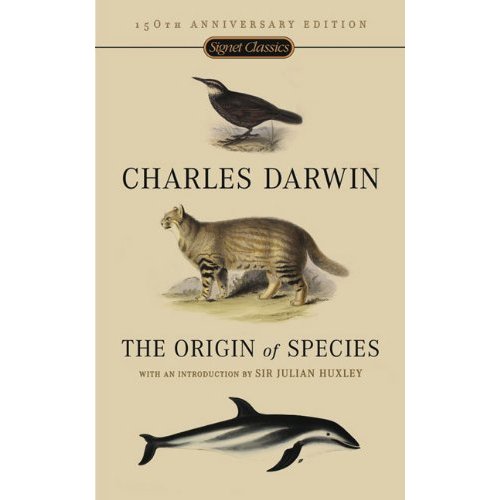
Just this week, a curious book was circulated in our own college – an abridged version of ‘On the Origin of Species’ published by creationist group ‘Living Waters Ministries’ that omits several chapters of the original and includes a bizarre religious introduction that attacks Darwin. Sigh…

The Living Waters version …I prefer the original

Comments Off on The last Darwin lecture and the real ‘Origin of Species’

Filed under History and philosophy of science, Science and society

Einstein, de Valera and the Institutes for Advanced Study

Is there a collective noun for a roomful of professors? A great many of the most senior figures of Irish academia turned up in Trinity College Dublin on Saturday night to hear the annual statutory lecture of the School of Theoretical Physics of the Dublin Institute of Advanced Studies.

The lecture, titled “No excuses in paradise: the past, present and future of the institutes for advanced studies” (see poster here) was a fascinating talk on the history and purpose of the Institutes for Advanced Study at Princeton, Dublin, Paris and elsewhere. It was given by Professor Peter Goddard, the current director of the famous Institute for Advanced Study at Princeton in the US. This institute, one of the most prestigious research centres in the world, has hosted staff such as Einstein, Godel, Oppenheimer, Freeman Dyson and Ed Witten and became the prototype for similar institutes around the world. Peter Goddard himself is extremely well-known as one of the early pioneers of string theory.

The  speaker started by tracing the initial idea by the American educationalist Abraham Flexner in the 1920s to seek funding for an Institute of Advanced Study in the US that could compete with research centres in Germany such as that in Gottingen. The plan was to create an elite American ‘graduate university’ –  a university that did not teach at undergraduate level but focused on research and on the training of researchers. Of course such an institute could only be staffed by the best of the best, and Einstein, already a world figure in science, was approached on one of his periodic visits to Caltech. Worried about the rise of the Nazis, Einstein quickly agreed. You can read more about this story here, but Prof Goddard showed a wonderful slide showing the famous issue of the New York Times with the headline: ‘Einstein to set up new school’.

Einstein in his office at IAS

The speaker then explained how during the war the Irish premier Eamon de Valera, a former mathematician, decided a similar institute would be of benefit in Ireland. Due to economic constraints, it was settled that the institute would deal with theoretical physics (as there were great advances being made in this field and it required no expensive equipment) and with Celtic studies (also not very expensive and of national interest). On the advice of Einstein, de Valera approached Schroedinger, the father of wave mechanics, to persuade him to come to Ireland to direct the institute.

This part of the story was well-known to an Irish audience but the speaker gave a very nice sketch of the history – Schroedinger did come in 1940 and spent many years at the Dublin IAS, followed by other prestigious theoreticians such as Heitler, Lanzcos and Synge. The institute became a great success internationally, attracting regular visits by famous physicists such as Paul Dirac. Indeed, some nice slides concerning Dirac’s visits were shown, not least a menu demonstrating the attraction of Ireland during wartime. Another slide showed a comment by Dirac, expressing surprise that the Irish Prime Minister had time to sit through a whole mathematics conference! All in all, it was a lovely overview of the history of the Dublin IAS and included a nice reference to Lochlainn’s work (it turns out Goddard collaborated quite a bit with Lochlainn in the early days of supersymmetry) .

Nobel laureates Dirac, Heisenberg and Schrodinger in Sweden

The speaker then explained how the American idea was imported back to continental Europe, notably at IHES in Bures-sur-Yvette just outside Paris (set up in 1958). This institute is also highly regarded in the world of academia, thanks to the work of mathematicians such as Alain Connes and the late Louis Michel. There are also informal links between the institutes – many of the professors in the audience had spent time at more than one (in my own family we have fond memories of years spent at both the Princeton and Paris institutes as well as Dublin).

The lecture finished with a brief discussion of the role of such research institutes. In a world dominated by the technological application of science, it is sometimes hard to persuade people of the importance of enquiry for it’s own sake – ‘the usefulness of useless knowledge’. Of course, one answer to this is that we don’t know which part of scientific enquiry will prove technologically useful (look at Boolean algebra or the development of the web at CERN). However, a deeper answer is that knowledge and the pursuit of knowledge will always be important for their own sake. The professor summed up with the best quote of the night: ‘the thing about a scholar’s paradise is that there are no excuses for failing to do something important!’

So have the institutes been a success overall and should they continue? As a student, I often heard certain university staff mutter darkly that precious little work went on there – however such comments rarely came from staff at the highest levels. It’s worth noting that Saturday’s speaker was introduced by Professor Samson Shatashvili, the well-known string theorist who directs the Hamilton Mathematics Institute , a research institute that functions within Trinity College. Prof Goddard didn’t compare the role of such institutes with the institutes for advanced study directly, but I think his historical account demonstrated that the latter still have an important role to play. As regards the Dublin IAS, I should have said that the lecture above took place in the middle of a conference to celebrate the 60th birthday of Professor Werner Nahm, a noted theorist at the Dublin IAS. A measure of the stature of Werner, and of the continuing prestige of DIAS, can be seen from the list of speakers in the conference program here. Another indication of the continuing success of DIAS was the preponderance of well-known international figures on Saturday night such as Shatashvili, Nahm, Goddard and Frohlich – not to mention the mathematician Micheal Atiyah and a quiet man in the back row who I later realised was Peter Higgs (yes, he of the elusive boson).

The school of theoretical physics (DIAS) on Burlington  Road

2 Comments

Filed under History and philosophy of science, Public lectures

Faraday Institute summer school

I spent all of last week at a summer school on science, philosophy and religion hosted by the Faraday Institute of St Edmund’s College, Cambridge. I found the course absolutely excellent and have tried to summarize most of the talks on a daily basis as the conference progressed (see last four posts below). You can also find a list of speakers and talks on the conference website .

All that is left to do is to make a few general observations. I found the school quite exceptional, a real treat for anyone with an interest in the history and philosophy of science, and its impact on religion (and vice versa). A different topic was tackled each day, from historical and philosophical interactions between science and religion on Tuesday to Big Bang cosmology on Wednesday, from the theory of evolution on Thursday to ethical challenges in contemporary science on Friday.  Each day would begin with an introductory overview of the basic science (or history), followed by talks on slightly more specific subjects. Each talk would finish by exploring the philosophical and theological implications of the science.

All the speakers kept good time, leaving 30 minutes of question/answer session after each talk. This definitely made for good audience participation. This was followed by a panel discussion every evening on questions raised during the day.

Note: videos of the talks will be available on the multipage  multimedia page of the Faraday website from mid-September only, apologies for misinformation in earlier posts.

St Edmund’s college, Cambridge

Other reasons for the success of the conference were

1. Fantastic environment; it’s hard to beat Cambridge on this, especially with everyone staying in the same college

2. All the talks were in the same venue, a nice small conference room that holds about 50.

3. Interdisciplinary nature; since the subject matter spanned science, history of science, philosophy and theology, none of the talks were too specialised, the bugbear of most scientific conferences

4. All the talks were by world-class researchers, well used to giving public talks on their subject – a treat for anyone interested in the communication of science.

5. No parallel sessions; since everyone was at the same talk, it made for great discussions over dinner.

Coffee time outside the conference room

A number of my colleagues have expressed reservations about the course, pointing out that it is funded by the Templeton Foundation. All I can say is that all of the speakers presented the science or history in an unbiased way. The week was a treat in the history and philosophy of science, even for those with no interest in religion. That said, it was fascinating hearing renowned theologians criticizing the fundalmentalist positions taken by some religions (and atheists). No-one can demolish the Intelligent Design argument quite as comprehensively as an eminent theologian! Another good example of the impartiality of the conference can be seen in the fact that the scientific work of Richard Dawkins was cited on several occasions and two of his books were on sale  on the conference table..

Update

Speak of the devil! About 10 minutes after writing the above, I walked right past Richard Dawkins himself. He was walking up the back drive into Clare College just as I was wandering out. I wonder if he is giving a talk here in Cambridge? I was dying to ask, but he looked a bit tired and had luggage with him. Possibly not a good moment for questions from random strangers..

8 Comments

Filed under History and philosophy of science

Last day at Cambridge conference

Today was the last day of the Faraday Institute summer school (see posts below) and it was devoted to ethical challenges in contemporary science.

The day started with an excellent overview of the whole area of ethics by Dr Cherryl Hunt of the University of Exeter. Dr Hunt set the stage for the day by explaining concepts such as ethical relativism, ethical objectivism and ethical absolutism. She then went on to discuss the differences between naturalistic, utilitarian and deontological positions in an ethical context.

Dr Cherryl Hunt on ethics

Commenting on why ethic challenges are often involved the biological sciences in particular, Dr Hunt explained that the biosciences tend to throw up interesting questions such as

– human improvement: do we need it?

– the mixing of animal and human genes; should we do it?

– genetically modifying plants and animals: is it dangerous?

Dr Hunt  addressed each of these in turn. She also discussed another dilemma, the ethics of environmental challenges. Going over the different positions of many religions, she contrasted the ‘dominion over the earth’ viepoint with that of the ‘stewardship of the natural world’.  This was a fascinating talk and you should be able to get the slides and video on the Faraday Institute website in a few days.

The second talk, given by Prof Keith Fox, Professor of Biochemistry at the University of Southampton, dealt with the specific topic of ‘Genetic engineering: How Far Should We Go?’

Keith started with a great overview of  DNA, genes and genetic code, making some simple points :

– the same copy of DNA exists in every cell

– genes make up 2% of DNA

– the genetic code is universal

– there is no such thing as a human gene

– all life clearly arises from a single source

This was followed by a quick review of landmarks in modern genetics such as recombinant DNA (1972), transfer into E-coli (1973), first genetically modified animals (1976), first genetically modified plants (1983) etc. Then followed a detailed discussion of animal-animal and human-animal gene transfer. I won’t give details, but I particularly enjoyed a discussion of GM foods. A familiar issue here is the pubic misunderstanding of science: the public distrust of GM foods is in marked contrast to the scientific consensus, making it very difficult for GM technology to progess.

Dr Keith Fox on the podium

After lunch, we were treated to a very different sort of lecture:, a lecture on the nature of personhood and the ethical challenges raised by medical technology, given by Professor John Wyatt, Professor of Neonatalogy at University College Hospital London.

Prof Wyatt started with a wonderful slide, a picture of a tiny, prematurely-born baby hooked up to an astonishing number of tubes in ICU at his hospital. Having brought the audience to the human side of things he gave a few interesting statistics:

– about 50% of such babies will be absolutely normal

– about 20% suffer severe mental and physical difficulties

– society values such lives, given the investment in medical treatment

On the other hand, Prof Wyatt explained that, in the same hospital , many parents are offered the option of abortion for babies with handicaps or deformities. In particular, about  90% of unborn babies with Down’s Syndrome are aborted, a truly shocking statistic. Given that it is often the same doctors, you can see the ethical maelstrom. This issue is set to get worse, with the onset of pre-natal tests which may give a full analysis of the DNA of unborn child..

There followed a detailed discussion of the nature of personhood, starting with the views of the philosopher Peter Singer. Dr Wyatt showed the weaknesses of the Singer position by considering examples from brain-damaged adults to dementia. He also emphasised the issue of dependence – how it is intrinsically human to be dependent, from the youngest infant to the oldest person-our natural condition far from an abherration.( ‘We are designed to be burdens!) This was an outstanding talk but I won’t attempt to summarize it further..you can see the video on the conference website or go and buy his book!

The last talk of the day was another talk by Dr Cherryl Hunt (see above), this time on the particular subject of the ethics of stem cell research. Starting with simple definitions such as totipotent cells (can make all cell types, can grow into embryo), pluripotent cells (can make many cell types  but can’t grow embryos) and multipotent cells (can make few cell types), Dr Hunt explained the huge advantages of embryonic stem cells. She went on to describe the ethical challenges concerning the use of these cells, contrasting the utilitarian to deontological viewpoints discussed this morning.

I won’t give a proper review here, but in the discussion afterwards, I was struck by the common sense approach adopted by the speaker and most of the audience, representatives of many religions and none. Essentially, many felt that the fact that nature disposes of about 80% of fertilized eggs for a variety of reasons implies that we should probably not be too absolute in our view of the status of embryonic stem cells. There was also the issue of spares: in IVF, unused embronic cells are routinely disposed of, so  is it not better to use them for the good of mankind?

That was the last talk of the conference; again a recording will soon be available on the Faraday website. As on other days, the day’s presentations were followed by a plenary panel discussion of questions raised by the talks. Overall, this was a fantastic week of highly interesting talks, see review tomorrow. Right now, it’s time for the conference dinner at High Table!

Note: videos of the talks will be available on the multipage  multimedia page of the Faraday website from mid-September only, apologies for misinformation in earlier posts.

2 Comments

Filed under History and philosophy of science

Evolution at Cambridge

Today was evolution day at the Faraday summer school (see posts below), with a number of fascinating talks on the theory of evolution.

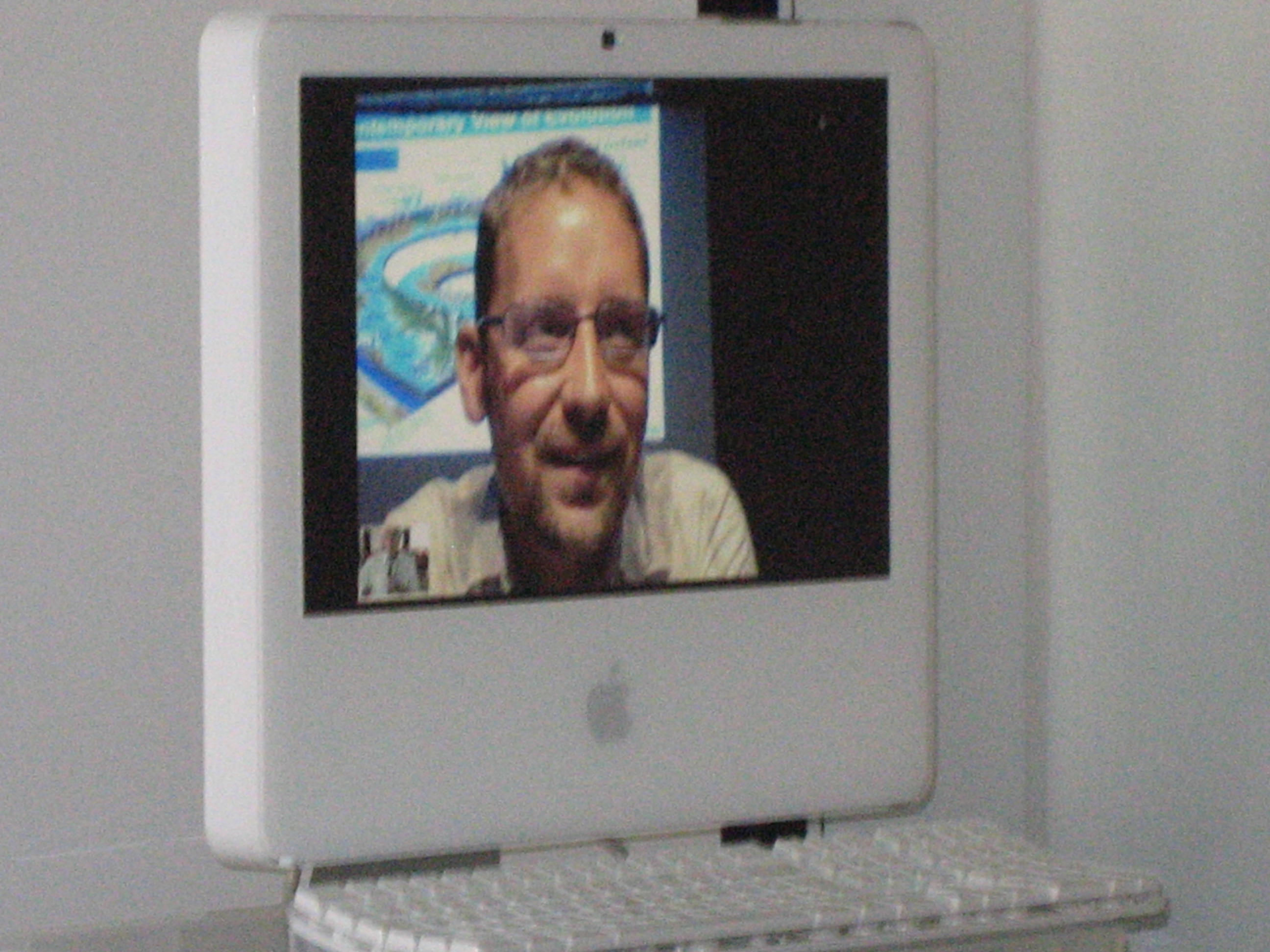
First up was Professor Stephen Freeland of the University of Maryland. An interesting aspect of Stephen’s talk was that it was delivered in realtime (by Skype) from Hawaii! With his slides projected on the conference screen and his voice and image on a nearby computer, one quickly forgot he was not actually in the room.

Stephen’s first talk was a super overview of the modern status of the theory of evolution by natural selection, explaining how advances in microbiology and genetics have strengthened and deepened the theory. One interesting aspect of this talk was Stephen’s belief in the fallacy of human supremacy: he sees humans as far from the top of the chain of life,  as often depicted. Indeed, he showed that a great deal of the common portrayal of man at the pinnacle of the evolutionary tree really arises from pre-Darwinian theory!

Stephen also gave a talk on astrobiology, the study of life on other planets. Much of astrobiology is concerned with the study of the emergence of life in the earliest years of earth, but there was a fascinating overview of the factors need for life elsewhere. I particularly enjoyed his discussion of attempts to quantify the Drake equation, an equation that attempts to describe the probability of there being intelligent life on other planets (more on this later).

Denis Alexander in conversation with Stephen Freeland

Next up was a fascinating talk by Simon Conway Morris on ‘Evolution and the Inevitability of Man’. This was a superb overview of the theory of convergence in evolution, a theory Simon has pioneered. Essentially, it concerns the fact that many complex organs such as the camera eye have evolved not once, but several times. Simon went on to explain why he evolutionary convergence may render the emergence of intelligent life not just likely but inevitable, and sees the evolution of intelligent life as an ultimate and inevitable result of the process, in marked contrast with the previous speaker.

This was followed by a superb talk by Keith Fox, Professor of Biochemistry at Southampton University on ‘Creation and Evolution’. Essentially, Professor Fox gave a detailed exposure of scientific flaws in young earth creationism, and in intelligent design. He finished with a description of theistic evolution. In a way, this talk was the most archetypal of the week – a careful rebuttal of the literal positions of fundamentalists by a highly educated scientist and theologian.

The final talk of the day was a salutary lesson in biblical studies by Dr Ernest Lucas. Dr Lucas gave an outline of the challenge for interpreters of any text: when does one need a literal interpretation and when does one need a figurative one?  These are normally decided on factors such as

What kind of language is used in the text?

What kind of literature?

What kind of audience?

What is the purpose of the text?

There followed a detailed discussion of the interpretation of the Book of Genesis, with Dr Lucas concluding that a figurative rather than literal interpretation is clearly called for.  Again, this was a strong attack on fundamentalism by a renowned theologian, absolutely fascinating.

The day finished with a planary question-and-answer session chaired by Dr Denis Alexander, with Stephen participating by Skype link. Again, I was astonished how well it worked.

Simon, Stephen and Dennis in panel discussion

4 Comments

Filed under History and philosophy of science

Cosmology day at Cambridge

Today was cosmology day at the Faraday conference (see above). Due to a mishap in scheduled speakers, course director Rodney Holder gave an impromptu talk on ‘God, the multiverse and everything’. Essentially, this was two talks: an introduction to Big Bang theory, inflation and the multiverse, followed by a discourse on the philosophical and theological implications of the multiverse model. It was a super overview and highlighted many of the limitations of the proposition of the multiverse.

That said, it must be remembered that the mutiverse model is at a very early stage of development (indeed, it seemed to me that a separate introductory talk on the status of inflation and the mutiverse might have been helpful for non-physicists in the audience). You can find Rodney’s excellent book on the subject here

Rodney’s talk was followed by a presentation by the renowned Irish philosopher Ernan McMullin on ‘Fine tuning and the ‘The anthropic principle’. This was an excellent talk which I won’t attempt to summarize (it will be soon be available on the Faraday website). It culminated in an outline of 4 main explanations for fine tuning

1.Chance

2. Almost all fine-tuning constants found to be related by future theories (bearing in mind that we know GR and qt are incomplete)

3. Anthropic argument

4. Arguments from natural theology

Ernan in full flight

Later in the day, we had a fascinating talk on ‘Habitable exoplanets and the implications for human significance’ by Jennifer Wiseman, director of the search for exo-planets at NASA. This was a super overview of the methods of the search for earth-like planets orbiting suns, either our own or in other solar systems and the recent successes. The talk finished with a brief overview of the philosophical implications of the discovery of life on other planets.

This was a fascinating talk, but I can’t help thinking that there is a fundamental paradox here: given the size of the universe, it may well be that there are lots of planets in the right zones, all teeming with life – but we will probably not find them, due to the same size of the universe! Jennifer answered this by pointing out that the rate of discovery is very exciting – just think of the excitement if we did find one in the right zone and it did have life!

As ever, the day finished with panel discussion, where the speakers answered a variety of questions based on all the talks.

Comments Off on Cosmology day at Cambridge

Filed under History and philosophy of science