Tag Archives: Particle physics

MIT, the LHC and a royal wedding

It’s always a pleasure to pop over to MIT for the afternoon, and on Friday I attended a seminar titled ‘MIT and the World’s Largest Science Experiment: Hunting the Higgs Boson”, given by Markus Klute, Assitant Professor of Physics at MIT and member of the CMS (compact muon solenoid) collaboration at CERN. It seems MIT has quite a big involvement with the LHC, with a large group working at the CMS detector and a smaller group at ATLAS; about 40 researchers overall.

MIT and the World’s Largest Experiment: Hunting the Higgs Boson

The talk was aimed at a wide audience, and much of it was a fairly standard introduction to particle physics and the experiments at the Large Hadron Collider. I always try and attend such talks whenever I can, partly to pick up any new information but also to see how the real players present the story.

Starting with a review of the nucleus and its particles, Markus gave a succinct overview of the Standard Model. I liked the way he linked the theory to today’s news; in describing the way particles are believed acquire mass (the Higgs mechanism), he invited the audience to imagine Charles and Kate entering the auditorium, how people would interact (i.e. cluster around them) to different degrees, thus acquiring different masses. This is a nice twist to a common analogy and it never hurts to connect with current events. (Being Irish, I’d be a neutrino with almost zero interaction, though I wish the couple well).

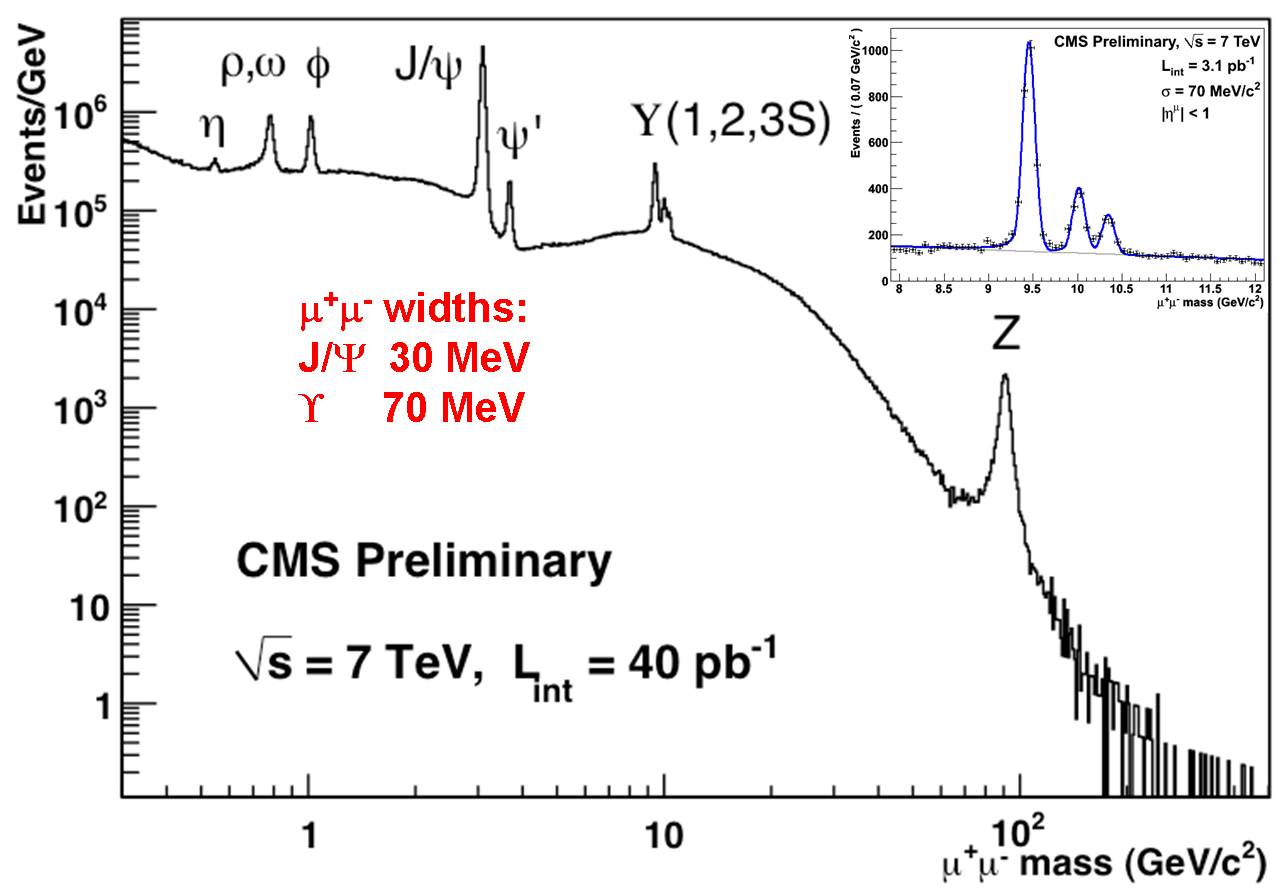
Professor Klute then gave a nice overview of the four main detectors at the LHC, and then some details about his group’s contribution to the CMS experiment, particularly in the area of building the tracking system. I won’t repeat the details but you can find a good review of US involvement at the CMS detector here. I particularly enjoyed the emphasis on the ‘rediscovery’ of the particles of the Standard Model at CMS, beautifully summarized in the plot below. I think particle physicists should emphasize this chart more, it gives great confidence in the methods of particle physics (and shows how sociologists such as Shapin and Schaffer underestimate the reproducibility of big science experiments, see ‘Leviathan and the Air Pump’).

Summary chart of particles rediscovered at CMS

I liked the speaker’s simple description of particle detectors: a camera with a hundred million pixels and a shutter speed of 400 million times per second – not to mention the filtering. He also placed great emphasis on the computing challenges thrown up by the data, giving a nice overview of the Worldwide LHC Computing Grid. I also liked the way he described particle physics experiments  in terms of four components: accelerators, detectors,  computing and people!

Finally, there was a nice overview of the challenge of the hunt for the Higgs, explaining that

– it is rarely produced

– decays almost immediately

– its mass is not known, hence neither are the main production or decay channels

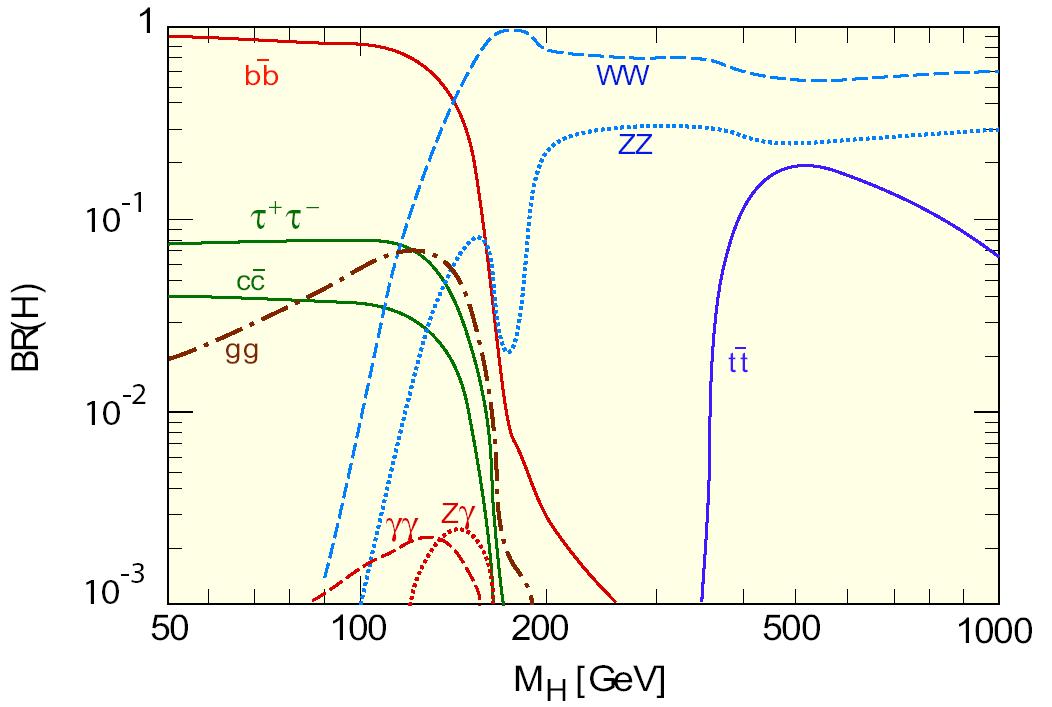
Professor Klute then gave a very quick review of the main production and decay channels for the Higgs and explained how CMS will look for them.

Higgs production via gluon fusion; a dominant process for a range of mass

The decay channel depends on the Higgs mass

Another nice plot was a summary slide showing the masses already ruled out by previous accelerator experiments.

The window is closing

Finally, the speaker gave a quick synopsis of the possibility of observing physics beyond the Standard Model, concentrating on the possibility of the detection of supersymmetric  particles, in particular the possibility of supersymmetric Higgses. After questions and answers, there was a poster session and reception, with some very impressive posters by MIT postgrads at CMS.

All in all, a very enjoyable LHC talk with a useful description of US participation in the project. If you want to more about this, the US LHC blog is well worth following.

Update

Markus points out I said Charles and Kate instead of William! This is such a whopping error (of planetary magnitude) I think I’ll leave it. Re Higgs production and decay channels, there is an really nice overview here by a group at Imperial College also involved with the CMS experiment. This week there was a big meeting at Notre Dame concerning US participants in the CMS experiment, you can link to it here

8 Comments

Filed under Particle physics

Heuer at Harvard

Rolf Heuer, the Director General of CERN, gave a talk on the Large Hadron Collider at the weekly physics colloqium at Harvard this week. The talk, “The Large Hadron Collider: Entering a New Era of Fundamental Science“, was aimed primarily at undergraduates and postgraduates in the physics department and it certainly lived up to expectation.

Professor Rolf-Dieter Heuer

The talk was roughly structured in 4 parts:

– a brief introduction to quarks and the standard model of particle physics

– a brief description of the LHC experiment; the four main detectors and their main purposes

– a brief review of results so far: luminosity successes, top quark production, quark gluon plasma using heavy-ion collision etc

– a  brief overview of possible new territory; from the Higgs boson to physics beyond the Standard Model (supersymmetric particles  etc)

What struck me most was the speaker’s emphasis on the link between the world of the sub-atomic and the universe at large. From the very first slide, Prof Heuer explained the symbiosis between particle physics, astrophysics and cosmology, pointing out that the Standard Model of particle physics addresses just 5% of the the universe (since it is now thought that dark matter and dark energy make up the rest). This theme came up many times and is indicative of how much has changed in the world of particle physics in the last few decades. Another major theme was how the individual detectors overlap and complement one another, giving a result that is greater than the sum of its parts.

The big news is that due to its excellent performance to date, the LHC is to run through until the end of 2012 (and not to go into a long technical upgrade at the end of 2011 as perviously planned). This means there will be enough data collected (albeit at 7 TeV) that some exciting new physics may have been discovered by 2013.  This is very good news for particle physics, given that the Tevatron is due to cease operations in September.

Schematic of the four main detectors of the LHC

Overview of the 27-km LHC ring

Heuer also introduced a historical perspective, pointing out that this year is the centenary of the Rutherford’s discovery of the atomic nucleus, the first public announcement of this I’ve heard so far. There was also a reference to the fact that 2011 is also the centenary of the discovery of superconductivity, without which the LHC would not be possible (superconducting materials are used in the giant magnets that guide the proton beams in the LHC).  On the experiments, I particularly liked that he payed special attention to the LHCb experiment; although it is on a much smaller scale than ATLAS and ALICE, this is my favourite of the four detectors, because of the connection with antimatter (LHCb will seek to answer why matter predominates in our universe by probing the asymmetry between matter and antimatter decay in beauty quarks, see website here or a nice blogpost on it here). It is also the only major CERN experiment that has an Irish connection, see here.

Event display of a pp collision in the LHCb detector producing two b-hadrons.

Some quotes I really liked were

We know everything about the Higgs boson, except whether it exists”

Within the next 2 years, we will have found a Higgs boson between 114 and 200 GeV, or ruled it out”

“Ruling things out is important, but we hope to have some discoveries too” (on supersymmetry)

At question time afterward, questions were deftly handled, with clear and succinct answers. I asked a question on dark energy; what did Prof Heuer have in mind when he said he hoped that LHC experiments could shed light on dark energy? His answer was that if the Higgs boson is found, it will be the first scalar boson observed (the W and Z bosons are vector bosons). Hence the idea of  a scalar field, required by cosmologists for dark energy, while not the same field, becomes more tangible. On string theory, he declined to dismiss the theory as philosophy (as suggested by someone in the audience), pointing out that the detection of supersymmetric particles at the LHC could offer some support for ST.

All in all, it was a great talk, pitched at exactly the right level for students and really conveying the excitement of discovery. I was slightly surprised the speaker didn’t call more attention to the international aspect of CERN, that an inter-european project involving a motley collection of sparring nations has emerged as the world’s premier centre for experimental particle physics (perhaps he was being polite). Just as the detectors complement one another and offer a result that is greater than the sum of its parts, so can genuine co-operation of individual nations working in harmony (and all the more reason for Ireland to join, as I have said many times in public and in the press).

7 Comments

Filed under Particle physics

The sound of music at the LHC

The BBC have a great story about a new way of searching for the Higgs boson (or God particle) using sonic modelling; each layer of energy in a particle detector is represented by a note and their pitch is different depending on the amount of energy that is deposited in that layer. By analyzing the resulting sounds, it’s possible that physicists may be able to pick out the Higgs particle by “listening to the data”. You can hear a sample of what the Higgs might sound like on the BBC website.

Simulated collision event producing a Higgs boson

Richard Dobson, a composer involved with the project, says he is struck at how musical the products of the collisions sound – “We can hear clear structures in the sound, almost as if they had been composed. They seem to tell a little story all to themselves. They’re so dynamic and shifting all the time, it does sound like a lot of the music that you hear in contemporary composition”.

Actually, that doesn’t surprise me . Most good music is pleasant to the ear because of internal symmetries. Given that our understanding of particle physics is founded on elegant mathematical symmetries, it’s not surprising that if you translate particle masses and energies into sound you get pleasing sounds!

Best of all, this might offer another way to seach for brand new particles  – I wonder what supersymmetric particles would sound like?

Update

Musicians wanted – CERN, Switzerland

7 Comments

Filed under Particle physics

‘Black Holes, the Hadron Collider and the God Particle’

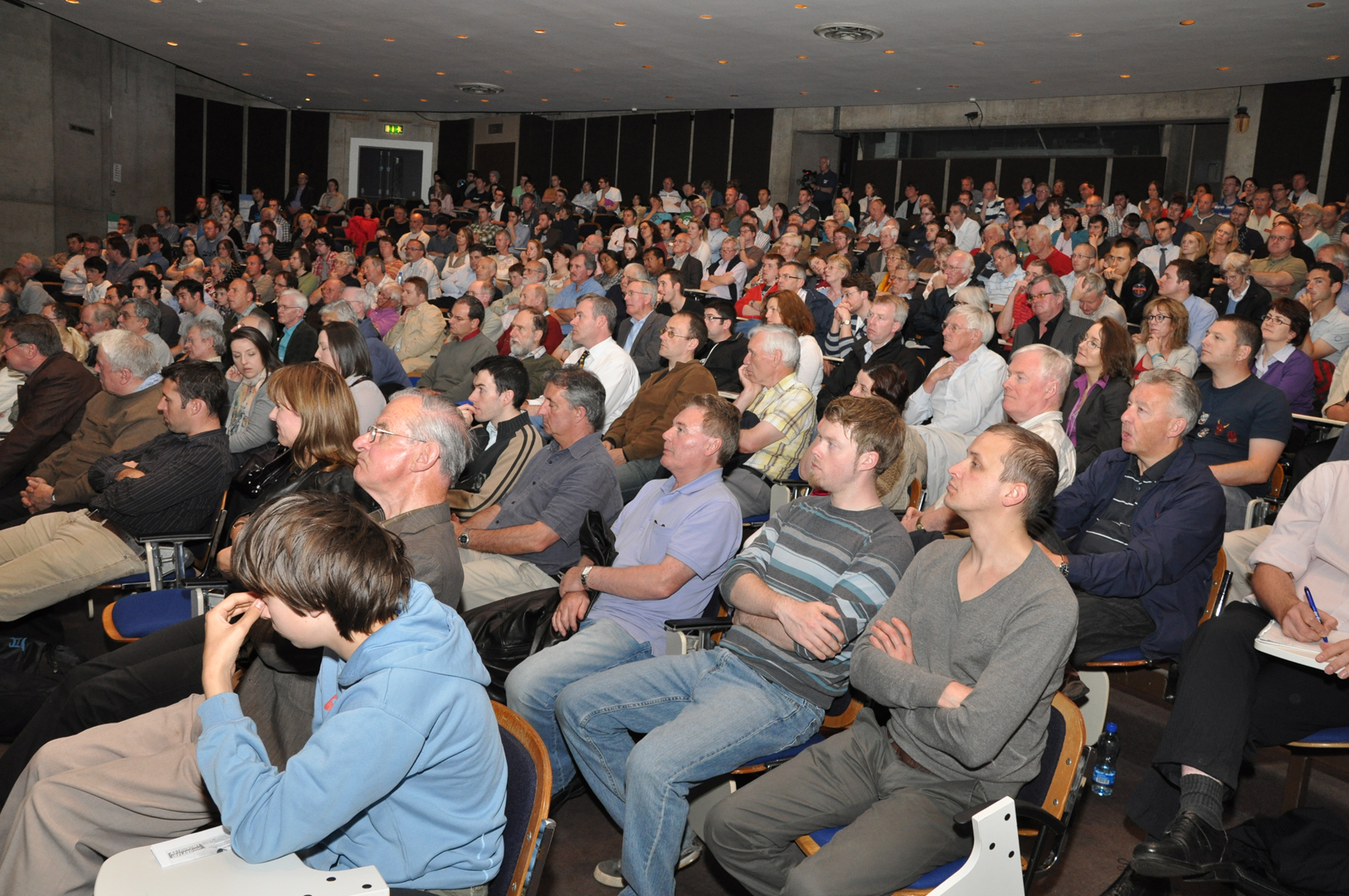
We got a massive turnout on Monday evening for a public lecture I gave on the Large Hadron Collider at Trinity College Dublin. I was invited to give the talk by Astronomy Ireland and it was a great time to give it as there is still plenty of interest in the Collider because of the black hole ‘controversy’, and because last week saw the first offical conference on results from the LHC. Indeed, there has been very little media attention given to the fact that, in the space of a few months,  all four detectors at the LHC have been busily rediscovering the elementary particles of the Standard Model that took so many years to first detect, from pions, muons and kaons right up to W and Z bosons.

A lot of physicists might have a problem with the populist title ‘Black holes, the Hadron Collider and the God particle’; however the title was worked out with Astronomy Ireland, an organisation that knows a thing or two about attracting a wide audience! Also, I think controversies such as the black hole controversy are best tackled head on i.e. by describing early on in the talk what a black hole is and why one doesn’t expect to create one at the LHC  (in particle physics, one gets only a minute amount of mass  from a very large amount of energy since  m = E/c2 ). I also touched on micro-black holes and Hawking radiation; overall I had the distinct feeling the audience enjoyed this part of the talk no end!

As for the term ‘God particle’, I happen to be one of the few physicists who likes this name for the Higgs boson. Yes, it was probably originally ‘that goddamn particle’ due to its elusiveness,  but I think ‘God particle’ neatly gets across the importance of the particle; after all it is the interaction of the other particles with the Higgs field that is thought to determine their mass, according to the Standard Model.

I divided the talk into three parts; first, an overview of the LHC – how, what, why etc. Then I devoted the central part to a brief history of particle physics, from the discovery of the nucleus to protons and neutrons, from the hypothesis of quarks to the electroweak interaction and the Standard Model. In the third part, I described extensions to the SM such as supersymmetry and Grand Unified Theory and went over our expectations of the LHC experiments, from the possible detection of the Higgs boson to supersymmetric particles, from candidates for dark matter to the search for assymetries in matter/antimatter decay at LHCb.

The LHCb experiment is of particular interest to an Irish audience, as a group at University College Dublin are heavily involved, despite Ireland’s non-membership of CERN.

Finally, I can never resist showing a couple of slides on the basics; not only do experiments at accelerators give us information on the elemental structre of matter and the interaction of the fundamental forces, they also give us supporting evidence for our underlying theories of modern physics, from the observed mass-increase of particles (predicted by special relativity) to the detection of antiparticles (predicted by quantum theory). You can see the full set of slides for the talk here and a video is available here.

All in all, there was a great atmosphere at the talk and I really enjoyed the occasion. There were plenty of questions afterwards, from queries on black holes to the prospect of detecting extra dimensions. I was also asked about a recent study of the cosmic microwave background (CMB) that may cast doubt on the hypothesis of dark matter (based on a revision of measurements of perturbations in the  CMB). I haven’t studied this report yet, but I gave the answer that I always give in public fora: let’s see if other groups replicate the findings before pay too much attention. After all, the postulate of dark matter comes not primarily from measurements of the CMB, but from thousands of measurements of the movement of stars, galaxies, galaxy-clusters and halos. That said, it’s certainly an interesting paper…

Update

I really enjoy giving such talks on particle physics, there are so many fascinating subjects to cover; special relativity, quantum theory, quarks, the fundamental interactions, symmetry breaking, antimatter, dark matter etc. Yet while there are quite a few excellent books for the public on cosmology, there are remarkably few on particles physics… might be fun to try to put one together one day.

Update II

Apparently, U.S. newspapers are full of stories on the discovery of the God particle at the Tevatron. It seems these stories are based on an unpublished paper (see discussion on Not Even Wrong) – I wouldn’t pay too much attention just yet.

13 Comments

Filed under Particle physics, Public lectures

Institute of Physics (Ireland) Spring Weekend

The teaching term ended with the Spring Meeting of the Institute of Physics in Ireland. These annual IoP weekends are quite unique as they are more relaxing than a technical conference and a great way of keeping in touch with physicists from all over Ireland. At the same time, there are usually plenty of good talks on general topics and this year was no exception. As ever, as well as the seminars, there was a physics pub quiz on Friday night, an enjoyable conference dinner on Saturday and a highly competitive postgraduate poster competition throughout the weekend (the winners are listed on the meeting website above).

The theme of the 2010 meeting was particle physics and a strong program of talks was offered on Saturday: a brief history of 20th century particle physics (by Peter Kalmus of UCL), a description of last year’s accident at the LHC (by Steve Myers, director of accelerators at CERN), a description of the upcoming experiments at the LHC (by Ronan McNulty of UCD and the LHCb experiment), an overview of recent developments in measurements of the cosmic microwave background (by Hiranya Peiris of UCL), and a brief summary of applications of particle physics in medicine (by Lynn Gaynor of the Mater Misercordiae University Hospital). You can see the full programme on the IoP website.

Lecture Summaries

I thought it was a really good idea to start with a general overview of particle physics and Peter Kalmus didn’t certainly didn’t disappoint. Starting with a slide on Rutherford’s discovery of the nucleus, Peter traced the evolution of particle physics from 1911 to the 1970s. From the beginning, he placed great emphasis on the relation between theory and experiment, and between the fundamental forces and particles, explaining how neutrinos were ‘invented’ (predicted) by Pauli and pions by Yukawa, and describing the subsequent experimental discovery of these particles. Then it was on to the particle zoo of the 1950s, where unexpected and unwanted new particles were suddenly being discovered regularly and experimentalists ‘faced the prospect of paying a fine”! The simplification of the new particle physics by the development of quark theory by Gellman and Zweig was explained and the discovery of evidence for quarks in the famous scattering experiments at SLAC described. Finally, Peter explained the prediction of new heavy particles (W and Z bosons) from the elecro-weak unificaton program of Salaam, Glashow and Weinberg and went on to decribe his own role in the discovery of these particles in the famous CERN experiments.

Steve Myers stared his talk with one of my favourite slides (below), explaining succintly the importance of the TeV energy range for both particle physics and cosmology. He gave a brief overview of the engineering challenges involved in achieving beam collisions at that energy, touching on almost every aspect of engineering technology imaginable, from the civil engineering projects in the tunnel build to the use of superconducting magnets for beam bending, and the challenges of maintaining the extremely low temperatures and extremely high vacuum necessary for the experiments. He then gave an overview of last year’s accident and the steps taken to repair the damage and ensure such an event does not re-occur  (and yes, it did come down to one joint that was simply not soldered, although other faults were subsequently found). All in all, Steve’s talk was a salutary reminder that the LHC is not just a large scale experiment, but a whole industry.

BB time/energy line: note how the LHC energy is only slightly higher than the Tevatron, while cosmic ray collisions are much more energetic

Ronan Mc Nulty then gave a brief overview of the how and why of the experiments that will be done at the LHC. Central to this talk was an explanation of the role of symmetry in particle physics. By slid three, Ronan was talking about Noether’s theorem – a theorem of fundamental importance in physics that states that for every observed symmetry in physics, there is a corresponding law of conservation. He then moved on to the difference between local and global symmetries and how the masses of the W and Z bosons suggest an extra field in nature – the famous Higgs field. In the second part of his talk, Ronan explained the experimental approach of the four experiments at the LHC and how the LHCb experiment differs by talking a tangential slice of the beam rather than the cross-sectional ”cathedral’ approach of the larger detectors. He finished with an overview of possible discoveries at the LHC, including candidates for dark matter. I couldn’t do justice to Ronan’s succinct talk,  but you can find the slides on the IoP website.

Dr Hiranya Peiris then gave a talk on current measurements of the cosmic background radiation and how they constrain models of cosmic inflation. This was a timely reminder of the connection between cosmology and the world of particle physics. As particle accelerators reach higher and higher energies, we can create and study particles that have not existed since shortly after the Big Bang; similarily, there is much information for particle physicists in the study of the cosmic background radiation. It is often forgotten that the basic idea of inflation was first postulated by particle physicist Alan Guth in order to address a problem in grand unified theory (the lack of obsevation of magnetic monopoles). Dr Hiranya’s talk was extremely clear and to the point;I won’t say more on it here but you can find the slides on the IoP website.

The final talk of the day was a seminar on applications of particle physics in medicine. Medical application is often quoted as one of the major spinoffs of particle physics, so it was good to hear a full talk on the subject. Dr Lynn Gaynor brought us up to date with a description of advances in X-ray imaging, radiotherapy, nuclear medicine and positron emission tomography. She finished the talk by pointing out that medical physics is a very exciting career opportunity for a physicist, with a workload including the administration of physics-based therapies for patients, the teaching of radiation physics courses to medics and the involvement in innovative research projects.

Physicist in the Chair

On Sunday morning, the ‘Physicist in the Chair‘ session featured Prof Alex Montwill, Ireland’s best known particle physicist. It was a highly appropriate choice as Alex was one of the very first Irish scientists to work at CERN and led a particle physics group at UCD for many years. It was a fascinating interview, with the legendary Tony Scott of UCD giving Alex the ‘This Is Your Life’ treatment, from his flight from Latvia after the war to Ireland, to his career at UCD. This was also another mini-talk on the history of particle physics, as Alex described the role of his group in the discovery of kaons. [The direct successor of that UCD particle group is the current group led by Ronan Mc Nulty that has a major involvement in the LHCb experiment, see above]. Alex taught legendendary 4th year courses in quantum theory and particle physics at UCD for many years and his thoughful approach spawned a whole generation of students interested in the philosophy of quantum physics. The interview also touched on Alex’s activities in the communication of science; an expert chess and international bridge player, he became very well known as a communicator of science through the radio series ‘The Laboratory of the Mind’ on RTE Radio 1. Alex also recently published the popular science book ‘Let there be light’ with Anne Breslin (more on this here).

Panel discussion

The weekend finished with a panel discussion on Irish membership of large scale scientific instruments, chaired by IoP President Dame Jocelyn Bell-Burnell (Ireland is not a member of CERN or of the ESO). The panel comprised four physicists: Dr Sheila Gilheany of the IoP, Dr Paul Callanan of University College Cork, Dr Kevin McGuigan of the Royal College of Surgeons and myself. Each of us gave a 5 min presentation of reasons for and against and questions were then taken from the floor. Of course, you might expect a roomful of physicists to be broadly supportive of the idea and so it transpired (although Kevin made some cogent arguments against, which I won’t describe here). My own argument was that Ireland cannot afford not to join such facilities for four reasons:

1. Experimental – small countries simply don’t have the facilities for big science, so this is our only way to do it

2. People – it is very important that our best young scientists get to train and work with the very best

3. Knowledge industry – large scale contracts in advanced technology (software and hardware) are awarded primarily to members

4. Politics – CERN and ESO are examples of historic and successful co-operation between different European nations that Ireland should not snub

All in all, it was a super weekend, courtesy of the Institute of Physics. Next day, I flew to Geneva for a ski holiday: on the same flight were Ronan and Tara of the UCD group and Steve Myers (above), all on their way back to CERN for Tuesday’s switch-on! I was delighted to see the event got frontpage coverage in the French, Swiss and German press the next day (if not the British, see post below).
Comments Off on Institute of Physics (Ireland) Spring Weekend

Filed under Institute of Physics, Particle physics

Retro particle physics at CERN

Passing through Geneva airport on my way skiing last week made me think of the Large Hadron Collider. The recent news from CERN has been very good. Quietly and without fuss, the LHC got back into business last month and in the brief period before the Christmas powerdown,  a great many elementary particles were detected (‘rediscovered’) whose original discovery took years of labour. It’s very satisfying to see science repeat itself like this – a retro tour of the Standard Model before the stage is set for the next step. And the news on the next step is also good as the Collider has already broken several new energy records, finally bringing us into a new regime of high energy physics. Below is a nice summary of what has been achieved so far, taken from Jim Pivarski’s blog The Everything Seminar – I think it gives a really good insight into how particle physics is done.


Earlier today, the LHC finished its 2009 run.  They did everything they said they were going to do: provide physics-quality 900 GeV collisions and break the world record by colliding protons with a combined energy of 2.36 TeV (that happened Monday), as well as many other studies to make sure that everything will work for 7 TeV collisions next year.  We’ve been busily finding the familiar particles of the Standard Model— I wrote two weeks ago about the re-discovery of the π0; since then new particles been dropping in almost daily.  I’ll explain some of the already-public results below the cut, but first I want to point out that there will be another LHC Report this Friday at 12:15 (European Central Time = 6:15 AM Eastern U.S. = 3:15 AM Pacific) on CERN’s webcast site.  This is where all of the LHC experiments will present their results and probably make a few more public. In the past month of LHC running, we’ve seen evidence or hints of the following particles:

Particle Original discovery
Muon 1936
Pion 1950 (π0)
Kaon 1947 (KS)
Lambda 1947 (Λ0)
Quarks and gluons (partons)* 1968 et seq
J/ψ candidate* 1974 “November Revolution”

* The two with asterisks require qualification: see below.

The muon is an easy one: as soon as the tracking detectors were turned on, they saw muons raining down from cosmic rays. CMS collected hundreds of millions of muons in a month-long campaign in 2008, the basis of 23 detector-commissioning papers submitted to JINST (a personal point for me, since I edited one of those papers).  Muons originating from proton collisions are more rare, but were observed.

The neutral pion (π0) was seen in the first 900 GeV LHC collisions this November.  Most of the charged particles produced in proton collisions are also pions (π+ and π), and the tracking detectors saw plenty of tracks originating from the collision point as well.  But the first LHC run required the experiments’ magnetic fields to be turned off to avoid complicating the orbits of the proton beams, and this meant that all of the tracks from charged collision products were straight lines, providing little information about their momenta.  The energy of the two photons (γγ) from neutral pion decays (π0→ γγ), measured by calorimeters, gives us a handle on the mass of the parent particle, and therefore confirm it definitively as a π0.

The December run was conducted with full magnetic fields, allowing for some precision tracking.  Two absolutely beautiful resonance peaks came out of that: KS → π+π and Λ0→ π+p0→ πp+.  (These are the ones that I know have been approved by the collaboration so far: there’s a nice article on them in the CMS Times.)

Much like the π0 peak, the distributions above are the mass of the particle from which the pair of charged pions (top) or proton-pion pair (bottom) were assumed to originate.  The calculation is pretty simple: in special relativity, the relationship between mass (m), energy (E), and momentum \vec{p} is

E^2 = m^2 + |\vec{p}|^2

so

m_{\mbox{\scriptsize invariant}} = \sqrt{(E_1 + E_2)^2 - |\vec{p}_1 + \vec{p}_2|^2}.

The distributions above are histograms of m_{\mbox{\scriptsize invariant}}, calculated for pairs of observed particles (1 and 2).  More charged pion pairs have an invariant mass of 0.497 GeV than would be expected from random combinations, so we see a K-short peak (KS) on top of a low, flat background.  Similarly, pairs of protons and π, and of antiprotons and π+, pile up at 1.116 GeV, the neutral Lambda (Λ0) mass.  Red lines are fits to the distributions and the blue lines are the masses measured from experiments before the LHC.

When I flew home from CERN yesterday, I couldn’t resist and brought a reduced sample from the dataset with me on the plane.  Poking around, finding vertices where pairs of charged particle tracks intersect and calculating their masses, I saw our two friends KS and Λ0 and tried looking for more.  It reminded me of why I became an experimental physicist: these things really are there!  The guy next to me on the plane asked if I was programming, and I had to say, “not exactly,” because even though it looks like computer work, it’s reaching beyond the computer to something physical, if not tangible, that was happening inside a beryllium beampipe in France.  The beam quality was better in some runs than others, and you could see that in the backgrounds.

Quarks and gluons (collectively called “partons”) have a weird history in that they were considered computational devices before the physics community begrudgingly, then whole-heartedly, considered them real particles.  The three “colors” of quarks and three anticolors of antiquarks were a physicist’s mneumonic for the algebra of the Lie group SU(3), with the 8 two-colored gluons being the group generators.  The problem with their interpretation as particles was that single quarks and single gluons were never seen in isolation, a phenomenon today known as confinement: a single quark can’t get away from other quarks without creating more quarks in the processes, and so a high-energy quark or gluon fleeing the proton collision “hadronizes” into a pack of hadronic particles.  It’s important to therefore be able to identify groups of particles originating from the same quark or gluon, called jets.  Here’s a nice candidate for a two-jet event:

The wireframe cylinder shows where the tracking detector is, with the yellow lines being tracks of charged particles from the collision.  On top of that, red and blue bars show where the calorimeters (surrounding the tracking detector) registered energy.  The tracks and calorimeter energy are clustered into two apparent jets, indicated by the yellow cones.  This is as much of a quark or gluon as nature will ever allow us to see.

On Monday, the LHC gave the experiments a few hours of record-breaking 2.36 TeV collisions.  At high collision energies, the production rate of more massive particles increases.  One intriguing event from this run contains not just one muon, but two.  Moreover, the invariant mass of this pair is 3.03 GeV, consistent with J/ψ→μμ, where the J/ψ mass is 3.097 GeV.  This event alone is not a “J/ψ observation” because other processes yield muon pairs— imagine one of the invariant mass plots above with a single event in it.  That event has the right mass to be in the peak of the distribution, though.

This display shows three views of the event, including the muon detector measurements that identify the two long, red tracks as muons.  Of all the stable charged particles that originate in proton collisions, only muons pass through enough steel to reach the muon detectors.  Thus, seeing anything at all in these detectors, matched to a track in the central detector, is a pretty clean muon identification.

Some of the (older) professors I worked with in grad school told stories about the November Revolution, the 1974 discovery of the J/ψ that changed particle physics overnight.  Up to that point, all of the major ideas of the Standard Model had been expressed in one form or another, but had not jelled into the single picture we know today.  One of these ideas was that the strange-flavored quark should have a charm-flavored counterpart— a patch on the quark theory to avoid neutral flavor-changing decays through Z bosons that were not observed (the GIM mechanism).  The dramatic J/ψ resonance discovered months later (thousands of events with little background) could only be explained as a charm-anticharm bound state, which lent a lot of credibility to the quark model for making such a prediction, and made W and Z bosons concievable, as long as there’s also a Higgs boson to generate their masses— one by one, the pieces of the Standard Model fell into place.  According to James Bjorken, the whole theory was complete by 1976, though people tell me that they weren’t convinced until the early 80’s when W, Z, and gluon jets were observed.  It turned the field from a collection of puzzling observations into a Theory of Almost Everything, and a search for hints of physics beyond the Standard Model.

Hopefully, we’ll get back into the business of puzzling observations soon enough.  

Jim Pivarski 


 UpdateYou can find a slightly updated version of this on a more recent post on Jim’s blog 


Comments Off on Retro particle physics at CERN

Filed under Particle physics

The first antimatter

Reading the post below on the spectrum of anti-hydrogen, it strikes me that I haven’t explained the concept of antimatter very well. AM has always been one of my favourite manifestations of the strange world of quantum physics (hence the blog title), so let’s have a proper post on it…

The idea of antimatter first emerged in 1928. In that year, Paul Dirac derived, from first principles of quantum theory, a wave equation for the electron that included the effects of special relativity. It was a stunning achievement and marked the beginning of modern quantum field theory. However, the Dirac equation had one very strange property – there were dual solutions for the equation, implying that positive and negative energy levels existed for the particle.

What was the physical meaning of a whole extra set of energies of opposite sign for the electron ? It couldn’t be that a repulsive electromagnetic force also existed, as the atom would fly apart. Dirac eventually decided that the only sensible answer was that the equation also described the energy of a particle of opposite sign to the electron.

This was an outlandish prediction of a brand new version of quantum theory and few scientists were convinced. However, in 1932 the experimentalist Carl Anderson discovered the decay track of an intriguing new particle in studies of cosmic rays – a particle that was of the same mass as the electron, but of opposite charge (the anti-electron or positron). It was a spectacular success for Dirac’s equation and marked a watershed in quantum theory. Long years later, other anti-particles were discovered in accelerator experiments, from the anti-proton to the anti-neutrino.

The discovery of the positron (1932): the particle was deflected by a magnetic field in the opposite direction to the electron, but was too light to be a proton

In the 1980s, accelerator physicists managed to create entire anti-atoms of hydrogen, by allowing positrons to be trapped by anti-protons. However, such ‘hot’ anti-atoms are hard to study and the next challenge was to create ‘cold’ anti-atoms so their properties could be studied in detail; this was achieved in the late 1990s.

***********************************************

A fundamental problem

From the first, it was realised that antimatter and matter would annihilate on contact (from relativity), and this raised a new fundamental question in physics: Why do we live in a universe made almost entirely of matter? Why didn’t matter and anti-matter annihilate immediately after the Big Bang? This puzzle hints at a deep asymmetry in the decay of matter and antimatter and is known as the puzzle of baryogenesis, more on this later..

14 Comments

Filed under Particle physics

Spectrum of anti-hydrogen?

What does the spectrum of anti-hydrogen look like?

This question came up at our Maths/ Physics Seminar Series on Wednesday, during a presentation I gave on the forthcoming experiments at the LHC (slides here).  It’s a good question, I never thought to ask it before. Before I look it up, here is my guess at an answer – any comments welcome.

First a definition: as you know, antimatter is the name given to matter consisting of elementary particles in which the electric charge (or other quantum property) of each particle is the reverse of that in ordinary matter (see blog title). Just as a Hydrogen atom consists of an electron orbiting a proton, an anti-Hydrogen atom consists of a positron orbiting an anti-proton. However, although antiparticles are often found in cosmic rays or produced in accelerators,  anti-atoms are very rare: only a few atoms of anti-Hydrogen are made at accelerator facilities around the world.

My guess is that the sprectrum of anti-H looks exactly like that of Hydrogen. After all, the emission spectrum of Hydrogen is due to an excited electron jumping from the excited energy level down to a lower level(s): presumably the positron in anti-H has the same separation of energy levels, so I can’t see how there would be any difference in the light emitted.

Pictorial representation of H and anti-H

**************************

However, there is a problem with this answer: how do we detect anti-atoms if their spectrum is the same as normal atoms? By deflection in a magnetic field, you say – this is how the positron was first discovered. But anti-atoms are neutral and in any case antimatter is not always matter of opposite charge, sometimes it is another quantum property that is swapped (consider the anti-neutrino). Indeed, how do we distinguish anti-neutrinos from neutrinos? I’m not sure, but I know we can.

Also, I think I  read somewhere that we have detected clusters of antimatter in some places in the universe. Again, how do we know it’s antimatter? These sort of unexpected questions are what makes giving a seminar worthwhile..

10 Comments

Filed under Particle physics

Thoughts on CERN and NASA

I’ve been meaning to point out that you can view the slides used by the incoming Director General of CERN, Rolf Heuer, in his recent inaugural address to the CERN community here.

Rolf-Dieter Heuer

There are many interesting points, but one that comes across clearly is Heuer’s vision of CERN as a global centre for particle research. Of course, one could argue that it already is, but it’s clear from the presentation that the scope of the facility is expected to broaden even further. Fascinating that an inter-european project involving a handful of sparring nations has become so successful that it is now one of the world’s most successful centres for scientific research – and all the more reason for Ireland to join, as I have said many times in public and in the press.

It’s often said that CERN is the NASA of the particle world, but it’s actually more. Quite apart from the opportunity for scientists to work at a top-level facility, with top-level scientists, I think the international aspect of the project is important in itself – perhaps science can give humans a taste of how genuine co-operation of individual nations working in harmony can yield a result that is greater than the sum of its parts…

The world’s largest acclerator (LHC) at CERN under Geneva

Of course, CERN isn’t perfect and I think there are PR lessons to be learnt from the media coverage of the LHC startup:

(i) A spurious story of black hole creation was allowed to dominate the coverage

(ii) A serious technical setback ocurred in the full glare of maximum publicity (the consequence of a single faulty weld)

As a result of these, the general public saw the LHC first as a threat, and then as something that broke down at the first fence….hardly confidence inspiring.

In fact, I saw remarkably few articles in the press on the beauty of particle physics, or the ‘why’ of the experiment. One reason was that sporadic press contributors (like this one) couldn’t get articles accepted due to the sheer volume of articles on the topic by regular journalists (who knew little of the topic). Instead, the public were presented with repeated technical details that interested no-one.

Perhaps it is true that scientists do not convey the excitement of their work very well – but I wonder. I wouldn’t mind a shot at disproving this theory. I’m currently trying to persuade The Irish Times to run a regular column on cosmology and particle physics (The Puzzling Universe) and they seem interested ..we’ll see…

2 Comments

Filed under Particle physics

Standard Model at Trinity College

I gave an introductory talk on the Standard Model and the forthcoming LHC experiments to some physics students in Trinity College last night. There wasn’t a huge turnout, but it was great being back in the Schroedinger Theatre – lovely wooden theatre, steep tiered seating, buckets of atmosphere. All mod cons of course but also a good big old fashioned blackboard for back-of-the-envelope calculations to accompany the slides (you can get the slides here).

It was a real trip down memory lane – as a postgrad, I used to give quantum mechanics tutorials in the same theatre to 2nd year theoretical physics. I used to spend hours preparing answers to Denis Weaire’s problem sheets, only to find the students hadn’t opened a book!

Anyway, I think the lecture went well (I heard it was completely incomprehensible  – Ed). The best thing about it was the poster – students really know how to put a poster together.

glendagilson1

I also found time to point out that Ireland is not a member of CERN, almost uniquely in western Europe (see September posts on this). This denies our best students and researchers the opportunity to work with world-class researchers at a world-class facility – an omission that has had a devasting effect on experimental particle physics in Ireland. The map below says it all really.

The 20 member states of CERN (blue) do not include Ireland. Many non-European States have associate membership (U.S., China, India and Japan), but this does not include Ireland either.

1 Comment

Filed under Particle physics