Last day at Cambridge Infinities Conference

Today was the third and last day of the ‘Infinities and Cosmology’ conference at Cambridge (there is also a workshop tomorrow, see website). Yesterday saw quite a heavy schedule, with part II of George Ellis’s ‘Infinites of Age and Size Including Global Topological Issues’, part II of Anthony Aguirre’s ‘Infinite and Finite State Spaces’ and part II of Michael Douglas’s ‘Can We Test the String Theory Landscape?’ (see previous post for an outline of these topics). We also had a fairly technical talk on ‘Singularities and Cosmic Censorship in General Relativity’ by the Cambridge mathematician Mihalis Dafermos: nuts-and-bolts talks like these are great for non-relativists like me because you get to see the mathematical tools used in GR research.

Universes_small

The logo for the Infinities in Cosmology conference; an artist’s impression of small universes

Today saw part II of Mihalis’s talk and the lecture ‘Infinite Computations and Spacetime’ by Mark Hogarth, a fascinating exploration of new methods of computation by exploiting relativistic spacetime . I won’t attempt to summarize either, but the lectures should soon be available on the conference website.

For me, the highlight of the day was the talk ‘At Home and At Sea in an Infinite Universe: Newtonian and Machian Theories of Motion’ by Simon Saunders,  the well-known Oxford physicist and philosopher of physics. This was a superb discussion of Newton’s cosmology, in particular the paradox of gravitational instability in the Newtonian universe of infinite size and absolute, fixed space. Did Newton realize that our solar system might possess a net acceleration, or did he assume that external gravitational forces somehow cancel out? Drawing on material from Newton’s Principia and his ‘System of the World’,  Professor Saunders argued that Newton assumed the latter, though whether he attributed such a delicate cosmic balancing act to divine intervention or to unknown forces is not clear. (The possibility of a theological argument is not so fanciful as this work was the first mathematical attempt to try to describe the universe as a whole). Later, Professor Saunders suggested that it is likely Newton declined to spend too much time on the question simply because it was untestable.

index

Newton’s famous Principia

There were many other interesting points in this fascinating lecture. Viewing the slides shown from Newton’s Principia, I was struck by the equivalence drawn again and again between bodies at rest and in uniform motion. This anticipates Einstein’s special theory of relativity and is again slightly in conflict with Newton’s assumption of a fixed, absolute space, as Simon pointed out. All this hints at a possible difference in Newton’s philosophy towards the universe at large versus motion on local scales – ironic as he was the first scientist to unite terrestrial and celestial motion in a single framework. I won’t comment further, but the lecture left one eager to read Simon’s recent paper on the subject.

All in all, a superb conference. It was interesting that, even with such distinguished speakers, moderators observed time limits strictly in order to allow plenty of time for questions and comments after the talks. In some ways, this was the best part; it’s not often one gets to hear to-and-fro arguments between scientists like John Barrow, George Ellis, Julian Babour and Simon Saunders, in the lecture theatre and over coffee.

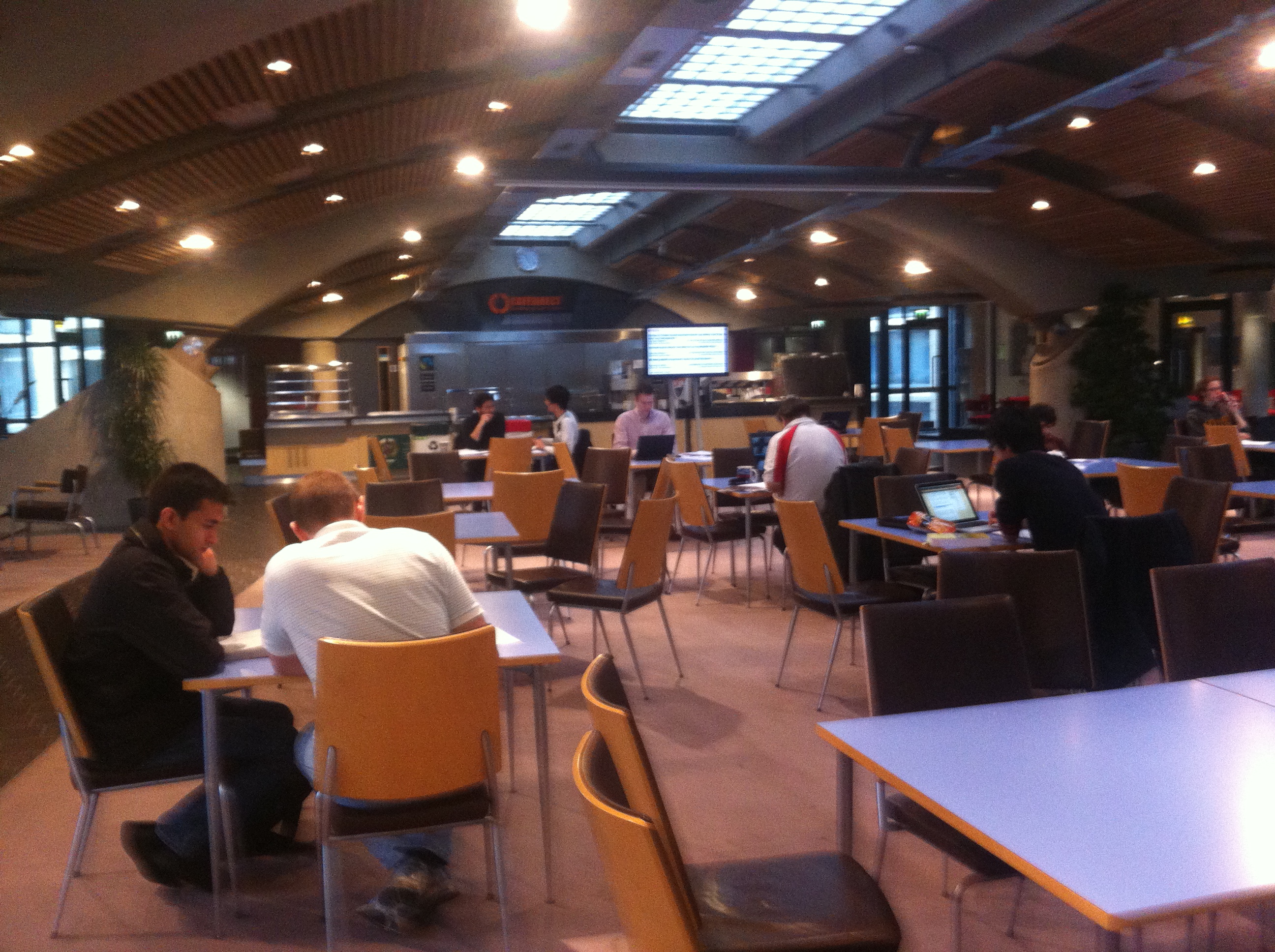
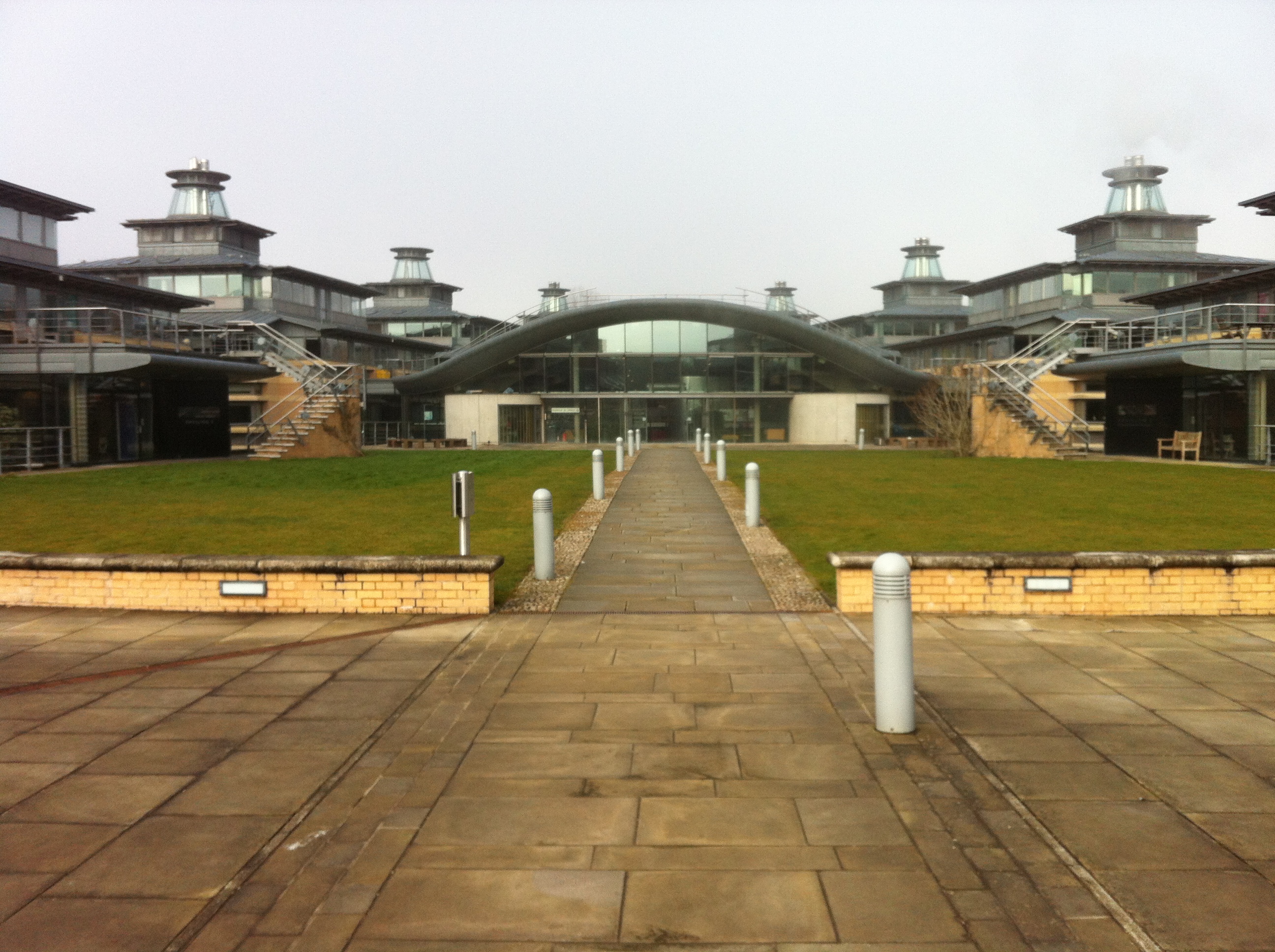
Speaking of coffee, one of the best aspects of the conference was the venue. Cambridge’s Department of Applied and Theoretical Physics forms part of its Centre for Mathematical Sciences and is housed in a lovely modern open-plan building, with the smell of coffee and scones wafting throughout the atrium. What other mathematics institute can boast such a setup?  Not DIAS, I’m afraid. Indeed, I’m writing this post in the quiet atrium/canteen (no annoying background music – that wouldn’t be tolerated here). However, I’ve just realised that we are now finished for the day, so I’m off to do some sight-seeing at last.
IMG_0479

The main atrium in the Center for Mathematical Sciences is one big coffee shop, perfect for group discussions of physics, philosophy and mathematics
IMG_0432

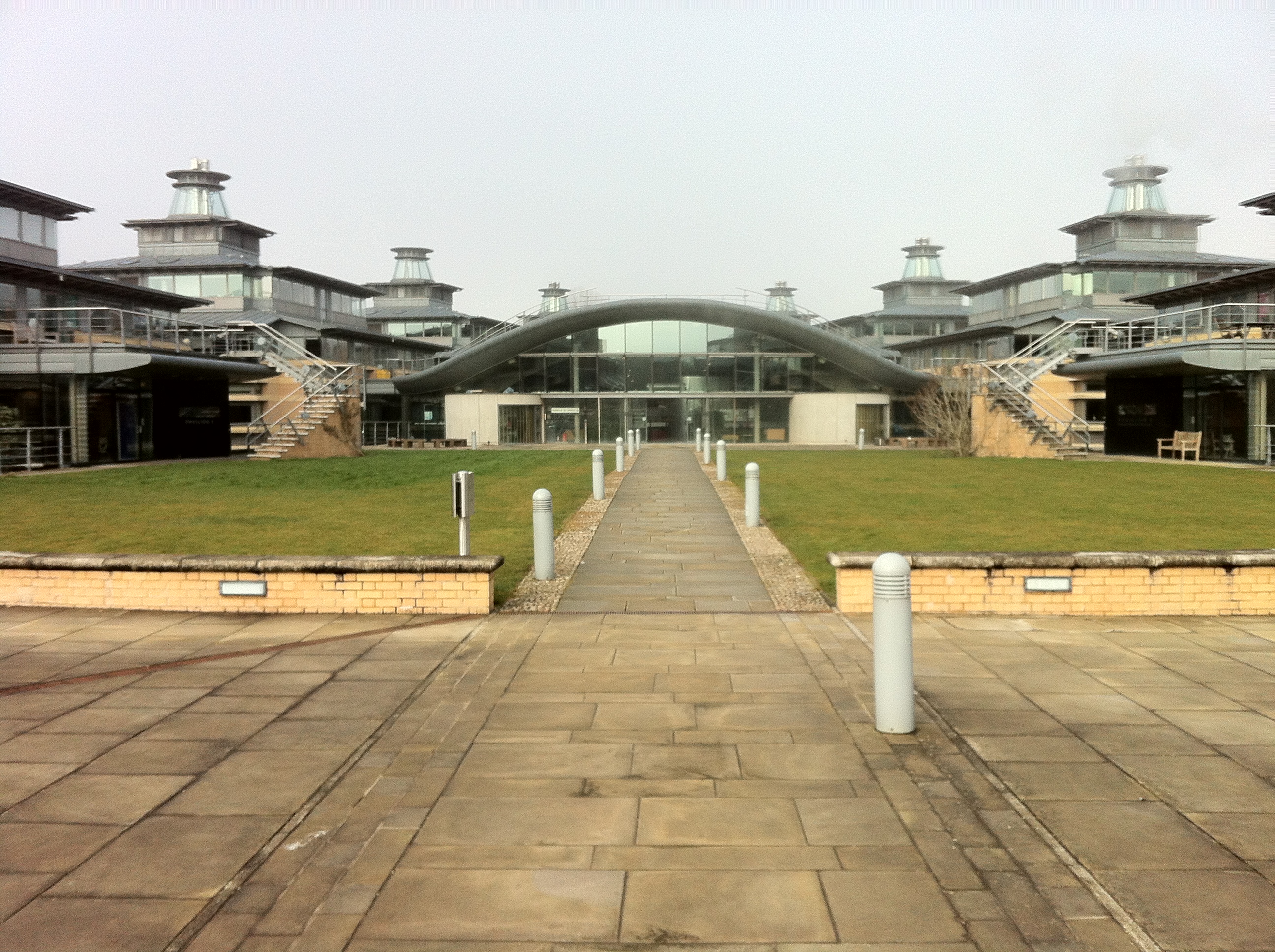
The Department of Applied Mathematics and Theoretical Physics forms part of the Centre for Mathematical Sciences at Cambridge
2 Comments

Filed under Cosmology (general), History and philosophy of science

Infinities at Cambridge

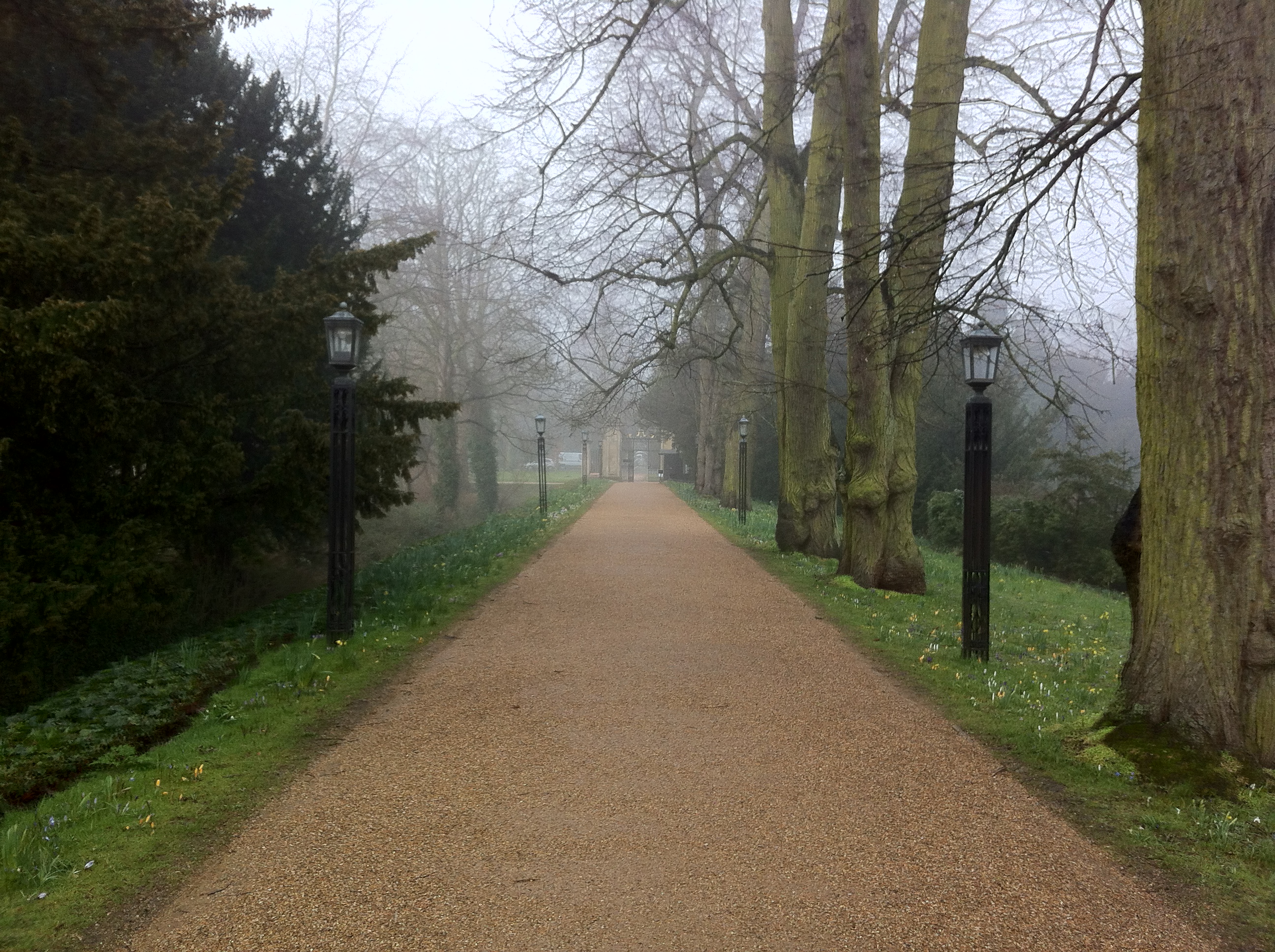
The ‘Infinities and Cosmology’ conference  (see last post) got off to a great start here at Cambridge today. The first surprise was that DAMTP, Cambridge’s Department of Applied Mathematics and Theoretical Physics, is now housed in a beautiful modern building with lots of light, wide open spaces and a great canteen. The building forms part of the new Centre for Mathematical Sciences, most impressive. I couldn’t resist taking a few other photos after breakfast on my way to the conference, nearly missed registration!

IMG_0433

The Department of Applied Maths and Theoretical Physics at Cambridge

IMG_0415

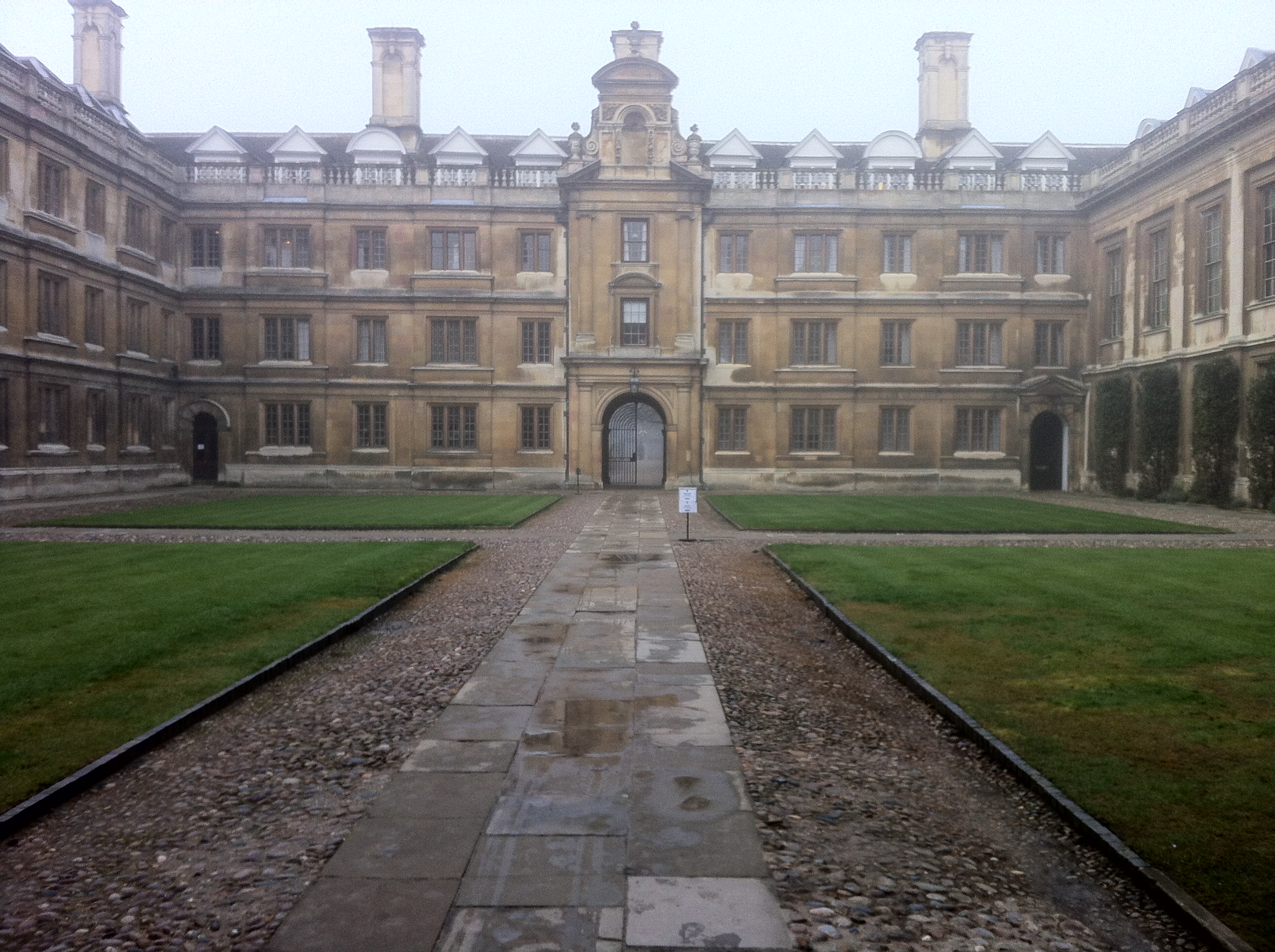
 Clare College (where I’m staying) in the mist at breakfast this morning

IMG_0427

IMG_0429

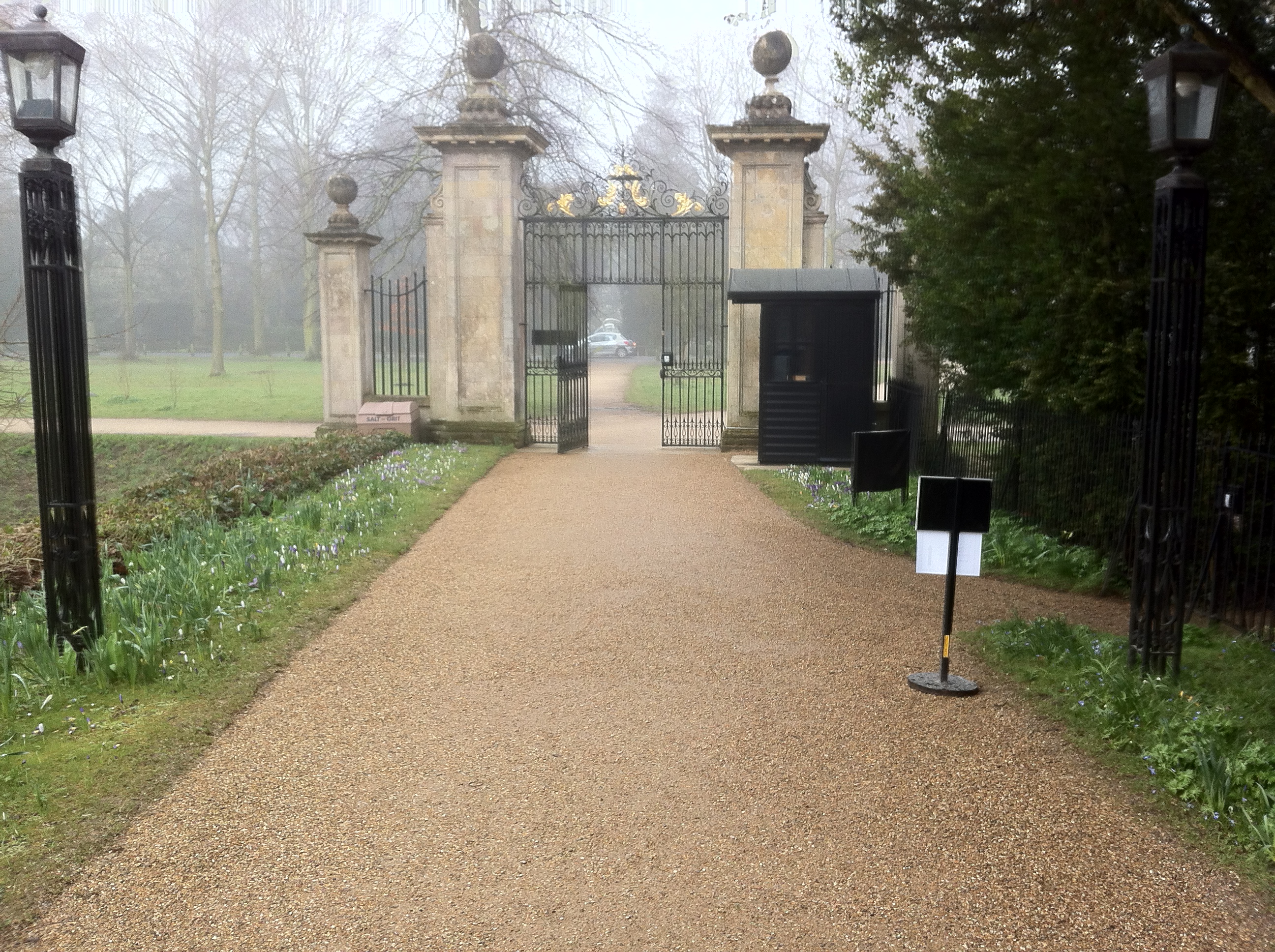
Walking through Clare College on the way to the conference

After registration and coffee, the conference started with a ‘brief introduction’ by John Barrow . This comprised a succinct but comprehensive overview of problems posed by infinities in mathematics, classical physics, quantum physics and particle physics, finishing with a discussion of specific problems in cosmology. There’s nothing quite like an overview like this by an expert, all sorts of connections between diverse phenomena become apparent. I took copious notes which will keep me busy over the next few days. Indeed, I suspect that if no other speaker had turned up, Prof Barrow could have expounded further on the topics he touched on for the duration of the conference.

George Ellis then took the podium for the first installment of his talk ‘Infinities of age and size, including global topology issues’. He set a no-nonsense tone by starting with a pet peeve – that physicists routinely confuse inconceivably large numbers with infinity, a very different beast. He expounded on this theme at length and then set about an interesting argument: that talk of infinities in physical systems is meaningless unless one can verify that they are truly infinite – which cannot be done, as pointed out by David Hilbert. Thus, the hypothesis of an infinite universe is dubious science and dubious philosophy. George then postulated a general test (the Ellis/Hilbert fork) for theories; any hypothesis that no longer works when infinite quantities are replaced by arbitrarily large numbers is bunk!

We were still pondering this opening salvo when Anthony Aguirre took the podium after coffee to talk about ‘Infinite and finite spacetimes’. This started with a succinct review of the ‘initial conditions’ problem in the big bang model, the theory of cosmic inflation and the main inflationary models of today. In particular, Anthony explained why inflation leads naturally to the concept of the multiverse  (essentially, quantum tunneling or equivalent processes are simply far too slow to compete with the still-inflating universe, leading to separate bubble universes). Personally, I once hoped that some mathematician would one day prove that inflation either happened to all or the universe or not at all, but this is looking increasingly unlikely. Anthony then went on to describe the model of eternal inflation and explained how Hoyle’s famous ‘steady-state universe’ could be right after all (at least on the global scale of the multiverse, as he explained in response to a silly question from yours truly).

After lunch, string theorist Michael Douglas presented the first installment of his talk ‘Can we test the sting theory landscape?’. This was the most technical talk so far, nothing less than a brief review of fundamental ideas in string theory and the famous problem of the landscape. A very basic argument Michael made chimed with me, namely that “almost all physical theories have a landscape of possible solutions” (there are dozens of example of this in solid-state physics). After some more general points, Michael went on to address the problem of dark energy, describing how his recent work on the flux vacua hypothesized by Bousso and Polchinski might deliver a mechanism for the cancellation necessary to reduce the quantum energy of the vacuum to the tiny ‘dark energy’ value we see today. I need to read around this area before Michael’s follow-up talk tomorrow so I’ll stop there!

Comments Off on Infinities at Cambridge

Filed under Cosmology (general)

Back at Cambridge
This week I’m back in Cambridge University, attending  a cosmology conference at  DAMTP, the famous Department of Applied Mathematics and Theoretical Physics. I’m delighted to be back – Cambridge is only a short hop from Dublin and it is such a great place to visit, with its beautiful colleges, bijou shops and lively student life. I arrived late in the afternoon, and walked to the town centre in a light rain; tourists everywhere were complaining about the English weather but I thought the rain and the falling light set the scene perfectly as I walked along past the ancient colleges.

IMG_0402

St John’s College in the rain this evening

This time around I’m staying in Clare College, one of the oldest colleges in the university. Its beautiful front quad is just off Kings’ parade to the front, while the back of the college straddles the River Cam all the way back to the University Library. The rooms are lovely (no tv – wouldn’t have it otherwise). In fact, working at my little desk and watching the rain across the quad makes me feel quite nostalgic, like a student again – perhaps in another universe there is a younger me starting out in this fabulous university .

Welcome_to_Clare

Clare College in the daytime

The conference, Infinities and Cosmology,  is not on theoretical or experimental cosmology, but on the philosophy of cosmology. It forms part of a new Oxford-Cambridge initiative  aimed at bringing physicists and philosophers together in order to improve our understanding  of the universe and its origins, from exploring the meaning of the initial singularity to the philosophical implications of theories such as cosmic inflation and the multiverse. This particular conference was organised by John Barrow , Jeremy Butterfield and David Sloan, names that carry a lot of weight in the intersection of physics and philosophy, and visiting speakers include other heavy hitters such as Anthony  Aguirre, Mihalis Dafermos, George  Ellis and Simon  Saunders. You can see the conference program here.

That said, mixing philosophy with physics is not an approach that meets with universal approval – Stephen Hawking once declared that  ‘philosophy is dead’, while Laurence Krauss has also been pretty scathing about the contribution of philosophers to physics.  Both are physicists I hugely respect, but I think this initiative is more about making physicists aware of their deepest assumptions than about  converting philosophers into cosmologists.  Also, those of us with an interest in the history of cosmology notice that scientific progress has often been hindered by unexamined philosophies – from Aristotle’s geocentric model of the solar system to Harlow Shapley’s faith in a single-galaxy model, from Einstein’s assumption of a static universe to the steady-state universe of Hoyle, Bondi and Gold. More recently, I have long suspected that some of the resistance to inflationary models arises from a simple dislike of the exceedingly large numbers involved – an objection that is understandable, but not really tenable from a philosophical point of view.

So I’m not expecting that philosophers will suddenly shine light on well-known problems in big bang physics – it’s more that we physicists can profit by examining the philosophical assumptions we operate under. In general,  scientists  are pretty good at being aware of underlying scientific assumptions, but sometimes a general philosophical viewpoint is often overlooked precisely because it is so widespread. Another  advantage is that philosophy gives us a useful language in which to articulate underlying assumptions.

To give one example, consider the following. The  ‘big bang ‘ model predicts a universe that was once in a hot, tiny, dense state,  expanding and cooling ever since. There is a great deal of evidence to support this model, but it runs into mathematical difficulties as time zero is approached (part of the problem is that we do not have a theory to describe gravity on the smallest or ‘quantum’ scales).  These are technical problems that every cosmologist battles with, but they might one day be resolved, leaving us with a consistent theory of a universe with a definite beginning. In that case, questions that few physicists ever consider become very important:

–          In a universe with a definite beginning, when did the laws of physics becomes the laws of physics?  Were they somehow ‘born’ with the universe, or did they come into being at a later stage. In other words are they emergent, rather than fundamental? If so, what entity or entities did they emerge from?

–          Could it be that space and time themselves are not fundamental but also emergent? In other words, is it possible that space and time were not born with the universe, but are made up of something more fundamental than either? (One clue here is Einstein’s discovery that space and time are not absolute but affected by motion and by gravity).  Could it be that they are non-fundamental as well as non-static?

–          If so, doesn’t this create problems of causality in the case of time?

This is just a flavour of the sort of questions one encounters in the philosophy of cosmology.  Right now, I’d better turn in so I’m wide awake for  tomorrow. In the first lecture, George Ellis, one of the world’s leading theoretical cosmologists, will give a talk ‘Infinites of age and size, including issues in global topology’ .  I suspect I’ll need my wits about me….

2 Comments

Filed under Cosmology (general), Travel

Cosmic fingerprints at Trinity College Dublin

I was back in my alma mater Trinity College Dublin on Monday evening in order to catch a superb public lecture, ‘ Fingerprinting the Universe’ , by Andrew Liddle, Professor of Astrophysics at the University of Edinburgh. The talk was presented by Astronomy Ireland, Ireland’s largest astronomy club and there was a capacity audience (despite the threat of snow) in the famous Schrödinger lecture theatre in the Fitzgerald Building, Trinity’s physics department.

march2013

Professor Liddle was introduced by David Moore, Chairman of Astronomy Ireland, who also presented an update of the club’s recent activities  (David and I participated in a discussion of the life and science of Sir Isaac Newton on NEWSTALK radio station the evening before, you can hear a podcast of the show here). Anyone with an interest in cosmology will be familiar with Andrew Liddle’s seminal textbook ‘ An Introduction to Modern Cosmology’, (not to mention several other books) and the ensuing lecture certainly didn’t disappoint.

An-Introduction-to-Modern-Cosmology-Liddle-Andrew-9780470848340

Starting with a tribute to the work of both Schrödinger and Fitzgerald, Andrew gave a brief outline of today’s cosmology, showing how it has moved from a rather speculative subject to a mature field of study. He attributed this progress to key advances in three main areas: precision observations by satellite, sophisticated theoretical models and high performance computing for both analysis and simulation.

He then described five specific challenges that any successful model of the cosmos must address –  the expanding universe;  the formation of structure (galaxies etc);  the age of the universe; the composition of the universe (baryonic matter, radiation, neutrinos, dark matter and dark energy);  a consistent description of the very early universe (cosmic inflation or alternatives).

As ever, many in the audience were surprised to hear that, while dark energy is estimated to make up about 73% of the mass-energy content of the universe, we have very little idea of the nature of this phenomenon!

In the second part of the lecture, Andrew focused on the cosmic microwave background (CMB), explaining how the study of this ‘fossil radiation’  gives precious information on the early universe,  and in particular describing how tiny non-uniformities (or anisotropies) imprinted on the radiation formed the seeds of today’s galaxies (‘cosmic finger-printing’). There followed a swift description of results of CMB studies by the COBE and WMAP satellite missions, with a reminder that more recent measurements by the European Space Agency’s   PLANCK Satellite Observatory  will be announced next week. He also reminded us how, amongst other triumphs, the theory of inflation gives a very satisfactory explanation for the origin of the variations in the background radiation terms of quantum fluctuations in the very early universe. This link between inflation and galaxy formation is often under-stated in the popular literature; in answer to a query from me question time, Andrew confirmed that non-inflationary explanations for the origins of the observed variations in the microwave background have not been very successful. It’s pretty impressive that inflation can give an explanation for the origin of structure, given that this was not part of the original motivation for the theory.

ESA's Planck mission

The ESA’s PLANCK Satellite will report new measurements of the cosmic microwave background on March 21st this month

All in all, a fantastic talk, well worth the trip; afterwards, we all repaired to a nearby pub for sandwiches and further discussion of the universe over hot ports and Guinness…

P.S. In his discussion of the discovery of the expanding universe, I was pleased to see Professor Liddle refer to the work of Vesto Slipher; it seems that recent historical work on the important contribution of Slipher is finding its way into the mainstream community.

2 Comments

Filed under Cosmology (general), History and philosophy of science

Mid-term in Chamonix

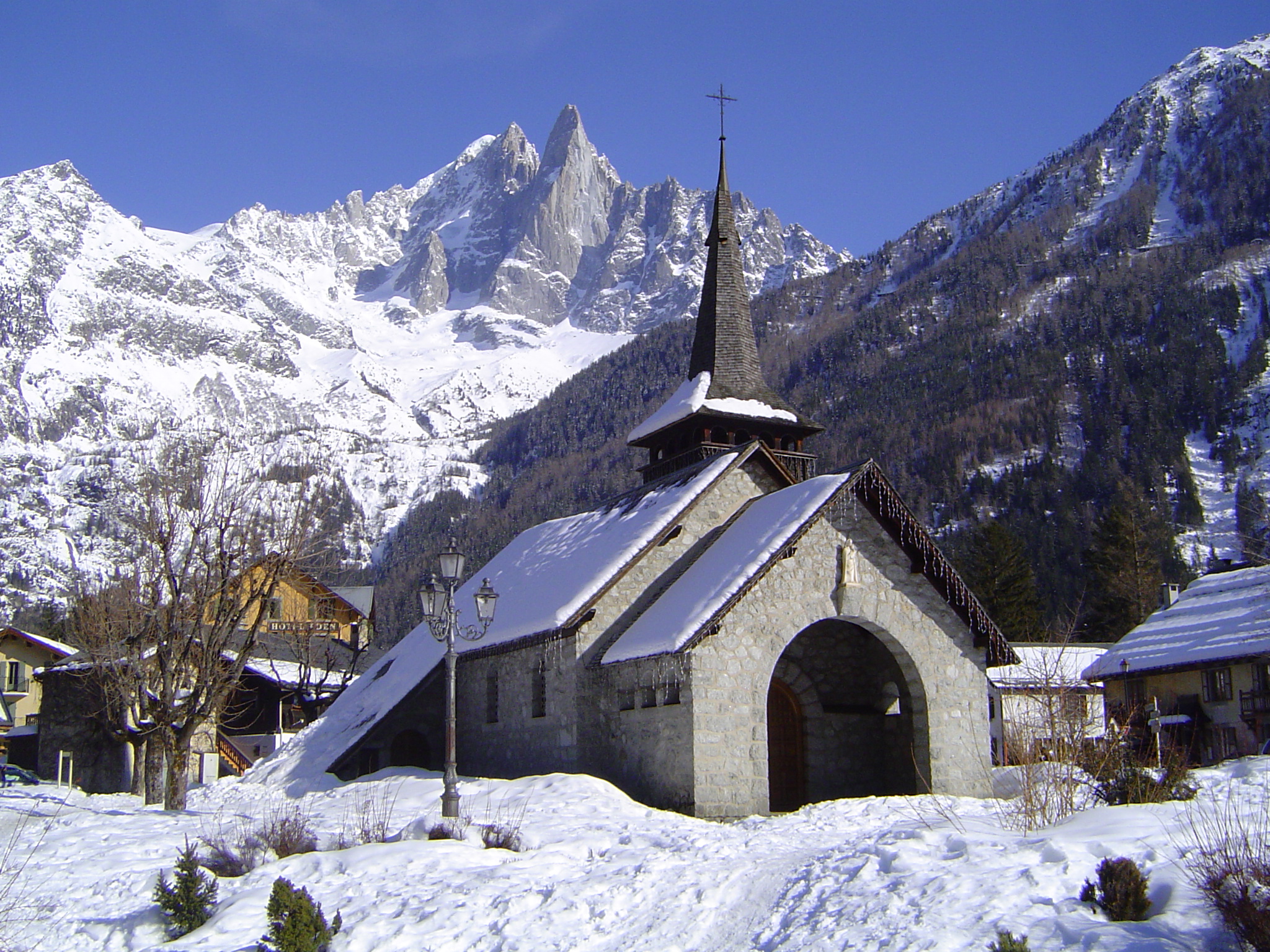
Last week was mid-term and I had a few days skiing in Chamonix in the French Alps. Chamonix lies in the shadow of Mont Blanc, the highest of the Alpine peaks, and the area is famous for its challenging snowsports and mountain climbing. It was surprisingly easy to get to (1 hr 30 mins from Geneva airport) and the skiing certainly didn’t disappoint.

I stayed with my brother and his family in a tiny chalet in Les Praz, a small village just outside the town of Chamonix. The great advantage of this village is that it offers easy access to La Flègere, a large ski area on the opposite side of the valley to the crowds at Chamonix. We had one day’s skiing out of Flegère, another at Argentière, the next resort along the valley, and the final day at Le Tour, further down the valley again.

Les_Praz_de_Chamonix_(l'église)

The village of Les Praz in Chamonix

The skiing was great in each case; lots of snow, steep pistes  and clear skies almost every afternoon. An extra thrill was the fact that one could ski over the Swiss border and have lunch in Switzerland. Of the three resorts, Flegère was my favourite; plenty of trees, nice unpisted runs under the lifts and not too many people.

ski-holidays-argentiere-v5t

The lonely skier

That said, I retain my preference for skiing in Austria. One reason is that, like many French resorts, Chamonix has relatively few gondolas, a large number of button lifts  and uncovered chairlifts. Button lifts are quite tiring on the feet after a while, while exposed chairlifts can get very cold – a concern at altitudes above 1500 m where the midday temperature is often below -10 degrees Celsius. In Austria, almost all the main resorts have installed a healthy distribution of small, efficient gondolas and covered chairlifts (in the latter case, the chairs are heated by solar panels in the plastic cover). There were also far fewer restaurants and cafes on the Chamonix slopes, which I found quite surprising for such a famous resort (coffee breaks are important for the tired skier). So while the French are justifiably proud of their resorts, I still prefer Austria!

All in all a very good ski holiday, highly recommended…

3 Comments

Filed under Skiing, Travel

Resistors in series and parallel

In the last post, we saw that for many materials, the electric current I through a device is proportional to the voltage V applied to it, and inversely proportional its resistance, i.e. I = V/R (Ohm’s law). If there is more than one device (or resistor) in a circuit, the current through each also depends on how the resistors are connected, i.e., whether they are connected in series or in parallel.

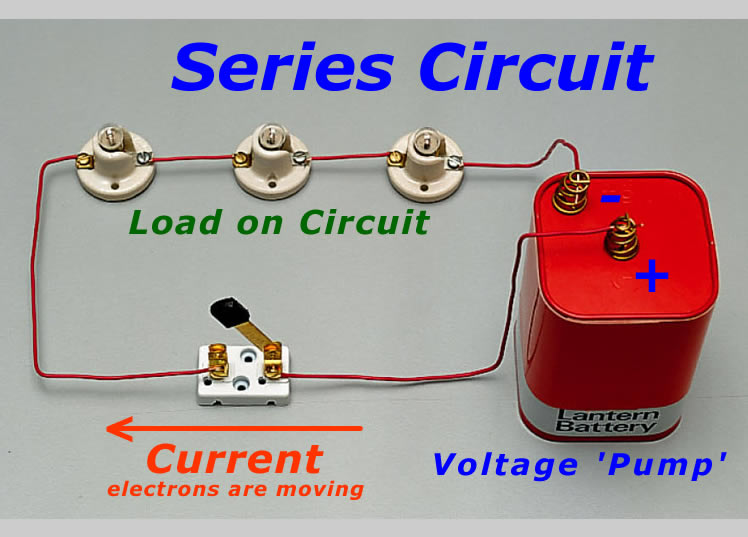
In a series circuit (below), the resistors are connected one after the other (just as in a TV series, one watches one episode after another). The same current runs through each device since there is no alternative path or branch, i.e.  I = I1 = I2. From V = IR, we see the voltage across each device will be different; in fact, the largest voltage drop will be across the largest resistance (just as the largest energy drop occurs across the largest waterfall in a river). The total voltage in a series circuit is the sum of the individual voltages, i.e. V = V1+V2. As you might expect, the total resistance (or load) of the circuit is the simply the sum of the individual resistances, R = R1 + R2.

series_circuit

Series circuit: the current is the same in each lamp while there may be a different voltage drop across each (V = V1+V2 +V3)

On the other hand, resistors in a circuit can be connected in parallel (see below). In this case, each device is connected directly to the terminals of the voltage source and therefore experiences the same voltage (V = V1=V2). Since I = V/R , there will be a different current through each device (unless they happen to be of equal resistance) .The total current in a parallel circuit is the sum of the individual currents, i.e. I = I1+I2. A strange aspect of parallel circuits is that the total resistance of the circuit is lowered as you add in more devices (1/R = 1/r1 + 1/r2). The physical reason is that you are increasing the number of alternate paths the current can take.

image_sci_elec002

Parallel circuit: the voltage is the same across each lamp but the currents may be different (I = I1+I2)

Confusing? The simple rule is that in a series circuit, the current is everywhere the same because there are no branches. On the other hand, devices connected in parallel see an identical voltage. In everyday circuits, electrical devices such as kettles, TVs and computers are connected in parallel to each other because it is safer if each device sees the same voltage source; it also turns out to be more efficient from the point of view of power consumption (an AC voltage is used, more on this later).

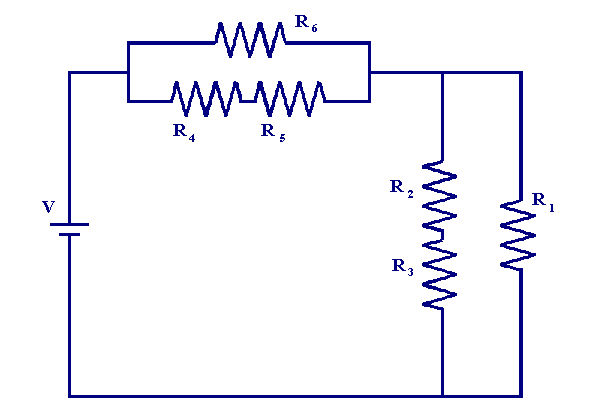
In the lab, circuits often contain some devices connected in series, others in parallel. In order to calculate the current through a given device, redraw the circuit with any resistors in parallel replaced with the equivalent resistance in series, and analyse the resulting series circuit.

sparal2

Problem

Assuming a resistance of 100 Ohms for each of the resistors in the combination circuit above, calculate the total resistance of the circuit. If a DC voltage of 12 V is applied, calculate the current in the circuit. (Ans: 133 Ω, 0.09 A)

4 Comments

Filed under Teaching, Third level

Current, voltage and the French resistance

Last week, our 1st science students had their first laboratory session on electrical circuits. They haven’t met electricity in lectures yet, so I spent some time explaining the concepts of current and voltage.

In essence, current is the flow of electric charge around a circuit (measured in amps) while voltage is the energy that drives the current (and is measured in volts). I find it helpful to think of the two in terms of cause and effect; a current will only flow in the circuit if a voltage is applied. In simple circuits, this energy is supplied in the form of a DC battery (or voltage source) that drives the current through some device (or resistor) in the circuit.

Let's Explore Science... Turn on the Light

The lamp (or resistor) lights as the current goes through it, completing the circuit

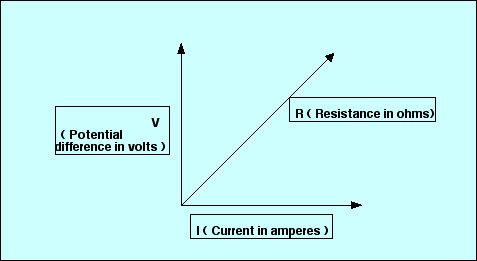
You might expect that there is a simple relation between voltage and current, and sure enough, the German scientist Georg Ohm discovered that, for many materials, there is a linear relationship between the two. Ohm’s law states that the current I passing through a material connected to a voltage V is given by the simple equation I = V/R. Here, 1/R is the constant of proportionality and is called electrical resistance and you can see why from the equation: a material with a very large value of R will pass almost no current (bad conductor), while a material with very small R will yield a large current for the same voltage (good conductor). So the term has exactly the same meaning as it has in ordinary speech, e.g. the French resistance. Resistance is measured in volts per amp, also known as Ohms (Ω).

Voltage_vs._Current

Many materials have a linear relation between voltage and current – the slope of the graph is the material’s resistance

In the experiment, the students apply a series of voltages to an unknown resistance in a circuit, and record the corresponding currents. A plot of voltage versus current then allows them to verify the linearity of the relation and the resistance is estimated from the slope of the line. (Strictly speaking, one should really put the voltage on the x-axis as it is the independent variable, but the calculation is simpler if the voltage is on the y-axis).

Measuring current and voltage

All of the above is fine in principle. Yet novices find the measurements quite difficult in practice. They have problems connecting the circuit because they get confused between measuring the current that flows through a device, and the voltage across it. It’s crucial to understand the difference between the two, and I suspect the modern multimeter adds to the confusion.

simple-circuit-diagram

The ammeter reads the current running through the resistor while the voltmeter reads the voltage across it. A plot of voltage vs current gives a measurement of the resistance

When I was a student, the current was measured by passing the current through an ammeter (marked A in the diagram), an analog device with a nice big dial calibrated in amps or milliamps. The voltage across the resistor was measured by connecting a different instrument, the voltmeter, across the terminals of the resistor; this voltmeter was a separate meter with a dial calibrated in volts (marked V in the diagram). So an ammeter was always connected in series with the resistor/device, while the voltmeter was always connected across it (in parallel).

index   voltmeter

Current is measured by passing it through the ammeter (L) while voltage is measured by connecting across the voltmeter (R)

Nowadays, identical instruments are used for both; to measure current, one passes the current through the terminals marked ‘current’ of a multimeter, and the main dial on the meter is switched to the amp scale. To measure voltage, one connects the ends of the resistor across the terminals marked ‘voltage’ on an identical multimeter, and the dial is switched to volts. It sounds simple, but it’s easy to connect to the wrong terminals, getting no readings or blowing the fuse in the meter. More subtly, I think the clever circuity inside the multimeter hides the fact that current goes through while voltage drops across. All in all, I suspect students would understand circuits better if  we went back to separate instruments for measuring current and voltage….

my64-digital-multimeter

The mysterious multimeter. To measure current, leads are connected to the sockets marked ‘common’ and ‘amps’; to measure voltage, one connects to the sockets marked ‘common’ and ‘voltage’.

Notes

1. If a 12-V voltage is applied across a resistor of 15, what current flows in the circuit? How many electrons per second does this current represent? (Ans: 0.8 mA,  5.0 x 10¹⁵ electrons)

2. What happens to the current if one end of the resistor accidentally touches the other? (Ans: the circuit resistance drops almost to zero and the current becomes very large – don’t try this in the lab!)

3. Ohm’s law is a misnomer – it is not a universal law of nature but simply a property of some materials (many materials have a nonlinear response to voltage, including your cat).

4. It might seem from Ohm’s law that a material with zero resistance can give infinite current! No such materials are known; the relation is simply not valid for these materials. However, some materials have extremely low resistance at very low temperatures, known as superconductors. A good application of superconductivity can be found at the Large Hadron Collider, where protons are guided around the ring by magnets made of superconducting material: this reduces power consumption enormously but the snag is that the entire accelerator has to be kept at extremely low temperatures during the experiments.

3 Comments

Filed under Teaching

RTE, NASA and a WARP drive

On Friday, I got a call from Mooney Goes Wild , the daily science programme on Irish national radio, asking me to participate in an interview concerning NASA’s recent interest in creating a WARP drive for space travel. I’d heard this interesting story over Christmas and I like science on the radio, so it was fun to look up a few details and take part in the discussion.

enterprise_at_warp_by_1darthvader-d30f287

Starship Enterprise of Star Trek uses a warp drive to traverse the immense distances of outer space

The live interview took place that very afternoon, right in the middle of our College Exam Boards (those weighty meetings when lecturers come together with external examiners to decide which students pass and which don’t). Our current physics extern, Professor Peter Mitchell of UCD, taught me as a student, so we had fun discussing the NASA project over lunch.

In the event, the interview was very interesting; I thought the RTE panel of Olan Mc Gowan, Eanna ni Lamhna, Richard Collins and Terry Flanagan asked great questions and we all enjoyed ourselves. Below is the Q&A script I prepared in advance (I always run up a draft script as it helps me organize my thoughts and it provides interviewers with a jumping-off point). The panel’s questions went a good deal further, you can hear a podcast of the interview here.

article-0-1512B1B2000005DC-600_634x414

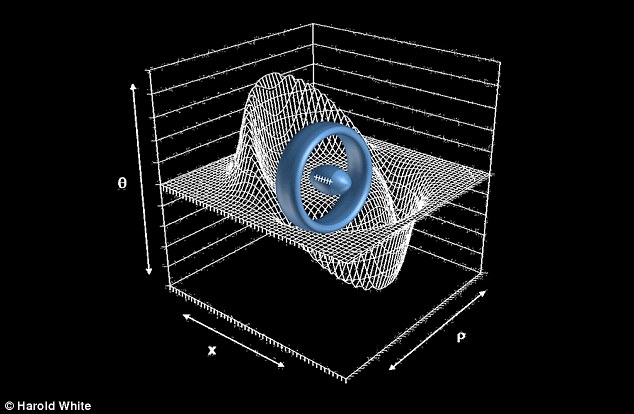
Artist’s impression of the NASA experiment; the vacuum ring causes space behind the object to expand, propelling it forwards

*******************************************************************

Script

We recently came across a story that NASA has begun work on the development of a WARP drive, a device that would allow spaceships to travel faster than light. Such an engine could in principle transport a spacecraft to the most distant stars in a matter of weeks, but seems the stuff of science fiction.  We contacted Dr Cormac O Raifeartaigh, a physicist at Waterford Institute of Technology, to get his opinion on this story…

PANEL: First of all, what is a warp drive?

 COR: It’s the word used for a hypothetical engine that could drive a spacecraft by distorting or ‘warping’ space. In principle, this could allow  the ship to travel faster than the speed of light, taking a shortcut to reach remote galaxies in hours instead of millions of years! (The device turns up in science fiction in order to enable people to get from one galaxy to another without dying of old age on the way…even travelling to a nearby planet  takes several years).

PANEL: How is it supposed to work? I thought faster-than-light travel was supposed to be impossible?

COR: That’s right. According to Einstein’s theory of relativity, no material body can reach the speed of light. If it comes close to this speed, the body gets bigger, and heavier, and it cannot match the speed of something with no mass (light). There is a lot of evidence to suggest that this is exactly what happens, it’s amazing to see particles like  protons accelerated at facilities like the Large Hadron Collider  up to speeds like 99.99% of the speed of light, but never quite reaching nature’s speed limit.

PANEL: So, how does the warp drive work then ?

 COR: Another prediction of relativity is that space and time are not fixed, but affected by motion and by gravity. For example, there is a huge amount of evidence that the space of our universe is continually expanding. In principle, a patch of space can move at any speed; if you could somehow  warp a bubble of space around an object ( or spaceship), then that object would travel at the speed set by the distortion..

PANEL: Has this mad idea been around for a while?

COR: Yes,in principle. The problem is that the energy required to make that bubble of warped space is far greater than any energy available. What’s new is that physicist Harold White at NASA thinks he can reduce the energy required, with a clever design; the object (spaceship) is surrounded by a thin vacuum ring of a special shape that causes the space just behind the spaceship to expand, and just in front to contract; the difference propels the spaceship very fast indeed! Of course that’s just the theory..

PANEL: Do you think it will work?

COR: No, I doubt it, even with objects on the atomic scale. However, we will learn a lot by trying, there’s nothing wrong with the principle. For example,  many cosmologists believe that our whole universe expanded at speeds far greater than light during the first instant (the theory of cosmic inflation), before settling down to today’s more sedate expansion. But as regards investment, I wouldn’t put any money in ‘warp drive’ shares just yet!

1 Comment

Filed under Public lectures, Science and society

New Year in Austria

I managed to finish my exam corrections before Christmas this year, so I’m now back in Austria for some snowtime, this time in Niederau, a quiet village in the Wildschönau valley in the Tyrolean Alps. I was pleased with my recent article on the history of cosmology appearing on the ArXiv on Christmas Eve, with another well on the way, so I grabbed the last place on a cheap’n’ cheerful package with the Irish tour company DirectSki.com and it has turned out to be one of those holidays where everything goes right.

Instead of the usual B&B, I’m staying in the Hotel Harfenwirt, a large family-run hotel a stone’s throw from the bottom of the ski-lift. It’s a really nice old-fashioned hotel, with plenty of Austrian and German guests (always a good sign) as well as Irish and British skiers, very sociable at dinner in the evenings. Things were a little chaotic on the first night of arrival, but the hotel has a real old-world charm that you just don’t get in the larger chains. As a bonus, my room has a balcony overlooking the slopes, not to mention the jacuzzi, swimming pool and sauna downstairs, perfect for tired thigh muscles. I speak reasonable German and I’ve skied since I was a child, so I’m very much at home here..

harfen

Hotel Harfernwirt in Niederau

As for the conditions, it’s a good season in Austria and Switzerland so far. Plenty of the white stuff, yet lots of days with clear skies. That said, it hasn’t snowed in the Wildschönau valley for three days so it’s beginning to get a little icy on-piste and cruddy off it. For the ski enthusiasts  amongst you, I tried out some Salamon deep-snow skis for off-piste today, but without much success. I didn’t find they made much difference in the deep snow (my weakest point) and they were hard work on-piste, not a very firm grip on the icy bits. So I’ve swapped them for a pair of Fischer all-mountain skis for tomorrow (the advantage of renting kit is that you can try out different types of skis).

IMG_0209

An off-piste trail (right of T-bar)  in the afternoon sun today

551255_10151427370155625_966944200_n

734947_10151427373380625_293135960_n

The view from the top of the local mountain

All in all, it’s been a great holiday so far, it was worth getting the exam corrections out of the way early. I do a few hours of physics in the mornings, head off to the slopes in the afternoons, then some more research after dinner. They say the great thing about academia is the holidays, and I must admit  that my research can be done anywhere with a decent internet connection…

The Schrödinger connection

I have just discovered that we are only one valley away from the town of Alpbach, the Tyrolean village well-known for its association with the great Austrian physicist Erwin Schrödinger. It was during a romantic break in Alpbach that Schrödinger discovered his famous wave equation, an important advance in the development of quantum physics (legend has it that he made the breakthrough in a burst of creativity between bouts of skiing in the mornings and romantic trysts with his girlfriend in the evenings, although her identity has never been confirmed). Schrödinger was very fond of Alpbach, and moved there full-time on his retirement from the University of Vienna; indeed he is buried there. (John Gribbin published a very nice biography of Schrödinger recently, you can find my review of it for Physics World here). Perhaps someone should start an annual winter conference in quantum physics in Alpbach in memory of Austria’s greatest physicist. I’d certainly be on for that!

4 Comments

Filed under Skiing

End of semester

This week is one of my favourites in the college timetable. The teaching semester finished last Friday and the hapless students are now starting their Christmas exams. It’s time to empty out the teaching briefcase and catch up on research…

EXAMS-RDS-copy

Examtime in college

I recently compiled a list of this semseter’s research and outreach and was pleasantly surprised – three conference presentations, two academic papers and eight public lectures , not to mention a couple of science articles and book reviews in The Irish Times (see here for presentations and here for articles).

All of this is on top of an 18-hour teaching week, which adds up to a lot of late nights. I’ve been arguing for years that the workload in the Institutes of Technology should be more flexible; it’s very difficult to do any meaningful research if you’re teaching 18 hours a week. Another challenge is that most lecturers in the IoT sector are 3-4 to an office, with consequent staff interactions, phone calls and students coming to the door. As a result, a great many lecturers simply stop doing research, which is a terrible waste and hardly ideal for a college that teaches to degree level and beyond. I often think that, far from enhancing ‘productivity’, work practices in the IoT sector mitigate strongly against good teaching and research at third level.

In my case, I stay in college most evenings until 9 pm. That said, I enjoy the research – as I say to my students, if you find a job you truly like, you’ll never work a day in your life!

I’m particularly pleased with my recent paper on the discovery of the expanding universe. It’s my first foray into the history of cosmology, and it has already got quite a bit of attention,  thanks to a very nice conference in Arizona. I very nearly didn’t go to this conference because of teaching commitments; now I’m glad I did as it was a lot of fun and the paper has opened quite a few doors. These days, I turn down far more opportunities than I accept, it may finally be time to consider an academic move.

img_tel

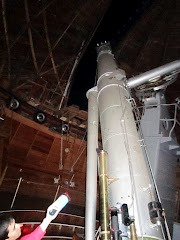
Slipher’s telescope at the Lowell Observatory in Flagstaff, Arizona

Update

Meanwhile, rumours continue to circulate in the media concerning the prospect of our college being turned into a technological university. This would certainly be a welcome development, especially if it meant reduced teaching for those engaged in research, but I’d be quite surprised. WIT has been very successful at attracting research funding in certain areas, but research activity per academic is quite low in our college in comparison with the university sector. I don’t see how we could qualify as a university without bringing in quite a lot of new research-active staff , a buy-in for which there is no money whatsoever; hopefully I’m wrong on this.

1 Comment

Filed under Teaching, Third level