Einstein, de Valera and the Institutes for Advanced Study

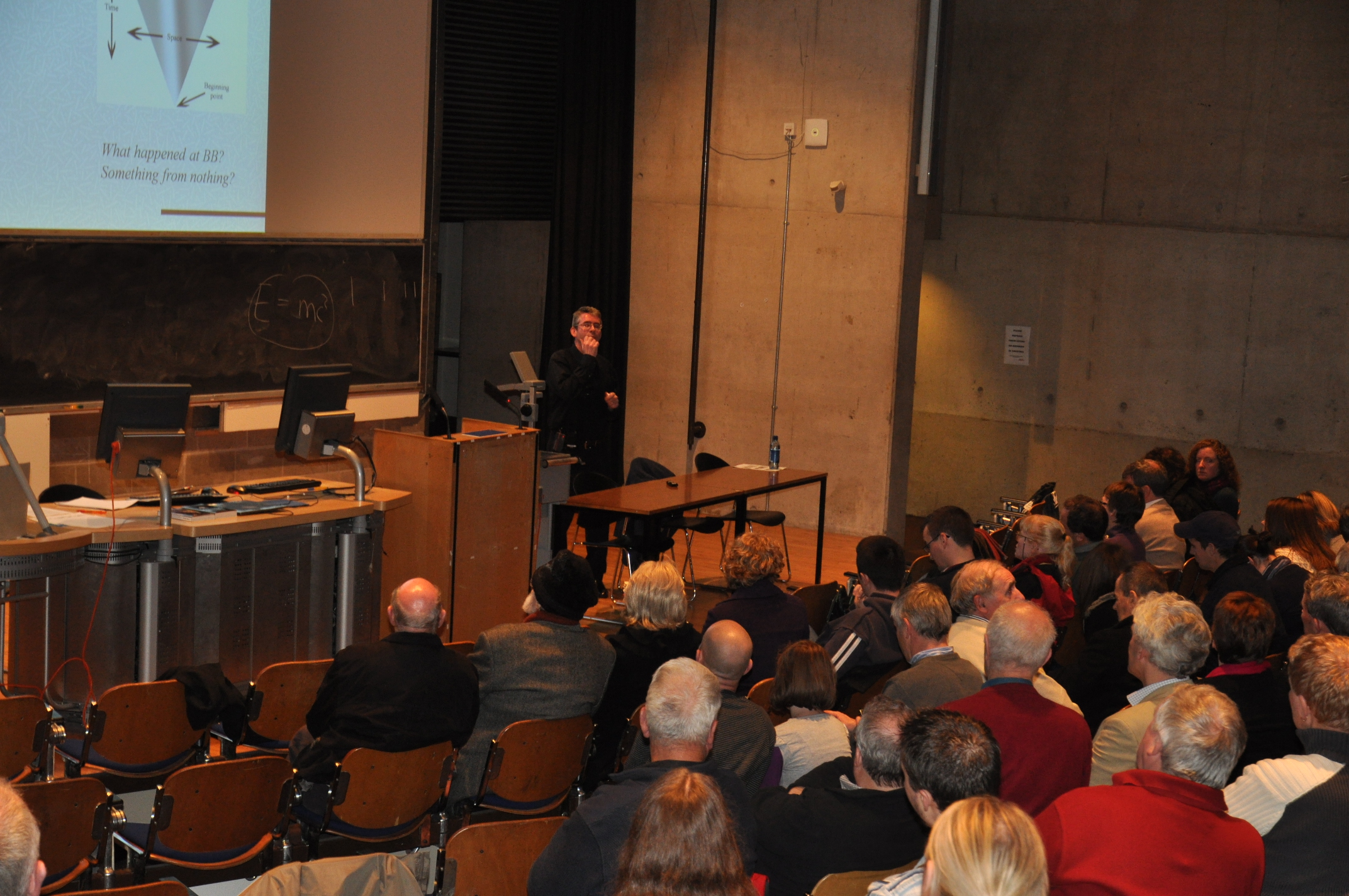
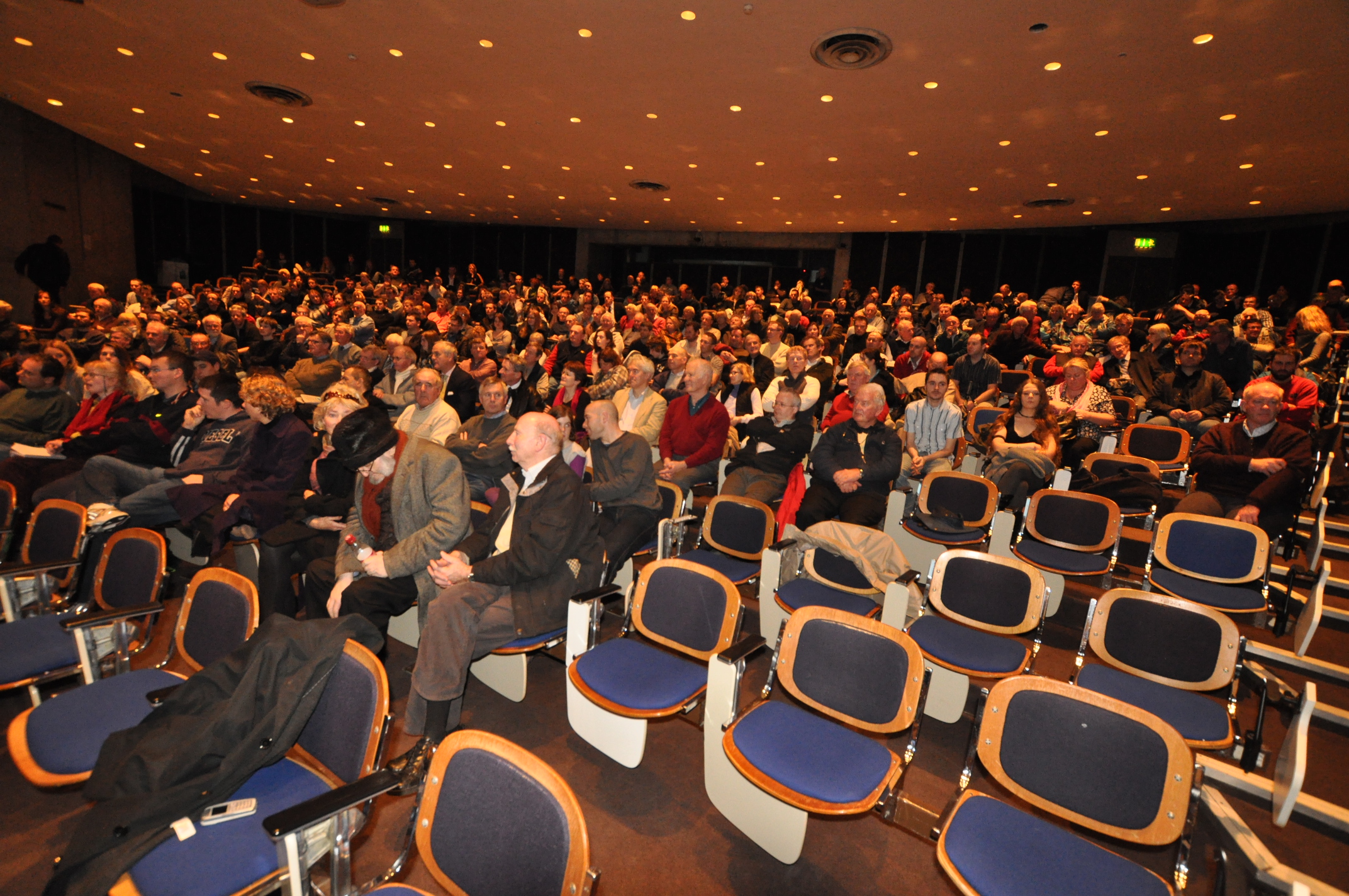
Is there a collective noun for a roomful of professors? A great many of the most senior figures of Irish academia turned up in Trinity College Dublin on Saturday night to hear the annual statutory lecture of the School of Theoretical Physics of the Dublin Institute of Advanced Studies.

The lecture, titled “No excuses in paradise: the past, present and future of the institutes for advanced studies” (see poster here) was a fascinating talk on the history and purpose of the Institutes for Advanced Study at Princeton, Dublin, Paris and elsewhere. It was given by Professor Peter Goddard, the current director of the famous Institute for Advanced Study at Princeton in the US. This institute, one of the most prestigious research centres in the world, has hosted staff such as Einstein, Godel, Oppenheimer, Freeman Dyson and Ed Witten and became the prototype for similar institutes around the world. Peter Goddard himself is extremely well-known as one of the early pioneers of string theory.

The  speaker started by tracing the initial idea by the American educationalist Abraham Flexner in the 1920s to seek funding for an Institute of Advanced Study in the US that could compete with research centres in Germany such as that in Gottingen. The plan was to create an elite American ‘graduate university’ –  a university that did not teach at undergraduate level but focused on research and on the training of researchers. Of course such an institute could only be staffed by the best of the best, and Einstein, already a world figure in science, was approached on one of his periodic visits to Caltech. Worried about the rise of the Nazis, Einstein quickly agreed. You can read more about this story here, but Prof Goddard showed a wonderful slide showing the famous issue of the New York Times with the headline: ‘Einstein to set up new school’.

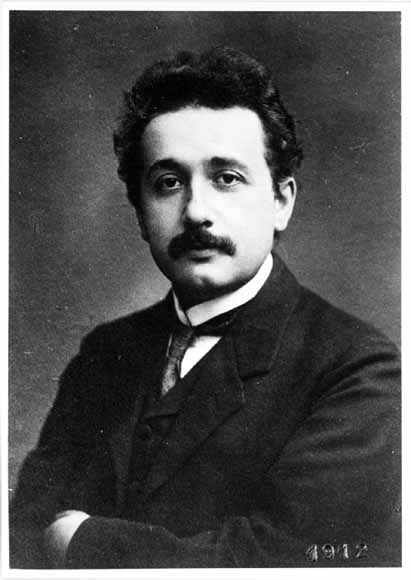
Einstein in his office at IAS

The speaker then explained how during the war the Irish premier Eamon de Valera, a former mathematician, decided a similar institute would be of benefit in Ireland. Due to economic constraints, it was settled that the institute would deal with theoretical physics (as there were great advances being made in this field and it required no expensive equipment) and with Celtic studies (also not very expensive and of national interest). On the advice of Einstein, de Valera approached Schroedinger, the father of wave mechanics, to persuade him to come to Ireland to direct the institute.

This part of the story was well-known to an Irish audience but the speaker gave a very nice sketch of the history – Schroedinger did come in 1940 and spent many years at the Dublin IAS, followed by other prestigious theoreticians such as Heitler, Lanzcos and Synge. The institute became a great success internationally, attracting regular visits by famous physicists such as Paul Dirac. Indeed, some nice slides concerning Dirac’s visits were shown, not least a menu demonstrating the attraction of Ireland during wartime. Another slide showed a comment by Dirac, expressing surprise that the Irish Prime Minister had time to sit through a whole mathematics conference! All in all, it was a lovely overview of the history of the Dublin IAS and included a nice reference to Lochlainn’s work (it turns out Goddard collaborated quite a bit with Lochlainn in the early days of supersymmetry) .

Nobel laureates Dirac, Heisenberg and Schrodinger in Sweden

The speaker then explained how the American idea was imported back to continental Europe, notably at IHES in Bures-sur-Yvette just outside Paris (set up in 1958). This institute is also highly regarded in the world of academia, thanks to the work of mathematicians such as Alain Connes and the late Louis Michel. There are also informal links between the institutes – many of the professors in the audience had spent time at more than one (in my own family we have fond memories of years spent at both the Princeton and Paris institutes as well as Dublin).

The lecture finished with a brief discussion of the role of such research institutes. In a world dominated by the technological application of science, it is sometimes hard to persuade people of the importance of enquiry for it’s own sake – ‘the usefulness of useless knowledge’. Of course, one answer to this is that we don’t know which part of scientific enquiry will prove technologically useful (look at Boolean algebra or the development of the web at CERN). However, a deeper answer is that knowledge and the pursuit of knowledge will always be important for their own sake. The professor summed up with the best quote of the night: ‘the thing about a scholar’s paradise is that there are no excuses for failing to do something important!’

So have the institutes been a success overall and should they continue? As a student, I often heard certain university staff mutter darkly that precious little work went on there – however such comments rarely came from staff at the highest levels. It’s worth noting that Saturday’s speaker was introduced by Professor Samson Shatashvili, the well-known string theorist who directs the Hamilton Mathematics Institute , a research institute that functions within Trinity College. Prof Goddard didn’t compare the role of such institutes with the institutes for advanced study directly, but I think his historical account demonstrated that the latter still have an important role to play. As regards the Dublin IAS, I should have said that the lecture above took place in the middle of a conference to celebrate the 60th birthday of Professor Werner Nahm, a noted theorist at the Dublin IAS. A measure of the stature of Werner, and of the continuing prestige of DIAS, can be seen from the list of speakers in the conference program here. Another indication of the continuing success of DIAS was the preponderance of well-known international figures on Saturday night such as Shatashvili, Nahm, Goddard and Frohlich – not to mention the mathematician Micheal Atiyah and a quiet man in the back row who I later realised was Peter Higgs (yes, he of the elusive boson).

The school of theoretical physics (DIAS) on Burlington  Road
2 Comments

Filed under History and philosophy of science, Public lectures

Science week in Ireland: was Einstein wrong?

This week is Science Week in Ireland, with science events taking place all over the country. There are talks and demonstrations on every aspect of science you can think of, from a demonstration of animal magic at Killaloe in County Limerick to astronomy at the Crawford Observatory of University College Cork.

This evening, I will give a public lecture on the Big Bang in Trinity College, hosted by Astronomy Ireland. We’re still in the International Year of Astronomy, celebrating the 400th anniversary of Galileo’s use of the telescope to establish the heliocentric model of the solar system, so it’s highly appropriate to have a lecture describing another paradigm shift in science brought to us by astronomy: the discovery of the expanding universe and the big bang model that followed. I’m delighted to be giving the lecture as Astronomy Ireland do a fantastic job of promoting astronomy and science around the country, with night-classes in astronomy, public viewings of astronomical events and regular public science lectures. It’s also fun to tell the story of the discovery of the big bang model to people with an interest in astronomy, as many of them already know most of the facts, but from a slightly different perspective. Indeed, much of what we know of cosmology really comes from astronomical observation. You can find a poster, a summary of the lecture and the slides I will use here.

As I write this post, I’m sitting in the RTE canteen having done an interview promoting the lecture on Today with Pat Kenny, the flagship radio show of RTE, the Irish broadcasting corporation. (The last time I was at RTE I was auditioning for deputy work with the  Concert Orchestra but that’s another story!). I think the interview went well, it was certainly good fun. Unlike a lot of scientists I quite enjoy talking to the media, it’s a challenge getting deep ideas across in a short interview without sounding completely incomprehensible! I also find this particular radio show very good and listen in whenever I can.

Astronomy Ireland marketed the lecture as ‘The Big Bang: Was Einstein Wrong? which is quite a good hook, so the interview touched on this quite a bit. Of course the answer is YES, it refers to a famous Einstein gaffe. When E. applied the general theory of relativity, his new theory of space, time and gravity, to the entire universe, it predicted a universe that was changing in time (space and time expanding). No evidence for such a thing existed at the time, so Einstein then introduced an extra term into the equations of relativity to force the universe to be static. Such fudge-factors are always risky in science and sure enough it turned out to be a big mistake. In 1929, the American astronomer Edwin Hubble established unequivocally that faraway galaxies are rushing away from one another and mathematicians realised that the universe is indeed expanding. Einstein immediately dropped the spurious term (known as the cosmological constant), declaring it his ‘greatest blunder’. You can listen to a podcast of the interview here, I hope I got the point across!

einstein

Einstein: right about relativity, but missed the prediction of the expanding universe

On Tuesday evening, I’ll give a repeat of the lecture in Waterford,in the main Auditorium of our college. On Wednesday, there is a talk on on the legacy of Charles Darwin at Waterford City Hall, which should be very good, I hope to attend myself. Both these lectures have been organised by CALMAST, the science communication group at WIT. All in all, it’s going be a busy week.

Update: I can see why media interviews are important, we had to change venue to the largest lecture theatre in trinity last night as we got a turnout of about 500! I think the lecture went well, I certainly enjoyed it.

DSC_4753

DSC_4751

DSC_4666

DSC_4728

DSC_9376

17 Comments

Filed under Cosmology (general), Public lectures, Science and society

Exam stress

This week is by far the most stressful week of the teaching semester for lecturing staff, as Friday marks the deadline for submission of exam papers. If you teach four courses, which is fairly typical for Institute of Technology lecturers, that’s eight papers of questions and model answers to be handed in if you include the repeats.

I’m not saying it’s a bad idea in principle to have exams submitted half way through the semester, far from it (besides, the timetable is set by the fact that the papers have to be posted to the external examiners). However, it’s a lot of prep and the stress is twofold. First there’s all those neat questions you thought of as you were teaching the course, but now can’t find. Second, it’s the realisation that, in every course, you are far behind where you should be. If only the students knew!

image

Enthralled class

Worst of all are the shared papers. This involves inumerable meetings, changes and compromises, until all participants are happy.I often feel it would be easier to write the whole damn paper myself, even if I only teach part of that course!

Still, shouldn’t complain. Next week is midterm and we have a whole week off. I intend to make the most of it, with a weekend in the Comeragh mountains with the Glenwalk Hillwalking Club, followed by some surfing and music in Doolin during the week. I deserve it.

7920_167639400624_709515624_3592543_4911188_n

With Glenwalk in the mountains of Mourne

5610_153351215624_709515624_3388740_786291_n

Tunes in Doolin last summer

5 Comments

Filed under Teaching, Third level

Current status of the concordance model

This week I’m studying a very nice article on the ArXiv by L.Perivolaropoulos on recent observational challenges to the ΛCDM model (thanks Bee).

The ΛCDM model is the technical name given to the concordance model of Big Bang cosmology (see final post in cosmology 101 series). Essentially, the model is the best attempt to account for the three main strands of observational evidence: the measurements of the cosmic microwave background, the measurements of the large scale structure of the universe by gravitational lensing, and the supernova measurements of the accelerated expansion of the universe. CDM stands for Cold Dark Matter, the postulate that much of the matter holding the galaxies and galaxy clusters together is unseen – i.e. does not couple with the electromagnetic interaction (see previous post on Dark Matter). Λ refers to the so-called cosmological constant –  i.e.  the ‘dark energy’ term thought to be responsible for the current acceleration of the universe expansion (see previous post on dark energy here).

_dark_energy_dark_matter

The matter-energy composition of the universe according to ΛCDM

However, cosmologists are well aware that there is an alternative: the ΛCDM model could simply be wrong, and the postulates of dark matter and dark energy completely spurious, if our underlying theory of gravity – general relativity – does not apply at the largest scales. Both postulates arise from the attempt to shoehorn the observational data into gravitational theory, and it is always possible that the underlying theory is incomplete (after all, we know GR breaks down at the smallest scales). There is a very nice discussion of this in Perivolaropoulos’ s paper, in the context of six experimental observations that have emerged in the last few years that don’t seem to fit easily into the ΛCDM model.

Of course, given the spectacular success of general relativity in explaining so many aspects of our universe so far, the betting money is on relativity being correct, while the new observational data may modified as more measurements are made (this has happened countless times before). Either way, it’s a really nice update on the current state of play and shows how good science is done – not to mention the usefulness of the ArXiv database.

Update

Over on the DiscoverScience blog, Sean Carroll also has very nice post on a specific challenge to the concordance model from measurements of the large scale structure of the universe by weak gravitational lensing. Again, both the post and the discussion afterwards are excellent and give a good idea of how this sort of science is done.

It”s worth mentioning that both dark matter and dark energy are favourite targets of skeptics, philosophers of science and other commentators. To be sure, they both probably seem like an obvious fix to an outsider, particularly given their postulated prevalence relative to ordinary matter (our universe is estimated to comprise 73% dark energy, 23%  dark matter and only 4% ordinary matter!). However, in this sort of debate, it’s important to listen to the experts. While keeping an open mind, most cosmologists seem convinced that dark matter almost certainly exists. The general line is that you can see it – by its gravitational effect, not electromagnetic. This is perfectly feasible if dark matter is made up of WIMPS (weakly interacting massive particles), a not unreasonable proposition. Such particles may even be detected at the LHC, which would be very exciting. It should also be remembered that the existence of dark matter is also invoked to account for the nucleosynthesis of the elements, a seperate plank of the big bang model. Finally, there are now strong experimental hints of the existence of dark matter from studies of galaxy collisions

Bullet_cluster

Evidence for dark matter in the bullet cluster

As for dark energy, it is certainly true that this is a lot more speculative, and could turn out to be one of many different things  (see wiki for a good summary). However, it’s important to note that the postulate does not arise solely from the supernova measurements – there are also indirect evuidence of dark energy from measurements of the cosmic microwave background.

5 Comments

Filed under Cosmology (general)

Frontiers conference 2009

I spent last weekend at the Frontiers conference of the Irish branch of the Institute of Physics. This is a conference aimed at establishing links with secondary schools all over the country and bringing physics teachers up to date with the latest developments in physics and physics teaching. I attended Frontiers for the first time at University College Dublin last year and enjoyed it immensely (see September 2008 post). This year it was WIT’s turn to host the conference and I think it went very well, thanks to the superb organisational skills of Paul Nugent, David Keenahan, Alison Hackett and Eilish Mc Loughlin of the Institute of Physics and WIT physicist Gabriel Gallagher.

The weekend started with a dinner for the conference speakers and organisers in the Tower Hotel on the Friday night. It’s always great to catch up with other physicists in an informal setting and the occasion didn’t disappoint. In particular, I was amazed to discover that well-known science communicator and Northern Ireland Space Office director Robert Hill and I share a colourful past: many years ago Robert used to play 1st trumpet with the National Youth Orchestra of Ireland while I scraped away in the 1st violins!

Saturday morning kicked off with a series of three lectures: you can see the conference program here.

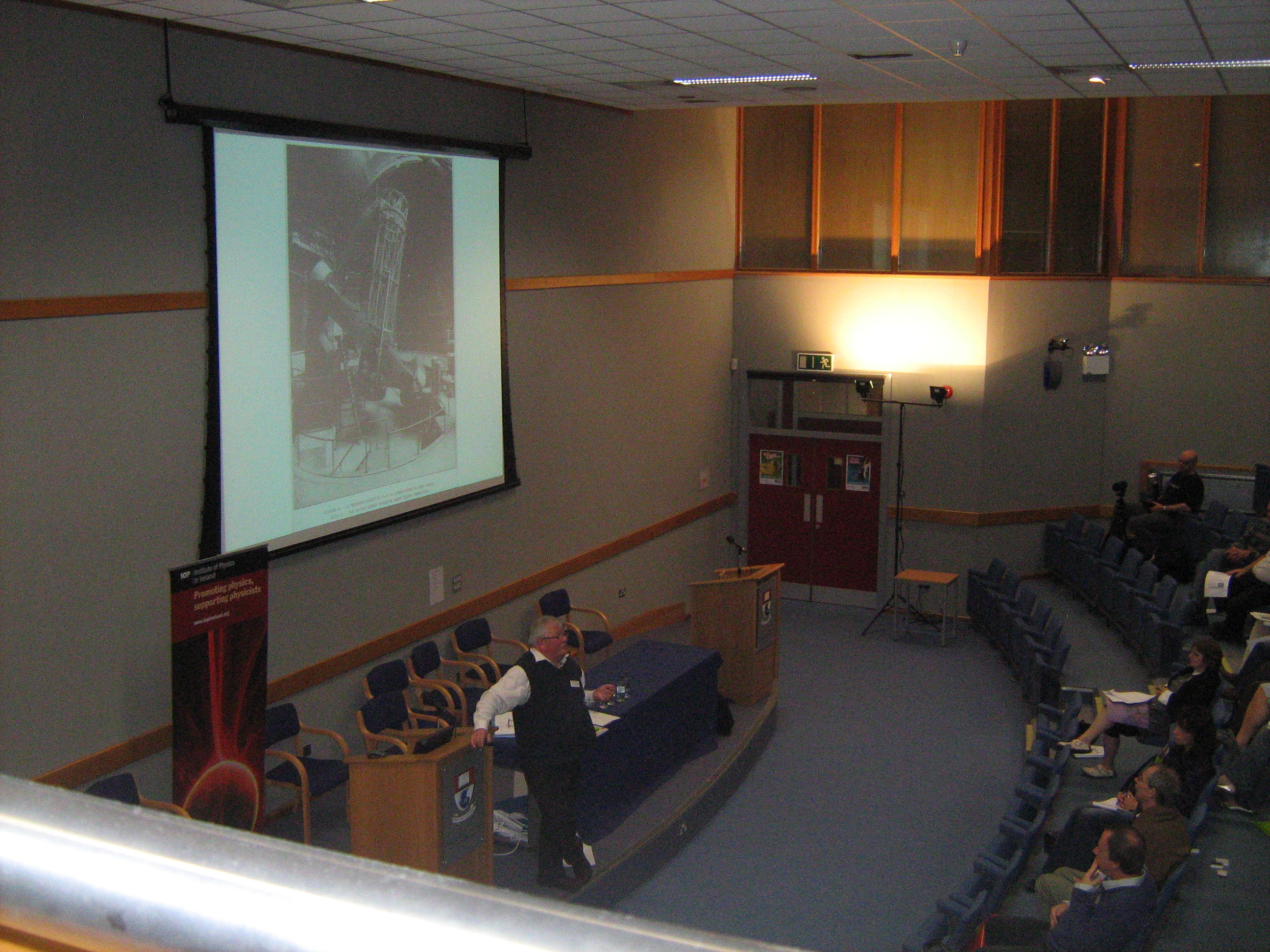
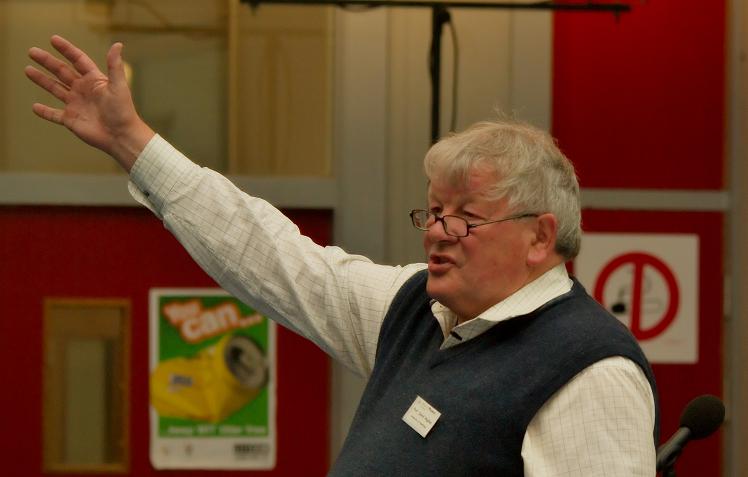
First up to the podium was Prof David Hughes, a highly distinguished astronomer and science communicator from the University of Sheffield, with a talk entitled ‘Telescopes: their history, development and future’. This was a masterly presentation on the evolution of the telescope over the centuries and its effect on science. The seminar covered the whole gamut – from Galileo’s use of a primitive telescope to observe the moons of Jupiter and the phases of Venus, and its impact on the geocentric model of the solar system, to Hubble’s use of the 100-inch Hooker telescope on Mt Wilson to establish the existence of distant galaxies and the subsequent discovery of the expanding universe (the first plank of evidence for the Big Bang model). I really liked the way the speaker emphasised the impact of each technological step in the development of the telescope: from refracting lenses to reflecting pyrex mirrors, from simple drawing to photographic images, from cumbersome mechanical mountings to computer-controlled giants, from simple photography to the modern CCD camera. (Interesting stat: for the last four centuries, the physical size of telescopes has doubled every 50 years). This was a masterclass in science communication and the audience was enthralled.

telescope

David Hughes with an image of the Hooker telescope in the background

David Hughes2

It’s astonishing how astronomy still revolutionizes cosmology from time to time: throughout David’s talk I kept thinking of the recent measurements of distant supernovae that led to the discovery of a universe expansion that is currently acclerating (see post on dark energy here). Interestingly, David was quite cautious about this result in discussion, pointing out that it depends critically on our understanding of Type 1 supernovae – it’s just possible that the effect arises from a lack of understanding of these stars, although there is some coobborating evidence of dark energy from recent measurements of the cosmic microwave background.

In the second talk of the day, Eoin Gill of the WIT science communication group CALMAST gave a talk on ‘The life and legacy of Robert Boyle’. It’s often forgotten just how important the work of this Irish scientist was, from his theory of ‘corpuscules’ to his famous work on gases. Eoin gave a great talk on Boyle, giving an overview of his life and times and the impact of his scientific discoveries. As regards the former, many were surprised to hear that the Irish have a mixed view of one their most famous scientists because of his family background. Robert Boyle was able to indulge his passion for science due to vast wealth inherited from his father, the Earl of Boyle: unfortunately the latter was a notorious Englishman who made his fortune by stealing land from the Irish and redistributing it to English nobility!

boyle

Robert Boyle (aka Eoin Gill) in action

Robert Boyle 2

The high points of the talk were the simple but effective demonstrations. Taking his cue from the famous demonstrations employed by Boyle himself at Royal Society lectures, Eoin showed several neat demonstrations of the vacuum that could be done in the classroom – snuffing out candles in a sealed container attached to a simple pump, the elimination of noise from a bell in the same container, the impossibility of pulling apart spheres separated by a vacuum and many others.

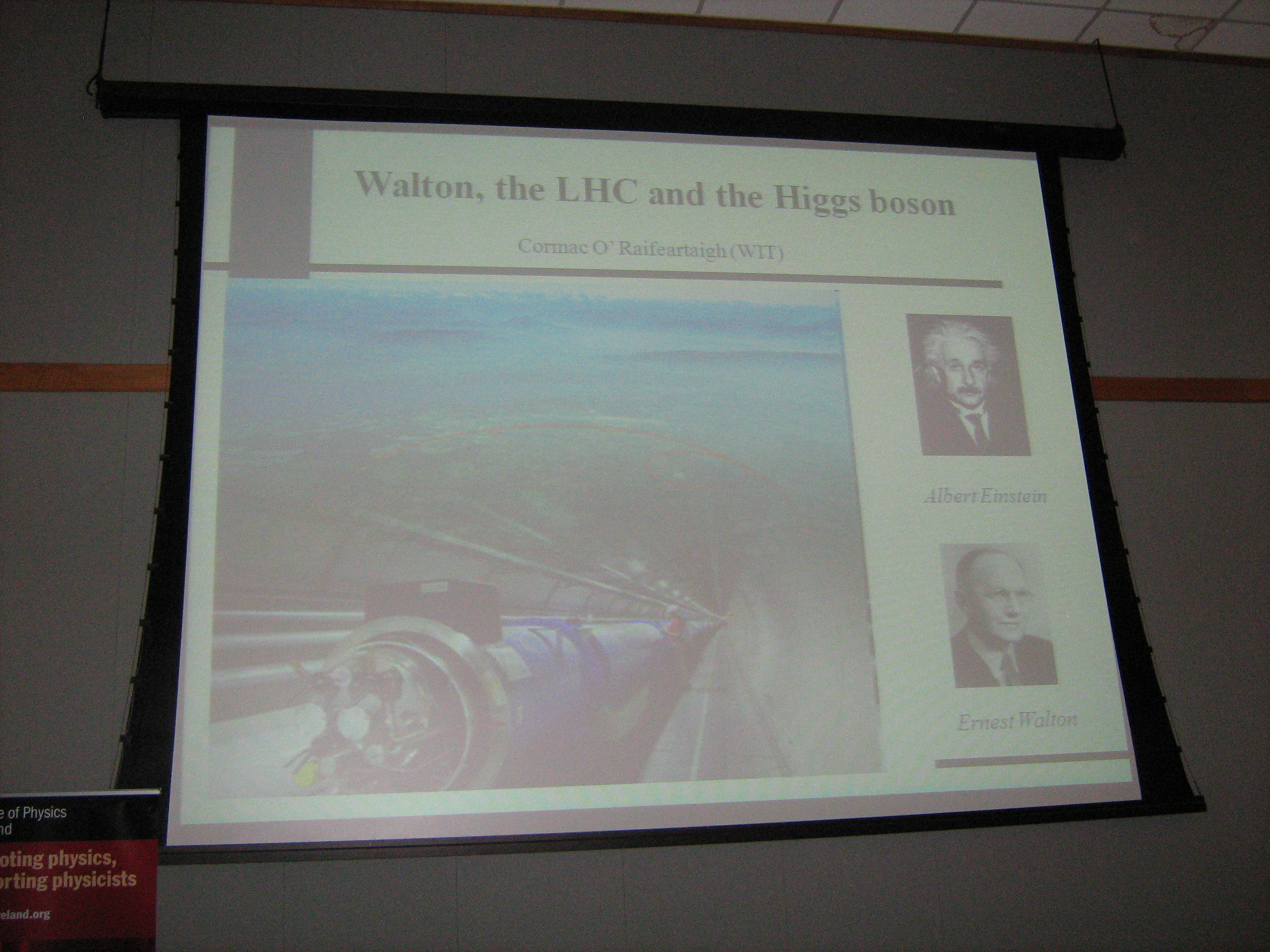
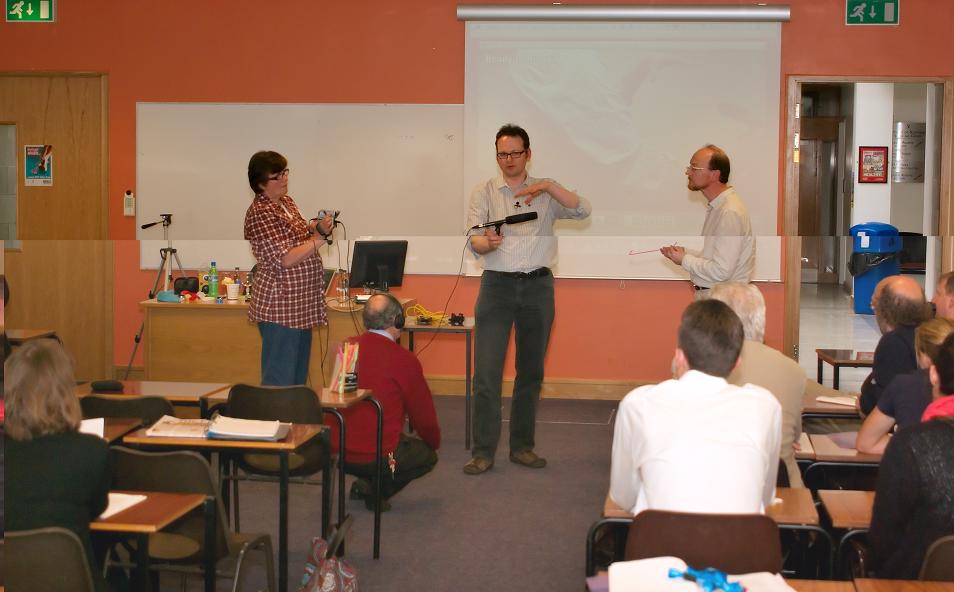
The third talk of the morning was my own presentation on ‘Walton, the LHC and the Higgs boson’. This was a 40-min overview of the forthcoming experiments at the Large Hadron Collider at CERN and their importance in the study of the elementary particles, along with a few words on the role of the Waterford-born scientist Ernest Walton in the evolution of accelerator physics.

w2

Cormac2

Ronan McNulty of University College Dublin gave an excellent short talk on his group’s involvement in the LHCb experiment at last year’s conference, so this was an attempt at a more general overview of experimental particle physics. Part one dealt with the how, what and why of the LHC: how particles are created and detected, the relevence of such experiments for particle physics and cosmology and a few specifics on the proton beams and the detectors. (I also tried to emphasise the fact that relativistic effects such as mass-energy equivalence, time dilation and length contraction are routinely measured in particle experiments as I feel this point is often forgotten). The second part consisted of a whirlwind introduction to the Standard Model, from the discovery of quarks to electroweak unification. In the 3rd part, I sketched the role of the Higgs boson in the model and the difficulties of detection. I touched on the possiblity of physics beyond the standard model at the LHC (supersymmetric particles and the implication for grand unified theories) before finishing up with a few words on cosmology – the search for dark matter particles and the study of matter/antimatter decay in the LHCb experiment.

You can find the slides from the talk here and a video will be available on the conference website next week. My only regret is that the conference had been running 15 minutes late all morning so there was no time for questions  – the best part of any talk. Also,  I never got time to show Kate McAlpine’s LHC rap, it would have gone down a bomb!

*************************************************

After lunch, Robert Hill , the director of the Northern Ireland Space Office, gave a workshop on useful astronomy software and website resources for teachers. As the former science communicator for the Armagh Planetarium and founder of the Astrogazers Ireland Schools Network, Robert knows a thing or two about getting young people interested in astronomy and science and this was a highly useful workshop, fnishing with a great 3-D show on the universe. I won’t give more details, but examples of the sort of invaluable web resources he gave are

Astronomy Ireland

Armagh Planetarium

The Hubble Site

The Faulkes Telescope Project

Celestia

Finally, there was a workshop on making videos for educational proposes by Jonathan Sanderson. Jonathan is a highly experienced producer of TV science shows (he has produced series on science for the BBC, ITV and RTE) and he gave us an overview of the SciCast project: this is a nationwide effort in the UK to get students to discover the wonder of science by making short films of simple scientific demonstrations. Jonathan had some great tips on how to get the students to work in teams for the production of such films and then showed us some classic examples from the existing SciCast collection. So far, there are more than three hundred films in the SciCast collection, you can view the collection here!

Video workshop2

A masterclass in science film directing

All in all, it was a great conference, with plenty of items of interest for any science educator. There were also plenty of useful freebies such as astronomy posters, polarising sheets, SPIN science magazine, flash memory sticks and a DVD on the universe produced by the ESA. Professional photos of the event and videos of the talks will be available on the conference website in a few days.

4 Comments

Filed under Particle physics, Public lectures, Teaching

Institute of the Year 2009/10

This week is Clubs and Societies week at WIT and there is a great atmosphere around the college. As in any third level college, there are many interesting clubs, from Gaelic games to swimming, from canoeing to rock climbing etc. This is an important part of college life as the clubs offer a wonderful opportunity for students to try a sport they may never otherwise encounter. For example, the sailing club gives students an opportunity to learn to sail without the hassle of buying a boat or joining an expensive sailing club. My own favourite is the surf club – this is a big hit as the college is only a few miles from Tramore surf beach and students from distant parts of the country (and abroad) are keen to sign up.

Image0016

*************************************

There is also a good mood around the college because WIT has just been nominated Institute of Technology of the Year in the Sunday Times league table of Irish third level colleges. The Sunday Times ranking is the only league table for the IoT sector and it is the second time WIT has won the award in the last few years.

It’s always good to come first, but it’s hard to know how accurate such rankings really are. Different colleges come top each year, which might indicate that the variation in a given college from year to year is larger than the variation between different colleges. That said, only a small number of colleges vie for top position every year so I guess it’s an honour to be in that number.

The main categories used in the Sunday Times rankings are: median CAO entry points, staff/student ratio, graduate employment, student grades, research income,  % non-standard entry rate and % dropout rate. This year, WIT scored an impressived 9/10 overall,  with the following breakdown:

average CAO entry points : 357

average staff/student ratio: 12:1

graduate employment: 99.2%

student grades of 2.1 and above: 56%

annual research funding: 18.2 million €

non-standard entry: 35%

student dropout rate: 15%

You can see more details here. It’s a good result, but one must admit that the poll is not a scientific study. For example, some academics question the ‘student grades’ category: a high percentage of 2.1s or above is awarded a high score, but it’s always possible that such a score reflects exam standards rather than better teaching (colleges set their own exams). This is an argument for another day, but let me note that even if this were true, I’m not mad about the other extreme: a recent study confirmed that throughout the 1980s, UCC and UCD graded their students far harder than Trinity, a habit that advantaged nobody and disadvantaged their students.

As regards the university rankings in the Sunday Times study, NUI Maynooth is the 2009 University of the Year up from 7th place last year. This is only one of two categories for the universities (I’m not that clear on the difference) but it’s pretty impressive for one of Ireland’s smallest universities. It does however raise a question: how could any college change this much in one year? I suspect it indicates that there are only small differences in scoring between the universities. Indeed, a positive result that can be drawn from the Sunday Times annual rankings is that Irish university students are offered pretty much the same level of education irrespective of which university they attend, in marked contrast with the American system. I like the Irish system better and I think we should stick with it, and forget the recent suggestion of a two-tier university system with an eye to world rankings.

550W-Campus-Tour-for-University-of-Dayton-students

University College Maynooth

How do the Institutes of Technology compare with the Irish universities? It’s hard to tell as there are separate lists for the two types of college. I think it would be interesting to see a direct comparison between the two: in particular, I think the results in research funding for WIT and CIT might come as a surprise to some university colleagues.

Finally, I can’t resist pointing out the sad irony of WIT coming top in such studies. Waterford is one of the most disadvantaged of Irish cities and one reason for this may be that is the only Irish city without a university, causing an inevitable braindrain of our best schoolleavers to Dublin and making it difficult to attract multinationals to the region. In other words, the city desperately needs the cachet that a university would bring and clearly has a college that could form the basis of such a university, but nobody in government is much interested.

Some might argue that if Ireland were governed by logic rather than history and religion, there would be no university in the town of Maynooth and there would be one in the city of Waterford where it’s needed…I couldn’t possibly comment!

Update: this post has been reproduced on the 9th level Ireland website, you can see the comments there

Comments Off on Institute of the Year 2009/10

Filed under Teaching, Third level

A day in the life

Update: WIT has just been declared Institute of Technology of the Year in the annual Sunday Times league table. This is the second time we have been awarded this and the  criteria include research funding, graduate employment and staff/ student ratios. I rest my case!

*********************************************************

We’re already in the second week of the teaching semester at WIT and life is settling back to normal after some timetabling problems. University colleagues are often curious about life in an Institute of Technology, so I’ll try and describe a typical day…

I start most days with a 9.15 lecture to 1st science (after parking some distance away as the college simply can’t cater for 6,000 cars but is strangely reluctant to introduce permit parking). Teaching first year physics is a bit of a chore after all these years and the class is large at 75 students. That said, it’s nice to be present for their first introduction to physics and I try to keep them interested by linking the elementary stuff to deep ideas in cosmology and particle physics (How big is the universe? Is time a vector or a scalar?).  Also, the vibe in 1st science is always good as the students are delighted to be in college, studying a host of new subjects.

images

Waterford Institute of Technology, Ireland

Most days, I’ll give a second lecture before lunch, to electronic engineers, with a morning break to catch up on email in the office. After lunch, I generally take a practical class, or else more advanced classes like 3rd and 4th year quantum physics. All in all, it is quite a heavy teaching load (16 h/w) in comparison with university lecturing. I enjoy the teaching, but the lectures, labs and staff meetings required for four different courses can take up 100% of your academic life if you let it. Still, it’s not too bad if you don’t have too many new modules in any given semester! Ironically, the new modules are often the most interesting, from cosmology 101 (see categories)  to the science of climate climate change next semester.

p3-2

The college library

After the day’s teaching, I try to get some research done in the office from 4–6 or 5-7. One big difference with university life is that research in the IoT sector is self-driven, i.e. there is nothing specific in our contract about research. In some ways, this makes for a more relaxed life and indeed some staff confine themselves to teaching and preparation. On the other hand, there can be problems of motivation for those who do choose the research path, particularly as there is no reduction in teaching hours, or a definite career path linked to research. Despite all this, there are some highly competitive research groups in the college, attracting serious funding at national and international level. Recently, the college authorities decided to award nominal professorships for outstanding researchers and I think this will be helpful.

Another issue in the IoT sector is office space. Because the Institutes started out as teaching-only institutions, staff often share quite large offices. I myself share an office with seven other lecturers; with students coming to the door and phones continually ringing, not much real academic work gets done between classes during the day, hence the evening shift.

Overall, there is a very good atmosphere in the college,with a fairly young, well-motivated staff. There is plenty of interaction between staff of different disciplines at coffee time, more than in any other college where I have worked (3). It helps that the college is the only third level college in this part of Ireland and enjoys a reputation of being effectively university-level in both teaching and research. Sadly, it may never actually get the deserved upgrade for reasons of realpolitik; in the parish pump world of Irish politics, there is a very real danger of all of the Institutes being subsequently upgraded, resulting in 13 new universities!

*********************************************************************

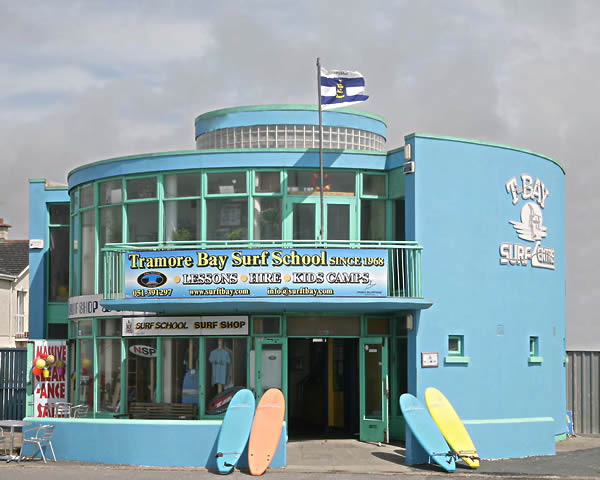
After work, I might catch a wave in Tramore Bay on the way home if conditions are good, otherwise it’s off to the pool or gym. Failing, that, there is always something going on in college, from an excellent film club to concerts, from public lectures to evening classes – this year I’ve enrolled for Creative Writing, can’t wait.

tbaysurfcentre

T-bay surf centre

*********************************

As regards my own research, I took a break from technical research two years ago in order to concentrate on science communication. I’ve been interested in the whole area of the public perception of science for some time and it’s an area that’s becoming more and more important as society faces challenges such as global warming and energy supply. My particular area of interest is that of public information vs misinformation. There seems to be a great deal of misinformation around on matters scientific in the US and Ireland; sometimes it arises from journalistic ignorance and sometimes from vested interests.

It’s not an easy field to break into but I’ve been lucky so far, with regular pieces in newspapers like The Irish Times and magazines like Physics World (see My Articles).  The blog doesn’t hurt either; I’m currently in negotiations for a pop book on cosmology and I often get asked to give public lectures (this month, I’m giving a talk on the Large Hadron Collider at the Institute of Physics teacher’s conference and next month I’ll give a talk on the Big Bang to Astronomy Ireland at Trinity College, see Public Lectures).

In the longer term, I guess it’d be nice to get back to the university sector eventually, ideally as a Professor for the Public Understanding of Science. Writing articles is fine, but I’d relish the chance to be involved in public science debates in the media with prominent doubters and skeptics (wouldn’t say no to a quiet office, either). Although there are many PUS positions in the UK and the US, there are currently none in Ireland, hopefully this will change in the future.

In the meantime, I enjoy both the teaching and research in different ways. I can summarise a typical day’s work with a famous quote – if you find a job you enjoy, you’ll never have to do a real day’s work in your life!

10 Comments

Filed under Science and society, Teaching

back 2 school

Last week was exam week, with repeat paper corrections and countless exam board meetings. I quite enjoy the cut and thrust of these meetings, but I notice a paradox: the hardliners and sticklers always seem to be staff that are the least active in research. Perhaps flexibility about student marks is also about being aware of one’s own limitations.

This week it’s back to school in earnest as lectures begin. My timetable’s not too bad – like any lecturer in the Institute of Technology system I have a heavier teaching load than a universtiy lecturer, but on the other hand I get to teach on all sorts of different courses – from so-called service teaching (1st year science and and 1st year engineering courses) to 4th year solid-state and quantum physics.

I don’t mind really mind the service teaching, but the classes seem to get bigger every year, with no corresponding increase in staff. Plus, physics is the not the favoured subject of most of these students, so it can be a struggle to keep them motivated.

image

Enthralled class

The really bad news is that our degree in physics with computing is being phased out due to poor uptake. We were not permitted a first-year intake, so the future of physics at WIT the looks pretty grim. So much for the knowledge economy, then.

Comments Off on back 2 school

Filed under Teaching

The Doolin sessions

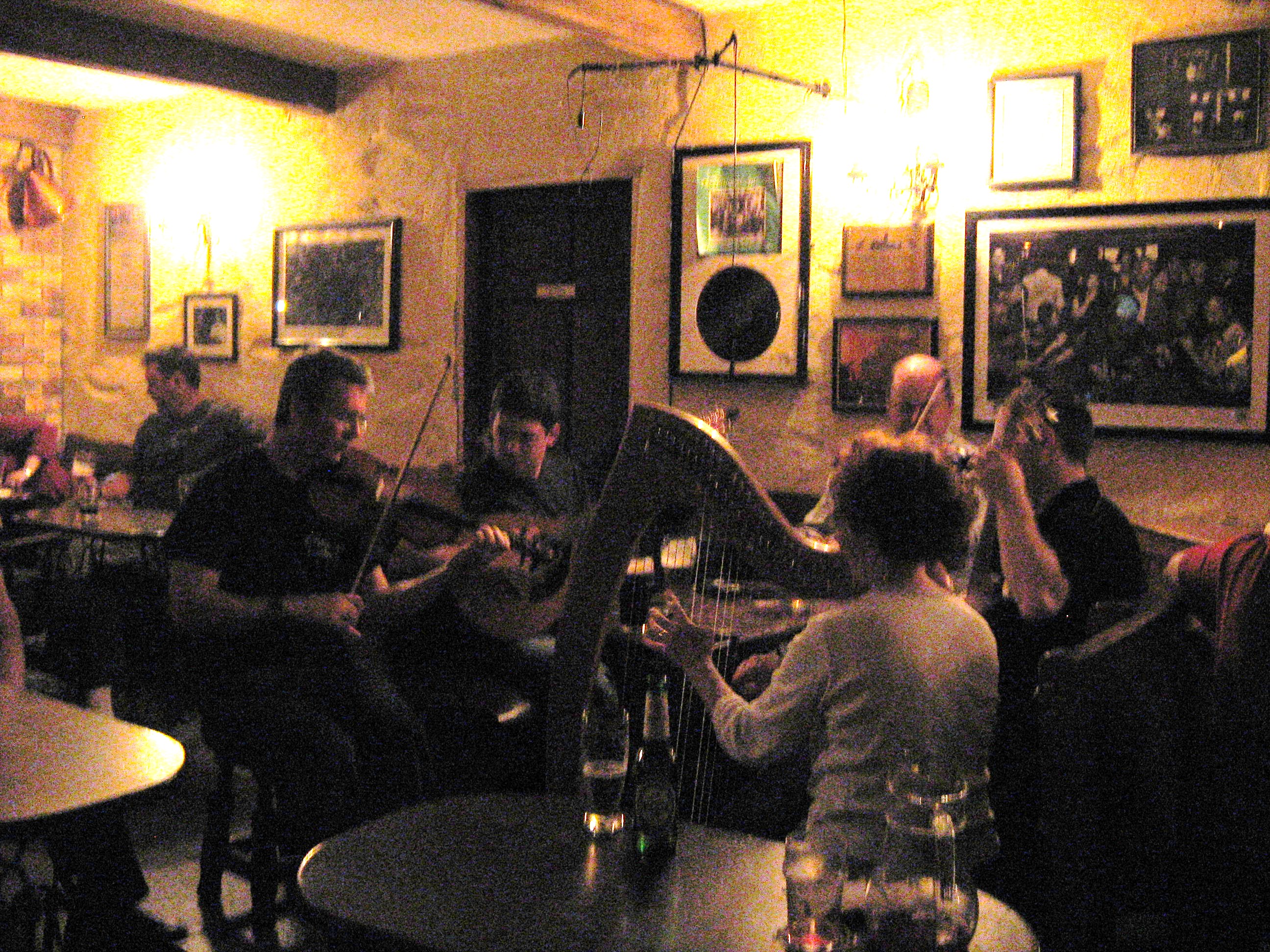
I’ve stayed on an extra few days in Doolin, the surf is good and the music second to none. Most nights I have a tune in O Connor’s Pub, the only pub left in Doolin that has truly spontaneous sessions, with different musicians every night.

The tradition of the session is the huge strength of Irish traditional music. Essentially, two or three local musicians are paid a few bob to play a few tunes in the local pub on a certain night, without rehearsal or amplification. Because it’s spontaneous, visiting musicians can join in if they know enough of the repretoire. In this way, visiting musicians get exposed to Clare tunes and styles, while the local players get to hear music from all over the world. It’s a wonderful tradition to observe or participate in.

001

IMG_0195

Late night jamming in O’ Connors

Sadly, a great many pubs have now gone the route of ‘gigs’: employing one or two musicians to play a rehearsed show using mikes. This ensures a certain standard every night, but effectively prohibits visiting musicians from joining in. Even in Doolin, there is really only one pub left where one can join in and have a relaxing evening with tunes, songs, jokes and stories. As for the tourists, I’m pretty sure from their reaction they can tell the difference between the rehearsed and the contrived..

3 Comments

Filed under Music

Waves and music in Doolin Co. Clare

I’m spending the last week of the holidays in Doolin, Co. Clare in Ireland, one of my favourite spots in the world. Right on the westmost edge of Europe, Doolin is a tiny village that has a very special landscape and tradition. It’s also a mecca for traditional music, not to mention one of Europe’s best surfspots. What a place.

Doolin, Co. Clare

Most evenings I get my fiddle out in O’ Connors pub, jammin with old friends and new. The standard of playing is very high – Clare is the birthplace of much of Irish music – but the locals are always very welcoming. It’s a different crew every night, so it’s great experience for a Dublin musician like me, playing tunes I rarely hear. There’s also a fantastic atmosphere in the pub every night as it’s packed with international tourists who have travelled to Doolin specifically to hear the music.

5810_1035156334416_1690702491_67446_529403_n

During the day  there’s the surf. Few of the tourists realise that Doolin is neatly sandwiched bewteen Fenor and Lahinch, two of the best surf beaches in Ireland. At the moment I’m teaching the manager of the hostel and his kids to surf, it’s very satisfying. That said, there are bigger waves coming on Thursday, so it’ll be out back for me from then on..

5340020853400209

What a place, I’ll be sorry to go back to being a boring scientist. I’ve even got fit again without really trying!!

Update: photo for PW

surfer physicist

Comments Off on Waves and music in Doolin Co. Clare

Filed under Music, Surfing