STS Conference at Harvard

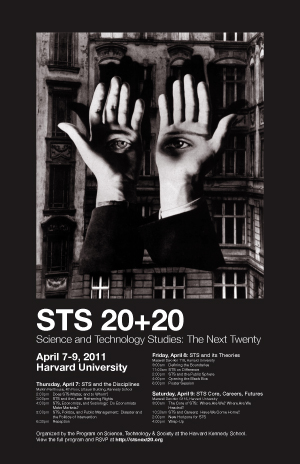
This week the Program on Science , Technology and Society (STS) at Harvard is hosting a major conference. The conference STS 20+ 20:  Science and Technology Studies : The Next Twenty, will run from Thursday May 7th until Saturday May 10th. The theme of the conference is “A Meeting Reflecting on the Past Twenty Years of STS Graduate Study, and Looking Ahead to the Next Twenty”. As a visiting fellow with the program, I am really looking forward to it.

You can see the conference program here. Each day is based around a different theme; Day One will deal with the theme of disciplinarity (Does STS Matter, and to Whom?), Day Two with STS theory, and Day Three with the future of the discipline (more details on this later). There will be 3-4 sessions per day, with leading thinkers in the field such as Sheila Jasanoff, Trevor Pinch, Stephen Hilgartner and Stephen Eptstein acting as Chairs and discussants.

A summary of the conference is provided by Sheila Jasanoff, the director of the STS program at Harvard, on the  conference webpage:

[This meeting is the product of a year of conversations across several continents and dozens of institutions. It weaves together the hopes, aspirations, and—yes—frustrations of STS scholars from around the world who have committed their careers to studying the central role of science and technology in our social, political, and moral lives.

The meeting is in part a stock-taking. After two decades of increased public funding for STS, what can we say about our achievements as a “thought collective”? What have we learned from speaking the truths of our field to the power of established disciplines? Which areas of work do we recognize as displaying the greatest theoretical depth and creativity? What do we impart to STS scholars-in-the-making, and what can we do to ensure that their ideas are heard more widely and that they find appropriate academic homes? The three-day program addresses these questions: first, STS and the disciplines; second, STS and its theories; third, STS’s institutional challenges and opportunities.

In part, too, the meeting is a provocation: an invitation to reflect on the conditions needed for this field to thrive and grow—in keeping with the importance of its mission. As with any provocation, the questions we hope to explore may have conflicting answers. Ideas will be generated throughout the meeting from both our physical and virtual audiences. This website, managed by a local team of scholars, is part of an effort to make the meeting as inclusive and participatory as possible, both during the event and after it.

Overall, this is a meeting to rethink questions that all STS scholars have grappled with at some point in their intellectual lives. Why do STS? What makes it interesting, distinctive, coherent, relevant, and deserving of stronger institutionalization?]

Comments Off on STS Conference at Harvard

Filed under Science and society

The big bang: is it true?

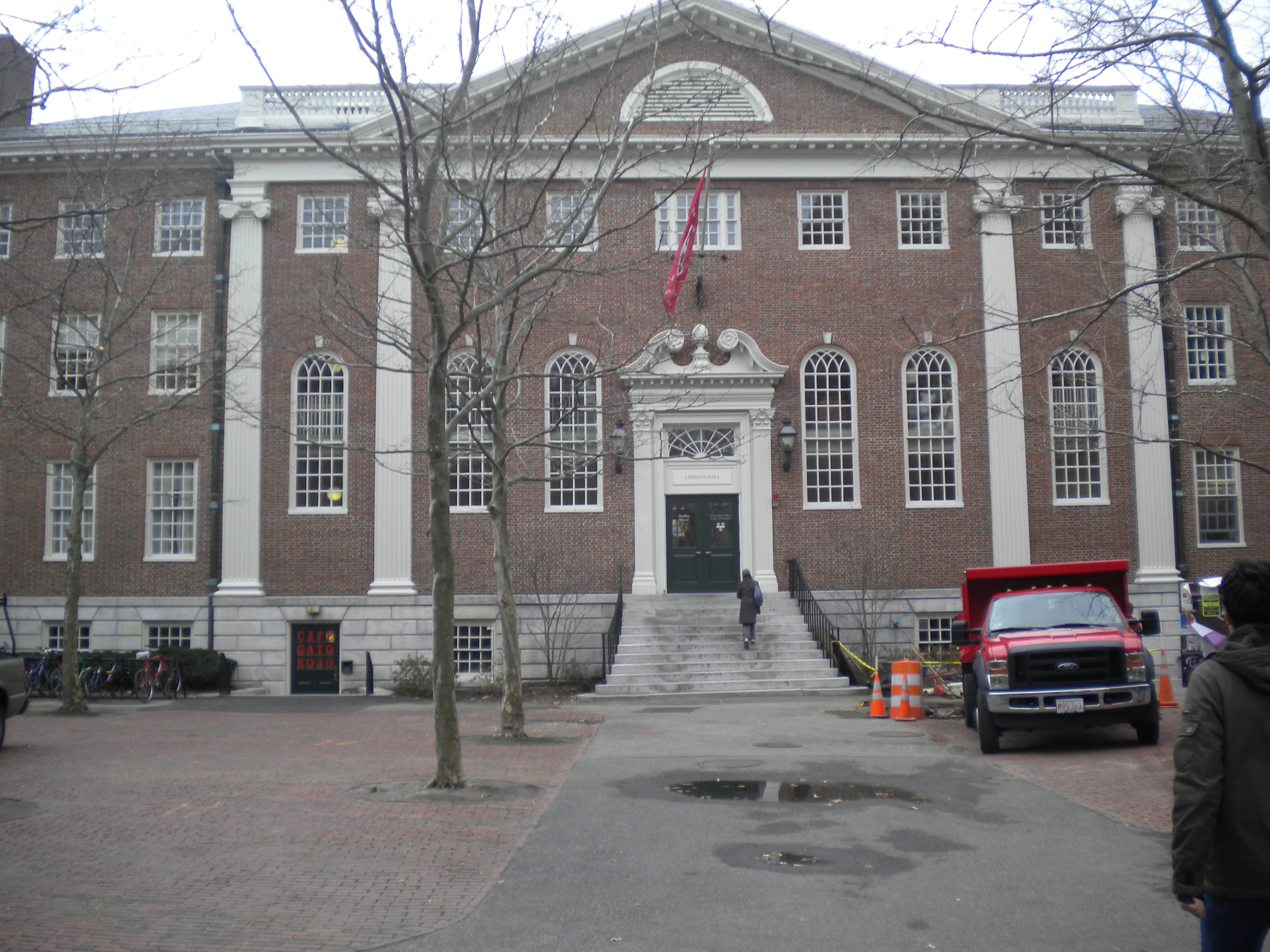
On Monday evening, I gave a big bang talk to the Harvard Graduate School of Arts and Sciences. I really like the way there is a single graduate school for both arts and science at Harvard, what a great interdisciplinary mix. The school has its own activity center, Dudley House ; the house is non-residential but modeled on the residential houses at Harvard, with its own building (Lehman Hall) complete with coffee shop, canteen, senior common room, games room, and a beautiful and quiet library with a fantastic view of Harvard Square.  It is served by two faculty masters, an administrative staff and graduate student fellows who organize activities for the School’s 4,000 Masters and PhD candidates. In truth, I spend a good deal of time at Dudley House – perhaps it’s the wide variety of disciplines that makes for such interesting conversations.

Dudley House, home of the Harvard Graduate School of Arts and Sciences

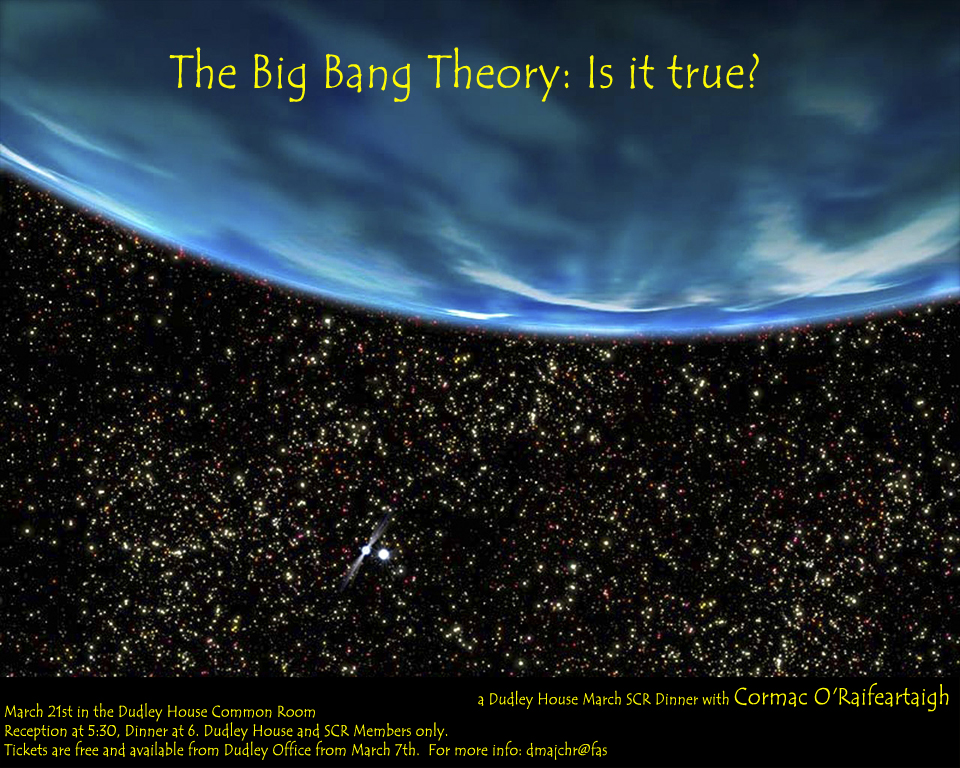
The talk was titled The Big Bang; Is It True? and it was great fun, with a drinks reception, a really nice dinner, a 40-min spiel from me and then almost an hour of questions from the audience. There were postgrads there from history, literature, psychology, philosophy, astronomy and other fields. Apparently, tickets sold out within hours of the posters going up, it shows the interest in the subject.

Of course, no scientist can give a definitive answer to the question I posed. Instead, I laid out a brief history of the discovery of the evidence supporting the big bang model (the expanding universe, the composition of the elements and the cosmic microwave background), followed by an outline of recent puzzles that have arisen from modern studies of the microwave background. I like a quasi-chronological approach to such talks, I think it makes the discoveries and concepts easier to understand, and at the same time it gives the audience a great feel for the surprises nature has in store for scientists. As for truth, the audience can decide for themselves.

You can see the full slideshow at https://coraifeartaigh.wordpress.com/my-seminars/

I really enjoyed the questions and discussion afterward; not for the first time, it struck me that you get very interesting questions and comments from a wide interdisciplinary audience (it doesn’t hurt if they are Harvard PhD candidates). There was also plenty of time to touch on one of my favourite themes; that a great many scientific discoveries come as a complete surprise to the discoverers. Far from being ‘constructed’ in order to support pet theories, scientific findings are often undesirable, unexpected data that no-one knows what to make of  at first – an aspect of science that proponents of the social construction of scientific knowledge often fail to address, in my view.

All in all, it was great to interact with postgrads from so many different disciplines, I wish I could do this more often.

Questions

One of the most challenging questions came from Prof Sam Schweber, a well-known Harvard physicist and historian of science. Sam couldn’t make the talk, but he emailed me his question: What happened before the bang?

I think the answer is twofold:
1. The standard answer is that the big bang model is situated within the context of general relativity, the modern theory of gravity. Since relativity predicts that space and time form part of the universe (and are affected by motion and by mass for example), we expect that time is born at the bang along with everything else – there is no ‘before’ just as there is no north of the north pole.

2. However, cosmologists are less cocksure of this answer nowadays. This is because fundamental problems in describing the moment of the bang (the singularity) have, far from going away, got worse. The problem is due to the inapplicability of the modern theory of gravity to phenomena on the atomic or quantum scale i.e. due to the absence of a successful theory of quantum gravity. Since we have no real way of modeling the singularity, we cannot rule out the prospect of exotic phenomena such as multiple bangs. The problem is compounded by the fact that, while recent observational evidence offers support for some type of cosmic inflation close to the birth of the universe, there is (so far) no way of selecting a particular model of inflation – which leaves the door open for models such as the cyclic universe. In other words, we cannot rule out the possibility of a ‘before’ until we have a clearer picture of what happened at the bang itself.

25 Comments

Filed under Cosmology (general), Public lectures

Boris Hessen and externalism

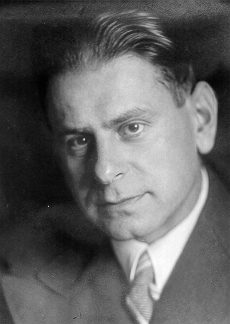
We met a very interesting figure in the study of the history of science in class today: the Russian physicist Boris Hessen. Hessen is famous for a 1931 paper entitled The Social and Economic Roots of Newton’s Principia, in which he suggested that Newton’s monumental work was created to cater to the goals and desires of 17th century industry and society in England. In other words, Hessen argued that Newton’s work was not the disinterested study of the natural world, but was motivated by an attempt to solve the problems of society of the day.

Boris Hessen (1893-1936)

Modern scholarship has revealed that Hessen’s motives were not completely academic. In the Soviet Union in the 1930s, the work of Albert Einstein was under attack by Communist Party philosophers, as they saw it as a concern of the bourgeoisie. Hessen was a strong supporter of Einstein’s theories and his study of Newton was intended to show that scientific validity could exist whatever the motivations were for undertaking it. Sadly, he was executed by the NKVD in 1936.

Hessen’s focus on the relationship between society and science was quite novel at the time and became very influential. It was a challenge to the tacit notion that the story of science is a story of independent genius in action. The assertion of a connection between the growth of knowledge and society at large was viewed with keen interest, not least because of the prospect of another war in Europe. Previous views of science as separate from the mundane aspects of life were becoming less plausible than a view of scientists embedded in the world in which they worked.

This view of the history of science  i.e. looking at the manner in which science and scientists are affected by society, is now known as externalism. It is the opposite view to internalism , a view that sees the acquisition of scientific knowledge as a process that can occur at any place and time given the right human actors. Internalist histories of science tend to focus on the development of ideas wholly within the scientific world, and emphasize the norms of modern science such as disinterestedness and universalism.

Which is the “correct” view for a historian of science? This is not an easy question to answer because the differences between internalism and externalism are closely related to basic problems in the philosophy of science we have met before. What is the relationship between the producers and consumers of scientific knowledge? What does objectivity really mean in a scientific context? All of which quickly leads us back to familiar questions such as what is the nature of scientific truth?

The historian and sociologist of science Robert K. Merton produced many famous works in reaction to Hessen’s thesis. Merton accepted the influence of external factors on science but differed from Hessen in his interpretation: Merton maintained that while researchers may be inspired by problems suggested by extra-scientific factors, ultimately the researcher’s interests are driven by the internal history of the science in question. Indeed, Merton sought to delineate externalism and internalism along disciplinary boundaries, with context studied by the sociologist of science and content by the historian.

5 Comments

Filed under History and philosophy of science

The philosophy of Bruno Latour part II

In the last post, we touched on some of Latour’s ideas that have been so influential in the history and philosophy of science, notably the work Laboratory Life and the later concept of Actor Network Theory.


An early contribution that should be mentioned is Latour’s study of the work of Louis Pasteur: in The Pasteurization of France , Latour published a history of Pasteur’s work that laid great emphasis on the social forces at work at the time, and on Pasteur’s harnessing of those forces. In the book, Latour goes to some lengths to argue that the widespread acceptance of Pasteur’s work by French society was not primarily a matter of evidence or reason, but due to a large degree to social factors that had been neglected in earlier accounts. This work went on to become very influential in the field of Science and Technology Studies (STS).

*********************************************

What is really unusual about Bruno Latour is that this particular philosopher published a review paper in 2004 that seemed to question the fundamental premises of most of his career. Titled “Why Has Critique Run out of Steam? From Matters of Fact to Matters of Concern” , the paper contains a critique of much of his own work and of the social criticism of science in general. Latour specifically asks  “Was I wrong to participate in the invention of this field known as science studies?” and suggests that much of social criticism may have been directed at the wrong target.

What caused this apparent change of heart? One reason is that, like many STS scholars, Latour seems concerned that many of his cherished critical ideas have been appropriated by constituencies whose agenda is anti-science; specifically by “conspiracy theorists, including global warming skeptics and the 9/11 Truth movement“. He expresses concern that his attempts to lay bare “the lack of scientific certainty inherent in the construction of scientific facts” have now been appropriated in a manner he never intended; “I am worried to detect, in those mad mixtures of knee-jerk disbelief, punctilious demands for proofs, and free use of powerful explanation from the social neverland, many of the weapons of social critique.”

A second cause for a rethink is that Latour feels there are some fundamental flaws in social critique; in particular that “there are inconsistencies and double standards that go largely unrecognized in the field”. His point here is that “social critics tend to use anti-fetishism against ideas they personally reject; to use “an unrepentant positivist” approach for fields of study they consider valuable; all the while thinking as a perfectly healthy sturdy realist for what you really cherish.”

These are serious criticisms and Latour goes on to suggest that in order to maintain any vitality or relevance,  social critique of science requires a drastic reappraisal; in particular “it must embrace empiricism, to insist on the cultivation of a stubbornly realist attitude – to speak like William James”. Embrace empiricism? Speak like William James? Much of the above seems a fairly radical U-turn for an outstanding proponent of the constuctivist view of science. However, it should be pointed out that there are different interpretations of Latour’s 2004 article as we shall see below.

Reception

Latour’s 2004 paper has received a great deal of attention. Many scientists, and some historians of science, see it as a recant. Sentences such as “the danger would no longer be coming from an excessive confidence in ideological arguments posing as matters of fact …but from an excessive distrust of good matters of fact disguised as ideological biases” resonated with many scientists, as did “ dangerous extremists are using the very same argument of social construction to destroy hard-won evidence that could save lives”. This was a common criticism of the social study of science all along – that there was a danger of throwing the baby out with the bathwater i.e. that social critique of science was serving to undermine hard-won scientific discoveries, all on the basis of sociological methodologies that were themselves far from perfect.

On the other hand, scholars in the field of Science and Technology Studies point out that a careful reading of Latour 2004 shows that he is talking about the future, not the past; his paper is primarily concerned with future directions for fruitful research in the social study of science, not with past studies. This is more marked in the second part of the article; Latour’s real point is that the world has changed, but the target of social critique may not changed to match this. He is particularly concerned at the instant revisionism he reads, from 9/11 conspiracies to moon landing fables. In a nutshell his main concern is ” what if explanations resorting to power, society discourse had outlived their usefulness and deteriorated to the point of now feeding the most gullible sort of critique?…threats might have changed so much that we might still be directing all our arsenal east or west while the enemy has moved to a very different place”.

What interpretation is correct? It’s hard to say, as always with Latour. In any case, it is an extremely thought-provoking article from a major figure in the social studies of science ..I strongly recommend reading it for yourself

5 Comments

Filed under History and philosophy of science

The philosophy of Bruno Latour (part I)

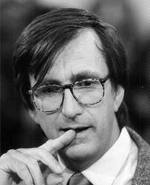
In today’s class on the history and philosophy of science, Alex introduced us to the French philosopher Bruno Latour. Latour is an extremely influential figure in the philosophy and sociology of science, and a leading light of the modern field of Science and Technology Studies.

Bruno Latour

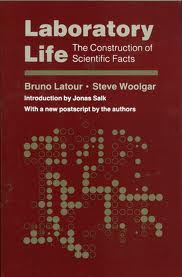
Much of today’s discussion concerned an early work of Latour, the book Laboratory Life: the Construction of Scientific Facts co-authored with Steve Woolgar. In the book, the authors undertake a study of a scientific research laboratory using the methods of anthropology. They make two major observations; first that laboratory process is deeply a process of inscription i.e. all measurements are ultimately reduced to written documents that are then durable and transportable. Hence, measurements are not debated directly but via representations such as documents and graphs. Second, Latour and Woolgar find that their observation of laboratory process does not square with the common understanding of the scientific method, in which theories stand or fall on the outcome of careful experiments. Instead, they find that an experiment typically produces only inconclusive data and that a large part of laboratory method involves taking the subjective decision of what data to keep and what to throw out. Hence, the experimental process is an elaborate mechanism for constructing facts rather than uncovering them.

This idea, that ‘scientific facts’ are not uncovered in a laboratory so much as produced or constructed, led Latour to more abstract ideas of the construction of knowledge. In particular, he formulated his ideas in terms of a theory known as Actor Network Theory (ANT). ANT describes scientific facts as being constructed via a methodology that involves a network of different actors; the scientists, the equipment, the laboratory, the technicians, the subjects or samples being studied and the wider scientific community etc. In Latour’s view, any study of science methodology must involve a detailed study of all the actors involved (particularly the non-personal ones) and on their interactions and alliances; scientific knowledge is then the product of the such alliances. [A classic example of ANT is an analysis of a scientific study of scallops by Michel Callon].

What exactly does Latour actually mean by the construction of scientific facts? Clearly, some things are socially constructed; society agrees on the importance of money so it becomes important, even though dollar bills are inherently worthless (this is known as known as weak construction). It also seems reasonable to argue that knowledge is socially constructed at least to some extent; that how we ‘find things out’ is very much contingent on the actorsinvolved i.e. scientists, samples, equipment, institutions and their interaction with one another. However, Latour goes further than this; he insists that what we call scientific facts are socially constructed. In a sense, researchers transform disorderly nature into orderly artifacts; scientists produce new objects in the lab, not pre-existing ones. For example, in Latour’s view, E = mc2 is not a fact of nature; it is a constructed fact, just like a beautiful building or a Mozart symphony. Note that this constructivist view of scientific knowledge may seem at odds with scientific realism (the belief that there is a real world out there and that science reveals the deep structure of nature). However, this is not a given as Latour is talking about the acquisition of knowledge; that said, he does seem to lean towards anti-realism as we shall see later..

Reception

Laboratory Life and similar studies that followed it have been enormously influential among philosophers and sociologists of science. However, a common criticism from scientists is that it is possible that the methods of anthropology give only a superficial view of scientific work. In this view, it only seems to Latour that some data was arbitrarily rejected; in fact, it was rejected for good reasons that would only be comprehensible to someone experienced in both theory and experiment (just as an experienced car mechanic will ignore side issues and quickly home on what is wrong with an engine using a process that is clear only to other mechanics). This may seem a rather arrogant view, but it is true that it takes years to train a student to be a good experimentalist.  [It’s interesting to imagine what an anthropologist with no musical training would make of a symphony orchestra; this person would make many interesting observations about the dress and social behaviour of the musicians, but could she form a good understanding of the core activity of the musicians, the group interpretation and performance of difficult music?].

On the construction of knowledge, Latour’s view has become a major lynchpin of the field of science and technology studies. It is a radical and difficult concept.  Most philosophers of science agree that knowledge is socially constructed in its acquisition and pay attention to studies by Latour and others of laboratory practice as a social phenomenon. However, whether this affects the ultimate content of scientific knowledge over time is the subject of much debate (philosophers call this the difference between the ‘context of discovery’ and the ‘context of justification‘). Hence, the process by which the phenomenon of radioactivity was discovered was undoubtedly a complex social process, involving the interaction of many scientists, seemingly unrelated studies, samples, equipment and institutions, to name but a few actors. But to suggest that our current knowledge of radioactivity is entirely dictated by this process seems more problematic; and to suggest further (as Latour often seems to) that the phenomenon of radioactivity is a human construct seems very strange. For example, people died of exposure to radioactivity before anyone knew of the dangers of gamma radiation; how is this reconcilable with a view of radioactivity as a constructed fact? Indeed, Latour attracted some negative publicity over just such a claim; when French scientists declared in 1976 that tests on the mummy of Pharoah Ramses II pointed to a death by tuberculosis, Latour claimed this to be impossible because the bacillus virus was not known at the time of the ancient Egyptians!

4 Comments

Filed under History and philosophy of science

The philosophy of Paul Feyerabend

We have seen that Lakatos adopted a view of science that is somewhere in between that of Popper and Kuhn. The Austrian philosopher Paul Feyerabend also studied under Popper, but adopted a very different position to that of Lakatos. Starting with Kuhn’s view that paradigm shifts do not occur on the basis of reason alone, Feyerabend went on to develop what is known as an anarchistic philosophy of science.

Paul Feyerabend

Feyerabend was heavily influenced by the counter-culture movements of the 1960s. The central themes of his philosophy of science can be found in his seminal work Against Method. (The book was originally intended to be published as a dialogue with his friend and colleague Lakatos but the latter died before the project was finished). I will try to summarize Feyerabend’s view of science in a few points;

1. On the issue of falsifiability, Feyerabend argues (in common with Kuhn and Lakatos) that no theory is ever consistent with all the relevant facts. Like Lakatos, he sees the use of ad-hoc postulates to save the dominant paradigm as an essential to the progress of science (see last post). However, Feyerabend goes much further than Lakatos; taking examples from the history of science, he claims that scientists frequently depart completely from the scientific method when they use ad-hoc ideas to explain observations that are only later justified by theory. To Feyerabend, ad-hoc hypotheses play a central role; they temporarily make a new theory compatible with facts until the theory to be defended can be supported by other theories.

2. On the issue of paradigm shifts (or moving from a regressive research programme to a progressive one, as Lakatos would say), Feyerabend emphasises Kuhn’s idea that the reigning paradigm heavily influences interpretation of observed phenomena.  However, he adds to this by suggesting that in the paradigm model, the reigning paradigm would also have a stifling influence on the incoming theory; instead of being dictated by agreement with observation alone, the new theory must also agree with the old in almost every instance.

3. Epistemological anarchism; putting the two points above together, Feyerabend concludes that it is impossible to view the progress of science in terms of one set of methodological rules that is always used by scientists; such a ”scientific method’ would in fact limit the activities of scientists and restrict scientific progress. Instead of operating according to universal and fixed rules, Feyerabend suggests that science often progresses by ad-hoc postulates that break the rules; this ‘anything goes’ view is formally known as epistemological anarchism.

4. Science and Society: the doctrine of epistemological anarchism is considered Feyerabend’s major contribution, However, he also had a major point to make about science and society. Starting from the view that a universal scientific method does not exist, Feyerabend goes on to argue that science therefore does not deserve its privileged status in western society. Since scientific points of view do not arise from using a universal method which guarantees high-quality conclusions, there is no justification for valuing scientific claims over claims by other ideologies like religion. Indeed, he was quite indignant about the condescending attitudes of many scientists towards alternative traditions such as astrology and complementary medicine.  In Feyerabend’s view, science can be a repressing ideology in society instead of a liberating movement; he thought that a pluralistic society should be protected from being influenced too much by science, just as it is protected from other ideologies.

This pluralistic view, that science does not have a monopoly on truth and its authoritarian status in society should be questioned, went on to become a major tenet of the modern discipline of Science and Technology Studies.

Criticisms

1. Feyerabend’s view of science is considered radical but interesting by many philosophers of science. However, one obvious criticism is that the comparison of science with cultural traditions such as religion doesn’t seem to stand up; faced with experimental evidence to the contrary, scientists do, eventually, change their story – unlike religion. No scientific theory that is in conflict with observation survives over time.

2. A criticism from historians of science is that Feyerabend often backs his thesis by choosing the science of Galileo; time and again, Galileo is portrayed as an example of a scientist in rebellion against the science of the day. The problem with this example is that it can be argued that what we now consider the scientific method was developed after Galileo, not before; the invention of instruments such as the telescope and the microscope led to the evolution of the sophisticated method of hypothesis and experiment we call the scientific method today. Hence the Galileo-as-rebel-against-the science-of-the-day narrative is questionable.

3. A general criticism from scientists is that an extraordinary thesis requires extraordinary evidence. Instead, Feyerabend’s thesis is based on case studies from the history of science that are debatable (see above, and last post), despite his meticulous research. Indeed, Feyerabend is sometimes accused of either misunderstanding or misrepresenting science in his examples. [For example, Feyerabend claims that the Newtonian view of gravitational acceleration was rebellious because it was in conflict with that of Galileo; most physicists consider this argument to be dead wrong. Newtonian mechanics deals with gravitational acceleration in a far more general way than Galileo, but it reduces to the Galilean case for an object is close to the earth’s surface; hence Newton is not in conflict with Galileo].  This example is fairly typical and raises concerns. Philosophers infer general conclusions from isolated case studies in the history of science; this is not ideal and it’s even more problematic if the case studies used are questionable.

4. On the other hand, Feyerabend’s idea of scientific imperialism is considered very important indeed and led to many studies that suggest that the use of science in society has not always beneficial, including studies that show that claims of scientific legitimacy were sometimes used by the state to introduce unpopular and unnecessary measures on populations..more on this later.

9 Comments

Filed under History and philosophy of science

Kuhn vs Popper; the philosophy of Lakatos

We saw earlier that Kuhn described scientific knowlege as progressing in a very different way from Popper. One attempt to reconcile their very different views was provided by the philosopher Imre Lakatos. Lakatos attempted to reconcile the two views of science by replacing Kuhn’s concept of the scientific paradigm with his own concept of the progressive research programme.

Imre Lakatos

Recall that Popper described science as progressing by a process of falsification; theories whose predictions conflict with experimental observation are soon discarded, and science progresses as a process of elimination. Kuhn saw this as an idealist view of science; a study of the history of science led him to view science as consisting of periods of ‘normal science’ in which experiment and theory are performed within a particular paradigm, with scientists holding on to their theories in the face of anomalies. Very occasionally, the reigning paradigm is overturned, but even when such a paradigm shift occurs, it is not based on reason alone because observation is influenced by the paradigm in which it occurs (see previous post for details).

The Lakatos view of science lies in between the two views above. The key to his contribution lies in what we understand by a ‘theory’; Lakatos suggested that in science, a ‘theory’ is really a succession of of slightly different theories and experimental techniques developed over time that all share a common hard core; such a collection he named the research programme. Scientists working within a given research programme shield the core from falsification with a protective belt of auxiliary hypotheses. The question of whether a worldview is true of false is replaced by the question of whether a research programme is progressive or degenerating. A progressive research programme is characterized by growth, prediction of novel facts and more precise predicitions etc. In contrast, a degenerative program is marked by a lack of growth; its auxiliary belt does not lead to novel predicitions that are later verified.

Note first that Lakatos’s idea of the research programme leads to a more nuanced version of Popper’s falsifiability; instead of theories being summarily rejected at the first conflict with observation (see earlier post), science is now seen to proceed by continually adjusting and developing the protective belt aound the hard core of a research programme; this is a systematic process that forms part of normal science. [It’s worth noting that Lakatos was a student of Popper and considered the Popperian viewpoint to be oversimplified by Kuhn and others].

Lakatos’s view is very different to that of Kuhn.  By replacing the notion of the paradigm with the notion of the research programme complete with hard core and auxiliary belt, Lakatos legitimizes the action of scientists of expanding the auxiliary belt in order to preserve the hard core of the research programme as far as possible. This is a rational process. More importantly, when a paradigm shift does occur, the shift occurs from a degenerative research programme to a more progressive one; hence the paradigm shift is rational, not irrational as seemingly suggested by Kuhn.

Criticisms

Among scientists, Lakatos is not as well known as Popper or Kuhn, but many of those familiar with his work find his view of science more nuanced than Popper, and more reasonable than Kuhn. The lLakatos concept of the research program certainly avoids the Popperian problem of ‘falsification at the first fence’ (see above). At the same time, Lakatos’s view of the replacement of one research programme by a more progressive one according to a rational process seems more reasonable than Kuhn’s irrational paradigm shifts. It neatly avoids the Kuhnian paradox of incommensurable paradigms and goes some way to explaining how science really does make progress.

On the other hand, the Lakatos view of science was severely criticized by philosophers such as Paul Feyerabend; we will look at Feyerabend in the next post.

However, before we consider any more philosophers, it’s a good time to note a more general criticism of the philosophy of science from some scientists. As we explore the views of different philosophers, you will have noticed that we seem to be building up a repository of who said what (Popper sees science in one way, Kuhn in another, Lakatos yet another). How can we ever know which view is the more valid? Many empirically-minded scientists see this as a fundamental problem; there are no controlled experiments one can do to distinguish between competing models – unlike in science itself. The evidence philosophers of science offer to support their views is based on reason, interviews  and case studies from the history of science, but the latter can often be interpreted in many different ways. This is a very different process to the testing of theory against experiment carried out by scientists (however flawed). So to hardened empiricists, this is the great irony; while philosophers and sociologists of science like Kuhn and Feyerabend seem to take a skeptical view of science, they arrive at that view using a methodology that ould be  considered less rigorous than the scientific method (flawed though the latter may be). Perhaps this is one reason some practicing scientists take only a marginal interest in the views of the philosophers and sociologists of science…it is an example of the battle between the two cultures of science and humanities articulated by the physicist C.P. Snow.  I think the answer to this criticism is that one cannot/should not expect philosophers to use the empirical methods of science for enquiry that is outside of science; this does not make their views any less important…see comment 5 for an excellent exposition on this.

Comment

[Saying that philosophy and social science is less rigourous that physical science kind of misses the whole point, doesn’t it, Cormac? It’s like saying, “The only knowledge worth having is the knowledge that we can be sure we know.” Leaving aside for the moment the debate on the social construction of facts, the reason we have social science and philosophy isn’t to get at “the truth,” but to be able to think more critically about the structure of our (sociotechnical) world. For instance, a value in an approach like actor-network theory is its ability to get us thinking about the role both human and non-human things play in stabilising what we take to be “real”. Is ANT valid? I think that’s a nonsensical question. Is it useful? Certainly, in many cases it provides ways of thinking about our world that other approaches to not bring out. It is, then, at least valuable.

That scientists only take a marginal interest in social sciences and philosophy reflects, I think, a belief that the knowledge these fields provide is not relevant to conducting scientific research. But if a scientist is trying to build a lab, get funding, get published, or engage in policy debates (e.g. over climate change) then they would be walking blind.]

Comment by Sam | February 13, 2011 | Edit | Reply

12 Comments

Filed under History and philosophy of science

Kuhn’s philosophy of science part II

Having considered the views of the logical positivists and of Karl Popper, it’s probably a good idea to review the philosophy of Thomas Kuhn before we go any further with Alex’s lectures series. Also, my earlier treatment of Kuhn was very much the scientist’s view, let’s now consider the more radical arguments contained in The Structure of Scientific Revolutions.

Thomas Kuhn

Recall first two central themes of Kuhn’s approach:

(i) Most of the time, science proceeds as ‘normal’ science. Theory and experiment takes place within a given paradigm ; this paradigm consists of a set of fundamental theories and assumptions that are accepted by all members of the community (and includes a view of what future research will look like and how it should be tackled). Normal science is performed within the paradigm i.e. apparent mismatches between theory and experiment are addressed within the paradigm. Indeed, it is exactly the job of the scientist is to resolve such puzzles without shaking the foundations of the paradigm.

(ii) Very occasionally, enough anomalies build up that scientists begin to lose confidence in the basic paradigm itself; a point is reached when there are simply too many phenomena that cannot be explained in the context of the reigning paradigm. A this point, extremely fundamental ideas can be critically questioned and the stage is set for a new paradigm to emerge.

Both the above points are accepted by scientists nowadays, mainly because many great revolutions in science can be described quite well in terms of a model of paradigm shift, rather than science as a linear process. [Good examples are the shift from the earth-centered view of the solar system  (Ptolemy) to the sun-centered one (Copernicus), and the shift from Newton’s theory of gravitation to Einstein’s relativity]. In both cases, science did not progress as a linear, cumulative process; instead, enough anomalies emerged to cause a crisis that resulted in the overthrow of the dominant paradigm and the ushering in of the new.

However, Kuhn has two further themes that are uncomfortable for scientists:

(iii) Kuhn insisted that reason alone cannot account for a paradigm shift. In his view, the transfer of allegiance to a new paradigm is not purely on the basis of objective evidence, but owes much to peer pressure, groupthink and other social factors. The main reason this can happen is that ‘facts’ gathered about the world are not objective but paradigm-driven, i.e. scientific observations derive their meaning from the background theory in which they are carried out.

(iv) As a consequence, it is not a given that the new paradigm is a better fit to nature than the old. Instead, it is simply a different worldview. In fact, it is impossible to compare the two because the new paradigm is incommensurable with the old;  because the two paradigms involve two different worldviews, supporters of each see observational data through different lenses and simply talk past each other.

Criticisms

1. Kuhn’s view of the subjectivity of paradigm shifts is informed by what philosophers call the problem of the ‘theory-ladeness’ of data. While the logical positivists firmly believed that observational data exists independent of theory (and therefore provides an objective court between competing theories), Kuhn argued that our measurement of data can never be fully independent of theory; all observations are couched in terms of some theory (e.g. to report that a current of 0.5 amps in a circuit involves an acceptance of the concept of electric current etc). This view is worrying, because if all observations are paradigm-contingent, there is no reason to believe that science progresses i.e. that the Copernican view of the solar system is a better model of nature than the geocentric model; according to Kuhn, all our ‘supporting observations’ (planetary orbits, black holes etc) are really determined by the current theory. However, this viewpoint seems to defy common sense at least to some extent, especially when one thinks of the technological application of modern science (if quantum physics is simply a point of view, how does a laser work?). Indeed, it raises questions about what we can ever know about reality.

Many philosophers of science resolve the paradox by suggesting that Kuhn’s view of theory-laden data is too radical. In fact, scientific data is not completely theory-laden; while the positivist’s view of objective evidence may be an impossible ideal, it doesn’t follow that all observation is contaminated by theory. Hence, scientists working within different paradigms can in fact compare data meaningfully. For example, a Copernican and pre-Copernican may not agree on a model of the universe, but they can certainly agree on measurements of the orbit of Mars. The fact that at least some observations can be agreed on allows scientists to have meaningful debates about which model best resembles the data.

2. Many scientists take a dim view of Kuhn’s idea of the incommensurability of old and new paradigms, pointing out that the clear-cut change in worldview he sees is much too simplistic. To cite a specific example used by Kuhn himself, it is quite inaccurate to describe Newtonian physicists and Einsteinian physicists ‘talking past each other’. In fact, there is no such thing as a Newtonian physicist or an Einsteinian physicist. Every physicist is trained in classical Newtonian physics and we use Newtonian physics in physics routinely (for example to launch rockets to the moon). The only time we don’t use it is in extreme cases (when dealing with objects traveling at extremely high speed or objects that are extremely massive, when relativistic effects become significant). So while relativity certainly entails a different worldview (Newtonian mechanics deals with space and time as a fixed stage independent of the universe, whereas relativity sees a dynamic spacetime that can be affected by the universe), the equations of relativity reduce to Newtonian mechanics in all but the most extreme cases. In this sense, relativity does not ‘replace’ Newtonian mechanics, it encompasses it; most importantly, it is certainly not incommensurable with it. [This example of theories building on one another is very common in science. Even quantum theory, a theory that is in many ways radically different to classical physics, builds to some extent on well-established concepts in classical physics.Indeed, a standard approach to problem-solving in quantum physics is to frame the problem in a classical viewpoint first].

Update

In later years, Kuhn seemed to row back somewhat on the concepts of theory-ladeness of data and incommensurability. While his intention had been to provide an alternate philosophy of science to that of the logical positivists, he was dismayed to see his views adopted by anti-science groups that wished to portray science as a non-rational activity, or by groups that saw scientific discovery as the view of one particular culture (cultural relativism). Meanwhile, sociologists took a keen interest in Kuhn’s work. Indeed, it was precisely the more radical of his ideas that were to form the foundation of a new movement, the sociology of scientific knowledge which nowadays forms part of a discipline known as Science and Technology Studies.

1 Comment

Filed under History and philosophy of science

Popper’s philosophy of science

I attended the second of Alex Wellerstein’s lecture series on the history and philosophy of science for Harvard sophomores today (see last post for Alex’s response to my comments on Kuhn, in particular his excellent explanation of Kuhn’s ‘normal science’).

This week, Alex dealt with the views of science of Karl Popper and Robert Merton, contrasting them with those of Paul Feyerabend. Popper is an extremely influential figure in the history and philosophy of science, so I’ll concentrate on him today and consider Feyerabend ‘s alternate views in the next post.

Karl Popper

Karl Popper was an earlier philosopher of science than Kuhn. He was born in Vienna in 1902 and lived until 1994. Hence he experienced a great deal of 20th century political upheaval in Europe at first hand. As a young man, he was greatly interested in developments such as Marxism and psychoanalaysis, but he soon became seriously disenchanted with both. At the same time, he retained a great respect for science and his view of science came to be informed by the simple question: in what way is science different to other movements? (this is often known as the problem of demarcation of science and non-science).

Popper addresses the question of demarcation in his seminal paper ‘Conjecture and Refutations; The Growth of Scientific Knowledge.’ In a nutshell, his view is that scientific knowledge progresses by guesses or conjectures; these conjectures are then subjected to severe critical tests, which they may or may not survive. A crucial point is that conjectures can never be verified; those conjectures that turn out to be highly resistant to testing are not proven ‘true’, but they are a better approximation to the truth than others. Hence, science progresses as a process of elimination (or falsification). In addition, the argument about whether a given conjecture solves problems better than its competitors constitutes the core rationality of science.

[Note on philosophy: Popper’s view of science is a bit different to the earlier philosophy of logical positivism; the Vienna Circle of logical positivists believed that science progresses by verification, the determining of a correctness of a theory by comparison with experiment. Popper’s point is that one can never know if a ‘verified’ theory will later be refuted by experiment (philosophers call this the problem of induction; we should not make assertions about what we have not measured based on what we have). Instead, Popper believed that science works by falsification i.e. a gradual weeding out of incorrect theories. In this view of science, the emphasis moves from induction to deduction, a much stronger process. Further, the notion of falsification gives Popper a very neat answer to the demarcation problem; a theory is only scientific if it is falsifiable i.e. if there is a possibility that it can someday be disproved by experiment].

Among scientists, Popper’s view of science is still popular today; many feel it captures the essence of the scientific method in a very simple way and that it is a good approximation of how science actually works in practice. After all, your typical lab slave carries out experiments and then uses the data to rule out models that conflict with observation. Note that Popper’s view of science as a process of deduction also resembles how a detective works; police talk about ‘eliminating someone from their enquiries’, a process that resonates with scientists. Note also that the current controversy about String Theory is exactly centered on the notion of falsifiability; ST critics point out that since current versions of ST make no predictions that can be tested by experiment, it is not falsifiable and is therefore not (yet) a scientific theory.

Criticisms

1. Nowadays, there is much criticism of Popper’s view of science from historians and philosophers of science.  One major strand of criticism is that the notion of falsifiability is simply too narrow. In fact, almost all scientific theories are initially in conflict with data; it is only by a certain amount of tailoring and adjustment of theory and/or data that agreement is reached. [A good example of this is the case of Uranus;  it was known for a long time that the observed orbit of the planet Uranus was in conflict with Newton’s theory of gravity. Rather than throw out the theory (which explained the orbits of the other known planets v nicely), astronomers postulated the existence of a hidden planet that was affecting the motion of Uranus (a very convenient explanation, if you like). In fact, just such a planet was later discovered (Neptune), and the prediction of Neptune is regarded as a great triumph of Newtonian mechanics].  However, here is the problem; how far should one go with such ad-hoc adjustment in order to preserve the theory? This is a serious problem and it immediately leads back to the issue of demarcation; at what point does the theory become non-science?

The problem of ad-hoc adjustment that arises in the Popperian view of science was a major item of interest to Thomas Kuhn; as we saw in the last post, Kuhn’s resolution of the problem was to view science as being conducted within a dominant paradigm that endures quite a few challenges over time, during which scientists resolve conflict with experiment by adjusting the theory (or sometimes the data). Eventually, a point is reached when there are simply too many phenomena the theory cannot explain, and a shift to a new paradigm occurs.

2. A second major criticism of Popper (and Kuhn) comes from sociologists of science, who suggest that Popper’s view is how science should be done, rather than how it is actually done. This is because of the contingency of knowledge; our knowledge of theory and experiment, and our interpretation of each, can never be entirely objective but is driven by social context at least to some extent. This idea, that scientific knowledge is socially constructed, is a very important theme in the field known as Science and Technology Studies. In particular, we will consider the views of sociologist Paul Feyerabend in the next post.

4 Comments

Filed under History and philosophy of science

Was Kuhn more wrong than right?

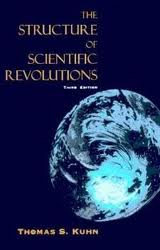
Today, I sat in on a fascinating lecture on Thomas Kuhn, the noted historian of science, given by Alex Wellerstein to Harvard sophomore students as part of a module in the History of Science. Kuhn is quite possibly the best-known product of Harvard University, famed for his extremely influential book on the history and philosophy of science The Structure of Scientific Revolutions.

Thomas Kuhn and his famous book

It was an excellent lecture, outlining the fundamentals of Kuhn’s work in exemplary fashion, as well as setting him in historical context. I particularly enjoyed the lecturer’s emphasis on graphics and explanatory images (I take a keen interest in the methods other academics use to present material). However, as so often when this Kuhn is discussed, I left the room feeling dissatisfied. I had re-read the book in anticipation of the lecture and found myself faced with the same old questions. Just what is it about Thomas Kuhn that bothers me? It’s probably a bit ridiculous to attempt a thorough critique of Kuhn’s seminal work in a blog post, but below are three key objections from an ODS (ordinary decent scientist):

*****************************************************

1. The Aristotle question. Kuhn (who trained to PhD level as a physicist) always claimed that much of his approach to the history and philosophy of science was informed by the simple question “How could Aristotle, one of the world’s greatest philosophers, be so wrong about so much of physics?” His answer to this question that Aristotle was not wrong. A. was simply exposed to knowledge that is different to what we have now and therefore simply perceived the world differently to modern scientists. Indeed, much of what A. believed was perfectly reasonable in terms of evidence at the time and we must beware of judging the past through the lens of today’s knowledge.

So far, so fairly standard. But what is more radical is that Kuhn then goes on to assert that different perceptions can be equally valid. There is no right or wrong view. This relativism quickly becomes very problematic for practising scientists. First, it ignores the fact that Aristotle was famously disinterested in evidence; he believed the ideas of the mind were far superior to any physical observation. More importantly, today’s science places great emphasis on the concept of wrong; it is only by comparison with observation that we make progress i.e. select between theories that describe the world reasonably accurately and theories that don’t. This process of elimination is a fundamentally different starting point to that of Aristotle et al. and it has driven all the major breakthroughs of modern science. There is surprisingly little discussion of this simple point (now known as Popperian falsification) in Kuhn’s book.

2. A second problem concerns Kuhn’s idea of the paradigm shift in science (considered to be his major contribution). According to Kuhn, all of scientific theory and experiment takes place within a given paradigm. From a theory of gravity to particle physics, experiment and theory generally occur within an agreed overarching sets of beliefs. If enough contradictory evidence builds up that cannot fit the paradigm, a new paradigm then arises which replaces the old i.e. a paradigm shift occurs. So far, this is a perfectly reasonable description of how science is done (if a bit simplistic as it ignores competing models within paradigms etc).

But it is what comes next is problematic. According to Kuhn the new paradigm completely replaces the old, rendering the old effectively redundant. Time and again in his book, the new paradigm is portrayed as a new world-view, entirely replacing and invalidating the old, much like a shift in philosophy. This view amazes me, particularly coming from a physicist. First, it is very, very difficult for a paradigm to become established in the first place: it has to provide an adequate explanation for hundreds of measurements in different, but related, fields. This skeptical aspect of science should not be understated. For the same reason, it is difficult for a new paradigm to emerge; this is because it the old paradigm explained a tremendous amount and is not lightly overthrown. If the old is overthrown , it is only on the emergence of startling new evidence, usually gradually accepted over long periods of time. Even then, there are periods of time during which time the new and old coexist and compete (like two records being mixed). Pick any revolution you like, from relativity to quantum physics. The new can only replace the old if it explains all the old did, plus a whole lot more (because as new evidence is uncovered, old evidence also remains). This view of science as a cumulative process (as opposed to alternate views) is criticized by Kuhn, but it matches 20th century science very well. For example, it took quantum physics at least thirty years to emerge; it was the slow accumulation of experimental observation and theory (not Planck’s quantum, as Kuhn asserts). Hence, the new is very much an extension (however radical) of the old and the old paradigm is not discarded. We still use no-relativistic and non-quantum physics to this day, where we always used it; where the limitations do not apply.
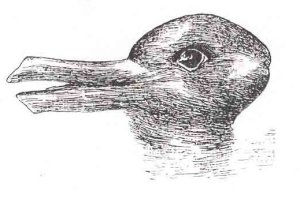
The duck-rabbit illusion: in Kuhn’s view, a paradigm shift is a change of perception rather than a cumulative process

3. Most problematic of all for scientists is Kuhn’s notion of ‘normal science‘. In his view, when a paradigm shift is not occurring, scientists are engaged in ‘normal research’, essentially dotting the is and crossing the ts of known knowledge. Indeed, this is how most of science is done, in Kuhn’s view.

I see this as a serious distortion of scientific practice. For starters, who knows when ‘extraordinary evidence’ is going to turn up? If scientists spent their time in the lab engaged in the collation of routine measurements, revolutions would never happen, because we would not be receptive to extraordinary evidence when it emerges. There is no such thing as ‘normal’ science for the good scientist; one takes equal care in all experiments, for the simple reason that we never know when surprising evidence will emerge. To divide science into arbitrary epochs of ‘normal’ and ‘revolutionary’ seems to me to be the worst sort of revisionism. Far more reasonable is the modern view: that all paradigms are temporary and it is the scientist’s job to test them to their limits. [To give a contemporary example, the Large Hadron Collider was NOT built to ‘find’ the Higgs boson: the LHC was built to investigate whether or not the Higgs particle exists at certain energies (among other things), a very different question. In other words, the paradigm (the Standard Model) may stand (normal science) or may fall (extraordinary science) – there is no telling until the measurement is made. That is why we’re doing the experiment!]

*******************************************************************

If the inconsistencies above are right – and I am not the only scientist to make such points – why is Kuhn’s book so famous ? Why so influential, if many scientists, even in Kuhn’s own discipline, consider it flawed? It’s worth pointing out that Kuhn’s work went on to form the bedrock of an entire discipline, the social study of science and technology.

Perhaps one answer is who it speaks to. The book is possibly the most widely-read science book ever; widely-read by a great many non-scientists, that is. Here is a dark thought: perhaps Kuhn’s view resonates with historians, social scientists and others, precisely because it resembles practice in their fields more than it does science. To put it baldly, is it popular with those in the humanities because it tells them what they like to hear? We are all scientists now.

But look at it this way. It takes years (5-6 min) to train a person to become a reliable experimentalist. That training is not trivial: it is about training the observer to observe as objectively as possible. Of course, science is a social activity, subject to human behaviour. But is this is a determining factor? Don’t scientists go out of their way to minimize social factors by rigorous training in the use of the scientific method? To paraphrase Churchill, it may not be perfectly objective but it is a damn sight more objective than the alternatives! Can an outsider understand the extent of this training if they are not trained in the method? How do all those non-scientists become such experts on the limitations of scientific knowledge?

Difficult questions. But it’s interesting that the most trenchant criticism of science often comes from those with almost no training in the area. (Many like to point out that Kuhn himself had a PhD in physics, not realising that, in science, this does not constitute an expert). Finally, Kuhn himself often claimed that he was widely misread and misunderstood. I find this a bit of a cop out; although some of his definitions are rather vague (famously, there is no clear definition of the scientific paradigm), the book is not at all ambiguous in its general thrust. In fact, it is all too clear and very repetitive. Like so many of the studies that were to follow, it takes a good idea and extends it to a radical extent, garnering much attention but alienating the very community that could have benefited from it.

The result? Scientists themselves pay very little attention to this book, or to much of the literature of science studies that followed, which is a great pity. This is the great danger of overstatement, in my view

Update

Below is Alex’s response to my comments on Kuhn above. Bear in mind that he knows a great deal more about this subject than I do!

[ Hi Cormac, my thoughts on the blog post, finally…! Thank you for coming to the lecture, and I’m glad it provoked such interesting thoughts. As you know, I’m no strict Kuhnian in any respect, and the lecture was meant to raise far more questions than it answers. Specifically:

1. Aristotle. I don’t think Kuhn was a relativist about Aristotle. I think his point on him was to say, “A. was really a good philosopher, and judging him as a modern physicist is the wrong thing for an historian to do.” Which I’m sure you find an entirely unproblematic statement. What’s interesting is that then people want to jump and take the next step and say, “so that means we should or shouldn’t acknowledge he’s right or wrong?” But Kuhn wouldn’t see it that way. In his later book, _The Essential Tension_, he more or less says, “look, you can’t be a good scientist and a good historian at the same time.” So when you’re judging Aristotle as an historian, you’re using a different standard than if you’re judging him as a physicist. If you look at Artistotle from a modern physicist point of view, the answer is clear: Aristotle is not a good physicist by modern standard for what that means. But Kuhn would say, “Who would say otherwise?” And he might also point out, though, that the standard for a “good physicist” has changed quite a bit over the years. (One of the reasons there is a profusion of amazing Jewish theoretical physicists in German in the first decades of the 20th century is because a “good physicist” in Germany was an experimentalist, and you wouldn’t want to let Jews into those good positions. So they did theoretical physics — and made it “good.”)

2. I agree that the Gestalt shift suggested by Kuhn is awfully unsupported by evidence. In some cases you can see it: the “canonical” revolutions (Copernican, Newtonian, Einsteinian, Darwinian). But it doesn’t very well capture the shifts that happen more frequently, which still don’t fall under the definition of “normal science.” Kuhn’s model is very all-or-nothing in my eyes: you’re either Normal or Revolutionary. It strikes me as a rather stark set of options, and one which does a particularly poor job of describing science after 1945. There *are* big changes in science after 1945, and I’m not sure I’d say they were all perfectly cumulative (because you’re by definition throwing out everything you’ve decided wasn’t cumulative, even though it was judged to be “good physics” at the time), but I do think it is more “cumulative looking” than the Normal/Revolutionary model.

3. I can see your resistance to the idea of Normal Science, but I’m not sure I agree with your reading of it. Kuhn emphasizes that Normal Science just means that you aren’t spending all day trying to find the Next Big Thing. People aren’t sitting around saying, “let’s throw out all of what we know and do something RADICAL.” They *do* occasionally do that, and Kuhn’s examples from quantum theory are maybe the best examples of that: you have people like Bohr and Heisenberg saying, “well, what if we just threw causality out of the window, and see what happens?” But that can’t be the day-to-day operation of science. For Kuhn, Normal Science is just trying to advance knowledge a tiny piece at a time, the kind of thing you see in NSF projects: “doable” results that will get you a tiny bit further in knowing how something works. It doesn’t mean you’re just re-running the same experiments all day long — it just means you aren’t re-examining the fundamentals of your theories at every moment.

Now it would be a very good question to ask whether current theoretical physics is in Normal or Revolutionary mode according to Kuhn. The String Theory people seem to fluctuate back and forth — there are little moments of stability, and then every few years some of those get completely up-ended. Furthermore, you misunderstand Kuhn if you take him to be using Normal Science as a way to criticize science. In fact, for Kuhn, Normal Science is the key to the reliability of science. It is “dogmatic” and “conservative” on the whole: it requires extraordinary evidence before it decides to unseat its theories, it doggedly avoids flights of fancy. He would compare this (perhaps unfairly) to, say, Literary Theory, which has a new “turn” every decade or so, and lacks any real foundation other than the whimsy of whomever runs the big departments at any given time. The fact that the “hard sciences” don’t change their fundamental theories very often is exactly what makes them so compelling as truth-machines. Their conservatism is their strength. This is actually a very radical aspect of Kuhn that makes him quite different from what most of the social studies of science people interpreted him to be saying.

(I’ll be talking about this some more next Monday, when we discuss Feyerabend, who takes the entirely opposite point of view regarding knowledge. Feyerabend’s truly “anarchistic” view of knowledge makes one long for the “dogmatism” of Kuhn!)

As for the broader question of why Kuhn is popular, I’m not sure it’s always because it is destabilizing or relativistic. There’s some of that, to be sure. But I do think it’s mostly because he manages to frame these kinds of questions in ways that most people, even those who don’t know or care about science, can understand and respond to. He provides a sort of synthetic whole that we can then play with and modify and adapt to our own anecdotes.

That doesn’t mean it is “right” — but it might be “useful.” I think Kuhn does provide an alternative, however vague, to the linear model of scientific progress. Should we be looking for alternatives to that model? I’m sure you and I probably would not agree on that, in any case… :-)  I think the linear model, depending on how it is used, can be extremely misleading. I don’t think Kuhn is really right but he highlights some interesting things. I like the idea of Normal Science, though I don’t see it as a transcendent, “real” category. Anyway — this is a big question (if you don’t have the linear model, what do you have?), one that we’ll be really pushing at over the run of the entire course. I don’t claim to know the right answer here, but certain models feel more plausible to me than others.

Best,
Alex ]
10 Comments

Filed under History and philosophy of science