The Science Delusion

A few weeks ago, The Irish Times published my review of The Science Delusion by Rupert Sheldrake, the former Cambridge don and enfant terrible of science. Sheldrake was a prominent name in evolutionary biology in the 1970s but he has since become a controversial figure because of his espousal of disputed phenomena such as telepathy, precognition and extra-sensory perception.

Overall, I found the book fascinating but flawed. I didn’t feel the author offered any real evidence for his central thesis: that a strict philosophy of materialism (the belief that all reality is physical in nature) has hindered progress in science and caused working scientific hypotheses to harden into rigid dogma. Most of the evidence offered for this contention consisted of a critique of the methods of science reminiscent of practitioners of the discipline known as  science studies; almost no attempt was made to engage critically with these views or to explain why the scientific method has been so successful.

I also found that some of the basic science was flawed, especially in the sections on modern physics. Most of the material cited as evidence for ‘scientific dogma’  was not drawn from the scientific literature, but from review articles in popular science magazines. Such publications offer only a superficial version of scientific theories and I would argue that many of the ‘dogmatic principles’ identified by Sheldrake are in fact open questions in scientific research.

Meanwhile, I found the author’s own pet theory of morphic resonance a bit far-fetched. In essence, this theory posits that the fundamental constituents of nature are not matter and energy, but self-organising systems that resonate with their environments. In this worldview, atoms, molecules and cells are not unconscious material, but have patterns of behaviour and habits. Sheldrake uses this theory to examine whether the universe is alive, whether the laws of physics are habits that change and evolve, whether all biological inheritance is material, and whether the mind is really confined to the brain. He also suggests that the theory can offer an explanation for phenomena such as telepathy and precognition.

Overall, these discussions were fascinating, especially the descriptions of experiments attempted to test the theory. However, the experiments are also highly controversial; indeed, a little research shows that in many cases, the results are hotly disputed even amongst the experimenters themselves!

You can read my full review of The Science Delusion on The Irish Times website here. I was surprised to see that the book received rave reviews in both The Guardian and The Independent. However, neither review was written by a scientist. Indeed, there seems to be something of a culture divide here; Sheldrake’s views are enthusiastically embraced by people who know nothing of science, while scientists themselves are less impressed. Is that because we are fatally blinkered or could it be that we know what we are talking about?

Update

Reading the comments, I should probably make it clear that I think the answer to the above question is the latter. It seems to me that Sheldrake makes the classic error of rejecting well-established science that is backed by very strong evidence, whilst embracing highy questionable theories that are backed by very flimsy evidence…funny how these often go together

8 Comments

Filed under Science and society

Sun, snow and clear skies in Hinterglemm

This week I’m spending half-term in Saalbach in the Hinterglemm valley in Austria. I have a ton of work to do but given the current snow conditions in Europe, I couldn’t resist a cheap last-minute package deal. I’ve never been to Saalbach before and it’s lovely, one of those tiny Austrian towns where the village centre consists of a single cobblestone street lined with traditional buildings (pedestrianized of course), with ski lifts to the peaks branching off at the top and bottom ends of the street.

Saalbach in the Hinterglemm valley

It doesn’t hurt that the British half-term is over; the main language in the resort is German and it seems to be mainly German and Austrian skiers on the slopes, always a good sign. The snow is as good as I expected but visibility was terrible until today. It takes a lot of the fun out of skiing if the light is poor – it makes the skier stiffen up and tire easily (not to mention taking the wrong turn at every intersection). However, the sun was out today and we had a dream combination of clear skies, sun and powder. The weather is expected to remain like this for the rest of the week, yippee.

It really does look like this on a clear day

I usually go skiing with clubs like the Ski Club of Great Britain or the Frankfurt Ski Club, but this week I’m on my own, skiing during the day and studying in the evenings. It sounds better than it is – I’d forgotten how tiring on-piste skiing becomes after a while, a bit like driving on the autobahn except worse because you have to avoid a lot of out-of-control skiers and boarders. Luckily, there are plenty of ‘ski touring’ routes just off the main pistes, always my favourites, with plenty of powder. That said, I’m joining an Austrian group tomorrow for some real off-piste ouch! I know my legs will be jelly after an hour (‘we’ll just walk up to that ridge over there’), but it’s worth doing if only for the views.

Update

The ski-tour turned out to be a sort of group lesson whilst touring around the mountain and was absolutely great. It’s amazing the bad habits that develop if you don’t have a checkup every now and then, I must do this more often. That said, it was no easy stroll through the woods – one of us clocked our group doing a speed 96.7 km/hr down a Schuss!

5 Comments

Filed under Skiing, Travel

A tribute to Stephen Hawking

RTE radio recorded an interview with me today on the subject of Stephen Hawking. I’m told it’s to have on file so I trust they don’t know something I don’t! Whatever the reason, it’s nice to have the opportunity to pay tribute to a living legend. Below is a script I prepared the interview; we only used a small part.

******************************************************************************

Q: Who is he?

Stephen Hawking is a famous English physicist at Cambridge University known for his work in cosmology, the study of the universe. In particular, he is admired for his work on black holes and on the big bang model of the origin of the universe.

Q: Why is he so famous?

Einstein used to be the only famous scientist of modern times, but Stephen Hawking has inherited that role. I like to think that one reason is his field of study; there seems to be a public fascination with scientific concepts such as the big bang and the nature of space and time (it’s hardly a coincidence that much of Einstein’s work was in this field).

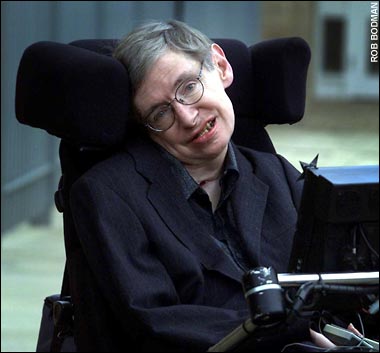
Another reason may be Hawking’s disability. He was diagnosed with motor neuron disease (ALS) in his early 20s and given two years to live. The story of a brilliant mind trapped in a crippled body has universal appeal, and the wheelchair-bound figure communicating deep ideas by voice synthesizer has become an icon of science.

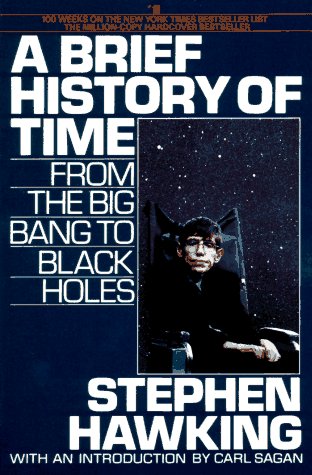
Then there’s the book. In the 1980s, Hawking published A Brief History of Time, a book on the big bang aimed at the general public  – it quickly became an unprecedented science bestseller and made him a household name. Since then, he has devoted a great deal of time to science outreach, unusual for a scientist at this level.

Q: Where is he from?

He was born in London in 1942, the son of two academics, and studied physics at Oxford. He wasn’t outstanding as an undergraduate but he did well enough to be accepted for postgraduate research in Cambridge. There, he became interested in cosmology, in particular in the battle being waged at Cambridge between the ‘big bang’ and ‘eternal universe’ theories. He showed early promise as a postgraduate when he demonstrated that Fred Hoyle, a famous cosmologist and prominent exponent of the eternal universe, had made a mathematical error in his work.

Q: Can you say a little about Hawking’s science?

His work is focused mainly on phenomena such as black holes and the big bang. Such phenomena are described by Einstein’s theory of relativity, which predicts that space and time are not fixed but affected by gravity. (In the case of black holes, relativity predicts that space is so distorted by gravity that energy,even light, cannot escape. In the case of the universe at large, relativity predicts that our universe started in a tiny, extremely hot state and has been expanding and cooling ever since; the so-called big bang model).

However, relativity does not work well on very small scales; this is the realm of quantum physics. Hawking’s lifelong work concerns the attempt to obtain a better picture of the universe by combining relativity (used to describe space and time) with quantum physics (used to describe the world of the very small).

He first established his reputation by defining the problem; with the mathematician Roger Penrose, he showed that relativity predicts that, under almost all conditions, an expanding universe such as our own must begin in a singularity i.e. a point of infinite density and temperature. This is not physically realistic and suggests that relativity on its own does not provide a true picture of the universe.

In later work, Hawking focused on black holes (a black hole is something like a big bang in reverse and may therefore offer clues to the puzzle of the origin of the universe). Successfully combining general relativity with quantum physics for this special case, Hawking was able to predict that black holes are not entirely black; instead they emit some energy in the form of radiation, now known as HawkingBekenstein radiation.  Most physicists are convinced by the logic and beauty of this result but Hawking radiation will be difficult to measure experimentally as it is predicted to be extremely weak.

My favourite Hawking contribution is the no-boundary universe. Working with James Hartle, he used a combination of relativity and quantum physics to predict that our universe may not have had a definite point of beginning because time itself may not be well-defined in the intense gravitational field of the infant universe!

Q: Is Hawking another Einstein?

No. Einstein made a great many contributions to diverse areas of physics. Also, relativity fundamentally changed our understanding of space and time, with profound implications for all of science and philosophy.(For example, the big bang model is merely one prediction of relativity). It’s hard for any scientist to compete with this.

Q: Why has Hawking not been awarded a Nobel prize?

He has received many prestigious awards, but not a Nobel. It’s quite difficult for a modern theoretician to win the prize because Nobel committees put great emphasis on experimental evidence. While we now have strong evidence that black holes exist, Hawking radiation will be very difficult to detect as it is predicted to be extremely weak.

Q; What is he working on these days?

At a conference in Dublin a few years ago, Hawking suggested a possible solution to the information paradox, a controversy over whether information is lost in black holes. The jury is still out on his solution. He is also involved with the theory of the cyclic universe, a theory that suggests there many have been many bangs.

Q: What lies in the future for Hawking?

Who knows. Last month, he celebrated his 70th birthday with a prestigious conference at Cambridge, 50 years after his terminal diagnosis. However, he was too ill to attend in person, reviving fears about his health. For now, he continues to work as ever, defying the predictions of modern medicine…

P.S. What’s all this about Hawking and God?

A Brief History of Time famously concludes with the phrase ‘‘..and then we would know the mind of God’’. At the time, many commentators interpreted this statement to mean that Hawking was religious. However, he was being mischievous – it is clear from other writings that he is not a believer in the normal sense. Indeed, his most recent book, The Grand Design, provoked controversy by stating that ‘‘It is not necessary to invoke God to set the universe going.” This statement was interpreted widely as a dismissal of God – in fact, it reflects standard cosmology (something can indeed arise from ‘nothing’) and says nothing about the existence of God.

10 Comments

Filed under Cosmology (general), Science and society

A tour of Irish universities

This week I’m on tour, giving the annual Tyndall lecture of the Institute of Physics to secondary school students. Yesterday I gave two lectures at University College Cork, today I was in the University of Limerick, tomorrow I’ll be at NUI Galway and on Friday I’ll be talking in Queen’s University Belfast. The biggest event is a set of twin lectures in the main hall of the RDS in Dublin on Thursday.

I decided to give a talk titled ‘The big bang – is it true?’ because this is the question I am most frequently asked. It is also the title of my book-in-progress so the tour is a good dummy run (I gave a similar talk to the Graduate School of Arts and Sciences at Harvard last year).  The abstract can be found on the poster below and the slides are on my Seminars Page.

Tyndall 2012 poster

So far, the lectures are good fun. I address the question by giving a brief overview of the main experimental discoveries that underpin the big bang model, with a little bit of theory along the way. I also explain the main flaws of the model, not least the problem of the singularity (while we have a highly successful model of the evolving universe from its first moments, we have no knowledge of the bang itself, or even know if there was a bang. Nor will we, until we learn how gravity, space and time behave on the quantum scale). I am constantly amazed by the number of scientists who are unaware of this problem.

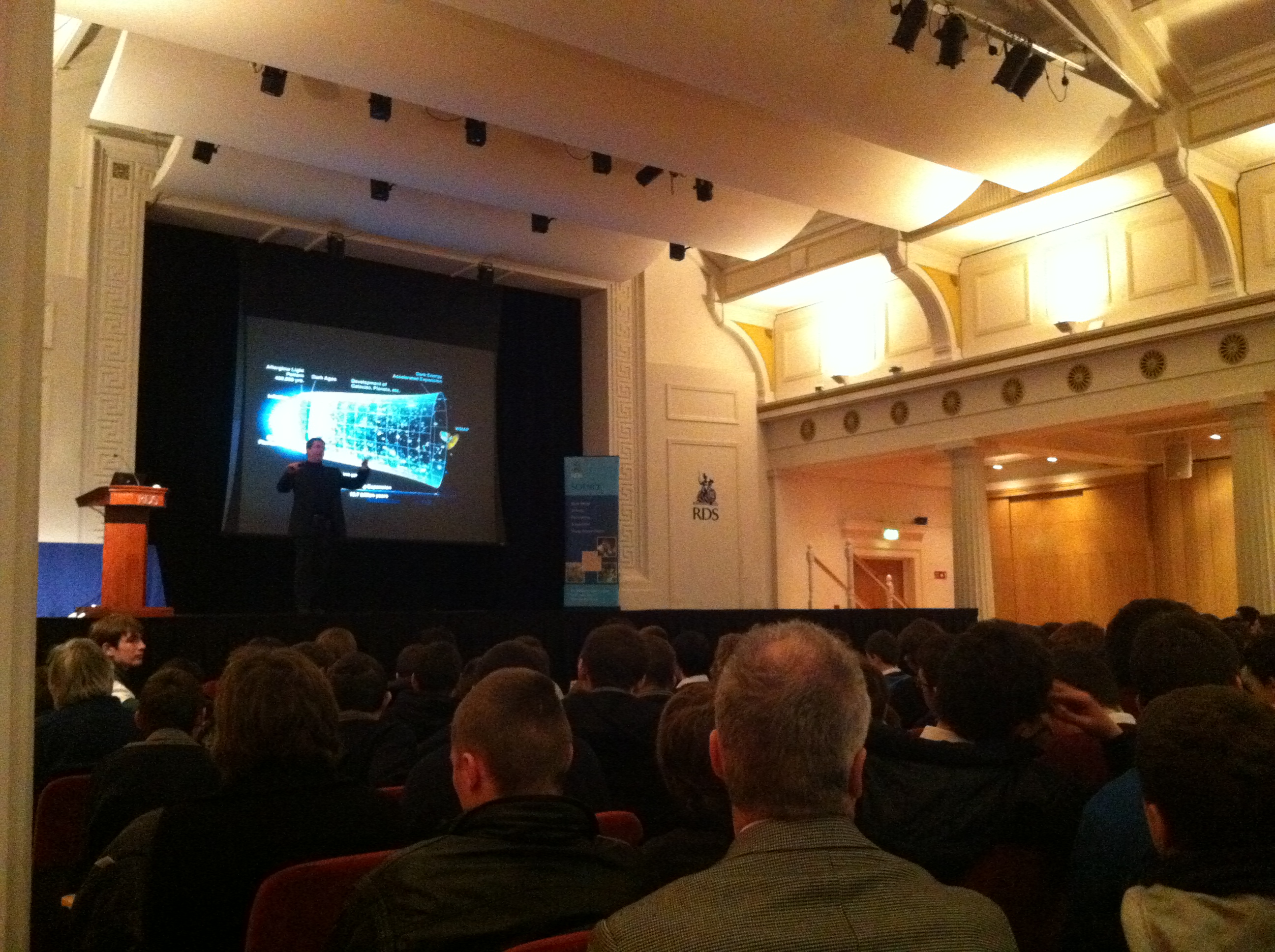
Lecturing at the Royal Dublin Society

There are always plenty of questions afterwards. I enjoy this part the most, it’s astonishing how the same questions come up agin and again. What happened before the bang? What is outside the universe? How will it end? All in all, the tour is great fun if a little tiring – a lot of traveling and searching for lecture rooms and hotels.

I’m also becoming an expert on university campuses in Ireland. My favourite so far is University College Cork. Beautiful, old and tiny, it is nicer again than Trinity College Dublin. On the other hand, the University of Limerick is very like University College Dublin with its fantastic grounds and playing fields.

Meanwhile, the future of my own college (Waterford Institute of Technology) remains uncertain. Local interests have been campaigning for many years for a regional university and it is true that the city and surrounding regions have suffered by not having a university. (The best and the brightest school-leavers head to college in Cork and Dublin and don’t come back – not to mention the problems in attracting industry to the region). As WIT is respected academically for its research output, there is now a strong political wind to upgrade the college to university status. However, the proposed upgrade has triggered a campaign to amalgamate and upgrade all the Institutes of Technology to university status. Like many academics, I think this would be a pity because the binary system of universities and Institutes has served Ireland very well (the latter are of slightly lower standard and more practical bent). So it’s a tricky situation, hard to know what the best solution is..

Update

Galway was fun, but the lectures in the Royal Dublin Society were hard work. A huge venue, there was a great buzz but it was a little difficult to keep the students focused and not easy for them to ask questions afterwards. They seemed to enjoy the talk all the same. Belfast was the opposite; a much more intimate venue and the quietest students so far. The campus was stunning but my fancy new iphone doesn’t seem to have saved my photographs. Tomorrow it’s Carlow and then back to Waterford at last…

6 Comments

Filed under Institute of Physics, Public lectures

Peter Watkins and Z bosons at Trinity College Dublin

last night, I attended a terrific lecture on recent developments at CERN’s Large Hadron Collider, hosted by Astronomy Ireland at Trinity College Dublin. The lecture was presented by Professor Peter Watkins, a former leader of the particle physics group at University of Birmingham and a member of the ATLAS collaboration at the LHC. Professor Watkins was a member of one of the experimental teams that discovered the Z boson at the LEP at CERN in 1983. He is also very well-known for his work in bringing particle physics to the public and is the author of ‘The story of the W and Z, one of my favourite books on particle physics.

I try to go to as many of these public lectures as I can, in order to see how others present physics to the public. In this case, the lecture was superb, very easy to understand yet at quite a high level. It was loosely divided into five sections;

– an introduction to the building blocks of matter

–  a description of what the LHC is looking for

– a description of experimental setup of the LHC and the ATLAS detector

– a description of the methods of searching for particles

– a discussion of recent discoveries at the LHC

The first section gave a brief introduction to the standard model of particle physics. However, rather than present the audience with a list of quarks and leptons, Peter described our view of ordinary matter in terms of up and down quarks, electrons and neutrinos. Only after this did he mention the higher generations, an approach that worked really well. On the next slide, he gave a description of the fundamental forces, explaining along the way how electricity and magnetism were unified into the unified framework of electromagnetism many years ago, and how the latter interaction was more recently unified with the weak force to form the electroweak interaction. There followed a very nice discussion of the force-carrying particles, and the subsequent search for the W and Z bosons. This section finished with an overview of the role of the Higgs field in determining the mass of the particles – about as succinct an introduction to particle physics as I’ve seen!

The second section of the talk described what the LHC will search for; from the Higgs boson to supersymmetric particles, from investigations of the slight asymmetry in matter and antimatter decay to candidates for dark matter. Professor Watkins was also careful to explain that the LHC may yield great surprises, from missing energy that might constitute evidence of hidden dimensions to possible hints of new forces.

An experimental overview of the LHC and the ATLAS detector was presented in the third part of the talk. The technical challenges of LHC operation were clearly laid out, from the need for ultra-low temperatures to the problem of establishing an ultra-high vacuum on this scale, from issues with beam focusing to problems with superconducting magnets. This section included a great overview of the ATLAS detector, with each component described carefully.

The ATLAS detector, not the LHC as many newspapers seem to think

The fourth section of the talk was most unusual, where Peter gave a clear description of how the existence of elusive particles is inferred from those beautiful patterns on computer monitors.  Starting with E2 = p2c2 + m2c4, he gave a few examples where measurements of momentum and energy in the detector lead to an estimate of the mass of the parent particle. This section included a great description of the search for the Higgs via the ZZ and photon-photon decay channels.

In the last part of the talk, the speaker gave a clear description of recent work at the LHC. Touching briefly on the initial accident of 2008, he explained how ATLAS and CMS have gradually been closing the window on mass ranges for the Higgs (including earlier data from LEP). He had a nice surprise for many in the audience when he mentioned that ATLAS has already discovered its first new particle – a new state of the chi-b particle . The lecture finished with a discussion of the famous ‘bump’ in the ATLAS data at 126 GeV announced two weeks ago, and the possible significance of the discovery.

Hints of a higgs in the ATLAS measurements ? (Dec 2011)

I found this a superb lecture overall. The speaker outlined difficult concepts extremely clearly and gave a great description of how concepts emerge, rather than presenting ‘facts’ as fixed dogma. The audience certainly thought so too and there were dozens of questions afterwards. As always with Astronomy Ireland lectures, the discussion continued in the pub across the road. At one point, Peter explained that part of the current excitement is due to where the bump is; if the 126 GeV result stands, this relatively low mass for the Higgs may be compatible with extensions to the standard model such as supersymmetry….a good time to be a particle physicist!

Update

Rumours are circulating that the CMS bump has not disappeared on further analysis, but is converging on the ATLAS result, exciting times

8 Comments

Filed under Particle physics

‘Verdict out on relativity questioning experiment’

What does the headline above mean? I’m not sure, but it is the title of an article in today’s Irish Times, written by your humble correspondent. (I had suggested ‘Faster than light?’ or ‘Was Einstein wrong?‘, but the above is what appeared).

It’s always nice to have a science article published in a national broadsheet, and I thought it was worth revisiting the OPERA experiment before the end of 2011. I enjoyed writing the article and colleagues tell me the question and answer format worked well.

But what about that title? And the opening line? (see print edition). Both were super-imposed by the sub-editor and I find them quite poor. This keeps happening; I take time and effort to write science pieces for the public as clearly as I can, and a professional writer comes along and superimposes something quite sloppy. It’s a pity because nine out of ten cats will read no further than the title and opening sentence.

If the article and headline were submitted as student work, this would be my verdict:

******************************************

The headline used for this article breaks almost every rule of science writing

1. The English is poor  – it is not clear what a ‘relativity questioning experiment’ is

2. ‘Verdict out’ is also not clear – ‘jury out’ would be better, but is still clumsy

3. The title is also intimidating – never use a word like relativity in a headline if you can avoid it.

As a result of points 1-3, the title does not clearly describe the content of the article – hence few readers will read further.

The writer should consider alternate titles such as ‘Faster than light?’ or  ‘Was Einstein wrong?’

These titles are both clear and succinct. Most importantly, they draw in the reader in, rather than drive her away

*********************************************

Update

There is also a major problem with the opening sentence; luckily, it is only in the print edition

5 Comments

Filed under Science and society

Last day of semester

Today was the last day of lectures in the first semester, hurrah. There’s something very satisfying about emptying out the teaching briefcase and filing the notes and overheads back on the bookcase until next year. (Yes, we have computers and data projectors in Waterford, but I still use overheads quite a bit). The students now have a study week followed by exams but for lecturers, it’s an ideal time to get back to research.

I’m frequently asked if WIT is a let down after Harvard, but I must say I enjoyed this semester no end. I taught maths (to 1st science), physics (to 1st engineering) and my ‘concepts in cosmology’ course to our physics students. I’m writing a book based on the latter so it was fun summarizing a chapter each week and presenting it in class as bullet points. After each lecture, I found myself rushing back to the office to rewrite a paragraph or re-jig an explanation – very satisfying!

Motivated students

Then there was the neutrino experiment; a superb opportunity for public lectures on relativity. Like almost all physicists, I expect this result is an anomaly because neutrinos are known to have a finite rest mass. I really enjoy explaining this in outreach lectures so long may the anomaly survive! The Trinity lecture was very satisfying, we got a great crowd including some very eminent physicists.

Now I have four weeks to work quietly on the book, uninterrupted by classes – what a job!

Update

Meanwhile, rumours continue to circulate in the media about a possible sighting of the Higgs boson. I haven’t heard anything in physics circles so I’m betting it’s a false alarm based on a misunderstanding of the purpose of next week’s roundup meeting at CERN (see here for more on the rumours). Still, I’ll be keeping an eye on the news on Tuesday!

23 Comments

Filed under Teaching, Third level

Neutrinos and string theory at Trinity College Dublin

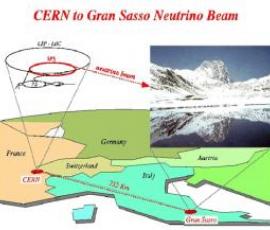
I gave a few more talks on the Gran Sasso neutrino experiments last week, in Waterford on Wednesday and in Trinity College Dublin on Saturday. I really enjoy giving these talks; it’s not often one gets an excuse to present the theory of relativity to the hapless public. Journalists talk about the ‘hook’ – well this is a hook from heaven. I even got a 20-minute interview on Ireland’s premier radio show Today with Pat Kenny . You can find the podcast and the slides I used for the lecture here.

There was a real buzz in the air at Saturday’s lecture, thanks to the latest results from OPERA. As you probably know, the team announced on Friday that the superluminal result has passed its first major test: a repeat experiment using a much shorter proton pulse. This time they used pulses only 3 nanoseconds long, separated by by gaps ten time larger. This is vastly shorter than before (10 microseconds) and obviates the statistical approach used for matching transmitted and received pulses used in the original experiment. Like most physicists, I am still pretty certain the result will eventually turn out to be an anomaly, but I certainly hope it survives for another few months! See here for the new OPERA paper.

The lecture was hosted by Astronomy Ireland,a very interested audience that always turn out in droves. The theatre was jammers, quite a few audience members had to stand throughout. As always, I particularly enjoyed the questions and answers afterwards. It’s also fun to be come home; as a postgraduate student, I spent many long years in the magnetic resonance lab next door!

David Moore of Astronomy Ireland presents me with something (?)

Afterwards, some of us all legged it over to another Trinity lecture theatre, to hear the annual statutory lecture of the School of Theoretical Physics of the Dublin Institute for Advanced Studies. This year, the speaker was well-known string theorist Cumrun Vafa from Harvard. Titled ‘Geometric Physics’, the lecture was an excellent introduction to string theory today.

String theorist Cumrun Vafa from Harvard

And after all that, there was a reception to celebrate the fact that Werner Nahm, the director of the DIAS School, was recently made a fellow of the Royal Society. What a weekend

Update

On Sunday, Werner gave a fascinating talk on ancient astronomy at the Dublin Institute of Advanced Studies. After the seminar, many of us remained in the fading light in that famous seminar room, discussing the neutrino result and other experiments at CERN. As so often, I was struck by the depth and detail of knowledge the theorists had of particle experiments. I also enjoyed the way the discussion wandered into German for a while, then seamlessly back to English – only at DIAS!

12 Comments

Filed under Particle physics, Public lectures

Faster than light and the public misunderstanding of science

Yesterday evening, I gave a public lecture in Dublin on the Gran Sasso neutrino experiment, hosted by the Irish Skeptics Society. The event formed part of Maths Week Ireland, an initiative co-ordinated by CALMAST, the science outreach group at our college. We had a great audience turnout and I enjoyed the Q&A afterwards immensely. Below is the abstract and you can find the slides for the talk here.

**********************************************************

In September 2011, a group of scientists announced that they had detected subatomic particles travelling at speeds greater than the speed of light in vacuum. The finding is in conflict with Einstein’s theory of relativity and has been met with great skepticism by mathematicians and physicists around the world. This lecture will examine the grounds for that skepticism and consider the role of skepticism in general in science and mathematics

 ********************************************************
 

       The Gran Sasso experiment

I suspect I was invited to speak because of a letter I had published on the subject in The Irish Times (below). Although the Gran Sasso experiment has certainly raised awareness of physics, I think the way the media are portraying this experiment as an  ‘Einstein wrong’ story is most unfortunate. It is far too soon to reach that conclusion and the overall effect is to make science seem very uncertain. It is more Public Misunderstanding of Science than PUS, in my view.

*************************************************

Sir, – Margaret Moore (September 29th) asks what word will be used to describe a speed faster than the speed of light. The technical term is superluminal speed. However, much of the media coverage of recent experiments at Gran Sasso has been very misleading. Almost all professional physicists (including the experimenters) consider the Gran Sasso result a curious anomaly almost certainly due to some unknown error in measurement, for several reasons:

1. Light is carried by particles of zero mass and it follows that there are fundamental theoretical reasons for supposing that the speed of light in vacuum represents a natural speed limit for particles of non-zero mass.

2. Thousands of experiments have verified that the tiniest particles of matter can be accelerated up to speeds close to, but not equal to, this limiting speed.

3. The recent Gran Sasso experiment involves measurements of time and distance of unprecedented precision, yet it was not designed for this specific purpose; thus there are many potential sources of systematic error.

It’s true that science sometimes progresses by upsetting the status quo, but scientists are a sceptical lot and extraordinary claims require extraordinary evidence! –Yours, etc,

**************************************************************

Does it matter how the experiment has been portrayed in the media? I think it does. A few years from now, journalists will be say ‘ but didn’t you guys think in 2011 that Einstein was wrong’? In fact, there has already been one editorial in the Wall St Journal urging inaction on climate change, on the basis that science is never certain, given the neutrino result (see point 5 of this article ). Exactly the wrong conclusion to draw…

Update

I see my lecture got a short review in today’s Irish Times. It’s not a bad overview, considering the writer wasn’t at the lecture. The last sentence doesn’t make sense, however – I suspect she meant supernovae instead of black holes!

Udate II

Just caught  BBC program on the experiment (Marcus du Sautoy). Superb, superb program. Nothing like the players themselves for conveying the concepts of science..

24 Comments

Filed under Public lectures, Science and society

Hamilton Walk and Maths Week in Ireland

October 16th is a special day for mathematics and physics in Ireland. On this day, we commemorate the discovery of quaternions by William Rowan Hamilton, the great Irish mathematician and astronomer. Essentially, his insight was to postulate three distinct roots for the number -1, thus generalising complex numbers to four dimensions. It can be said that this discovery marks the birth of modern algebra, as quarternions opened the door to non-commutable algebra. Quaternions have found great application in modern technology, notably in compter algorithims for animation in films and computer games.

William Rowan Hamilton made a great many other contributions to mathematics and physics. For example, his formulation of a mathematical operator for the energy of a body – the Hamiltonian –  is a vital tool in quantum mechanics, the mathematical description of the quantum world. Open any modern textbook on quantum physics and you will encounter the word ‘Hamiltionian’ on almost every page.

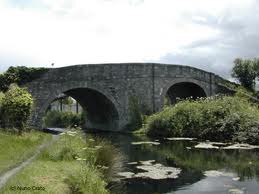
As regards quaternions, we know exactly when Hamilton had his Eureka moment. According to his own writing, inspiration struck on the 16th october in 1843,  as he was walking with his wife from Dunsink Observatory in County Dublin (where he was Astronomer Royal) along the Royal Canal towards the city centre, in order to attend a meeting of the Royal Irish Academy, of which he was President.  He was so pleased with the breakthrough that he used his penknife to carve the new equation onto Broom bridge as they passed. The carving no longer exists but the bridge does, and the occasion is celebrated with a plaque. Every year, mathematicians and friends of mathematics congregate at Dunsink Observatory at 3pm and re-enact Hamilton’s famous walk along the canal to the bridge.


William Rowan Hamilton; the plaque displays the famous equation i2 = j2 = k2 = ijk = -1

This year, October 16th fell on a Sunday, so mathematicians and the general public arrived from far and near. The day started in Dunsink Observatory, with a brief description of Hamilton’s life and work by Fiacre O Cairbre, event organiser and lecturer in mathematics at NUI Maynooth. There followed a lovely walk along the canal in perfect weather conditions, all the way to Broom bridge to view the plaque. The outing finished with a short description of Hamilton’s breakthrough by another Maynooth mathematician, Anthony O’ Farrell, and a chorus of ‘Happy birthday, quaternions’ by all present. I think it’s great to remember our scientific heros like this;  it’s curious that even our very best scientists and mathematicians receive far less public attention that writers and musicians.


Dunsink Observatory and Broom Bridge on the Royal Canal

Each year, the Hamilton Walk is soon followed by a prestigious lecture on mathematics presented by the Royal Irish Academy and The Irish Times. Previous speakers have included Andrew Wiles, Steven Weinberg, Murray Gellman and Lisa Randall. This year, renowned string theorist Ed Witten will give a talk on quantum knots, see here.

The Hamilton walk  is one of the core activies of Maths Week Ireland, an initiative to raise awareness of maths in Ireland with events and lectures all around the country. Co-ordinated by CALMAST, a science outreach group at Waterford Institute of Technology, Maths Week has grown larger every year – you can find the program of events here. I will give a talk in Dublin on Wednesday evening, on relativity and the recent ‘faster than the speed of light’ experiment, see here .

6 Comments

Filed under History and philosophy of science, Science and society