Category Archives: Uncategorized

Last day at Cambridge

There were no lectures on departure day, so a few of us went into town. We had already been on a tour of the Cambridge colleges organised by the Faraday Institute (see post below), so now it was time for some shopping! First stop was Cambridge University Press – awesome, what a selection. I finally chose three (Speakable and Unspeakable in Quantum Mechanics by John Bell, A Mathematician’s Apology by Hardy, and Life’s Solution: Inevitable Humans in a Lonely Universe by Simon Conway Morris), only to find I’d left my wallet in college.

Ah well. I was pleased to notice quite a few of the conference speakers represented in that one shop (Conway Morris, Polkinghorne, Harrison), it says a lot about the level of the conference. Further down the street, I came across the new Hawking book on relativity. It’s basically a collection of Einstein’s essays on relativity for a general audience, with a foreword to each by Hawking. I read Hawking’s introduction to the subject in the shop, it’s excellent (although I didn’t see a reference to Galilean relativity)..another must-have.

Incidentally, we nearly bumped into Hawking one evening in town. We were coming around the corner of Gonville and Caius (his college) on our way for a drink in the famous Eagle (the pub where they first announced DNA), when who should be emerge from the college but SH! As it happens, one of us was in a wheelchair (hope the leg’s better soon Hannah!) and I fancy Hawking shot her a sympathetic look as his people were bundling him into a large car…

Comments Off on Last day at Cambridge

Filed under Uncategorized

Day 5 Cambridge: neuroscience

Friday started with the talk ‘Brains and Machines’, by distinguished neurobiologist Peter Clarke of the University of Lausanne. Peter started by outlining the history of the idea of the brain as a neuronal machine (Democrates, Descartes, La Mettrie, d’Holbach etc). Making the point that brain activity seems to underlie all our conscious experience, he went on to describe the effects of recent brain stimulation experiments. This was followed by a discussion of the implications for free will, the soul, religious faith etc.
Prof Clarke expanded on this theme in the second talk,‘Genetics, brain plasticity and personhood’. Emphasizing recent evidence of the effects of damage to the prefrontal lobes, he explored whether we are responsible for our immoral behaviour or simply the victims of inadequate brains. The discussion made reference to the astonishing case of a teacher found guilty of sexual deviation (possession of child pornography, intereference with a young child etc), who was observed to have a serious tumour in his frontal lobes. After succcessful treatment he returned to normal behaviour – only for the tumour to later grow back, accompanied by a recurrance of deviant behaviour …
There was also a discussion as to whether criminality and violence are genetically programmed or arise from environment, in the light of recent evidence (conclusion – mixture of both). This was a terrific lecture, which I think will be downloadable from the Faraday Institute website in a few days..

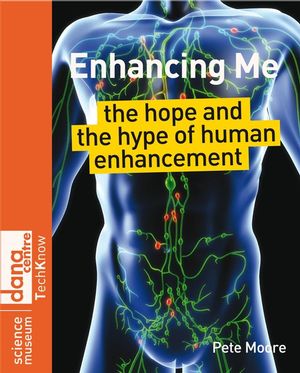
Peter’s talk was followed by a talk on brain enhancement by Pete Moore, the well-known science writer. Pete’s talk concerned the possibility of building an artificial brain by the process of scanning a human brain into a computer, storing all the information…and then allowing it to carry on as normal, including the interaction with other ‘uploaded brains! The aim here would presumably be that one could live forever through the computer. Pretty futuristic stuff – I didn’t really get a clear of the process, or the program that would run such a brain, but it was an intruiging talk. Peter has a recent book on the subject called ‘Enhancing Me’ published by Wiley; you can see a you_tube clip on it here

The last talk of the conference was by Alan Torrance, Professor of systematic theology at the University of St Andrews. Titled ‘Theological and philosophical perspectives on recent developments in neurosceince’, this was a rather more serious affair, with a full discussion of physicalism, dualism and pluralism. I won’t attempt to summarize it (way beyond my knowledge of philosophy), but I think there will be a recording on the Faraday website soon.

The conference wrapped up with a formal drinks and dinner, in the best Cambridge style. It turns out Prof Torrance is also a very good violinist (ex-Scottish Chamber Orchestra) as is his son, a promising soloist, so we had a great discussion about music afterwards. ..

All in all it was a most enjoyable conference….I’m trying to put together a slideshow of photos of speakers and delegates, along with a good snapshots of Cambridge…many thanks to Christoff S hope you got hope safely!

Comments Off on Day 5 Cambridge: neuroscience

Filed under Uncategorized

Day 4 Cambridge: biology

Today was biology day, and it got off to a cracking start with a talk by world-famous paleontologist Simon Conway Morris. In his talk ‘Evolution and Fine-Tuning in Biology’, Simon concentrated on the phenomenon of convergence – the word used by biologists to describe the fact that some things such as the E-coli motor and the camera eye have evolved not once, but several times, by independent paths from different starting points. In fact, Simon has just a published a well-known book on this topic.

This was an astonishing talk for many of us, backed up by irrefutable evidence. The conclusion that biology is far more organized than we suppose seemed inescapable (nothing to do with intelligent design, which Simon strongly criticized in discussion time). Over dinner, I asked him the obvious question from physics – surely nature normally proceeds along the pathway of least energy? His patient answer was ‘Yes, she does indeed, but the starting point was different in each case’. Doh!

Later in the day, we had two interesting talks on evolution, creationism and intelligent design by Prof Darrel Falk. Apparently, there are 100 million evangelical Christains in the U.S., only 28% of whom believe in evolution at all and less than 6% of whom accept natural selection. Prof Falk spoke of the effort to ‘convince from the inside’ – i.e. the challenge for a thinking theoligian or religious biologist to convince the right wing evangelical community that evolution by natural selection is not incompatible with scripture or their beliefs.

Prof Falk spoke eloquently of the importance of ‘reconciliation’ – the alternative being the outright rejection of evolution by that whole community. Like most theists and atheists, he is convinced that if such a community rejects one aspect of science it is a short step away from rejecting all of it , a very frightening prospect in the context of right-wing U.S. politics (think global warming etc). The talk finished with a very nice discussion of the importance of a basic science education for all…

The day finished with a talk by renowned biblical scholar Ernest Lucas.The main point of this talk, from an expert fluent in Sanskrit, Hebrew, Greek and heaven knows what else, was the desperate fallibility of a literal interpretation of Genesis. Should be compulsory viewing for evey creationist if you ask me…

Apologies to Jim Clarage below, I hadn’t realised the videos weren’t on the Faraday Institute website yet. They should be up in the next few days…

2 Comments

Filed under Uncategorized

Day 3 Cambridge: cosmology

This morning started with a talk by Katherine Blundell ‘God and the Big Bang’. Katherine is a Professor of Astrophysics at Oxford and this was definitely an astrophysicist’s view of cosmology, with plenty of shots from the Hubble space telescope and much emphasis on the sheer scale of distance and time of the universe. She gave a brief introductory overview of the evidence for the BB, from Hubble’s Law to the cosmic microwave background, before going on the philosophical side of things.
In the second part, Prof Blundell gave a wonderful defence of the scientific method in the context of the criticisms of the creationist Ham, explaining how truth will eventually out in a community bent on proving each other wrong! However, she then drew an analogy between scientific investigation and interpretation of scripture which I for one found a bit unconvincing…

Interestingly, Katherine seemed quite skeptical about Dark Matter and quite taken with MOND as an alternative (see post on DM last month). I was quite surprised at this as I have always understood the MOND gang to be very much in the minority. Plus, I think many physicists are excited by last year’s ‘galaxy collision’ evidence for DM, while MOND has received a few setbacks in recent years..

Katherine’s talk was succeeded by a full knobs-on review of modern cosmology, inflation and the multiverse by Prof Paul Shellard , a colleague of Stephen Hawking at DAMTP, Cambridge. This was a joy for the physicists, a spectacular overview of today’s cosmology with a thorough review of inflation, eternal inflation, the multiverse and the landscape. Shellard went through the WMAP evidence, explaining that the evidence for some sort of inflation was very strong, but the mechanism under-determined (his word, glorious understatement -he showed a hilarious slide listing all possible flavours of inflation)…

Shellard’s discussion of eternal inflation and the multiverse was thorough but accessible, with emphasis on the viewpoint that this may be the price we have to pay for the success of inflation (in explaining the standard BB riddles), yet emphasising also the speculative nature of the multiverse idea…

Inhomogenieties in the cosmic microwave background (WMAP)

If this weren’t enough, the high point of the day for many was ‘Meta-stories of Fine-tuning ‘ by Sir John Polkinghorne. In typical fashion, Sir John gave a succinct overview of the fine-tuning problem from a philosophical viewpoint. In particular, he focused on a choice between the multiverse explanation and the anthropic principle from a philosophical perspective. He was clearly unimpressed with the theory of the multiverse, describing it as meta-physics and probably contrary to the principle of Occam’s razor. Calling on Leslie’s famous example of the firing squad, he suggested that it was a little excessive to suggest that the firing squad engaged in a gigantic number of shootings in order to explain a miss – suggesting that it was more likely that they simply missed by design…

He was also unimpressed with a third possibility (from me) that an unlikely outcome – however unlikely – can simply occur without the need for an explanation. I can’t do justice to John’s persuasive arguments here, but you can get his views on this, and other subjects on the Polkinghorne webpage

Peter Woit of NOT EVEN WRONG would be pleased to note that, along the way, Sir John gave a very terse overview of the opinion of his generation of particle physicists of string theory – not very high!

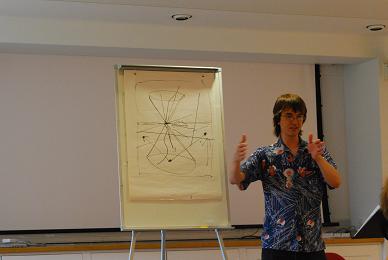
The day finished with a talk on time by the brilliant philosopher Dean Zimmerman, Professor of Systematic Philosophy at Notre Dame. Dean spoke of his A-theory of time, a theory in which the ‘priviliged present’ has  special properties over other tenses, and his work to reconcile it with the special and general theories of relativity. I’m not sure how much I really understood, but it was great to get a glimpse of how modern philosophy is reasoned out in the context of modern physics. Afterwards, it struck me that if he overcomes the apparent conflict with relativity, Dean’s A-theory might have some useful insights to offer concerning the ‘arrow of time’ problem in physics.

Dean in full flight – note the SR cone on the chart!

5 Comments

Filed under Uncategorized

Day 2 Cambridge: Darwinism and religion

Today was biology day, beginning with 2 talks by Pulitzer-prize winning science historian Ed Larson: ‘The Reception of Darwinism’ and ‘Darwinism, Eugenics and Religion’ . I won’t say much about the first (see the video here), except how refreshing it is to hear a science historian who carefully distinguishes between evolution, general modification, natural selection and neo -Darwinism from the very start. There was also a very nice discussion of the initial problems with the theory, e.g. the age of the earth according to Kelvin’s calculations, the precise mechanism of natural selection, the absence of early fossils and the gaps in the record…

The second talk was quite shocking, as Prof Larson detailed how the work of Francis Galton and others quickly led to the dominance of eugenics over theories such as ‘soft’ heredity and ‘blended heredity’ – the result was the emergence of repressive legislation on reproduction for the mentally deficient (segregation and sterilization) throughout northern Europe and the U.S.
Thankfully, the idea went out of fashion almost as quickly as it appeared, partly because of the horrors of Nazi Germany, and partly because of the emergence of scientific evidence that the model was deeply flawed.

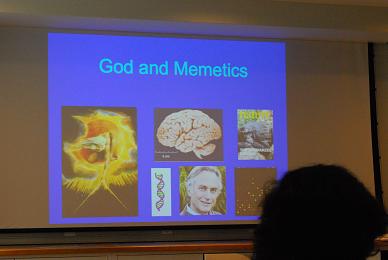
Denis Alexander, the director of the Faraday Institute, then gave a talk on ‘God and Memetics’, which consisited of an analysis of Dawkin’s theory of memes, and a discussion of the Dawkins description of religion as a ‘virus’. This was always going to be a lively talk and so it was. Dr Alexander had a field day dissecting the ‘virus’ theory in analytic terms (your humble correspondent pointed out at question time this might be a little unfair, as Dawkins probably uses the term in a metaphorical sense). More seriously, Denis also dissected the Dawkins ‘meme’ theory unmercifully, which I’ve seen a few biologists do recently. That said, he was very complimentary of many of Dawkin’s other ideas…more tolerant than vice versa anyway!

3 Comments

Filed under Uncategorized

Day one Cambridge: history

Phew! Quite a day. Oxford historian Peter Harrison kicked off with two excellent talks, ‘Religion and the Rise of Science’, followed by ‘The Fall of Man and the Foundations of Science’. I can’t do justice to either in a brief post, but Peter’s basic thesis is that, historically speaking, religion actually facilitated the rise of science, essentially by providing the stability it needed to flourish.

The first talk broke this idea down into areas such as

– social legitimacy for scientific enquiry

– presuppositions about nature (natural laws etc)

– motivation of discovery

– criteria for choosing between different theories etc.

He contrasted the rise of science in the west with that in China and the Islamic world, pointing out that the established Church gave legs to early scientific discovery.

The third talk dealt with a rather different encounter between science and religion – a superb overview of the Galileo affair by Prof Ernan McMullin of Notre Dame. Ernan had many insights I had not heard before – in particular, the role of the reformists. He started with a simple summary of Galileo’s telescopic findings, and then explained the context of the warning in 1616. Galileo’s timing was pretty terrible, as the rise of Luther and Calvin had by then forced a revised literal interpretation of the Bible throughout the Church – not the time for supporting the Copernican universe! Another point frequently overlooked is that the Church was not rejecting mainstream science – at the time, Galileo’s support for the Copernican was pretty way out there!

Just as I had always understood, the1633 trial itself consisted of a simple question – whether or not Galileo had supported a doctrine that contradicted a literal interpretation of Scripture – which was always going to give a positive result. Given the hegemony of he bible at the time, it could be said that he got off likely.

At question time, I made the comment that this is exactly what worries most people about the trial – the Church were simply not interested in the veracity of the claim, but simply whether it contradicted their precious doctrine…not the way to find out about the world…

Ernan also gave a great answer to the perennial question of why Galileo did not quote Kepler in his defence – because Kepler was a Lutherian! Of course! This would hardly be a source the Church wanted to hear from..

Ernan’s book on the Galileo affair received rave reviews

After the talk, we got a ‘science tour’ of Cambridge, concentrating on the colleges where famous science had been done. Hugely impressive tradition, from Trinity (Newton, Sedgewick, Darwin etc), St John’s (Dirac), Gonville and Caius (Stephen Hawking) to the Cavendish (Thompson, Rutherford, Cockroft, Walton etc). What a legacy…

The Cavendish

Comments Off on Day one Cambridge: history

Filed under Uncategorized

First impressions of Cambridge

And there I was moaning at having to leave the surf for a conference at Cambridge

In fact, Cambridge is fabulous, a lovely town. Having arrived by coach from Stansted, I decided to walk to the college (St Edmund’s) from the town centre. Most impressed to see all those famous colleges right in the centre – St John’s, Jesus, Magdalane, Trinity etc. The colleges give the town a lovely student atmosphere, great buzz and bicycles everywhere. I like the contrast between the beautiful ancient college buildings and the modern shops on the high street too, quite nice. It’s not at all a stuffy town either, tons of foreigners and tourists about.

St Edmund’s is obviously one of the newer colleges, but very nice. One big difference with Trinity College Dublin is that the rooms are lovely modern rooms, not 400 years old!

We’ve just had dinner -I’d love an afterdinner walk, but I’d better get swotting for Peter Harrison’s talk on religion and the rise of science tomorrow morning..

St John’s College

4 Comments

Filed under Uncategorized

Surf’s up in Ireland

Typical. On my last day in Dingle, Co. Kerry, the surf was up at last -just as I was leaving for Cambridge.

Nothing like it said on the radio (9 ft waves?- more like 2 ft) – but a nice clean wave at Inch all the same, after a week of poor surf. Plus the sun came out to play. It’s hard to beat, when you get both good surf and sun in the west of Ireland – a rare combination.I had a great last day.

The forecast is a nice big swell for the whole week. Meanwhile yours truly is off to a week long conference on science and religion at Cambridge University. Seemed like a good idea at the time.

Sigh. Not too many waves over at Cambridge, I imagine.

Last wave at Inch

Comments Off on Surf’s up in Ireland

Filed under Uncategorized

Nobel laureate conference

There’s a very interesting conference going on at Lake Constance (der Bodensee) this week, the Nobel Laureate Meeting in Lindau. There are a whole bunch of talks by Nobel laureates on diverse aspects of science, with several excellent talks on physics. The talks can be viewed on-line here.

For those interested in particle physics, there was a panel session devoted to expectations for the LHC experiments at CERN. I got these links from Peter Woit’s weblog NOT EVEN WRONG, and Peter has a discussion of the LHC session on his blog.

As regards the online Lindau lectures, the best I have found so far is David Gross’s talk on the future of particle physics (here). I just sat through the talk in its entirety, absolutely excellent. He gives a very good overview of particle physics, the Standard Model and the concept of supersymmetry. I particularly enjoyed his ‘big three’ reasons for SUSY, and his view of difficulties in detection at LHC. He predicts definite observation of a Higgs particle, and says he has taken bets that supersymmetry will be seen, at 50-50 odds. I wonder who his bet was taken with….

Official pic from Lindau website – is that E.? No, it’s Schweitzer

This evening, I’m looking forward to taking notes from ‘The Development of Particle Physics’ by Veltman, and tomorrow I think I’ll settle down with ‘The Beginning and Development of the Universe’ by George Smoot.

What a find!

Update

I’ve just sat through Martin Veltman’s talk. It is also very good, though he takes a totally different approach to Gross. Instead of a history of particle physics, it’s really a history of accelerator physics. Of course, some of the story of particle physics emerges naturally from the experimental narrative, but not as well as in Gross’s case (mental note for teaching – Ed).

That said, there are some great anecdotes. Almost the first physicist to be credited is the Irish priest Nicholas Callan, who developed the first high voltage transformer. I knew this, but I didn’t know Callan tested his instrument on hapless students until he was ordered to switch to turkeys! Veltman then goes on to the Rhumkoff transformer and its use by Roentgen in the discovery of X-rays. He descibes the discovery of radioactivity and the nuclear experiments of Rutherford as the true beginning of particle physics. Another Irishman, Walton, gets great credit for the invention of the Cockroft-Walton tube, and its use even in today’s machines is described.

There is a nice description of the role of cosmic rays, and the next generation of accelerators, including the development of the klystron, the synchrotron and finally the storage ring. Overall, it’s a very interesting talk for anyone in particle physics, if less so for non-professionals.

The end of the talk contains some interesting comments – Veltman points out that we are ending the end of an era, as accelerators reach circumferences in 10s of km. As the energy is determined by circumference, it’s hard to see how we’re going to increase energy further using this technology….

All the more reason to hope for interesting results at CERN

Update II

I sat through George Smoot’s talk this morning. Entitled ‘ The beginning and development of the universe’, it promised a lot more than it delivered. This was definitely what I call a type II lecture – everything was probably there somewhere, but not in any order one could make much sense of.

Smoot mentions the acceleration of the universe early on, without any discussion of the universe expansion. or Hubble’s law. Similarily, he launches into a description of measurements of the cosmic microwave background without giving any explanation of its importance as a snapshot of the early universe. Finally, while there was plenty of talk of both the COBE and WMAP satellite experiments, there is no mention of the ‘why’ – i.e. the advantages of satellite measurements over ground-based observation.

In fact, this talk was strangely reminiscent of a talk given by Smoot’s co-laureate John Mather at Trinity College Dublin last year. There should be a law – if you’re going to give a public talk about your area (cosmology), you need to spend a few minutes on the basics – univ. expansion, nucleosynthesis, backgound radiation and inflation models. That’s hat I think anyway.

I’m fairly sure any members of the audience not familiar with BB theory left that lecture no wiser than before…
2 Comments

Filed under Uncategorized

Supersymmetry

The success of the unification of the weak- and electromagnetic interactions (see SM post below) soon led to attempts to extend the program to include the strong interaction, i.e. a search for one unified scheme that could describe all three non-gravitational forces (known as Grand Unified Theory) .

However, the GUT program soon ran into serious trouble, with a clutch of ‘no-go’ theorems from mathematicians such as McGlynn, O’Raifeartaigh, Coleman and Mandula showing that such unification could not be achieved using similar gauge methods to that of the electro-weak program. In response, a dramatic new type of symmetry was proposed in the 1970s.

The theory of supersymmetry was a new type of gauge symmetry, and is called ‘super’ in the sense of an ultimate gauge symmetry. Supersymmety (SUSY) supposes a deep connection between two classes of particles that had previously thought to be unrelated – the particles that make up matter (quarks and leptons) and the particles that act as ‘force carriers’ (photons, W and Z bosons ). A very significant difference between the two sets is their spin – quarks and leptons have 1/2 integer spin (called fermions) and obey Fermi-Dirac statistics in consequence. They follow the Pauli Exclusion Principle which states that no two fermions with identical quantum numbers can occupy the same state. ‘Force-carrying’ particles like the photon have integer spin (called bosons ) obey no such rule, and basically behave completely differently.

In essence, supersymmetry posits that every fermion has a corresponding boson sibling and vice versa – in other words, for every quark and lepton there exists a supersymmetric sibling (squarks and sleptons), and every boson also has a supersymmetric partner.

Unfortunately, no-one has ever seen such particles, either in cosmic rays or in particle acceleraor experiments. Hence, if SUSY exists, it must be a broken symmetry, i.e. the supersymmetric partners must have different decay schemes to ‘normal’ particles, and must be much heavier than their ‘normal’ cousins (otherwise we would have seen them). The only way to see if SUSY particles ever existed is to try re-creating them at extremely high energies in particle accelerators (much as we create anti-particles). This is one of the things the new collider at CERN was built to look for.

That said, theoreticians claim that there are indirect hints that SUSY , or something like it, might be right. The first is the convergence of the three non-gravitational forces. While these forces appear completely different at low energy, they have a different energy dependence, and may in fact converge at high enough energies. However, detailed calculations show that they converge to a point only if supersymmetry is allowed for. Unfortunately, this is a purely theoretical conjecture – you can see from the diagram below that the convergence is expected to occur at energies way beyond the reach of current accelerators.

GUT convergence including supersymmetry

The second is a hint from cosmology – we are pretty sure that well over 2/3 of the matter of the universe is ‘dark matter’, i.e. only seen by its gravitational effect (see post below). Such matter must be massive and yet weakly interacting (WIMPS) – an idea that fits supersymmetric particles very nicely. In fact, the favoured candidate for dark matter is the lightest SUSY particle, the neutralino (see post below).

Hence the search for SUSY particles at CERN, and the search for Dark Matter in cosmology are experiments that complement each other. Progress on either front will probaby have implications for the other, a fantastic convergence of particle physics and cosmology.

7 Comments

Filed under Uncategorized