Category Archives: Teaching

Exam stress

This week is by far the most stressful week of the teaching semester for lecturing staff, as Friday marks the deadline for submission of exam papers. If you teach four courses, which is fairly typical for Institute of Technology lecturers, that’s eight papers of questions and model answers to be handed in if you include the repeats.

I’m not saying it’s a bad idea in principle to have exams submitted half way through the semester, far from it (besides, the timetable is set by the fact that the papers have to be posted to the external examiners). However, it’s a lot of prep and the stress is twofold. First there’s all those neat questions you thought of as you were teaching the course, but now can’t find. Second, it’s the realisation that, in every course, you are far behind where you should be. If only the students knew!

image

Enthralled class

Worst of all are the shared papers. This involves inumerable meetings, changes and compromises, until all participants are happy.I often feel it would be easier to write the whole damn paper myself, even if I only teach part of that course!

Still, shouldn’t complain. Next week is midterm and we have a whole week off. I intend to make the most of it, with a weekend in the Comeragh mountains with the Glenwalk Hillwalking Club, followed by some surfing and music in Doolin during the week. I deserve it.

7920_167639400624_709515624_3592543_4911188_n

With Glenwalk in the mountains of Mourne

5610_153351215624_709515624_3388740_786291_n

Tunes in Doolin last summer

5 Comments

Filed under Teaching, Third level

Frontiers conference 2009

I spent last weekend at the Frontiers conference of the Irish branch of the Institute of Physics. This is a conference aimed at establishing links with secondary schools all over the country and bringing physics teachers up to date with the latest developments in physics and physics teaching. I attended Frontiers for the first time at University College Dublin last year and enjoyed it immensely (see September 2008 post). This year it was WIT’s turn to host the conference and I think it went very well, thanks to the superb organisational skills of Paul Nugent, David Keenahan, Alison Hackett and Eilish Mc Loughlin of the Institute of Physics and WIT physicist Gabriel Gallagher.

The weekend started with a dinner for the conference speakers and organisers in the Tower Hotel on the Friday night. It’s always great to catch up with other physicists in an informal setting and the occasion didn’t disappoint. In particular, I was amazed to discover that well-known science communicator and Northern Ireland Space Office director Robert Hill and I share a colourful past: many years ago Robert used to play 1st trumpet with the National Youth Orchestra of Ireland while I scraped away in the 1st violins!

Saturday morning kicked off with a series of three lectures: you can see the conference program here.

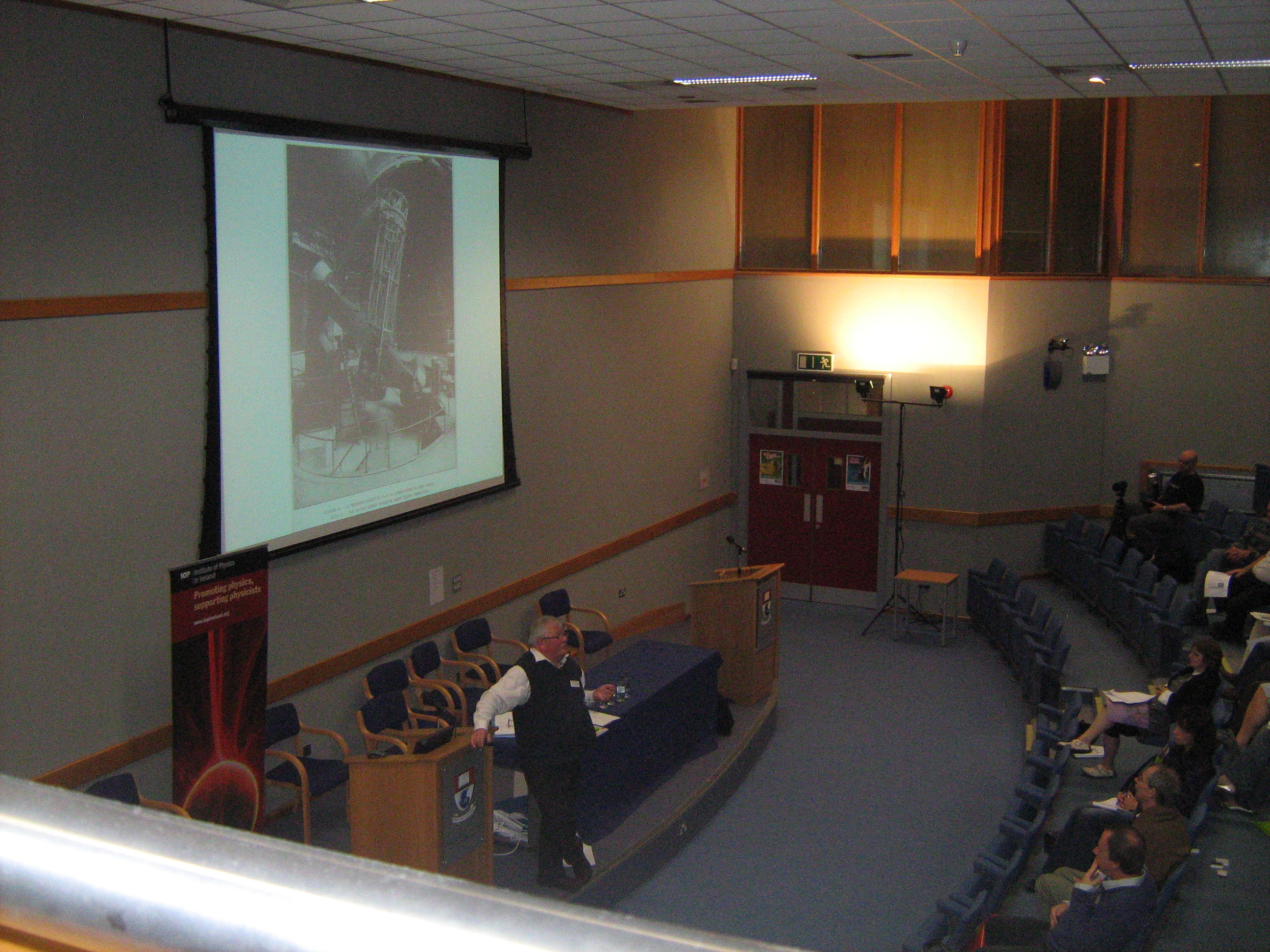
First up to the podium was Prof David Hughes, a highly distinguished astronomer and science communicator from the University of Sheffield, with a talk entitled ‘Telescopes: their history, development and future’. This was a masterly presentation on the evolution of the telescope over the centuries and its effect on science. The seminar covered the whole gamut – from Galileo’s use of a primitive telescope to observe the moons of Jupiter and the phases of Venus, and its impact on the geocentric model of the solar system, to Hubble’s use of the 100-inch Hooker telescope on Mt Wilson to establish the existence of distant galaxies and the subsequent discovery of the expanding universe (the first plank of evidence for the Big Bang model). I really liked the way the speaker emphasised the impact of each technological step in the development of the telescope: from refracting lenses to reflecting pyrex mirrors, from simple drawing to photographic images, from cumbersome mechanical mountings to computer-controlled giants, from simple photography to the modern CCD camera. (Interesting stat: for the last four centuries, the physical size of telescopes has doubled every 50 years). This was a masterclass in science communication and the audience was enthralled.

telescope

David Hughes with an image of the Hooker telescope in the background

David Hughes2

It’s astonishing how astronomy still revolutionizes cosmology from time to time: throughout David’s talk I kept thinking of the recent measurements of distant supernovae that led to the discovery of a universe expansion that is currently acclerating (see post on dark energy here). Interestingly, David was quite cautious about this result in discussion, pointing out that it depends critically on our understanding of Type 1 supernovae – it’s just possible that the effect arises from a lack of understanding of these stars, although there is some coobborating evidence of dark energy from recent measurements of the cosmic microwave background.

In the second talk of the day, Eoin Gill of the WIT science communication group CALMAST gave a talk on ‘The life and legacy of Robert Boyle’. It’s often forgotten just how important the work of this Irish scientist was, from his theory of ‘corpuscules’ to his famous work on gases. Eoin gave a great talk on Boyle, giving an overview of his life and times and the impact of his scientific discoveries. As regards the former, many were surprised to hear that the Irish have a mixed view of one their most famous scientists because of his family background. Robert Boyle was able to indulge his passion for science due to vast wealth inherited from his father, the Earl of Boyle: unfortunately the latter was a notorious Englishman who made his fortune by stealing land from the Irish and redistributing it to English nobility!

boyle

Robert Boyle (aka Eoin Gill) in action

Robert Boyle 2

The high points of the talk were the simple but effective demonstrations. Taking his cue from the famous demonstrations employed by Boyle himself at Royal Society lectures, Eoin showed several neat demonstrations of the vacuum that could be done in the classroom – snuffing out candles in a sealed container attached to a simple pump, the elimination of noise from a bell in the same container, the impossibility of pulling apart spheres separated by a vacuum and many others.

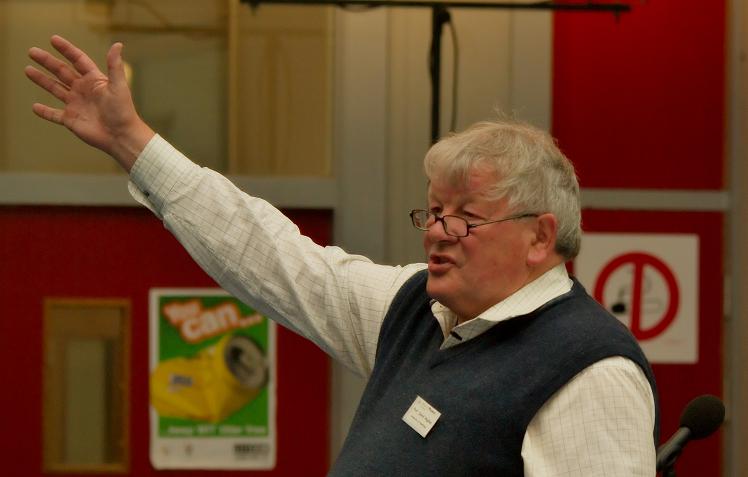
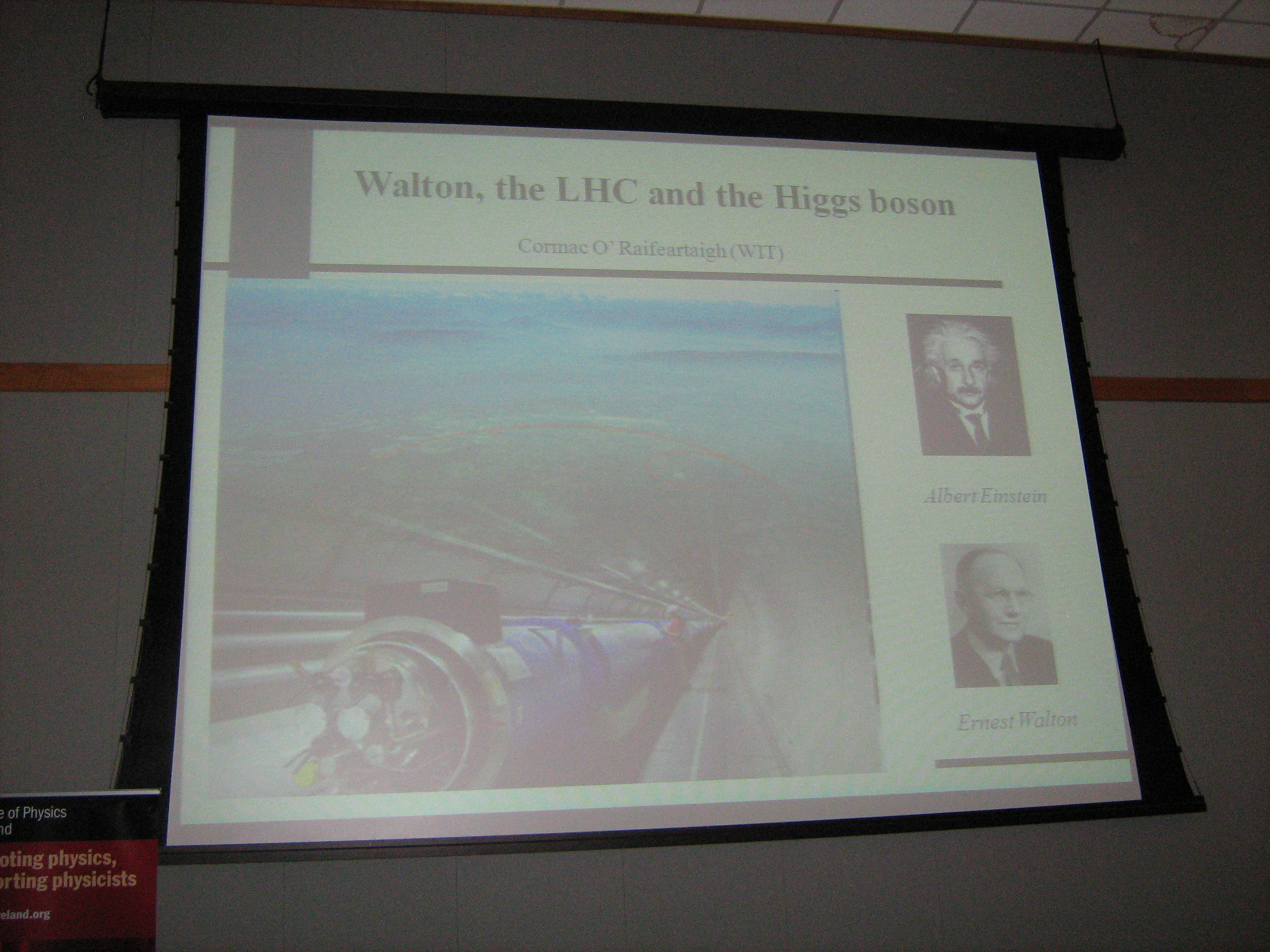
The third talk of the morning was my own presentation on ‘Walton, the LHC and the Higgs boson’. This was a 40-min overview of the forthcoming experiments at the Large Hadron Collider at CERN and their importance in the study of the elementary particles, along with a few words on the role of the Waterford-born scientist Ernest Walton in the evolution of accelerator physics.

w2

Cormac2

Ronan McNulty of University College Dublin gave an excellent short talk on his group’s involvement in the LHCb experiment at last year’s conference, so this was an attempt at a more general overview of experimental particle physics. Part one dealt with the how, what and why of the LHC: how particles are created and detected, the relevence of such experiments for particle physics and cosmology and a few specifics on the proton beams and the detectors. (I also tried to emphasise the fact that relativistic effects such as mass-energy equivalence, time dilation and length contraction are routinely measured in particle experiments as I feel this point is often forgotten). The second part consisted of a whirlwind introduction to the Standard Model, from the discovery of quarks to electroweak unification. In the 3rd part, I sketched the role of the Higgs boson in the model and the difficulties of detection. I touched on the possiblity of physics beyond the standard model at the LHC (supersymmetric particles and the implication for grand unified theories) before finishing up with a few words on cosmology – the search for dark matter particles and the study of matter/antimatter decay in the LHCb experiment.

You can find the slides from the talk here and a video will be available on the conference website next week. My only regret is that the conference had been running 15 minutes late all morning so there was no time for questions  – the best part of any talk. Also,  I never got time to show Kate McAlpine’s LHC rap, it would have gone down a bomb!

*************************************************

After lunch, Robert Hill , the director of the Northern Ireland Space Office, gave a workshop on useful astronomy software and website resources for teachers. As the former science communicator for the Armagh Planetarium and founder of the Astrogazers Ireland Schools Network, Robert knows a thing or two about getting young people interested in astronomy and science and this was a highly useful workshop, fnishing with a great 3-D show on the universe. I won’t give more details, but examples of the sort of invaluable web resources he gave are

Astronomy Ireland

Armagh Planetarium

The Hubble Site

The Faulkes Telescope Project

Celestia

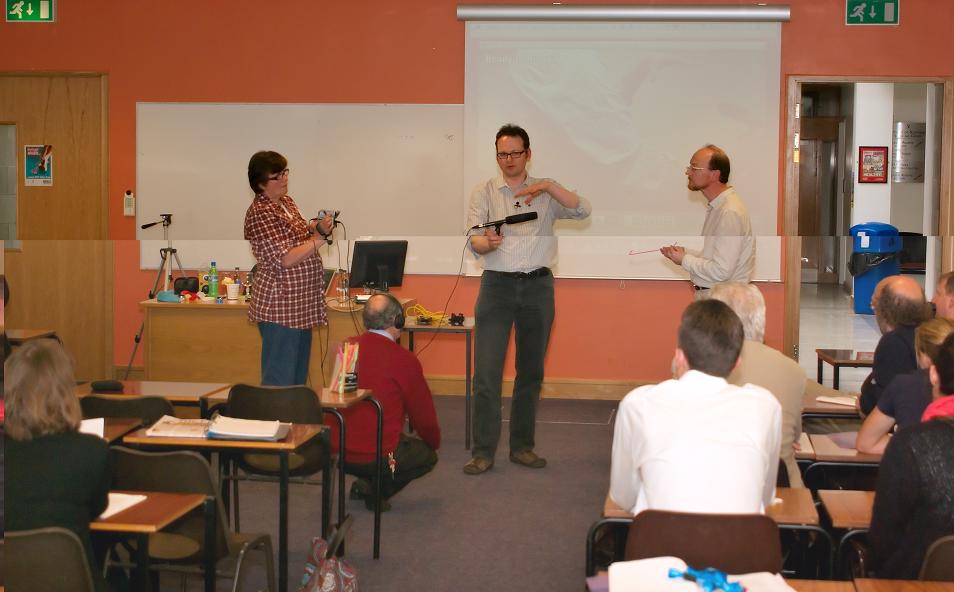
Finally, there was a workshop on making videos for educational proposes by Jonathan Sanderson. Jonathan is a highly experienced producer of TV science shows (he has produced series on science for the BBC, ITV and RTE) and he gave us an overview of the SciCast project: this is a nationwide effort in the UK to get students to discover the wonder of science by making short films of simple scientific demonstrations. Jonathan had some great tips on how to get the students to work in teams for the production of such films and then showed us some classic examples from the existing SciCast collection. So far, there are more than three hundred films in the SciCast collection, you can view the collection here!

Video workshop2

A masterclass in science film directing

All in all, it was a great conference, with plenty of items of interest for any science educator. There were also plenty of useful freebies such as astronomy posters, polarising sheets, SPIN science magazine, flash memory sticks and a DVD on the universe produced by the ESA. Professional photos of the event and videos of the talks will be available on the conference website in a few days.

4 Comments

Filed under Particle physics, Public lectures, Teaching

Institute of the Year 2009/10

This week is Clubs and Societies week at WIT and there is a great atmosphere around the college. As in any third level college, there are many interesting clubs, from Gaelic games to swimming, from canoeing to rock climbing etc. This is an important part of college life as the clubs offer a wonderful opportunity for students to try a sport they may never otherwise encounter. For example, the sailing club gives students an opportunity to learn to sail without the hassle of buying a boat or joining an expensive sailing club. My own favourite is the surf club – this is a big hit as the college is only a few miles from Tramore surf beach and students from distant parts of the country (and abroad) are keen to sign up.

Image0016

*************************************

There is also a good mood around the college because WIT has just been nominated Institute of Technology of the Year in the Sunday Times league table of Irish third level colleges. The Sunday Times ranking is the only league table for the IoT sector and it is the second time WIT has won the award in the last few years.

It’s always good to come first, but it’s hard to know how accurate such rankings really are. Different colleges come top each year, which might indicate that the variation in a given college from year to year is larger than the variation between different colleges. That said, only a small number of colleges vie for top position every year so I guess it’s an honour to be in that number.

The main categories used in the Sunday Times rankings are: median CAO entry points, staff/student ratio, graduate employment, student grades, research income,  % non-standard entry rate and % dropout rate. This year, WIT scored an impressived 9/10 overall,  with the following breakdown:

average CAO entry points : 357

average staff/student ratio: 12:1

graduate employment: 99.2%

student grades of 2.1 and above: 56%

annual research funding: 18.2 million €

non-standard entry: 35%

student dropout rate: 15%

You can see more details here. It’s a good result, but one must admit that the poll is not a scientific study. For example, some academics question the ‘student grades’ category: a high percentage of 2.1s or above is awarded a high score, but it’s always possible that such a score reflects exam standards rather than better teaching (colleges set their own exams). This is an argument for another day, but let me note that even if this were true, I’m not mad about the other extreme: a recent study confirmed that throughout the 1980s, UCC and UCD graded their students far harder than Trinity, a habit that advantaged nobody and disadvantaged their students.

As regards the university rankings in the Sunday Times study, NUI Maynooth is the 2009 University of the Year up from 7th place last year. This is only one of two categories for the universities (I’m not that clear on the difference) but it’s pretty impressive for one of Ireland’s smallest universities. It does however raise a question: how could any college change this much in one year? I suspect it indicates that there are only small differences in scoring between the universities. Indeed, a positive result that can be drawn from the Sunday Times annual rankings is that Irish university students are offered pretty much the same level of education irrespective of which university they attend, in marked contrast with the American system. I like the Irish system better and I think we should stick with it, and forget the recent suggestion of a two-tier university system with an eye to world rankings.

550W-Campus-Tour-for-University-of-Dayton-students

University College Maynooth

How do the Institutes of Technology compare with the Irish universities? It’s hard to tell as there are separate lists for the two types of college. I think it would be interesting to see a direct comparison between the two: in particular, I think the results in research funding for WIT and CIT might come as a surprise to some university colleagues.

Finally, I can’t resist pointing out the sad irony of WIT coming top in such studies. Waterford is one of the most disadvantaged of Irish cities and one reason for this may be that is the only Irish city without a university, causing an inevitable braindrain of our best schoolleavers to Dublin and making it difficult to attract multinationals to the region. In other words, the city desperately needs the cachet that a university would bring and clearly has a college that could form the basis of such a university, but nobody in government is much interested.

Some might argue that if Ireland were governed by logic rather than history and religion, there would be no university in the town of Maynooth and there would be one in the city of Waterford where it’s needed…I couldn’t possibly comment!

Update: this post has been reproduced on the 9th level Ireland website, you can see the comments there

Comments Off on Institute of the Year 2009/10

Filed under Teaching, Third level

A day in the life

Update: WIT has just been declared Institute of Technology of the Year in the annual Sunday Times league table. This is the second time we have been awarded this and the  criteria include research funding, graduate employment and staff/ student ratios. I rest my case!

*********************************************************

We’re already in the second week of the teaching semester at WIT and life is settling back to normal after some timetabling problems. University colleagues are often curious about life in an Institute of Technology, so I’ll try and describe a typical day…

I start most days with a 9.15 lecture to 1st science (after parking some distance away as the college simply can’t cater for 6,000 cars but is strangely reluctant to introduce permit parking). Teaching first year physics is a bit of a chore after all these years and the class is large at 75 students. That said, it’s nice to be present for their first introduction to physics and I try to keep them interested by linking the elementary stuff to deep ideas in cosmology and particle physics (How big is the universe? Is time a vector or a scalar?).  Also, the vibe in 1st science is always good as the students are delighted to be in college, studying a host of new subjects.
images

Waterford Institute of Technology, Ireland

Most days, I’ll give a second lecture before lunch, to electronic engineers, with a morning break to catch up on email in the office. After lunch, I generally take a practical class, or else more advanced classes like 3rd and 4th year quantum physics. All in all, it is quite a heavy teaching load (16 h/w) in comparison with university lecturing. I enjoy the teaching, but the lectures, labs and staff meetings required for four different courses can take up 100% of your academic life if you let it. Still, it’s not too bad if you don’t have too many new modules in any given semester! Ironically, the new modules are often the most interesting, from cosmology 101 (see categories)  to the science of climate climate change next semester.
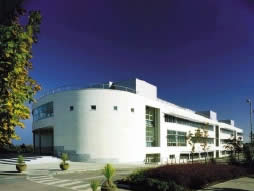
p3-2

The college library

After the day’s teaching, I try to get some research done in the office from 4–6 or 5-7. One big difference with university life is that research in the IoT sector is self-driven, i.e. there is nothing specific in our contract about research. In some ways, this makes for a more relaxed life and indeed some staff confine themselves to teaching and preparation. On the other hand, there can be problems of motivation for those who do choose the research path, particularly as there is no reduction in teaching hours, or a definite career path linked to research. Despite all this, there are some highly competitive research groups in the college, attracting serious funding at national and international level. Recently, the college authorities decided to award nominal professorships for outstanding researchers and I think this will be helpful.

Another issue in the IoT sector is office space. Because the Institutes started out as teaching-only institutions, staff often share quite large offices. I myself share an office with seven other lecturers; with students coming to the door and phones continually ringing, not much real academic work gets done between classes during the day, hence the evening shift.

Overall, there is a very good atmosphere in the college,with a fairly young, well-motivated staff. There is plenty of interaction between staff of different disciplines at coffee time, more than in any other college where I have worked (3). It helps that the college is the only third level college in this part of Ireland and enjoys a reputation of being effectively university-level in both teaching and research. Sadly, it may never actually get the deserved upgrade for reasons of realpolitik; in the parish pump world of Irish politics, there is a very real danger of all of the Institutes being subsequently upgraded, resulting in 13 new universities!

*********************************************************************

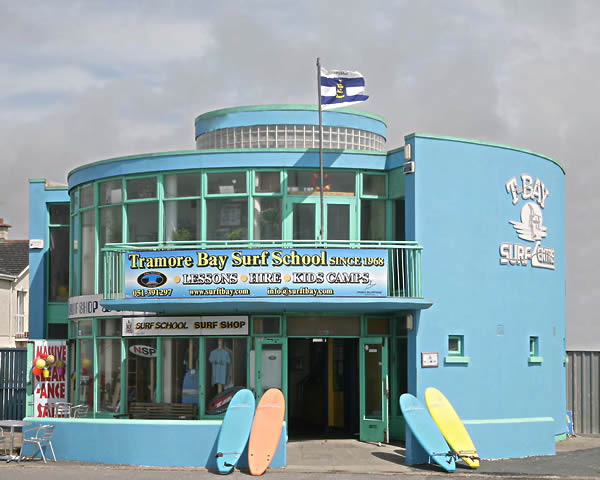
After work, I might catch a wave in Tramore Bay on the way home if conditions are good, otherwise it’s off to the pool or gym. Failing, that, there is always something going on in college, from an excellent film club to concerts, from public lectures to evening classes – this year I’ve enrolled for Creative Writing, can’t wait.
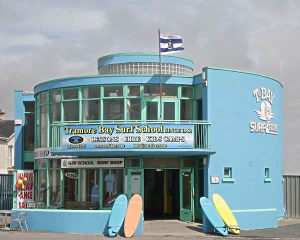
tbaysurfcentre

T-bay surf centre

*********************************

As regards my own research, I took a break from technical research two years ago in order to concentrate on science communication. I’ve been interested in the whole area of the public perception of science for some time and it’s an area that’s becoming more and more important as society faces challenges such as global warming and energy supply. My particular area of interest is that of public information vs misinformation. There seems to be a great deal of misinformation around on matters scientific in the US and Ireland; sometimes it arises from journalistic ignorance and sometimes from vested interests.

It’s not an easy field to break into but I’ve been lucky so far, with regular pieces in newspapers like The Irish Times and magazines like Physics World (see My Articles).  The blog doesn’t hurt either; I’m currently in negotiations for a pop book on cosmology and I often get asked to give public lectures (this month, I’m giving a talk on the Large Hadron Collider at the Institute of Physics teacher’s conference and next month I’ll give a talk on the Big Bang to Astronomy Ireland at Trinity College, see Public Lectures).

In the longer term, I guess it’d be nice to get back to the university sector eventually, ideally as a Professor for the Public Understanding of Science. Writing articles is fine, but I’d relish the chance to be involved in public science debates in the media with prominent doubters and skeptics (wouldn’t say no to a quiet office, either). Although there are many PUS positions in the UK and the US, there are currently none in Ireland, hopefully this will change in the future.

In the meantime, I enjoy both the teaching and research in different ways. I can summarise a typical day’s work with a famous quote – if you find a job you enjoy, you’ll never have to do a real day’s work in your life!
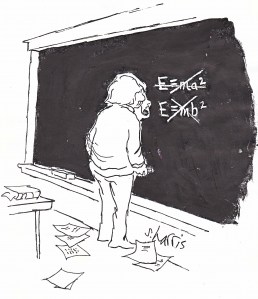
10 Comments

Filed under Science and society, Teaching

back 2 school

Last week was exam week, with repeat paper corrections and countless exam board meetings. I quite enjoy the cut and thrust of these meetings, but I notice a paradox: the hardliners and sticklers always seem to be staff that are the least active in research. Perhaps flexibility about student marks is also about being aware of one’s own limitations.

This week it’s back to school in earnest as lectures begin. My timetable’s not too bad – like any lecturer in the Institute of Technology system I have a heavier teaching load than a universtiy lecturer, but on the other hand I get to teach on all sorts of different courses – from so-called service teaching (1st year science and and 1st year engineering courses) to 4th year solid-state and quantum physics.

I don’t mind really mind the service teaching, but the classes seem to get bigger every year, with no corresponding increase in staff. Plus, physics is the not the favoured subject of most of these students, so it can be a struggle to keep them motivated.

image

Enthralled class

The really bad news is that our degree in physics with computing is being phased out due to poor uptake. We were not permitted a first-year intake, so the future of physics at WIT the looks pretty grim. So much for the knowledge economy, then.

Comments Off on back 2 school

Filed under Teaching

Institute of Physics Spring Weekend

This weekend I was at the annual spring meeting of the Institute of Physics in Ireland in Wexford. I always enjoy these weekends – more relaxing than a technical conference and a great way of keeping in touch with physicists from all over Ireland. As ever, there were good seminars, a physics pub quiz and discussions of science and philosophy over breakfast, lunch and dinner (not to mention a 32-strong Wexford choir who gave superb after-dinner entertainment). At the same time, there was a serious side to the weekend with committee meetings, the Annual General Meeting and a highly competitive poster competition for postgraduates.

The theme of the seminars on Saturday was ‘Physics for Life’ and it mainly concerned advances in medicine/ biology that have resulted from research in fundamental areas of physics such as atomic and molecular physics (Bob McCullough of Queen’s University Belfast), solar physics (Louise Harra of University College London), nano-photonics (Brian MCraith of DCU) and molecule manipulation using ‘optical tweezers’ (Martin Hegner from Trinity). I won’t attempt to describe each talk, but you can find abstracts of the talks here.

My favourite was a general talk on causality in complex systems by world-famous cosmologist George Ellis: ‘Top-down action in the hierarchy of complexity’. This was a fascinating overview of the subject of causation, focusing on the influence of feedback from top-down processes on bottom-up causes. There were lots of great examples and the speaker was fully convincing in his conclusion that ‘no complex system can have a single cause’. I couldn’t help thinking how true this is of climate change. Some media pundits describe global warming phenomenon in terms that too simple; by citing man-made CO2 as the only factor in climate, they give great ammunition to climate skeptics who point to other factors. (The point is that while CO2 is not the only factor in global climate, it is now clear that the man-made increase in CO2 is a significant driver of warming.)

img_36711

Top-down causality: George Ellis

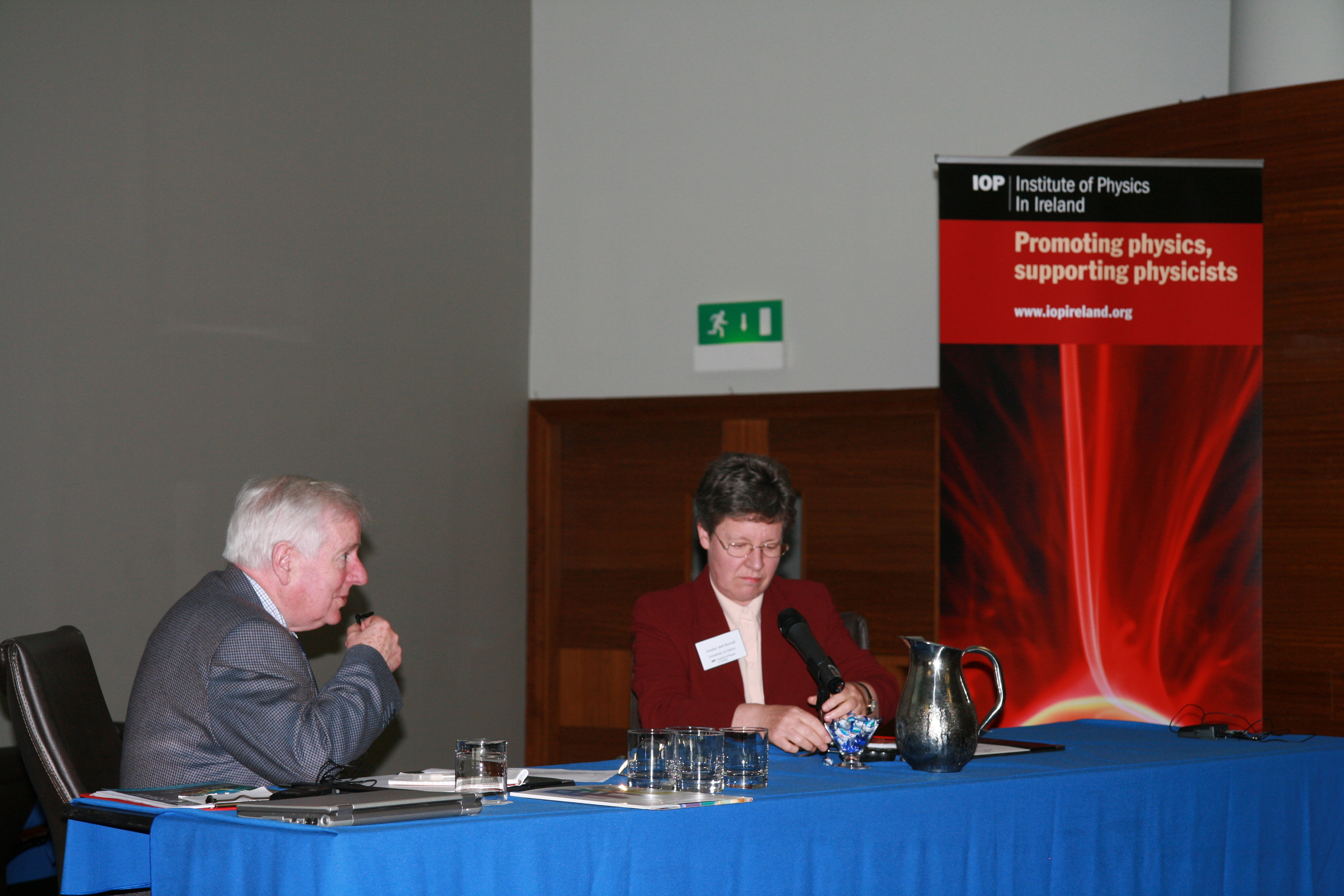
Sunday saw a new IoP initiative – instead of more seminars, four well-known physicists were given the ‘This is your Life’ treatment in sequence. It was a great success, with the legendary Tony Scott of UCD interviewing Ronan Mc Nulty (on the LHCb experiment), Sile McCormaic (on her path to the world of cold atoms) and Ray Bates (reknowned Irish climatologist who was one of the first in the area of climate modelling).

Best of all, the very first interviewee was Dame Jocelyn Bell-Burnell, the Belfast-born astrophysicist famed for her discovery of radio pulsars. (She is also President of the Institute of Physics). Professor Bell gave a fascinating overview of her life in physics, from failing the 11-plus exam to Cambridge. Of particular interest was her description of the postgraduate work leading up to the famous discovery: the long build of the radio-telescope from raw materials, perservering to the end as team members drifted off, the discovery of an unknown source, convincing her supervisor she was onto something, the disappearance of the source and the stress of a possible mistake and lost thesis, the re-appearance of the source, the classification of the first pulsars….terrific stuff.

img_3754

Tony Scott interviewing Jocelyn Bell-Burnell

Professor Bell’s story was reminiscent of the discovery of the microwave background by Penzias and Wilson (see post here), but with one big difference. Bell was a highly trained astrophysicist, who understood clearly that she might have discovered an important phenomenon. For this reason, it is still highly controversial that, while her supervisor Antony Hewish was awarded the Nobel prize for this work, she was not. Was it because she was still a postgraduate? Because she was a woman? Perhaps we will never know. Apparently, there was a very good BBC documentary on the story a few months ago – I misssed it but I’ll try and track it down.

As always, the most humbling part of the weekend was the postgraduate posters. The level of research made one feel seriously inadequate. You can find the results of the competition on the IoP website; choosing the winners must have been very difficult. I particularly enjoyed two posters from UCD on the LHCb experiment (an indirect measurement of luminosity using muon production rates, and the measurement the cross-section of Z boson -muon decay). Even there, Ronan had to explain to me how antiquarks arise in proton-proton collision; must revise my quark physics!

img_3681

Poster session at the meeting

All in all, a super weekend, courtesy of the Institute of Physics. Now it’s back to earth and those corrections…

2 Comments

Filed under Institute of Physics, Teaching, Uncategorized

Pesky exams

Since Christmas Day I’ve been busy correcting exams, but I just finished today yipee! I like to get them out of the way early so I can get back to the snow-world for a few more days before college starts up again…

Most academics hate correcting exams more than anything, but I don’t really mind that much – it always takes less time than expected (unlike research) and I like any job that has a definite beginning, middle and end (with room for targets, breaks and treats along the way). I also learnt years ago that it’s easier to stay focused if I correct exams script by script. Some lecturers dislike this method and claim it makes more sense to mark in parallel – i.e. correct all the first questions, then all the second the questions etc. I have never adopted this method as I’m terrified of making a mistake when the marks are totted up at the end. I feel there’s much less chance of this happening if one goes through the script question by question, as you get a feel for how a particular student is getting on…

Anyway, I finished at midday today and celebrated by going shopping. First thing I saw was a good skisuit for €99 and snapped it up (I used to be so proud of my ski instructor jacket, but have finally tired of being slagged over my gimpy outfit!). So it’s not all work and no play. Oh no. How’s this for cool – I’m off on Wednesday to some posh hotel in Montreux (Swiss riviera) to join friends from the Frankfurt Ski Club for their annual New Year’s Ball – after which we’re all staying over for a few days’ skiing in the nearby resort. Yipee.

Lake Geneva in winter- Viola Stockinger

And yes, I’m flying into Zurich again (see post below), more gorgeous train journeys through the snow..

That said, I do feel a bit guilty about all this flying, the main reason I hope one day to convert from being a good skier to a good surfer (a sport I can do at home). Unlike Lubos Motl, I don’t have the excuse of being a global warming skeptic – I find it hard to believe that the majority of the world’s climate scientists are fools or knaves. So sorry about those polar bears…

7 Comments

Filed under Teaching, Uncategorized

Last week of term!

There’s a great atmosphere around the college this week as it’s the last week of teaching term for the first semester. As one who strongly opposed the introduction of short semesters, I have to admit there’s a great sense of closure as staff and students  reach the end of taught courses.

This morning I finished the course with 1st science and went through last year’s paper with 1st engineering. This afternoon it’s the turn of 3rd year solid-state physics – a lot more serious as we revise all the major concepts the hapless students will need to know for their exam.

Meanwhile, I’m preparing yet another public lecture (slides here) on the LHC, this time as the keynote address for our careers day in physics at the college tomorow . What careers? Well, mathematicians and theoreticians have been kept busy calculating collision events and decay schemes. Engineers and experimentalists designed the detectors and experiments. Civil engineers build the major construction projects. Last but not least, computer scientists and software engineers have been working hard on constucting new methods for dealing with the petrabytes of data – not least the latest in distributed computing – the GRID. There’s a great article on this, the Large Hadron Computer, in the November issue of Physics World.

The GRID – National nodes at tier 2, universities at tier 3.

It’s often forgotten that the world wide web was orignally developed at CERN in order to facilitate the analysis of data from particle experiments at CERN . It’ll be interesting to see if the GRID has similar application to the world at large.

P.S. No teaching next week, and I can finally get down to some writing. After, that I’m going skiing yipee.

Comments Off on Last week of term!

Filed under Teaching, Uncategorized

Teachers, students and graduation

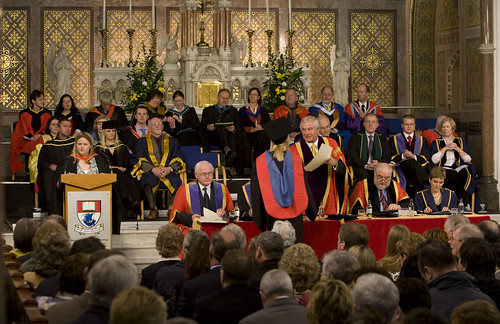
I took time out from exam preparation to catch the end of the college conferring ceremony yesterday and I’m glad I did. As well as the great atmosphere, the beautiful chapel, the students and their proud parents, there was a nice surprise – one of the first students I ever taught at WIT was conferred with a PhD (help I’m getting old).

Venet Osmani arrived at WIT from Kosovo at about the same time I arrived from Trinity – he was among the first of our fulltime students from abroad and I remember there was a certain amount of anxiety as to how the program would roll out! In the event, Venet turned out to be one of the best students we ever had. It’s such a privilege to teach good students – more like a sharing of knowledge than a chore. Venet went on to do his PhD research with the TSSG, the highly respected telecommunications software research group at WIT, and is now continuing research in the same area with renowned international research center CREATE-NET in Italy. Definitely one of our success stories…

Last year’s conferring at WIT

Today, its back to earth and back to work on those pesky exam questions. However, 24 hours from now, I’ll be airborne – en route to Portugal for a few days break with The Surf Experience, hurrah!

Me and my laptop, that is. There’s plenty of work to be done, but it’s as easy to do in the peace and quiet of lazy evenings in the surf lodge as in a busy office in rainy Ireland. Plus, one of the chief instructors at the lodge is doing an Open University course in fundamental physics – we always have great discussions on particle physics, string theory and the mysteries of the universe!

Comments Off on Teachers, students and graduation

Filed under Teaching, Uncategorized

Town, gown and college life

There is a nice atmosphere around the college this week as conferrings get underway. A curious aspect of the Institute of Technology system is that many students get conferred while still at the undergraduate stage! This is due to the stepwise nature of some of our courses, with a Certificate after two years, a Diploma after three and a Degree after four (of course we also have ab initio and postgraduate degrees).

The conferring ceremony is always lovely as it takes place in the beautiful Pugin Chapel in the College St campus, the part of our college that houses the humanities and the performing arts.

The  2007 graduation ceremony at WIT

Some academics dislike the pomp and ceremony of conferrings, but I enjoy them on the rare occasion I get to attend. There is a great sense of achievement among the students and their proud parents, and of the role of the college in the wider community among the staff. Makes it all worthwhile, somehow. There is also a nice atmosphere around town in the evenings as the students and their parents converge on the pubs and cafes – I wouldn’t be surprised if quite a few students decided to go to college as a result of the atmosphere they observed around town during commencements.

Unfortunately, this week is also one of the busiest of the year for lecturers, as it is the midpoint of the semester and exams must be submitted by the end of the week. This can be quite a tough prospect if one is lecturing new modules as it involves setting questions and answers on topics not yet covered. Setting a paper for 1st yr engineering didn’t take long, but I’ve spent all week trying to think up challenging but doable questions in the quantum physics of solids (3rd yr) and the physics of semiconductor devices (4th yr) . Sigh.

Still, no lectures next week yipee!

1 Comment

Filed under Teaching