Category Archives: Science and society

Wednesdays, WIMPs and super-WIMPs

Wednesday is my favourite day this year. The weekly STS seminar is over and discussed, the fellows group meeting is done and it’s too early to start next week’s readings. At 12.15, I give a solid-state physics class over the web to my hapless students in Ireland and then I’m finally free to catch up on what’s going on in the world…

One of the things going on this week is a terrific cover story in Scientific American on dark matter by particle cosmologists Jonathan Feng and Mark Trodden. As every schoolgirl knows, particle cosmology is one of the most exciting areas of physics today; the convergence of the study of the extremely small (particle physics) and the study of the extremely large (cosmology) has had some spectacular successes in recent years. For example, the theory of cosmic inflation arose from considerations of particle physics, see post on inflation here.

The article gives a great overview of the concept of dark matter, from a postulate in particle physics (Fermi’s beta decay – bit of a stretch here), to the postulate of dark matter in galaxy formation in the 1930s (Fritz Zwicki). Of course, the W and Z particles of ‘ordinary matter’ are now associated with the former, but it is thought that dark matter may play a role in their masses. Similarily, Zwicki’s proposal has now been extended to explain galaxy formation all scales, from galaxy clusters to halos. (Essentially, dark matter is thought to provide the inert scaffolding on which ordinary matter clustered to form galaxies during the expansion of the universe). The article goes on to describe the standard candidate for dark matter; hypothetical particles that feel only the gravitational and weak nuclear force (i.e. do not interact with the electromagnetic force, hence ‘dark’) they are known as known as weakly interacting massive particles or WIMPs. The authors do a great job of carefully describing the WIMP coincidence; the fact that the density of WIMPs postulated by particle physicists closely matches that postulated by cosmologists for the scaffolding necessary for the galaxy formation. The article also gives a useful overview of current searches for WIMPs in particle physics experiments.

What is unusual about the piece is that the authors then go on to explain the newer concept of super-WIMPs; the idea that the original WIMPs may have decayed into particles that do not feel even the weak nuclear force. Thus is a fascinating idea and leaves open the possibility that such particles may interact with ‘dark forces’ we are completely unaware of.

It’s a great overview, well worth reading – and unlike many such articles, it also includes a clear description of the famous bullet cluster i.e. the first tangible cosmological evidence for dark matter.

Galaxy collision:  x-rays (pink) are emitted when the interstellar gas clouds collide, while the dark matter (blue) remains aligned with distant stars because it is unreactive .

Update

The first comment below makes me realise that I should have  mentioned the counter-argument. Some physics groups suggest that dark matter does not exist – instead our current understanding of gravity is incomplete. This is a perfectly respectable area of research, known as MOND; however,  sophisticated experimental tests of our law of gravity (GR) have come out strongly in favour of the current theory..so far. Meanwhile, there have been tantalizing hints of particles that could be candidates for dark matter in at least two of the particle experiments mentioned in the article.

I should also mention that dark matter is a favourite target of science skeptics. However, it is often overlooked that the central thesis of the postulate is about not making an assumption i.e.  just because the ordinary matter that we are familiar with can be seen, we should not assume  that all matter can be seen..and science is very much a game of making as few assumptions as possible

8 Comments

Filed under Cosmology (general), Science and society

A typical day at Harvard

What’s a typical day at Harvard like? A good few people have asked me this. Truth is, I have no idea; but my own working day here is pretty busy.

I usually start the day online in my apartment; Boston  is five hours behind Ireland (actually four this week because European clocks went back last weekend), so it makes sense to deal with email/college issues at home immediately after breakfast. This little job has an annoying habit of taking up a lot more time than it should (what is it with email nowadays?) and this morning was no exception.

Turns out a book review I recently sent off to Physics World Magazine missed the agreed deadline because of problems with my email server. Marvellous. That took a while to sort out, as did the usual list of college administrative tasks. In particular I’m currently trying to organise a physics class I will give to WIT students from Harvard by videolink – an interesting technological challenge but of course I forgot about the hour change when booking a conference room!

Then it’s a 10 minute walk along beautiful leafy Harvard St to the Kennedy School, for the weekly seminar of our Science and Technology Studies circle. These talks are an important part of the STS activity at Harvard and there is always plenty of serious discussion afterwards. Today, Allison MacFarlane of George Mason University gave a talk on nuclear power; ‘A Free for All? Impacts of Emerging Nuclear Countries’ was a talk on the thorny issue of the acquisition of nuclear energy by countries not currently in the nuclear club. The talk focused on the reasons why such countries desire nuclear power (energy economics, energy security, prestige etc) and the issues perceived by current members of the club (reactor safety, waste disposal, weapons proliferation). One big surprise was the number of countries declaring an interest; the speaker concentrated on the case of Jordan, Indonesia, Turkey, Iran and the UAE  but there were many many more….I had no idea.

After the talk,  it was straight into our weekly Science, Power, and Politics reading group for STS fellows. This continued our review of science, citizenship and democracy.  For this discussion we had studied papers such as ‘A Question of Europe‘ by S. Jasanoff (in Designs on Nature:  Science and Democracy in Europe and the United States ) and ‘Science and the Political Imagination in Contemporary Democracies‘ by Y. Ezrahi, (in States of Knowledge, Jasanoff, ed.); the  two-hour discussion focused on science and democracy, in particular science policy and citizenship in the context of the  European Union. If you think physics is difficult, you should try this stuff..

A run across the quad

After this session, I had to run – literally – from the Kennedy School up to the Harvard Physics Department on the main campus for a talk on astrophysics.  How did the first stars and black holes form? was an excellent talk by Avi Loeb on the formation of the earliest stars and galaxies. The lecturer presented a masterly overview of current theoretical work in computer modelling of  galaxy and black hole formation,  the fit between theory and experiment for the case of the spectrum of cosmic hydrogen, and the importance of data from the next generation of large telescopes.  If you want to more on this subject, go and buy his book.

I particularly admired the way the speaker carefully described the assumptions underlining the simulations i.e. the basic assumptions of the Lambda CDM model used ( see here for the basics of this model). Theoreticians often have to make assumptions for their models, which is perfectly ok as as long as one doesn’t lose sight of the assumptions being made!  One oddity: in his opening remarks, Loeb made a few cracks about the speculative nature of string theory; I was quite surprised, given Harvard’s strong reputation in this area. Indeed, noted string theorist Lisa Randall was in the audience, among others, but no-one seemed to take offence – perhaps they are all concerned that too many young theorists are heading in this direction.

It is 6 pm by the time I get back to the office and the day’s work just starting. Tomorrow morning, we have our Science and Technology Studies fellow’s meeting, where STS fellows take turns to present their work to each other for discussion in closed session.  In the afternoon, there is  a talk on dark matter in MIT by Paul Schechter I’m really looking forward to. How does anybody get any work done in this place?

P.S. On second thoughts I’m too tired for serious work. I”ll go and fool around on the web in Lamont – my favourite library whose restaurant is open 24 hours !

2 Comments

Filed under Science and society, Travel

Harvard and Boston: first impressions

So here I am at last, taking a sabbatical from WIT to spend a year as a visiting fellow at Harvard University.  I’m not at the physics department (surprise) but at the Science, Technology and Society Program of the Kennedy School of Government, studying issues of science policy. Quite a move sideways and it’s early days so more on that later…

Harvard University is as lovely as you’d expect, beautiful redbrick buildings and quads. The main campus is almost entirely undergraduate teaching and accommodation with the famous postgraduate schools ringed around it a few blocks away. They don’t have the system of separate colleges of Oxford and Cambridge, so the campus looks more like dear old Trinity College Dublin than Oxbridge.

Harvard Gate

As far the city of Boston, I’ve got familiar with it quite quickly. I had to because the ‘campus accommodation’ I booked in adavnce turned out to be totally inappropriate in almost every way (in a different part of the city for a start). So I got to see plenty of Boston as I spent the first two weeks trudging around looking for alternate accommodation. I arrived in the middle of a heatwave and that didn’t help either. About half the city seemed to be in the same boat; the streets have been full of overheated students dragging their beds and sofas from one place to another (Americans don’t seem to believe in furnished apartments, is it something to do with the pioneer mentality?)

All of this didn’t stop me noticing that Boston is a beautiful, vibrant city, very European in many ways. Fascinating culture, diverse neighbourhoods, endless parks along the river and then of course there’s leafy Cambridge. Recently, I’ve been staying in Brookline village, a beautiful throwback to smalltown 1950s America. It’s quite a commute to work though, so this evening I’m packing my bags one last time and moving to a posh penthouse in a typical New England house in Cambridge, midway between Harvard Square and MIT (available for an unspeakable amount of money, but that’s the norm here).

Brookline village

A typical New England house in leafy Cambridge

Another big surprise is the public transport ; you can reach almost any part of the city with the superbly networked tram, subway and bus system, all integrated with one travel card – far better than the equivalent in any Irish city. It reminds me more of Germany than of Ireland. In fact, as a general first impression, Boston reminds me more of Berlin than Dublin (this is a reference to the famous ‘Boston or Berlin’ discussions so beloved of Irish politicans). It’s not just the transport, but people’s attitude and organisation. There’s something very Germanic about the way everybody is incredibily polite but firm and firmly organised. Whether you’re applying for a ID card, a phoneline or a lease, the rules are the rules; almost everything is automated, computed and done according to the book with no exceptions. Another similarity to Germany is the attitude to all things Irish – I’ve never known such a positive reaction to an Irish accent!

That said, there are some obvious differences to Europe. One is that smoking is dead here. You just can’t, even outside most cafes and pubs. Astonishing how a whole population can change their mind on an issue like this. (If finally convinced, will Americans one day take the same attitude to CO2 emissions?). Less pleasant is the issue of health insurance; my health insurance here (compulsory) is over ten times what I pay for european cover. So I can see why Obama is trying to change things. (But why an Irish health minister wants to imitate the current American health system is anyone’s guess).

Similarily, undergraduate college fees are crazily expensive. A different order of magnitude from the european system.  I know at least one CEO who works a second job at weekends in order to send his child to a good college. It’s hard to see how this doesn’t lead to a two-tier system…

All in all, my first impressions of Boston are very positive and I’m looking forward to spending time here. Best of all, the heatwave is over and ‘fall’ is approaching …to be followed by a snowy winter, can’t wait

10 Comments

Filed under Science and society

Should literacy include science?

Today I have an article inThe Irish Times, the Irish newspaper of record. It is the first of a series of commissioned articles on science and society. Basically, I make the point that if Newton and Boyle were to come back today, they would be astonished at the progress science has made but dismayed at the fact that this knowledge is restricted to so few. This is a great pity for two reasons

(i) the great discoveries of science are an important part of the human experience

(ii) a great many of the challenges facing modern society involve an understanding of basic science, and more importantly, how science is done.

I’m constantly amazed at the way expert scientific opinion is drowned out in media debates by those who know nothing of the subject, from discussions of nuclear power to climate change. But is this any real surprise if neither journalists nor the public have any knowlege of the painstaking, self-correcting methods of science? Ons solution might be that science form a basic part of every child’s education.

You can read the article on the Irish Times website or here if that link is closed

Update

There was a program on climate on TV3 last night that illustrates the point exactly: a 50/50 tv debate between 2 scientists and 2 members of a pressure group who knew nothing of the subject and repeated every well-known canard imaginable…utterly depressing

6 Comments

Filed under Science and society

Enigma and Katyn Forest

Wow. Caught the movie ‘Enigma’ again on tv last Sunday night. I knew the story, but Id forgotten just how good it was. I  enjoyed the film so much I bought the book on Monday in order to re-read it. What did I discover? I hadn’t read the book at all. Oh joy!

Robert Harris is an superb historical novelist and this has to be his masterpiece. Superbly written, well-informed, a fantastic plot – it simply has everything. Even the love angle is utterly convincing. As for the maths – the description of the codebreakers and their methods is superb. I think the description of the loneliness of the mathematican is the best I’ve ever come across.

Most important of all, the story just rushes along. It basically concerns the famous work at Bletchley Park in WWII, as the best and the brightest of Britain struggle desperately to break the Navy, Luftwaffe and Werhrmacht codes using a combination of guesswork and an early computer. The hero of the book is young mathematician Tom Jericho, which I presume is a stand-in for computer genius Alan Turing. Every now and then, the German ‘weather book’ changes, and they’re back to zero. The description of the codebreaking is superb, as is the serious subplot – when the Allies evesdrop on German reports of the Russian Katyn forest massacre, a British codebreaker of Polish origin decides he doesn’t want to be allied with Russia and attempts to leak the codebreaking secrets to the Germans. Clever plot – perhaps it really happened?

Apart from a great plot, it’s good to see codebreaking get recognition it deserves. Just last week, I read an article on the Battle of Britian that ignored the role of science, as usual.Yes, the pilots were brave – but important advances in both code-breaking and radar also gave the Britian an edge in that vital battle..

A  super read and a super introduction to the world of computing. Go and get it now.

2 Comments

Filed under Science and society

What are you doing for the summer?

What are you doing for the summer? Like most academics, I get asked this question every day in summer, usually by people who are convinced that college gates are locked the day students finish their exams.

Actually, that’s partly true. Some lecturers in the Institutes of Technology take off on June 20th and reappear on September 1st; as is their right, given the heavy teaching load during termtime. However, for those of us who try to keep up the research, the summer months are the time to get something done.

A few years ago, I used to spend my summers at my alma mater Trinity College, doing experimental work in the physics department. These days, I find myself doing more and more writing for the public about science, from particle physics to cosmology. Truth is, I always liked writing more than toiling in the lab..

This summer, I am reading up on climate science. I taught an introductory course in climate change last semester and found it utterly fascinating. It is a hugely challenging, multidiscpinary area of science that is firmly rooted in basic physics. Also, for anyone with an interest in the Public Understanding of Science, climate change certainly the hot topic; in no other field of science is there such a gap between what scientists believe (I should say what the vast majority of scientists in the field believe) and what the public believes – more on this later.

It’s great to finally have the time to sit down and read all the material, from the latest reports of the Intergovernmental Panel on Climate Change to recent research by groups at the Goddard Institute for Space Studies or the Hadley Centre for Climate Research. However, I am not reading up on the material just for fun – I’m frantically preparing for a year at the Science, Technology and Society Program of the Kennedy School of Government at Harvard University. Yes, I have been invited to spend next year at Harvard – don’t ask how I managed this!  My particular research topic will concern the science of climate change and the root causes of climate scepticism, so I’d better know my stuff.

Of course I won’t spend the entire summer on preparation for Harvard. I do a few hours work at home most mornings, walk into the village for lunch, and then spend the afternoons at WIT printing out papers and studying etc. Most days after work, I’ll have a long cycle and a swim, or an occasional game of tennis, so it’s not a hard life!

In August, I’ll spend 10 mad days at my favourite music festival, the Festival Interceltique de Lorient. After that, I intend hole up somewhere where I can surf in the mornings, work in the afternoons and play tunes  in the evenings – probably Doolin. And then it’s Harvard in September yipee!

Great session In Lorient last year

8 Comments

Filed under Science and society

Climate change: a burning question on tv

This week, RTE (the national broadcasting authority of Ireland) aired a program on climate change. ‘A burning question was an hour-long TV documentary on climate science, climate scepticism and the role of the media in this debate. The program was produced by Earth Horizon Productions, directed by Paula Kehoe and edited by Dónal Ó Céilleachair. I watched the program out of general interest and was intrigued to see my name listed in the credits (I think this arose from several discussions I had with Dónal).

I thought the program very good overall, with some reservations. It’s hard to cover such a topic in an hour, so the producers employed some media tricks that few scientists enjoy. I’m not sure cutting to a vox pop every few minutes throughout the program casts much light on the subject matter (besides, are the opinions of random individuals stopped on the street a reliable gauge of the view of the general poulation?). Secondly, the constant switching from expert to expert in a cyclic merry-go-round of byte-sized interviews tends to confuse rather than elucidate. Thirdly, I thought the program could have had more on climate skepticism (see below).

That said, the core of the program was solid. The main presenter was Duncan Stewart, an award-winning architect and environmentalist well-known for his excellent TV series Eco-Eye. There were some very good interviews, notably with heavy hitters such as former UN High Commision Mary Robinson, UN Secretary General Ban Ki-Moon and IPCC Chairman RK Pachauri.

Duncan Stewart of Earth Horizon Productions

The key scientist of the program was superb; Peter Lynch, a leading climatologist at University College Dublin, gave the lie to the old media adage that experts make poor communicators. Professor Lynch explained the basic principles of the enhanced greenhouse effect in exemplary fashion, starting with the work of pioneers such as Fourier, Tyndall and Arrhenius, and finishing with modern measurements of carbon dioxide emissions and surface temperatures. Interesting that the best way to explain science is often to describe it in chronological order of discovery!

Prof Peter Lynch of UCD

There were many other good contributions in the program; in particular from the environmental writer John Gibbons (on the societal impacts of climate), from Professor John Sweeney (Professor of Geography at UC Maynooth and member of the IPCC) and from economist and boadcaster David McWilliams (on the economics of climate change). One of the most lucid summaries was given by former UN High Commisioner Mary Robinson – describing the expected impacts of climate change on the poorest societies in the world, and the importance but difficulty of concerted international action, she left one wishing other politicians had as good a grasp of the subject.

Prof Mary Robinson, former UN High Comissioner

Justin Lewis, a Professor of Journalism and Media Studies at Cardiff University, talked a little about the role of the media in the public perception of climate science. He explained the basic problem clearly; that in the media’s attempt to present a balanced debate view, the observer is left with the impression of a great 50/50 debate between experts, rather than the overwhelming consensus that exists. This is the familiar problem of a ‘balanced debate’ in the media that pays no attention to weightings. Lewis also touched on ‘climategate’, contrasting the great publicity afforded to the hacked East Anglia emails with the minimal media attention given to the results of the subsequent enquiry (the ‘perpetrators’ have since been exonerated).

Prof Justin Lewis of Cardiff University

I thought this section very interesting, but there could have been more: for example, there was no mention of the obvious point that “Scientists Right!” is not much of a media story, while “Scientists Wrong!” is. By definition, the minority viewpoint will always get more publicity, a fact the public should be made aware of. I also thought that more time could have been spent on the analysis of the role of journalists. Given the dominance of the media in our lives, this is a key issue in the pubic perception of science (and of anything else). In particular, there was no mention of the issue of political bias. Much of the climate scepticism in the US media is driven not by business interests, but by journalists of a particular political viewpoint: the viewpoint of right-wing conservatives who oppose government regulation and taxation in all forms.

In general, I thought the program could have had more on climate skepticism, rather than simply dismissing it as ‘vested interest’. In my opinion, there are at least five distinct categories of skepticism (with many overlaps):

(i) A tiny minority of genuine scientists with no links to industry or politics (such as Freeman Dyson or Richard Lindzen), who remain unconvinced of the scale or extent of man-made warming. Such minority opinion is important, but exists for almost every scientific theory (an obvious fact that is almost never stated in the media).

(ii) A larger group of economists, political scientists and intellectuals such as Bjorn Lomborg who remain unconvinced. This community are strong on economics but they are not scientists and rarely understand the reliability (and limitations) of experimental measurements – another fact that is rarely highlighted in the media.

(iii)A huge community of commentators, journalists and bloggers who seem to have almost no appreciation of the difference between random, informed, and expert opinion. A great deal of these reject the opinion of the majority of scientists as biased and subscribe to all sorts of ‘rent-seeker’ conspiracy theories.

(iv)The vested interests of big business; as in the case of the tobacco lobby, there are still climate scientists who are paid to believe what they believe

(v)The political viewpoint of conservatives and anti-regulation interests; I suspect this last sector is much more influential than is generally realised.

Overall, I enjoyed the program very much – it’s hard to cover everything in one hour. I nearly fell off the couch when I saw my name in the credits!

Update

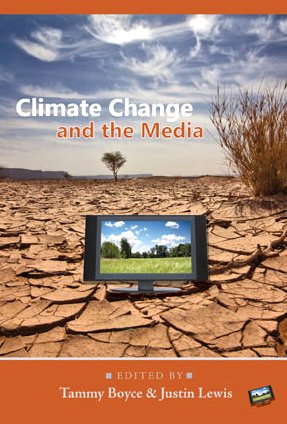
Justin Lewis has a book out on climate science and the media – ‘Climate Change and the Media’ looks well worth a read

9 Comments

Filed under Global warming, Science and society

Science v humanities: a matter of presentation?

I attended two very different seminars in college today and the differences were striking.

The first seminar was titled ‘Academic Freedom and the Notion of Rights’, and was given by a visiting lecturer in philosophy. He talked for an hour on the subject of rights, perceived rights, fundamental vs non-fundamental rights etc …and in the last ten minutes touched on the issue of academic freedom within this context. Basically, it was a long and detailed talk without any visual aids on the philosophy of human rights, with a little bit on academic freedom thrown in at the end.

(The talk was followed by a response, a much shorter talk by the Technology Transfer Officer at our college. This speaker gave a short, pointed talk on the concept of academic freedom, using several well-known cases in the news as examples. I liked this talk better, but again it was hard to make out the central point of the argument and there was no attempt to elucidate points with diagrams, pictures or slides).

After lunch, I attended a very different talk ; a seminar on recent research into gene therapy in plants by Prof. Liam Dolan, Sherardian Professor of Botany, University of Oxford. Now, I know as much about plants as you do about astrophysics, but the lecture was clear, well-laid out and easy to follow. The speaker made great use of simple pictures and excellent overheads, and explained the basic concepts of his field and the relevance of his research to society in exemplary fashion. At no stage were we bombarded with information, yet I came away knowing  good deal more than when I arrived. You can see the abstract for Liam’s talk here.

So there is the difference. One speaker renders an obscure, complex subject simple by presenting it in a clear, coherent manner – another presents an interesting, relatively simple topic in convoluted terms, rendering it far more complicated than necessary. Could it be that scientists tend to be clear because they have to be?  The subject is difficult enough as it is and swiftly becomes impenetrable  if not clearly explained.

Update

A colleague has suggested that ” we may have become used to visuals and it can be a challenge to listen attentively for 40 minutes”. It’s a fair point but I didn’t feel challenged. In fact, I think the narrative style allowed the speaker to repeat himself at regular intervals in a way that would become much more obvious if visual aids had been used!

4 Comments

Filed under Science and society

The last Darwin lecture and the real ‘Origin of Species’

College finished on Friday with what must have been one of the last of this year’s Darwin lectures. (In case you’ve been living in a cave, 2009 was the 150th anniversary of the publication of Darwin’s ‘On the Origin of Species’ and there have been events all over the world to mark the occasion). I caught a few excellent talks on Darwin at the Faraday Institute in Cambridge last summer (see posts here) but it was good to hear one in our own college; ‘The Life and Legacy of Charles Darwin’ by Eoin Gill of WIT’s CALMAST centre for the communication of science. This was a short, informal lunchtime talk but it covered all the main points:

– the life and work of Erasmus Darwin (Charles’s grandfather) including his ideas on evolution

– Charles’s family background, his early career at Cambridge and the influence of Rev Henslow

– the famous Beagle voyage with Capt Fitzroy and the emergence of Darwin the collector

– the return to Britain and the finch exhibition

– the slow dawning of the theory of naural selection

– family tragedies and the long quiet

– the letter from Wallace and the advice of friends at the Royal Society to publish simultaneously

– the publication of the book, the effect on society and the Huxely/Wilberforce debate

– modern genetics and further support for natural selection

You can view the slides from Eoin’s talk here.

Sadly, resistance to the theory of evolution by natural selection remains as strong as ever in some parts of the world, despite the overwhelming supporting evidence for the theory. As Richard Dawkins points out, it seems that those who insist on a literal reading of the Bible cannot and will not be dissuaded by scientific evidence contrary to their views. I heard a lot on this point last summer at the Faraday Institute in Cambridge, it was interesting to hear eminent theologians crticizing creationism just as much as scientists.

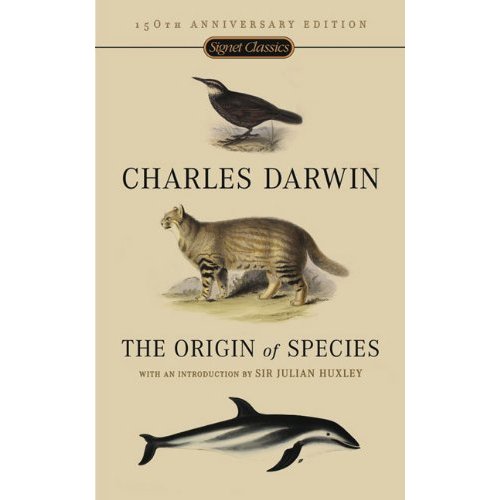
Just this week, a curious book was circulated in our own college – an abridged version of ‘On the Origin of Species’ published by creationist group ‘Living Waters Ministries’ that omits several chapters of the original and includes a bizarre religious introduction that attacks Darwin. Sigh…

The Living Waters version …I prefer the original

Comments Off on The last Darwin lecture and the real ‘Origin of Species’

Filed under History and philosophy of science, Science and society

Last week of term and Fulbright

This week was pretty crazy; as well as the last day of the teaching semester in our college, Friday marked the deadline for Ireland-US Fulbright fellowship applications.

All week, I’ve been giving wrap-up lectures in my courses to nervous students, not to mention pep-talks on revision and exam techniques to first years. Next week, the latter will face their first exam after only 12 weeks in third level. This is the downside of modularisation: for students newly arrived in college, that first semester goes very quickly and many of them will falter at the first fence.

At the same time, I myself have been busy with an application for a Fulbright fellowship. This seems to be a very enlightened program, offering academics around the world the chance to take a year out to spend time on a research project at a US institution. In my case, I have applied to spend some time at the BEYOND Centre of Arizona State University. I’ve been working on a book on big bang cosmology aimed at the public for some time now and the fellowship could offer the opportunity to take time out from fulltime teaching to concentrate on the book in a really stimulating environment.  The application process is quite rigourous – I don’t think I would have managed it in time for the deadline without help from our college research office!

The BEYOND Centre for Fundamental Concepts in Science at ASU is a really interesting research centre where foundational research in cosmology is combined with a philosophical approach to the subject. In addition, they have a strong activity in public outreach. Indeed, the centre boasts staff like Paul Davies and Lawrence Krauss, both well-known science writers as well as renowned physicists.  In addition, the centre is located close to several world-famous observatories. I’m not sure there’s a centre anything like BEYOND anywhere in Europe, never mind in Ireland.

Of course, the competition for the fellowships will be stiff as they are very prestigious, so fingers crossed..

President Clinton presents the Presidential Medal of Freedom to Senator  J.William Fulbright

Comments Off on Last week of term and Fulbright

Filed under Science and society