Category Archives: Science and society

A tribute to Stephen Hawking

RTE radio recorded an interview with me today on the subject of Stephen Hawking. I’m told it’s to have on file so I trust they don’t know something I don’t! Whatever the reason, it’s nice to have the opportunity to pay tribute to a living legend. Below is a script I prepared the interview; we only used a small part.

******************************************************************************

Q: Who is he?

Stephen Hawking is a famous English physicist at Cambridge University known for his work in cosmology, the study of the universe. In particular, he is admired for his work on black holes and on the big bang model of the origin of the universe.

Q: Why is he so famous?

Einstein used to be the only famous scientist of modern times, but Stephen Hawking has inherited that role. I like to think that one reason is his field of study; there seems to be a public fascination with scientific concepts such as the big bang and the nature of space and time (it’s hardly a coincidence that much of Einstein’s work was in this field).

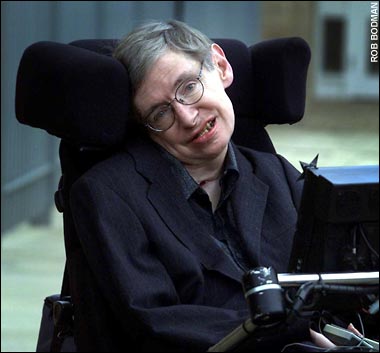
Another reason may be Hawking’s disability. He was diagnosed with motor neuron disease (ALS) in his early 20s and given two years to live. The story of a brilliant mind trapped in a crippled body has universal appeal, and the wheelchair-bound figure communicating deep ideas by voice synthesizer has become an icon of science.

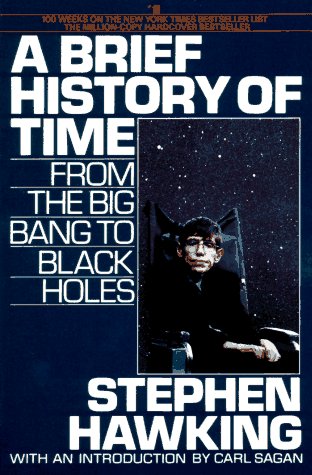
Then there’s the book. In the 1980s, Hawking published A Brief History of Time, a book on the big bang aimed at the general public  – it quickly became an unprecedented science bestseller and made him a household name. Since then, he has devoted a great deal of time to science outreach, unusual for a scientist at this level.
Q: Where is he from?

He was born in London in 1942, the son of two academics, and studied physics at Oxford. He wasn’t outstanding as an undergraduate but he did well enough to be accepted for postgraduate research in Cambridge. There, he became interested in cosmology, in particular in the battle being waged at Cambridge between the ‘big bang’ and ‘eternal universe’ theories. He showed early promise as a postgraduate when he demonstrated that Fred Hoyle, a famous cosmologist and prominent exponent of the eternal universe, had made a mathematical error in his work.

Q: Can you say a little about Hawking’s science?

His work is focused mainly on phenomena such as black holes and the big bang. Such phenomena are described by Einstein’s theory of relativity, which predicts that space and time are not fixed but affected by gravity. (In the case of black holes, relativity predicts that space is so distorted by gravity that energy,even light, cannot escape. In the case of the universe at large, relativity predicts that our universe started in a tiny, extremely hot state and has been expanding and cooling ever since; the so-called big bang model).

However, relativity does not work well on very small scales; this is the realm of quantum physics. Hawking’s lifelong work concerns the attempt to obtain a better picture of the universe by combining relativity (used to describe space and time) with quantum physics (used to describe the world of the very small).

He first established his reputation by defining the problem; with the mathematician Roger Penrose, he showed that relativity predicts that, under almost all conditions, an expanding universe such as our own must begin in a singularity i.e. a point of infinite density and temperature. This is not physically realistic and suggests that relativity on its own does not provide a true picture of the universe.

In later work, Hawking focused on black holes (a black hole is something like a big bang in reverse and may therefore offer clues to the puzzle of the origin of the universe). Successfully combining general relativity with quantum physics for this special case, Hawking was able to predict that black holes are not entirely black; instead they emit some energy in the form of radiation, now known as HawkingBekenstein radiation.  Most physicists are convinced by the logic and beauty of this result but Hawking radiation will be difficult to measure experimentally as it is predicted to be extremely weak.

My favourite Hawking contribution is the no-boundary universe. Working with James Hartle, he used a combination of relativity and quantum physics to predict that our universe may not have had a definite point of beginning because time itself may not be well-defined in the intense gravitational field of the infant universe!
Q: Is Hawking another Einstein?

No. Einstein made a great many contributions to diverse areas of physics. Also, relativity fundamentally changed our understanding of space and time, with profound implications for all of science and philosophy.(For example, the big bang model is merely one prediction of relativity). It’s hard for any scientist to compete with this.

Q: Why has Hawking not been awarded a Nobel prize?

He has received many prestigious awards, but not a Nobel. It’s quite difficult for a modern theoretician to win the prize because Nobel committees put great emphasis on experimental evidence. While we now have strong evidence that black holes exist, Hawking radiation will be very difficult to detect as it is predicted to be extremely weak.

Q; What is he working on these days?

At a conference in Dublin a few years ago, Hawking suggested a possible solution to the information paradox, a controversy over whether information is lost in black holes. The jury is still out on his solution. He is also involved with the theory of the cyclic universe, a theory that suggests there many have been many bangs.

Q: What lies in the future for Hawking?

Who knows. Last month, he celebrated his 70th birthday with a prestigious conference at Cambridge, 50 years after his terminal diagnosis. However, he was too ill to attend in person, reviving fears about his health. For now, he continues to work as ever, defying the predictions of modern medicine…

P.S. What’s all this about Hawking and God?

A Brief History of Time famously concludes with the phrase ‘‘..and then we would know the mind of God’’. At the time, many commentators interpreted this statement to mean that Hawking was religious. However, he was being mischievous – it is clear from other writings that he is not a believer in the normal sense. Indeed, his most recent book, The Grand Design, provoked controversy by stating that ‘‘It is not necessary to invoke God to set the universe going.” This statement was interpreted widely as a dismissal of God – in fact, it reflects standard cosmology (something can indeed arise from ‘nothing’) and says nothing about the existence of God.
10 Comments

Filed under Cosmology (general), Science and society

‘Verdict out on relativity questioning experiment’

What does the headline above mean? I’m not sure, but it is the title of an article in today’s Irish Times, written by your humble correspondent. (I had suggested ‘Faster than light?’ or ‘Was Einstein wrong?‘, but the above is what appeared).

It’s always nice to have a science article published in a national broadsheet, and I thought it was worth revisiting the OPERA experiment before the end of 2011. I enjoyed writing the article and colleagues tell me the question and answer format worked well.

But what about that title? And the opening line? (see print edition). Both were super-imposed by the sub-editor and I find them quite poor. This keeps happening; I take time and effort to write science pieces for the public as clearly as I can, and a professional writer comes along and superimposes something quite sloppy. It’s a pity because nine out of ten cats will read no further than the title and opening sentence.

If the article and headline were submitted as student work, this would be my verdict:

******************************************

The headline used for this article breaks almost every rule of science writing

1. The English is poor  – it is not clear what a ‘relativity questioning experiment’ is

2. ‘Verdict out’ is also not clear – ‘jury out’ would be better, but is still clumsy

3. The title is also intimidating – never use a word like relativity in a headline if you can avoid it.

As a result of points 1-3, the title does not clearly describe the content of the article – hence few readers will read further.

The writer should consider alternate titles such as ‘Faster than light?’ or  ‘Was Einstein wrong?’

These titles are both clear and succinct. Most importantly, they draw in the reader in, rather than drive her away

*********************************************

Update

There is also a major problem with the opening sentence; luckily, it is only in the print edition

5 Comments

Filed under Science and society

Faster than light and the public misunderstanding of science

Yesterday evening, I gave a public lecture in Dublin on the Gran Sasso neutrino experiment, hosted by the Irish Skeptics Society. The event formed part of Maths Week Ireland, an initiative co-ordinated by CALMAST, the science outreach group at our college. We had a great audience turnout and I enjoyed the Q&A afterwards immensely. Below is the abstract and you can find the slides for the talk here.

**********************************************************

In September 2011, a group of scientists announced that they had detected subatomic particles travelling at speeds greater than the speed of light in vacuum. The finding is in conflict with Einstein’s theory of relativity and has been met with great skepticism by mathematicians and physicists around the world. This lecture will examine the grounds for that skepticism and consider the role of skepticism in general in science and mathematics

 ********************************************************
 

       The Gran Sasso experiment

I suspect I was invited to speak because of a letter I had published on the subject in The Irish Times (below). Although the Gran Sasso experiment has certainly raised awareness of physics, I think the way the media are portraying this experiment as an  ‘Einstein wrong’ story is most unfortunate. It is far too soon to reach that conclusion and the overall effect is to make science seem very uncertain. It is more Public Misunderstanding of Science than PUS, in my view.

*************************************************

Sir, – Margaret Moore (September 29th) asks what word will be used to describe a speed faster than the speed of light. The technical term is superluminal speed. However, much of the media coverage of recent experiments at Gran Sasso has been very misleading. Almost all professional physicists (including the experimenters) consider the Gran Sasso result a curious anomaly almost certainly due to some unknown error in measurement, for several reasons:

1. Light is carried by particles of zero mass and it follows that there are fundamental theoretical reasons for supposing that the speed of light in vacuum represents a natural speed limit for particles of non-zero mass.

2. Thousands of experiments have verified that the tiniest particles of matter can be accelerated up to speeds close to, but not equal to, this limiting speed.

3. The recent Gran Sasso experiment involves measurements of time and distance of unprecedented precision, yet it was not designed for this specific purpose; thus there are many potential sources of systematic error.

It’s true that science sometimes progresses by upsetting the status quo, but scientists are a sceptical lot and extraordinary claims require extraordinary evidence! –Yours, etc,

**************************************************************

Does it matter how the experiment has been portrayed in the media? I think it does. A few years from now, journalists will be say ‘ but didn’t you guys think in 2011 that Einstein was wrong’? In fact, there has already been one editorial in the Wall St Journal urging inaction on climate change, on the basis that science is never certain, given the neutrino result (see point 5 of this article ). Exactly the wrong conclusion to draw…

Update

I see my lecture got a short review in today’s Irish Times. It’s not a bad overview, considering the writer wasn’t at the lecture. The last sentence doesn’t make sense, however – I suspect she meant supernovae instead of black holes!

Udate II

Just caught  BBC program on the experiment (Marcus du Sautoy). Superb, superb program. Nothing like the players themselves for conveying the concepts of science..

24 Comments

Filed under Public lectures, Science and society

Hamilton Walk and Maths Week in Ireland

October 16th is a special day for mathematics and physics in Ireland. On this day, we commemorate the discovery of quaternions by William Rowan Hamilton, the great Irish mathematician and astronomer. Essentially, his insight was to postulate three distinct roots for the number -1, thus generalising complex numbers to four dimensions. It can be said that this discovery marks the birth of modern algebra, as quarternions opened the door to non-commutable algebra. Quaternions have found great application in modern technology, notably in compter algorithims for animation in films and computer games.

William Rowan Hamilton made a great many other contributions to mathematics and physics. For example, his formulation of a mathematical operator for the energy of a body – the Hamiltonian –  is a vital tool in quantum mechanics, the mathematical description of the quantum world. Open any modern textbook on quantum physics and you will encounter the word ‘Hamiltionian’ on almost every page.

As regards quaternions, we know exactly when Hamilton had his Eureka moment. According to his own writing, inspiration struck on the 16th october in 1843,  as he was walking with his wife from Dunsink Observatory in County Dublin (where he was Astronomer Royal) along the Royal Canal towards the city centre, in order to attend a meeting of the Royal Irish Academy, of which he was President.  He was so pleased with the breakthrough that he used his penknife to carve the new equation onto Broom bridge as they passed. The carving no longer exists but the bridge does, and the occasion is celebrated with a plaque. Every year, mathematicians and friends of mathematics congregate at Dunsink Observatory at 3pm and re-enact Hamilton’s famous walk along the canal to the bridge.


William Rowan Hamilton; the plaque displays the famous equation i2 = j2 = k2 = ijk = -1

This year, October 16th fell on a Sunday, so mathematicians and the general public arrived from far and near. The day started in Dunsink Observatory, with a brief description of Hamilton’s life and work by Fiacre O Cairbre, event organiser and lecturer in mathematics at NUI Maynooth. There followed a lovely walk along the canal in perfect weather conditions, all the way to Broom bridge to view the plaque. The outing finished with a short description of Hamilton’s breakthrough by another Maynooth mathematician, Anthony O’ Farrell, and a chorus of ‘Happy birthday, quaternions’ by all present. I think it’s great to remember our scientific heros like this;  it’s curious that even our very best scientists and mathematicians receive far less public attention that writers and musicians.


Dunsink Observatory and Broom Bridge on the Royal Canal

Each year, the Hamilton Walk is soon followed by a prestigious lecture on mathematics presented by the Royal Irish Academy and The Irish Times. Previous speakers have included Andrew Wiles, Steven Weinberg, Murray Gellman and Lisa Randall. This year, renowned string theorist Ed Witten will give a talk on quantum knots, see here.

The Hamilton walk  is one of the core activies of Maths Week Ireland, an initiative to raise awareness of maths in Ireland with events and lectures all around the country. Co-ordinated by CALMAST, a science outreach group at Waterford Institute of Technology, Maths Week has grown larger every year – you can find the program of events here. I will give a talk in Dublin on Wednesday evening, on relativity and the recent ‘faster than the speed of light’ experiment, see here .

6 Comments

Filed under History and philosophy of science, Science and society

Faster than the speed of light

So. A respected experimental group, doing respected work, the OPERA neutrino experiment at Grand Sasso in Italy, have reported a startling result; they have measured a velocity for neutrinos that is in excess of the speed of light (a fractional increase of about of 1 in 100,000). The result is getting a huge amount of publicity because it appears to be in conflict with Einstein’s theory of relativity. ‘Einstein wrong‘ always makes headlines. I’m certainly getting a lot of calls and emails on the subject, not least because I had an article on relativity in Thursday’s Irish Times (see here).

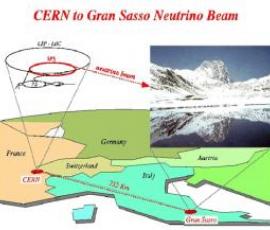
In the OPERA experiment, a beam of neutrinos travels underground from CERN travel to Gran Sasso in Italy

The OPERA paper has been posted on the ArXiv here. Most physicists (including the participants) are calling the result an ‘anomaly’ and expect to find a hidden error, for two reasons

1. Thousands and thousands of experiments on elementary particles suggest that the speed of light represents a natural speed limit for material bodies, no matter how much energy you whack them with

2. There are deep mathematical reasons for believing that the speed of light in vacuum represents an absolute limit, from arguments of symmetry to the principle of least action. Basically, all sorts of mathematics suggests that the speed of photons- massless particles –  is the highest speed achievable. In addition, the principle underlies a great deal of observed physics, far beyond the remit of relativity.

So what is going on?

Science is a skeptical activity and scientists are slow to throw out a successful theory at the first sign of trouble -especially a theory as successful and as central as special relativity. Most scientists adopt a ‘wait and see’ approach when an experiment like this is reported.

For example, we know a great deal more about relativity than we do about neutrinos. It is only a few years since it was discovered that neutrinos have mass, and the phenomenon of neutrino oscillation – the transformation of one type of neutrino to another – is still not well understood. So it is possible that this experiment is an artefact of some unknown neutrino process.

A more prosaic possibility is that there is a systematic error in the extremely precise time/distance measurements necessary for the experiment. For example, the time of flight of the neutrinos is measured using a sophisticated version of GPS – perhaps there is a hitherto undetected error lurking in this method that is affecting the measurement. A few years ago, it was discovered that the moon has an effect on the curvature of the LHC tunnel, as does the TGV arriving at Geneva – these effects only show up because of the unprecedented precision involved in the experiments.

Finally, it is always possible that this result may turn out to be a real effect. In this case, we could be looking at some exciting new physics; not a violation of relativity, but the first evidence of hidden dimensions. String theorists have long mooted the possibility that the three familiar three dimensions of space may be accompanied by other dimensions, tiny ones that are curled up so that they are undetectable at normal energies. In principle, a particle that takes a shortcut through such a dimension could arrive early! This may sound like a rather fantastic explanation, but it is possible that an experiment at the unprecedented energy and precision of OPERA could see this effect for the first time. Certainly, it would not contradict any previous theory or experiment.

So an exciting wait, but my money is on a systematic error in the measurement of distance or time

Technical note

I keep hearing in the media that ‘relativity forbids travelling at speeds faster than the speed of light in vacuum.’ Actually, it doesn’t, as Einstein was fond of pointing out. Special relativity suggests that it is impossible for  body to be accelerated from subluminal to superluminal speed. Thus particles that travel faster than light are possible in principle so long as they always travel at that speed (known as tachyons). However, such behaviour has implications for time (it would run backwards) and for causality, and is therefore thought unlikely. Also, no such particles have been observed  in five decades of experimentation in particle physics .

Last weekend, I was quoted (well misquoted) in The Irish Times, making the last point above; you can read it here, it’s quite a good article.

Update

If it is a systematic error, what could it be?  Looking at the paper, my own guess is that it is significant that the group do not measure the time-of-flight of individual neutrinos, but massive bunches of the particles. Essentially they measure the beginning and end of a bunch, and apply statistics to get the mean time. A messy enough procedure, considering the accuracy required..

Update II

I have a letter on the experiment in The Irish Times today, you can read it here

31 Comments

Filed under Particle physics, Science and society

Gravity probe B experiment does not ‘prove Einstein right’

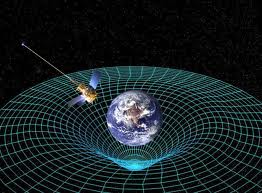
A good example of the problems of science journalism we discussed in the last post can be seen in this month’s media treatment of the important results from the NASA Satellite Gravity Probe B. After many years of frustration, the experiment has reported important evidence in support of two distinct predictions of the general theory of relativity – the geodesic effect (a distortion of spacetime by the earth) and frame dragging (caused by the rotation of the earth). See here for details of the experiment.

The result is a fantastic achievement. It offers important support for general relativity, a theory that underpins a great deal of modern physics, from our view of the origin of the universe to our understanding of black holes. It’s worth noting that such tests are rare and notoriously difficult (unlike the case of special relativity) and sincere congratulations are due to Principal Investigator Francis Everitt and all the team who worked so hard and so long to produce this important result.

The NASA Gravity Probe B Satellite

However, I was quite disappointed at the way the result was portrayed in newspapers and in science magazines. Almost without exception, the experiment was described as  ‘Einstein proven right‘ – see for example this article in the prestigious journal Science.

What’s the problem? The statement ‘Einstein proven right’ is deeply problematic for two reasons
1. As Einstein (and later Karl Popper) frequently pointed out, it is a basic tenet of the scientific method that no experiment can ‘prove’ a theory right. An experiment can offer supporting evidence but the case is never closed, because we do not know what new evidence may emerge in the future to cast doubt on other predictions of the theory
2. The constant personalization of the theory of relativity with Einstein creates the impression that the theory depends upon one scientist only, and devalues the work of hundreds of relativists since.
For the above two reasons, most physicists would have framed the result as ‘general relativity passes two important tests’.

It seems to me that such shorthand reportage does science no favours, as it misrepresents the result and plays into the hands of doubters and anti-science commentators. I wrote to Science to make this point; they have declined to publish my letter, so I am free to reproduce it here

***************************************************************************

Re: At Long Last, Gravity Probe B Satellite Proves Einstein Right

News Section, Science, May 5

As a physicist and a science writer, I was surprised by your headline ‘At Long Last, Gravity Probe B Satellite Proves Einstein Right’ (News Section, Science, May 5).

To be sure, the Gravity Probe B experiment is a fantastic achievement that offers spectacular evidence in support of two distinct predictions of the general theory of relativity. This is important support for a theory that underpins a great deal of modern physics, from our view of the origin of the universe to our understanding of black holes. It’s also worth noting that such tests are rare and notoriously difficult (unlike the case of special relativity) and sincere congratulations are due to the team who worked so hard and so long to produce this important result.

However, your headline is problematic for anyone with a knowledge of the scientific method or an interest in the philosophy of science.

In the first instance, it is a fundamental tenet of science that no experiment can ‘prove a theory right’, as Einstein himself (and Karl Popper) frequently acknowledged. Even the most ingenious experiment can only offer evidence in support of a theory –‘right so far’ (and this is leaving aside the difficult question of the interpretation of scientific data). The error is not simply a question of headline shorthand as it is repeated in the opening sentence of the article;  ‘..a ..NASA spacecraft has confirmed general relativity’.

Second, it is a pity that relativity is so often portrayed as the work of one great scientist. Granted, it is a matter of historical record that the general theory of relativity was first formulated by Einstein singlehandedly. However, a great many mathematicians and theoretical physicists have explored, deepened and refined the theory since that time (obtaining solutions to the field equations and deriving concrete predictions from these solutions, for example). Framing the story in terms of Einstein alone ignores this work, and implies that the entire edifice of relativity is dependent upon one scientist.

In sum, it is no easy task to summarize a groundbreaking scientific experiment in a brief article, but most physicists would frame this important result as ‘general relativity passes another experimental test’ rather than ‘Einstein proven right’.

Yours sincerely

Dr Cormac O’Raifeartaigh

Visiting Fellow, Program on Science, Technology and Society, Harvard Kennedy School

*******************************************************************************

14 Comments

Filed under Science and society

Refuting Einstein: a media controversy in Ireland

I had a very sobering conversation about science communication with an eminent climate scientist at MIT yesterday, and it got me thinking about the incident that first prompted my interest in writing science for a wide audience.

In the late 1990s, I had just returned from a postdoctoral research position at the University of Aarhus in Denmark, and was embarking on a similar stint at Trinity College Dublin. After all that training, I had the smug feeling that I was finally evolving into a scientist; and right at that moment, a scientific ‘controversy’ broke in the British and Irish media. A distinguished Irish engineer, Dr Al Kelly , published a number of papers that claimed to show that Einstein’s special theory of relativity (SR) was fundamentally unsound, work that received a great deal of media attention. I was intrigued by the story and set about getting my hands on the publications.

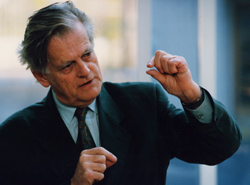
Dr Al Kelly, a highly respected engineer

The first surprise was that the papers were not published in a well-known peer reviewed journal, but in the monthly Journal of the Institute of Irish Engineers. This is a respectable magazine (now known as The Engineers Journal), but not a natural forum for technical papers on fundamental physics – yet the work had already received far more media attention than any other physics research in Ireland. [Dr Kelly himself complained publicly that the more established journals refused to consider his papers on special relativity on point of principle! A great many journals do in fact refuse to consider papers on SR, simply because the subject is such a favourite target of cranks and skeptics with little scientific training].

The second surprise was that, on reading the Kelly papers, it seemed to me that the author did not have a good understanding of the basic theory of SR (for example, his definition of an inertial frame seemed strange). In addition, there was no reference to the vast amount of experimental evidence supporting the key predictions of SR – time dilation, mass increase and the universality of the speed of light in vacuum (routinely observed in particle accelerators around the world). Instead, the author attempted a refutation of SR on the basis of the  Sagnac effect, a complicated effect that pertains to rotating bodies.

The Sagnac effect: coherent light travels around a rotating loop in opposite directions and the phases of the two signals are compared at a detector

Now, an effect concerning rotating bodies is not where one would normally start with a refutation of special relativity, because a rotating body is accelerating while SR pertains to inertial frames i.e. frames moving at constant velocity relative to one another. An additional problem is that the two light beams do not in fact travel the same distance relative to an observer in the centre of the frame (see reference above). A proper relativistic treatment of the Sagnac effect is quite complicated, and involves terms from General Relativity, the theory of relativity that deals with accelerating bodies. Most importantly of all, relativistic effects do not show up as first- or second-order effects in the Sagnac effect, making it an unsuitable effect for experimental tests of relativity.

Media reaction

It was not the work itself that shocked me. Any physicist regularly receives refutations of SR in the post, ranging from the completely crazy to the highly aggressive. What shocked me was the media reaction to Kelly’s work; the story immediately became a media ‘controversy’, with feature articles in The Irish Times (Ireland’ s paper of record), the Sunday Times (a respected UK paper), the Japan Times and many others. There were regular bulletins on TV and radio, with few journalists treating the story with even a small degree of skepticism. The internet also played a role in the affair, with hundreds of blogposts by writers who knew nothing about the subject. (It put a great many Irish physicists off blogs for life). The Irish Times set the tone for the affair by using the headline ‘Refuting Einstein’ for all articles and letters on the subject, thus framing the debate as plucky Kelly vs establishment Einstein.

Professional physicists paid very little attention to the story at first. In the few instances where their opinion was sought, the ‘debate’ was portrayed as one voice against another, not as the overwhelming consensus of 100 years of scientific evidence against one engineer. Most of all, the debate was portrayed as Kelly vs Einstein – I do not recall a single journalist draw attention to the fact that physicists’ belief in relativity stems not from a belief in Einstein, but from the mountain of experimental evidence that supports the theory (a confusion of the context of discovery with the context of justification). Finally, just as the story was beginning to die down, a French physicist cited one of Kelly’s papers and Irish journalists declared Kelly ‘vindicated’. [I read the French paper and the reference was not to Kelly’s theory at all, but to an experiment he suggested].

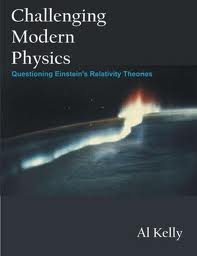
Not long after all this, Al Kelly sadly passed away. I should stress that he was a very nice man and an accomplished engineer. His papers on the subject were published posthumously as a book, which is available on Amazon.

Lessons

You rarely see a reference to the Kelly debate nowadays, but I learnt several things from the incident

1. In the eyes of science journalism, ‘Einstein wrong’ constituted a story. None of the journalists I contacted privately expressed any confidence in Kelly’s theory, but they thought it was an ‘interesting story and a good way of raising science awareness’.

2. In the few instances where professional opinion was sought, a ‘balanced’ media debate was achieved by pitting one voice against another, with no mention of scientific consensus

3. The reaction of the public was firmly anti-science. The affair dominated the letters page of The Irish Times for months and the general tone of the letters was a distrust of the establishment. All sorts of people jumped to defend the plucky Kelly, while the professionals were accused of ‘believing in relativity like a religion’.

Science journalism

All in all, the affair left me with a very skeptical view of science in the media, a view which has not changed much over the years. It seems to me that there are several problems in science journalism that are rarely aired;

motivation: the primary motivation of a journalist is to get the story, not the truth; a difference of opinion v quickly becomes a ‘controversy’

expert opinion: journalists can be quite hazy on what constitutes expert opinion; the Kelly story would only have been controversial if he was a Professor of relativity (or even a physicist)

scientific knowledge: journalists often have quite a low level of understanding of the science in question, and even of the scientific method. In particular, a great many journalists fail to grasp the difference between discovery (initial theory etc) and justification (evidence)

scientific consensus: this remains a mystery to many journalists; how it is achieved and why it is important yet never unaminous

As a result, I have become convinced that there is a need a new sort of science journalism – science communicated by scientists, not by journalists. Of course it is difficult to train scientists to write in a manner suitable for public consumption, but I suspect this is less difficult than training journalists to think like scientists. From debates on global warming to alternative medicine, there is an urgent need for scientists to be trained to speak for themselves.

A neutral debate

The one good thing about the ‘controversy’ above is that it was a neutral debate – neither business nor politics had a stake in the outcome, nor was there a prospect of Joe Citizen paying extra at the pump. This is not the case in areas such as climate science, which makes media coverage of the topic a great deal more complicated. All of the above concerns apply to media coverage of climate change – but in addition, much climate science in the media consists of op-eds by writers whose motivations are complex and whose portrayal of the subject is highly questionable. We’ll look at the communication of climate science in the next post.

Postscript

I just found a copy of my own letter to The Irish Times on the controversy above; my first media publication on science! It is co-authored with astrophysicist Lorraine Hanlon, now Head of Physics at UCD.

Update

The writer John Farrell, who wrote a very nice biography of Lemaitre, has a good article  on relativity cranks on the Salon website here.

34 Comments

Filed under Science and society

STS Conference Summary

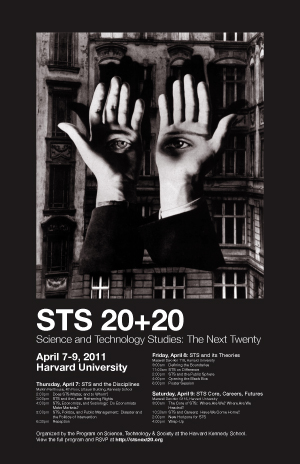
Yesterday was the last day of the Science and Technology Studies conference at Harvard, STS 20+ 20:  Science and Technology Studies: The Next Twenty. As said in the previous post, the conference was hosted by the Program on Science , Technology and Society (STS) at Harvard, the group I am spending this year with. The theme of the conference was “A Meeting Reflecting on the Past Twenty Years of STS Graduate Study, and Looking Ahead to the Next Twenty” and it was terrific. I  haven’t posted on the individual sessions (wanting to spend the time meeting so many people whose work I have been studying this year) but I found the meeting really stimulating, a real treat for anyone with an interest in the field of science and technology studies.

As said previously, each day was broadly based around a different theme; Day One on the theme of disciplinarity (Does STS Matter, and to Whom?), Day Two on STS theory and Day Three on the future of the discipline. In fact, all of these themes arose in almost every session. There were 3-4 sessions per day, with a panel consisting of Chair, provocateur and discussants, each of whom gave a short overview, followed by an hour of questions and comments from the audience. The ‘audience’ of course consisted of other STS practitoners from around the world – there’s something very nice about a conference where all the participants are all very familiar with one another’s work, it’s more like a big family meeting than the traditional type of conference. It’s also great to go to a meeting where, instead of participants presenting their latest work, the delegates discuss the field itself, its past present and future (at physics conferences, there are rarely more than 3 or 4 talks that I find relevant to me, or can even understand, something many scientists complain about nowadays).

The first session yesterday dealt with a discussion of the core of STS (what constitutes the core of the discipline, from research to pedagogy). After the break a younger panel discussed STS careers – their own experiences of opportunities available to emerging PhDs and postdocs currently and in the future. After lunch, the topic was New Horizons for STS , where a panel considered the future of STS  in terms of academic institutions. This last is a very serious topic indeed. Since STS deals specifically with the analysis of the intersection of science, technhnology and society, it’s hard to imagine a topic of more immediacy; yet it has struggled to establish its own place within the academy, partly because the subject straddles so many traditional disciplines (sociology, politics, law, history and philosophy to name but a few). Just recently, it was announced that the existing STS program in Penn State University is to be dismantled, with consequent loss of positions for some academic staff. You can find a list of exisiting STS programs and undergraduate courses in US unversites and around the world here.

All in all, a great conference – I wish there were more conferences where delegates discuss the field itself, it made for great discussions and a superb overview. From my point of view,  it was great to meet so many figures whose work I have been studying. (A highlight was discussing Trevor Pinch’s work on neutrinos with him, and his work with Harry Collins on the Eddington experiment). I was lucky to be at Harvard the year this unique meeting took place.

You can see the conference program here and slides of talks will be available in the next few days.

2 Comments

Filed under Science and society

STS Conference at Harvard

This week the Program on Science , Technology and Society (STS) at Harvard is hosting a major conference. The conference STS 20+ 20:  Science and Technology Studies : The Next Twenty, will run from Thursday May 7th until Saturday May 10th. The theme of the conference is “A Meeting Reflecting on the Past Twenty Years of STS Graduate Study, and Looking Ahead to the Next Twenty”. As a visiting fellow with the program, I am really looking forward to it.

You can see the conference program here. Each day is based around a different theme; Day One will deal with the theme of disciplinarity (Does STS Matter, and to Whom?), Day Two with STS theory, and Day Three with the future of the discipline (more details on this later). There will be 3-4 sessions per day, with leading thinkers in the field such as Sheila Jasanoff, Trevor Pinch, Stephen Hilgartner and Stephen Eptstein acting as Chairs and discussants.

A summary of the conference is provided by Sheila Jasanoff, the director of the STS program at Harvard, on the  conference webpage:

[This meeting is the product of a year of conversations across several continents and dozens of institutions. It weaves together the hopes, aspirations, and—yes—frustrations of STS scholars from around the world who have committed their careers to studying the central role of science and technology in our social, political, and moral lives.

The meeting is in part a stock-taking. After two decades of increased public funding for STS, what can we say about our achievements as a “thought collective”? What have we learned from speaking the truths of our field to the power of established disciplines? Which areas of work do we recognize as displaying the greatest theoretical depth and creativity? What do we impart to STS scholars-in-the-making, and what can we do to ensure that their ideas are heard more widely and that they find appropriate academic homes? The three-day program addresses these questions: first, STS and the disciplines; second, STS and its theories; third, STS’s institutional challenges and opportunities.

In part, too, the meeting is a provocation: an invitation to reflect on the conditions needed for this field to thrive and grow—in keeping with the importance of its mission. As with any provocation, the questions we hope to explore may have conflicting answers. Ideas will be generated throughout the meeting from both our physical and virtual audiences. This website, managed by a local team of scholars, is part of an effort to make the meeting as inclusive and participatory as possible, both during the event and after it.

Overall, this is a meeting to rethink questions that all STS scholars have grappled with at some point in their intellectual lives. Why do STS? What makes it interesting, distinctive, coherent, relevant, and deserving of stronger institutionalization?]

Comments Off on STS Conference at Harvard

Filed under Science and society

How it ends

This month’s issue of Physics World features a review of mine, of the book How It Ends by astronomer Chris Impey. I’m always chuffed to be published in Physics World; as the flagship publication of the Institute of Physics it is a very good science magazine indeed, with well-informed commentary and articles of very high level by prominent researchers. PW also take their book reviews seriously; I notice both the front cover and editorial of this issue draw attention to the reviews.


As for the book: I enjoyed How It Ends greatly, it’s a fabulous read for any scientist or anyone with even a marginal interest in science. In a nutshell, Impey, a noted astronomer and astrobiologist, considers the ultimate fate of all things, from the future of the planet and all living things to the fate of the sun, the galaxies and the entire universe. As you can imagine, the book traverses a great many disciplines, from biology, biochemistry and ecology to geophysics, astrophysics and cosmology. However, it is written in a very lighthearted and accessible style that is extremely readable. PW magazine is members-only but you can read my review here….or better still go and buy the book.

Actually, the skill with which Impey handles his interdisciplinary tale is no coinicidence as he is associated with a well-known research group at Arizona State University  that specializes in astrobiology, a discipline that combines the very different disciplines of astrophysics and biology in order to investigate the conditions necessary for biological life to form. In fact, members of the Arizona group had some input into the major success in astrobiology we all just heard about- the discovery of lifeforms that can thrive on arsenic (as opposed to phosphorous), an important advance that broadens the scope for the possibility of life existing elsewhere.

So go and buy the book.

2 Comments

Filed under Astronomy, Science and society