
We have seen that if a voltage V is applied to a device, the current I that flows is limited by the resistance R of the device according to I = V/R. Hence a material with high resistance will pass little current (insulator), while a material with low resistance will pass a large current (conductor).
In order to make a meaningful comparison of the resistances of different materials, we need to allow for the fact that resistance depends on how much of the material is present. Hence, we define the resitivity ρ of a material as its resistance per unit length L and cross-sectional area A e.g.
ρ = RA/L
Note that resistivity is a fundamental property of a material, like density. The room-temperature resistivites of some common conductors and insulators are listed below (just click on the table to see it properly)
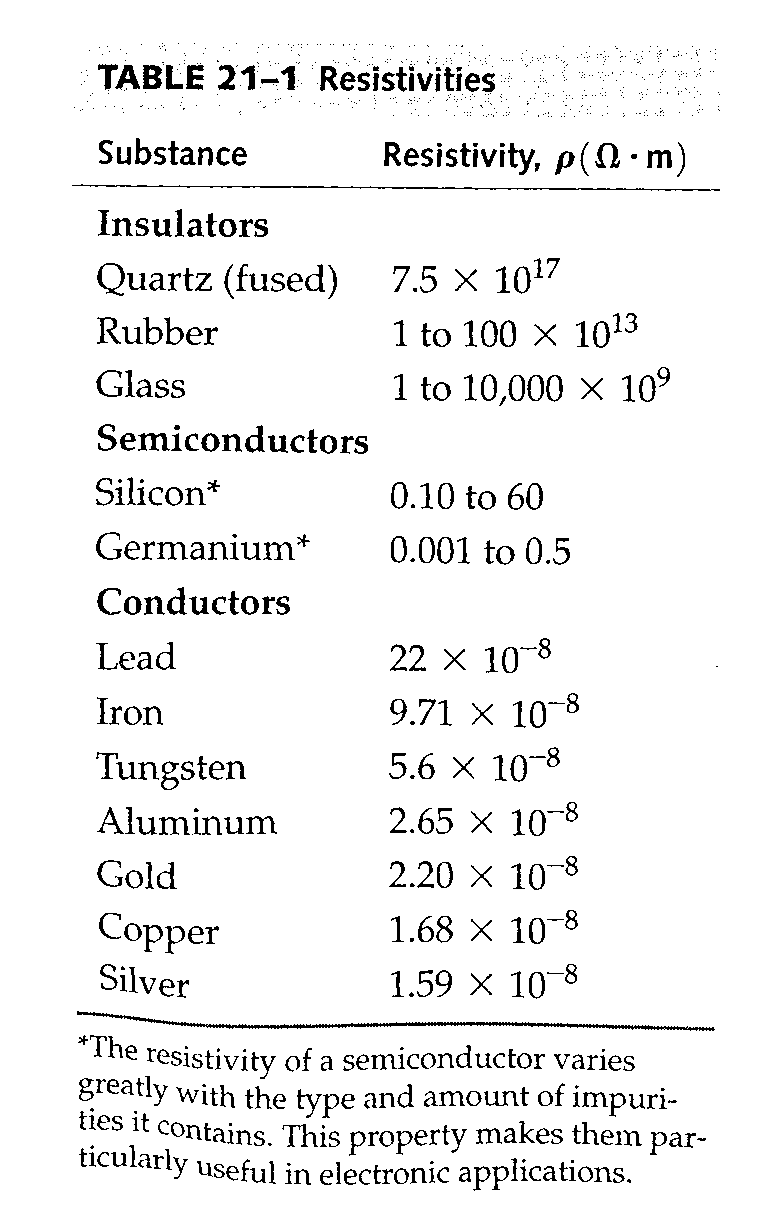
What is most noticeable is that the resisitivities shown vary over a huge range, from 10+17 Ωm for quartz to 10-8 Ωm for silver. Amongst solids, metals like silver have by far the lowest resistivities i.e. are the best electrical conductors – this is because the atoms of a metal have many electrons that are somewhat shielded from the nucleus and relatively free to move around. Hence, if a voltage is applied to a metal you have a steady supply of extremely light, charged particles to carry the current from one end to the other. Quartz, on the other hand, is an extremely good insulator because the electrons are tightly bound to individual atoms and there are almost no free charge carriers available for the conduction of electricity.
In between the conductors and insulators on the table lies a very interesting type of material called a semiconductor: these are materials that are normally insulators, but whose resistivity can be dramatically altered by the addition of impurities (doping). Semiconducting materials are extremely important in the manufacture of electronic devices and circuits and lie at the heart of the microelectronic revolution.
***************************************************************************
How is resisitivity measured in the lab? First, you measure the resistance of a material by monitoring the current through it as a function of applied voltage (see previous post). Then you measure the length and cross-sectional area of the material and calculate its resistivity from the formula above.

The slope of the graph V/I gives the resistance and a measurement of length and cross-sectional area is then used to calculate the resistivity
Note
The inverse of resistivity is conductivity, measured in (Ωm)-1. Many tables list the conductivity of materials rather than the resistivity.












 Antimatter