Tag Archives: Science and society

Science v humanities: a matter of presentation?

I attended two very different seminars in college today and the differences were striking.

The first seminar was titled ‘Academic Freedom and the Notion of Rights’, and was given by a visiting lecturer in philosophy. He talked for an hour on the subject of rights, perceived rights, fundamental vs non-fundamental rights etc …and in the last ten minutes touched on the issue of academic freedom within this context. Basically, it was a long and detailed talk without any visual aids on the philosophy of human rights, with a little bit on academic freedom thrown in at the end.

(The talk was followed by a response, a much shorter talk by the Technology Transfer Officer at our college. This speaker gave a short, pointed talk on the concept of academic freedom, using several well-known cases in the news as examples. I liked this talk better, but again it was hard to make out the central point of the argument and there was no attempt to elucidate points with diagrams, pictures or slides).

After lunch, I attended a very different talk ; a seminar on recent research into gene therapy in plants by Prof. Liam Dolan, Sherardian Professor of Botany, University of Oxford. Now, I know as much about plants as you do about astrophysics, but the lecture was clear, well-laid out and easy to follow. The speaker made great use of simple pictures and excellent overheads, and explained the basic concepts of his field and the relevance of his research to society in exemplary fashion. At no stage were we bombarded with information, yet I came away knowing  good deal more than when I arrived. You can see the abstract for Liam’s talk here.

So there is the difference. One speaker renders an obscure, complex subject simple by presenting it in a clear, coherent manner – another presents an interesting, relatively simple topic in convoluted terms, rendering it far more complicated than necessary. Could it be that scientists tend to be clear because they have to be?  The subject is difficult enough as it is and swiftly becomes impenetrable  if not clearly explained.

Update

A colleague has suggested that ” we may have become used to visuals and it can be a challenge to listen attentively for 40 minutes”. It’s a fair point but I didn’t feel challenged. In fact, I think the narrative style allowed the speaker to repeat himself at regular intervals in a way that would become much more obvious if visual aids had been used!

4 Comments

Filed under Science and society

The last Darwin lecture and the real ‘Origin of Species’

College finished on Friday with what must have been one of the last of this year’s Darwin lectures. (In case you’ve been living in a cave, 2009 was the 150th anniversary of the publication of Darwin’s ‘On the Origin of Species’ and there have been events all over the world to mark the occasion). I caught a few excellent talks on Darwin at the Faraday Institute in Cambridge last summer (see posts here) but it was good to hear one in our own college; ‘The Life and Legacy of Charles Darwin’ by Eoin Gill of WIT’s CALMAST centre for the communication of science. This was a short, informal lunchtime talk but it covered all the main points:

– the life and work of Erasmus Darwin (Charles’s grandfather) including his ideas on evolution

– Charles’s family background, his early career at Cambridge and the influence of Rev Henslow

– the famous Beagle voyage with Capt Fitzroy and the emergence of Darwin the collector

– the return to Britain and the finch exhibition

– the slow dawning of the theory of naural selection

– family tragedies and the long quiet

– the letter from Wallace and the advice of friends at the Royal Society to publish simultaneously

– the publication of the book, the effect on society and the Huxely/Wilberforce debate

– modern genetics and further support for natural selection

You can view the slides from Eoin’s talk here.

Sadly, resistance to the theory of evolution by natural selection remains as strong as ever in some parts of the world, despite the overwhelming supporting evidence for the theory. As Richard Dawkins points out, it seems that those who insist on a literal reading of the Bible cannot and will not be dissuaded by scientific evidence contrary to their views. I heard a lot on this point last summer at the Faraday Institute in Cambridge, it was interesting to hear eminent theologians crticizing creationism just as much as scientists.

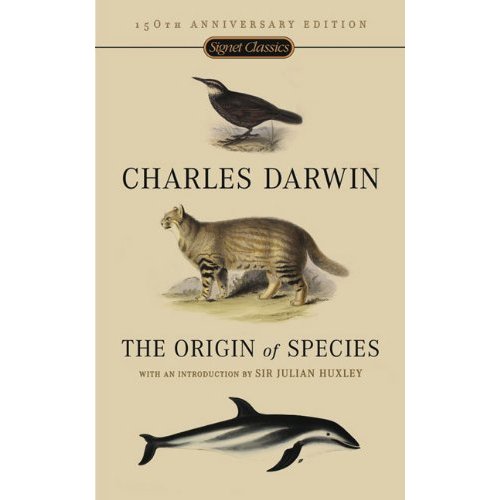
Just this week, a curious book was circulated in our own college – an abridged version of ‘On the Origin of Species’ published by creationist group ‘Living Waters Ministries’ that omits several chapters of the original and includes a bizarre religious introduction that attacks Darwin. Sigh…

The Living Waters version …I prefer the original

Comments Off on The last Darwin lecture and the real ‘Origin of Species’

Filed under History and philosophy of science, Science and society

Last week of term and Fulbright

This week was pretty crazy; as well as the last day of the teaching semester in our college, Friday marked the deadline for Ireland-US Fulbright fellowship applications.

All week, I’ve been giving wrap-up lectures in my courses to nervous students, not to mention pep-talks on revision and exam techniques to first years. Next week, the latter will face their first exam after only 12 weeks in third level. This is the downside of modularisation: for students newly arrived in college, that first semester goes very quickly and many of them will falter at the first fence.

At the same time, I myself have been busy with an application for a Fulbright fellowship. This seems to be a very enlightened program, offering academics around the world the chance to take a year out to spend time on a research project at a US institution. In my case, I have applied to spend some time at the BEYOND Centre of Arizona State University. I’ve been working on a book on big bang cosmology aimed at the public for some time now and the fellowship could offer the opportunity to take time out from fulltime teaching to concentrate on the book in a really stimulating environment.  The application process is quite rigourous – I don’t think I would have managed it in time for the deadline without help from our college research office!

The BEYOND Centre for Fundamental Concepts in Science at ASU is a really interesting research centre where foundational research in cosmology is combined with a philosophical approach to the subject. In addition, they have a strong activity in public outreach. Indeed, the centre boasts staff like Paul Davies and Lawrence Krauss, both well-known science writers as well as renowned physicists.  In addition, the centre is located close to several world-famous observatories. I’m not sure there’s a centre anything like BEYOND anywhere in Europe, never mind in Ireland.

Of course, the competition for the fellowships will be stiff as they are very prestigious, so fingers crossed..

President Clinton presents the Presidential Medal of Freedom to Senator  J.William Fulbright

Comments Off on Last week of term and Fulbright

Filed under Science and society

Science week in Ireland: was Einstein wrong?

This week is Science Week in Ireland, with science events taking place all over the country. There are talks and demonstrations on every aspect of science you can think of, from a demonstration of animal magic at Killaloe in County Limerick to astronomy at the Crawford Observatory of University College Cork.

This evening, I will give a public lecture on the Big Bang in Trinity College, hosted by Astronomy Ireland. We’re still in the International Year of Astronomy, celebrating the 400th anniversary of Galileo’s use of the telescope to establish the heliocentric model of the solar system, so it’s highly appropriate to have a lecture describing another paradigm shift in science brought to us by astronomy: the discovery of the expanding universe and the big bang model that followed. I’m delighted to be giving the lecture as Astronomy Ireland do a fantastic job of promoting astronomy and science around the country, with night-classes in astronomy, public viewings of astronomical events and regular public science lectures. It’s also fun to tell the story of the discovery of the big bang model to people with an interest in astronomy, as many of them already know most of the facts, but from a slightly different perspective. Indeed, much of what we know of cosmology really comes from astronomical observation. You can find a poster, a summary of the lecture and the slides I will use here.

As I write this post, I’m sitting in the RTE canteen having done an interview promoting the lecture on Today with Pat Kenny, the flagship radio show of RTE, the Irish broadcasting corporation. (The last time I was at RTE I was auditioning for deputy work with the  Concert Orchestra but that’s another story!). I think the interview went well, it was certainly good fun. Unlike a lot of scientists I quite enjoy talking to the media, it’s a challenge getting deep ideas across in a short interview without sounding completely incomprehensible! I also find this particular radio show very good and listen in whenever I can.

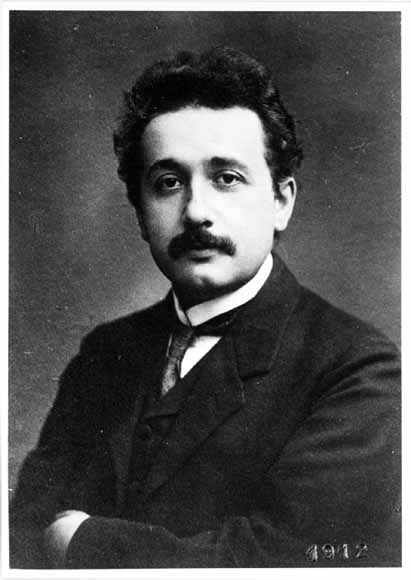
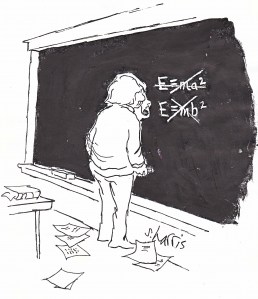
Astronomy Ireland marketed the lecture as ‘The Big Bang: Was Einstein Wrong? which is quite a good hook, so the interview touched on this quite a bit. Of course the answer is YES, it refers to a famous Einstein gaffe. When E. applied the general theory of relativity, his new theory of space, time and gravity, to the entire universe, it predicted a universe that was changing in time (space and time expanding). No evidence for such a thing existed at the time, so Einstein then introduced an extra term into the equations of relativity to force the universe to be static. Such fudge-factors are always risky in science and sure enough it turned out to be a big mistake. In 1929, the American astronomer Edwin Hubble established unequivocally that faraway galaxies are rushing away from one another and mathematicians realised that the universe is indeed expanding. Einstein immediately dropped the spurious term (known as the cosmological constant), declaring it his ‘greatest blunder’. You can listen to a podcast of the interview here, I hope I got the point across!

einstein

Einstein: right about relativity, but missed the prediction of the expanding universe

On Tuesday evening, I’ll give a repeat of the lecture in Waterford,in the main Auditorium of our college. On Wednesday, there is a talk on on the legacy of Charles Darwin at Waterford City Hall, which should be very good, I hope to attend myself. Both these lectures have been organised by CALMAST, the science communication group at WIT. All in all, it’s going be a busy week.

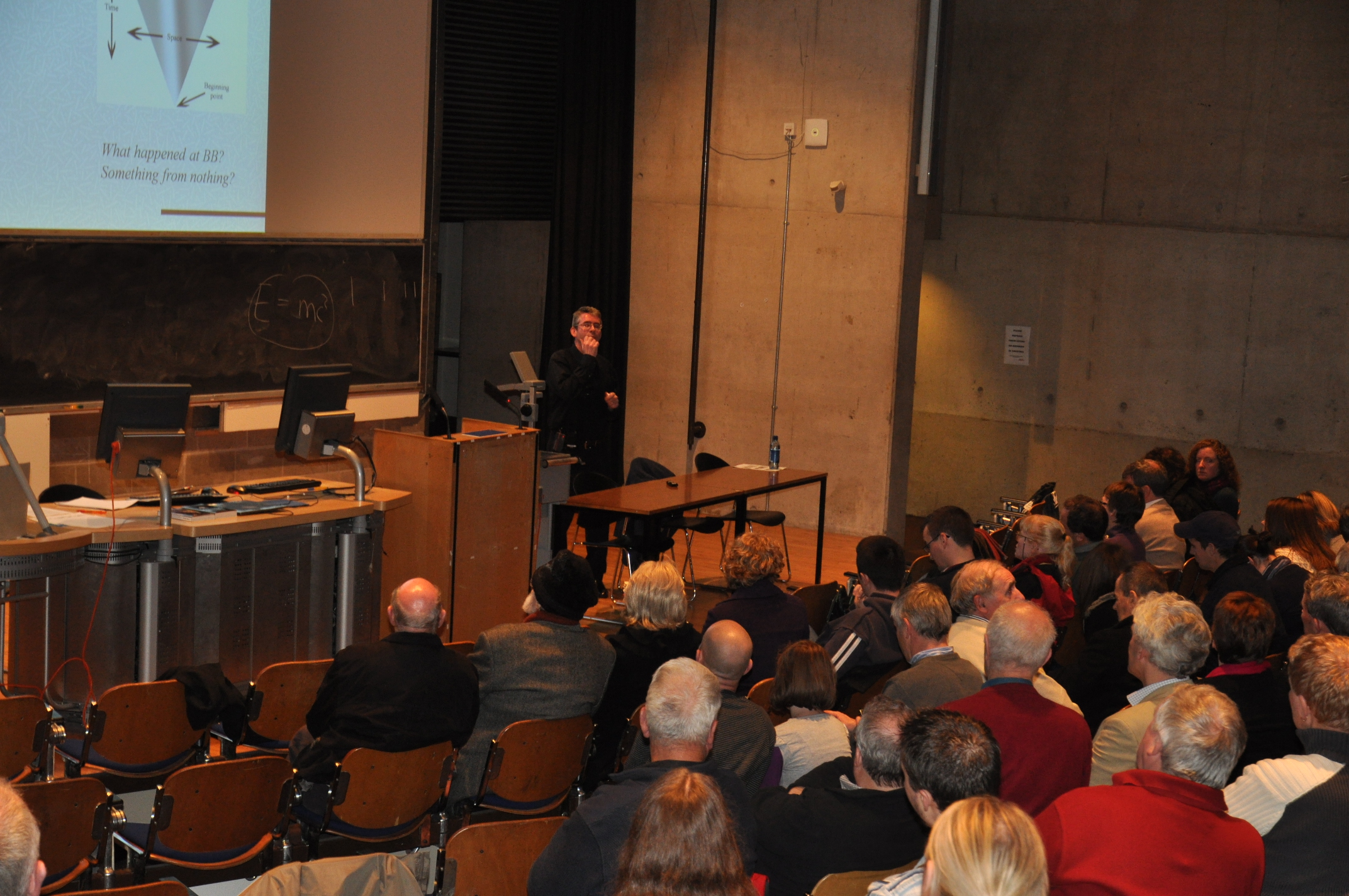
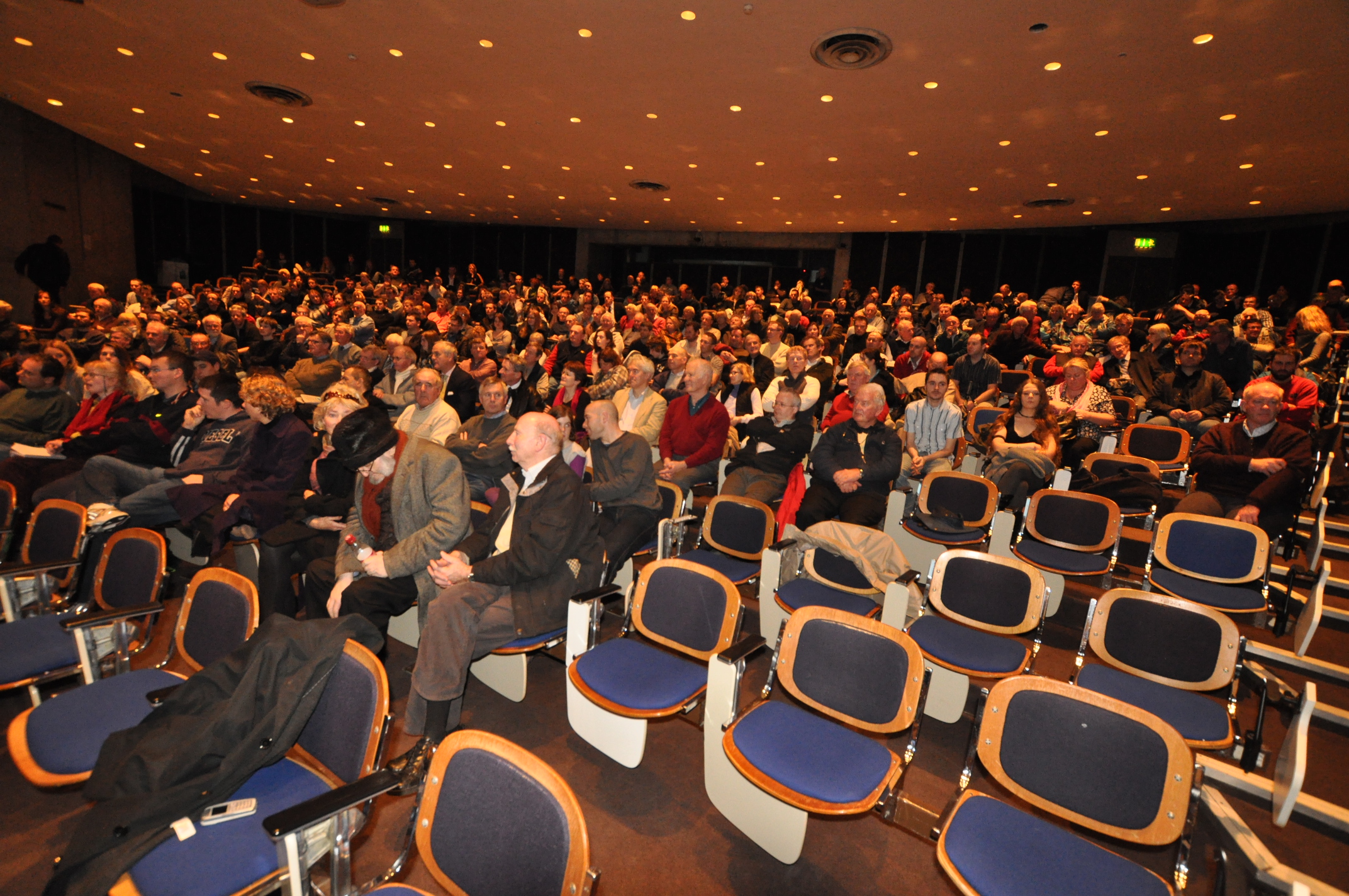
Update: I can see why media interviews are important, we had to change venue to the largest lecture theatre in trinity last night as we got a turnout of about 500! I think the lecture went well, I certainly enjoyed it.

DSC_4753

DSC_4751

DSC_4666

DSC_4728

DSC_9376

17 Comments

Filed under Cosmology (general), Public lectures, Science and society

150th anniversary of Tyndall’s greenhouse effect

Every scientist knows that this year marks the 150th anniversary of the publication of Darwin’s ‘On the Origin of Species’, but not so many may be aware that another scientific breakthrough occurred that year. In 1859, the Irish physicist John Tyndall discovered that certain gases – carbon dioxide and water vapour in particular – absorb infra-red radiation. The discovery was established over a few short weeks, but it provided an explanation for the greenhouse effect, one of the great puzzles of science.

The Irish Times have accepted a piece I have written on Tyndall for their Irishman’s Diary slot next month. I like this column- it is a unique feature of The Irish Times, comprising an 800-word essay prominently displayed on the op-ed page, written by the house journalist 3 days a week and by a freelance writer on other days. I have written a few diaries on various Irish scientists in the past (see My Articles) and I hope one day to publish the ‘Science Diaries’ as a collection of essays.  Below is a draft of what I intend to say on Tyndall:

**********************************

John Tyndall: celebrated Irish scientist who discovered the greenhouse effect

Many readers will know that this year marks the 150th anniversary of the publication of Darwin’s ‘On the Origin of Species’. Another breakthrough occurred in science that fateful year, this one with an Irish connection. The discovery attracted much less attention than Darwin’s theory of evolution at the time, but it has become one of the hottest topics in science today (literally).

In July 1859, the Irish physicist John Tyndall, one of the great scientists of the 19th century, established that certain atmospheric gases absorb heat quite strongly. This innocuous-sounding discovery was established over a few short weeks, but it provided the solution to one of the great riddles of science: the famous ‘greenhouse effect’.

The greenhouse effect was first proposed by the French polymath Joseph Fourier, almost a century before Tyndall’s experiments. Fourier had wondered how the earth maintains its warm temperature, and he speculated that while heat from the sun passes easily through our atmosphere on the way to earth, heat radiated outwards by the warm earth must somehow be trapped in the atmosphere. The hypothesis was highly controversial, as it was widely assumed that gases are transparent to heat.

Tyndall, a fierce proponent of the new experimental method of science, devised a series of simple experiments to test Fourier’s hypothesis.  Working in the dusty basement of the Royal Institution in London in the summer of 1859, he soon established that, while most gases are indeed transparent to light and heat, some gases – carbon dioxide and water vapour in particular – can absorb heat energy at certain wavelengths. As traces of each gas were known to exist in the earth’s atmosphere, the puzzle of the earth’s temperature was solved.

How did an Irish scientist come to make such an important discovery? John Tyndall was born in Leighlinbridge, County Carlow in 1820, the son of an RIC officer and land agent. On completing his schooling under renowned local teacher John Conwill, he started his professional career as a surveyor for the Ordinance Survey of Ireland.  He was soon transferred to a position with the Ordinance Survey in Lancashire, England, but became interested in the new experimental sciences of physics and chemistry emerging in Germany. He moved to Germany in 1848 to study under the famous experimentalist Robert Bunsen at the University of Marburg, returning to England with a PhD in experimental science in 1851. By 1853, he had been appointed Professor of Natural Philosophy at the Royal Institution, a position previously held by the renowned scientist Micheal Faraday.

Tyndall remained at the Royal Institution for the rest of his career, making important discoveries in diverse areas of science, from magnetism to optics, from the physics of sound to the behaviour of bacteria. He is probably best known for ‘Tyndall scattering’, the scientific explanation for why the sky is blue. A keen mountaineer, he became interested in the science of glaciers and made several important discoveries concerning their behaviour. He became extremely well-known in Victorian England as a public communicator of science and was a prominent member of the ‘X Club’, an influential group of prominent scientists who defended evolution and other new scientific theories from religious dogma.

Tyndall’s verification of the greenhouse effect was accepted by the scientific establishment, but not regarded as a matter of vital importance. He and his colleagues were aware of the output of Victorian England’s factory chimneys, but no-one drew a link between this pollution and the greenhouse effect.

Nowadays, evidence has emerged that the average temperature of the earth and its oceans has been gradually rising since the industrial revolution. Despite many uncertainties, the scientific consensus is that this global warming is associated with an increase in carbon dioxide in the atmosphere, an increase that has been produced by human activities such as industry and transport. The discovery has led to concerted international efforts to agree on targets for reducing carbon emissions worldwide, a process that is only just beginning.

What would Tyndall make of today’s climate problems? Like most scientists of his era, he would probably find it difficult to grasp that humans could have such a global effect on nature. On the other hand, he would be greatly depressed by the shrinking of his beloved glaciers. Above all, he would be astonished to find that, of all the scientific discoveries he made, the work he did in the summer of 1859 has become a major preoccupation of 21st century science.

Today, the work of this great Irish scientist is commemorated by the annual Tyndall lecture of the Institute of Physics, the Tyndall Centre for Climate Change Research in the UK, the Tyndall National Institute in Cork, Mount Tyndall in California and the Tyndall glacier in Chile.

*********************************

John Tyndall: celebrated Irish scientist who discovered the greenhouse effect

Many readers will know that this year marks the 150th anniversary of the publication of Darwin’s ‘On the Origin of Species’. Another breakthrough occurred in science that fateful year, this one with an Irish connection. The discovery attracted much less attention than Darwin’s theory of evolution at the time, but it has become one of the hottest topics in science today (literally).

In July 1859, the Irish physicist John Tyndall, one of the great scientists of the 19th century, established that certain atmospheric gases absorb heat quite strongly. This innocuous-sounding discovery was established over a few short weeks, but it provided the solution to one of the great riddles of science: the famous ‘greenhouse effect’.

The greenhouse effect was first proposed by the French polymath Joseph Fourier, almost a century before Tyndall’s experiments. Fourier had wondered how the earth maintains its warm temperature, and he speculated that while heat from the sun passes easily through our atmosphere on the way to earth, heat radiated outwards by the warm earth must somehow be trapped in the atmosphere. The hypothesis was highly controversial, as it was widely assumed that gases are transparent to heat.

Tyndall, a fierce proponent of the new experimental method of science, devised a series of simple experiments to test Fourier’s hypothesis. Working in the dusty basement of the Royal Institution in London in the summer of 1859, he soon established that, while most gases are indeed transparent to light and heat, some gases – carbon dioxide and water vapour in particular – can absorb heat energy at certain wavelengths. As traces of each gas were known to exist in the earth’s atmosphere, the puzzle of the earth’s temperature was solved.

How did an Irish scientist come to make such an important discovery? John Tyndall was born in Leighlinbridge, County Carlow in 1820, the son of an RIC officer and land agent. On completing his schooling under renowned local teacher John Conwill, he started his professional career as a surveyor for the Ordinance Survey of Ireland. He was soon transferred to a position with the Ordinance Survey in Lancashire, England, but became interested in the new experimental sciences of physics and chemistry emerging in Germany. He moved to Germany in 1848 to study under the famous experimentalist Robert Bunsen at the University of Marburg, returning to England with a PhD in experimental science in 1851. By 1853, he had been appointed Professor of Natural Philosophy at the Royal Institution, a position previously held by the renowned scientist Micheal Faraday.

Tyndall remained at the Royal Institution for the rest of his career, making important discoveries in diverse areas of science, from magnetism to optics, from the physics of sound to the behaviour of bacteria. He is probably best known for ‘Tyndall scattering’, the scientific explanation for why the sky is blue. A keen mountaineer, he became interested in the science of glaciers and made several important discoveries concerning their behaviour. He became extremely well-known in Victorian England as a public communicator of science and was a prominent member of the ‘X Club’, an influential group of prominent scientists who defended evolution and other new scientific theories from religious dogma.

Tyndall’s verification of the greenhouse effect was accepted by the scientific establishment, but not regarded as a matter of vital importance. He and his colleagues were aware of the output of Victorian England’s factory chimneys, but no-one drew a link between this pollution and the greenhouse effect.

Nowadays, evidence has emerged that the average temperature of the earth and its oceans has been gradually rising since the industrial revolution. Despite many uncertainties, the scientific consensus is that this global warming is associated with an increase in carbon dioxide in the atmosphere, an increase that has been produced by human activities such as industry and transport. The discovery has led to concerted international efforts to agree on targets for reducing carbon emissions worldwide, a process that is only just beginning.

What would Tyndall make of today’s climate problems? Like most scientists of his era, he would probably find it difficult to grasp that humans could have such a global effect on nature. On the other hand, he would be greatly depressed by the shrinking of his beloved glaciers. Above all, he would be astonished to find that, of all the scientific discoveries he made, the work he did in the summer of 1859 has become a major preoccupation of 21st century science.

Today, the work of this great Irish scientist is commemorated by the annual Tyndall lecture of the Institute of Physics, the Tyndall Centre for Climate Change Research in the UK, the Tyndall National Institute in Cork, Mount Tyndall in California and the Tyndall glacier in Chile.

Dr Cormac O’Raifeartaigh is the author of the science blog ANTIMATTER

9 Comments

Filed under History and philosophy of science, Science and society

Antimatter at the Royal Irish Academy

I was at a very interesting event in Dublin yesterday evening; an informal panel discussion for the public on ‘Angels, Demons and Antimatter’ hosted by the Royal Irish Academy and The Irish Times. It’s great to see the Academy hosting this sort of event as it helps to bridge the gap between science and the humanities (the ‘two cultures’ famously described by C.P. Snow).

The event was ably chaired by Dick Ahlstrom, veteran science editor ofThe Irish Times, and the panel boasted four heavy hitters from the world of particles physics: Alex Montwill, Ireland’s best-known particle physicist and renowned communicator of science: Ronan Mc Nulty, leader of the experimental particle physics group at UCD, a group that have a major involvement with the LHCb antimatter experiment at CERN: Tara Shears, lecturer in physics at Liverpool University, also heavily involved in the LHCb experiment: and Paul Bowe, the Irish physicist who is technical director of ALPHA, the anti-Hydrogen experiment at CERN.

In his introduction to the event, Dick Ahlstrom sensibly asked the audience how many had seen the film – only about a third, which confirmed my view that people are interested in particle physics for its own sake, film or no film. Tara Shears then kicked off with a pithy summary of the film, explaining that a ticking bomb made of antimatter provides the timeline of the unfolding story. Then it was over to Alex to give a brief introduction to the phenomenon of antimatter. He did this in exemplary fashion, starting with the prediction of antimatter from the Dirac equation (…“Dirac was not the sort of scientist to brush extra solutions that seemed to have no corresponding physical reality under the carpet“) and proceeding to the experimental discovery of the positron in 1932 (if you want details on the discovery of antimatter, see post here). The discussion then honed in on the nature of antimatter, how it occurs in nature and how it is produced in minicscule amounts in high-energy accelerators.

The panel then turned to one of the great mysteries of physics – why is our universe primarily made of matter and not antimatter? Ronan gave a brief overview of charge symmetry, parity symmetry, charge-parity (CP) violation and the Sakharov conditions ; these are three conditions that theory predicts must have existed in the early universe for the current asymmetry of matter and antimatter to develop.

Charge and parity operations: note that the final quadrant is not identical to the first

This led nicely to a discussion of the relevance of high-energy physics to cosmology. I was very pleased this came up, as it is not always obvious to the public that, as well as studying the fudamental nature of matter, high energy accelerators offer a direct glimpse of the very early universe by recreating the energy conditions that existed shortly after the big bang (a point that is often missed by critics of the big bang model).

Paul Bowe then discussed the production of anti-hydrogen at CERN (an atom of anti-hydrogen simply comprises an anti-electron orbiting an antiproton, see previous post on this). He gave a brief overview of the ALPHA experiment – the production of positrons, the production of antiprotons, the mixing trap etc.

Schematic of hydrogen and anti-hydrogen atom

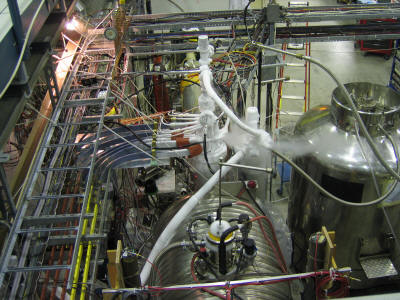
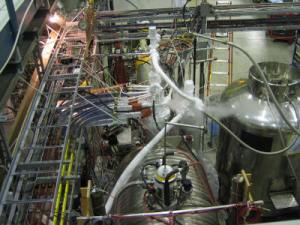
A picture of the experiment reminded me that while I find the discoveries of particle physics fascinating, I’m happy to leave the experiments to others!
IMG_1458

Image of ALPHA experiment

Paul also addressed a question I was asked a while ago – Do we expect the spectrum of anti-H to be the same as that of H? If I have understood correctly, the answer is yes (since the electromagnetic interaction between the anti-proton and the positron should mirror that between the proton and the electron). If not, the spectrum of anti-H will have major implications for our understanding of CP violation.

********************************************

The second part of the discussion dealt with Hollywood’s take on antimatter in Angels and Demons. It started with a clip from the film, the scene where Dr Vetra tries to explain to the destructive potential of the antimatter bomb to the authorities, advising that they evacuate the Vatican city forthwith.

Of course, the panel were quick to point out the unfeasability of the bomb, as mentioned in the post below: because of the difficulties of creating even a few atoms of antimatter in particle accelerators, it is simply not possible to create a bomb made of antimatter (or to use it as an energy source). And if such a bomb could be made, the trap container would be gigantic, not the little package portrayed in the film. However, I was pleased to hear that Tara (and I think the panel as a whole) felt Brown’s plot was acceptable cinematic license and made for a good story.

A small container for an antimatter bomb?

**********************************************

In keeping with the informal nature of the event, there was a lengthy question and answer session after the panel discussion. Some interesting questions were;

1. Is it possible there is plenty of antimatter in our universe today, in the form of distant galaxies made of antimatter?

I think the answer was that this is a real possibilty, but a basic asymmetry between matter and antimatter is still implied.

2. Does the neutron have an antiparticle?

Yes, because the neutron is a composite particle – the anti-neutron is made up of anti-quarks etc). Ronan pointed out that the question Does the neutrino has an antiparticle? is much more interesting and the subject of much debate.

3. What is the relation between antimatter and dark matter?

None – dark matter is the name we give to matter that has a gravitational effect but does not interact with the electromagnetic force. However, whatever particles make up dark matter presumably have anti-particle counterparts!

4. My question: Why did Dan Brown choose to introduce the topic of antimatter to the story at all, wouldn’t TNT have done?

My own view is that he was anxious to include cutting edge science, as the relation between religion and emerging science is a major theme of the novel. However, Tara had a better answer: novelists write about what they find interesting and Brown happens to be interested in particle physics! Apparently, he even visited CERN in 1990. QED.

********************************************************

All in all, this was a very interesting an informative event, a treat for anyone interested in particle physics or indeed are the public perception of physics. If there was one sour note during the evening, it was Dick Ahlstrom’s observation that “ the UCD contribution to the LHCb experiment really occurs through the back door” as Ireland is not a member of CERN. This is a sad situation that we have touched on many times before, so I’ll leave it for now. As for Dan Brown, long may he continue to include science in his bestselling novels.
9 Comments

Filed under Particle physics, Science and society

Angels & Demons: a good film

I was in Dublin yesterday for an Institute of Physics meeting so I took the opportunity to see Angels & Demons in the Savoy afterwards.

Shock news: I found the film reasonably interesting and entertaining, in stark contrast with every review I have seen (see a scathing review inThe Irish Times here). What is with the critics? I am no fan of Hollywood, but as Hollywood blockbusters go, I found A&D well above average.

Granted, the plot is a bit far-fetched, not to mention convoluted (you really need to have read the book to keep track of the story, from the history of the Illuminati to the frantic chase around Rome from cryptic symbol to cryptic symbol). However, the film is an improvement on the book as the storyline is tighter, with many unnecessary scenes removed. The cinematography is good – Ron Howard makes great use of the architecture of Vatican City and of the pomp and ceremony of Church traditions such as Conclave. The fabulous tradition of the Catholic Church in art, architecture and music is also portrayed quite well. There are some nice crowd scenes in St Peter’s square; my favourite was an incidental scene depicting a riot over the rights and wrongs of stem cell research! The key scene of a bomb-laden helicopter ascending into the heavens from St Peter’s was also quite effective.

The cardinals on the way to Conclave

I can’t help wondering whether some critics missed the central point of the film. One problem with this sort of thriller is that the theme is often not revealed until the end. In this case, it only becomes becomes clear in the closing moments that the real topic of the story is the conflict within the Church between those who seek to reconcile religion with science (the elderly cardinals) and those who see science as an implacable enemy that must be overcome by any means (the young Camerlengo). An unusual theme for a blockbuster..

What about the science in the film? Again, it was better than I expected. The opening minutes are set in CERN, with a nice portrayal of an accelerator facility and a decent simulation of proton-proton collisions as the LHC is switched on. There is a reasonable explanation of Professor Vetra’s antimatter experiment and the routing of the proton beam to his lab is portrayed in realistic fashion. Yes, yes, the whole concept of an antimatter bomb is wrong-headed (see post below), but this is fiction, not fact.

However, given the worldwide attempts to use A&D to promote science (see here), I feel bound to point out that the whole antimatter/CERN angle is rather tangential to the plot – that is incidental, as Hannibal Lecter would say. It happens that the bomb is supposedly made of antimatter, but that’s about the extent of the particle physics connection. (There is also the Camerlengo’s objection to the ‘blasphemous’ term God particle). Even the gorgeous young scientist Vetra doesn’t get much of a role. The real theme of the film is the battle between science and religion, now and in the past, a topic it handles quite well (see Camerlengo’s speech and eldest cardinal’s rebuttal).

All in all, I enjoyed the film and would certainly watch it again sometime. I even liked the central character (played by Tom Hanks) – a non-believer who is respectful of the rich tradition of the Church, he was quite convincing in the role…

Comments Off on Angels & Demons: a good film

Filed under Science and society