Maths teaching

Today and yesterday, I’ve been attending a conference on service teaching, hosted by the maths lecturers of our college. The conference is supported by the National Digital Learning Repository and the Irish Mathematical Society.

Service teaching refers to the teaching of students who are not majoring in mathematics (IT students physicists, engineers etc). It was an interesting conference, with a good few talks from colleagues in other Institutes of Technology. Not many IoTs have degrees in pure maths, so most maths teaching in the sector is service by definition.

Almost all contributors made reference to the problems 3rd level students have with maths. (There are many reasons for this, from the increase in college attendence among the general population, to low entry points, to the dumbing down of society, etc). The conference was mainly concerned with practical strategies to aid students, although Dr George McClelland talked of a large research programme into the teaching of maths and science at the University of Limerick.

A common theme was the introduction of extra support in the form of ‘drop-in’ maths centers – at least three speakers spoke of such centres in their institutions. It seems many students hate to approach lecturers in their office, but find it helpful to have a dedicated help center, with a different lecturer on hand to get them over a particular hump. Once over it, many first-years never look back. Small tutorial groups in a similar setting were found to be similarily beneficial.

This is a very good idea, if a little resource heavy. One speaker, Dr Diarmaid O’ Se of IT Carlow, found that the ‘drop-in’ idea worked better when modified to appointment by email. At the other end of the scale, Prof Tony Croft spoke of a very comprehensive support operation in Loughborough University (UK), with a large drop-in centre manned by permanent staff with very good resources, an initiative that has proved extremely popular with students and spread to several UK universities.

There were good tips concerning teaching methods in maths – Dr Neil Challis of Sheffield Hallam University (UK), had some great ideas on motivation for mathematics through technology. He showed how the simple measurement of physical data ( movement, sound etc) in maths class could help students relate to basic mathematical functions. Another great idea was to get the audience (or students) to participate in the representation of mathematical functions using semaphore !

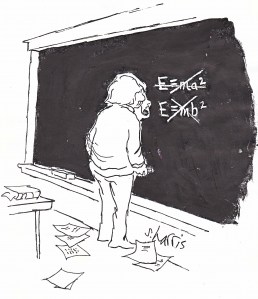
The function y = -x

My favourite talk was one on the teaching of circuit analysis by Donncha O hEallaithe of Galway-Mayo Institute of Technology. The talk concerned the use of phasors in the analysis of AC circuits, and why students are usually told everything except why! I was one of these students… I could never see the connection between AC current (or voltage) and complex numbers – did this mean AC current wasn’t real?

Donncha explained that students are rarely told that it is simply a matter of representation. Since an ac voltage Vsin (ωt) appears across a circuit element as Vsin (ωt + Ф), the variables are the amplitude V and the phase angle Ф, which we can represent using vectors. However, since vector division is messy, it makes more sense to handle the amplitude and phase angle using the same 2D representation as complex numbers. And then translate back when you’re done. No imaginary current. Tra la!

No-one told me this when I was a student. (I suspect they did – Ed ).

4 Comments

Filed under Uncategorized

Dark matter vs dark energy

Hoosier (below) is a bit confused between Dark Matter and Dark Energy, and unconvinced by the whole shebang. This is very common, so let’s have a post on it..

Dark matter is thought to account for 20% of all the matter/energy of the universe. Although we can’t see it, we’re pretty sure it exists, because its gravitational effect on visible matter can be seen. Put differently, we don’t insist that all existing matter must be ‘visible’ (i.e. emit or reflect electromagnetic radiation). Instead , we include the possibility that some matter may be seen only by its gravitational effect on neighbouring matter. The idea was first postulated by Fritz Zwicky in the 1930s – today, the known motion of certain spiral galaxies suggests that dark matter makes up 22% of all matter/energy, while ordinary (visible) matter makes up only 4% .

Of course, like the MOND crowd suggest, there is always the possibility is that our laws of gravity (both Newtonian and Einsteinian) are simply wrong. But most physicists consider this unlikely, as the predictions of our theory of gravity match observation in so many other instances…

Dark energy is a lot more speculative, and a lot more recent. It’s simply the name we give to whatever is causing the expansion of the universe to speed up (since 1998, it has been known that the expansion rate is currently increasing). The physical cause for dark energy is thought to be some sort of vacuum energy, but nobody’s sure yet. (From the point of view of theory, the phenomenon suggests that Einstein’s equations need an extra term, known technically as the ‘positive cosmological constant’.)

Putting the two together, cosmologists postulate that ordinary matter, dark matter and dark energy all add up to the critical density required for the geometry of the universe to be flat (which is what observation suggests). In other words, the current model of the universe can be summed up by

Density ord matter (4%) + Dens dark matter (22%) + Dens dark energy (74%) = 100%

More

The strongest evidence yet for dark matter was reported last summer. In the passage of one galaxy through another, one might expect the dark matter of one galaxy to interact differently than its ordinary matter, and researchers at the University of Arizona are pretty sure this is exactly they saw.

Galaxy collision seen by the CHANDRA space telescope

It is also reported here and here that another group, the DAMA-LIBRA collaboration, have observed seperate evidence of dark matter, but this claim is more controversial.

17 Comments

Filed under Uncategorized

Physics World and MoG

Yipee. Wow. Gosh.

I was informed yesterday that Physics World are going to feature an article of mine in their July issue! I had thought that my recent experience of a public talk on science and religion (see ‘The Big Bang and the Mind of God’ post below) might make a suitable article for their quirky backpage (Lateral Thoughts), and it seems they think so too…

Physics World is the flagship publication of the Institute of Physics. It’s a physics magazine of very high standard, easily my favourite (it’s a bit like a European version of the American Physics Today, but better). PW regularly has excellent, comprehensive articles on every area of physics research today, written by world-class researchers.

One snag – the dreaded words “we’ve made a few small changes”. In fact, the copy-editor made quite a lot of changes, especially at the beginning. To me, it doesn’t read like my voice at all. It’s something I’ll never understand, the compulsion of editors to change submitted prose around. What writer wants their carefully chosen words changed? Besides, all too often, the ‘edited’ version conveys a slightly different meaning to that originally intended…

So I’m now engaged in a process of trying to reach a compromise. I spent hours today trying to incoporate the changes I can live with, and sent the result back. Hopefully, we can each agreement.

Sigh. One day I’ll have my own magazine column somewhere!

2 Comments

Filed under Uncategorized

The theory of everything

The Lisi story below is a good hook for a post on the theory of everything…so here goes.

One of the big discoveries of 20th century physics is that there exist only four independent forces or interactions. These are gravity (known since Newton), electromagnetism (the unification of electricity and magnetism achieved by Maxwell in the 19th century), the strong nuclear force (that holds the protons together in the nucleus), and the weak nuclear force (responsible for nuclear decay and radioactivity).

Einstein always suspected that these interactions were not truly independent and spent most of the latter part of his life trying to achieve a unified theory that could describe both gravity and electromagnetism (a program that became known as unified field theory, initiated by Kaluza and Klein). Einstein failed in this program, not least because we now know that gravity is the hardest nut to crack (we have no satisfactory quantum theory of gravity, while all the others interactions can be described in terms of quantum theory).

Nowadays, unified field theory works from the oposite direction. Using the methods of gauge symmetry, theoreticians in the 1970s established a strong connection between the electromagnetic and the weak nuclear interactions. The theory predicted the existence of unkown particles (W and Z bosons), which were subsequently discovered in high-energy experiments at CERN in the 1980s…ever since we talk about the electro-weak interaction as a single entity.

One of the giant particle detectors at CERN

This success of electro-weak unification resulted in furious attempts to extend the unification program to include the strong interaction (a program known as Grand Unified Theory) . However, the GUT program soon ran into serious trouble, with a clutch of ‘no-go’ theorems showing that such unification was mathematically unsound (see the O’ Raifeartaigh theorem and the Coleman-Mandula theorem). Various novel ideas to circumvent this problem gradually emerged in the 1970s, the most promising of which is probably the theory of supersymmetry. Anyway, there now are strong hints of connections between the electro-weak and the strong interactions at high energies. Most ambitious of all is the prospect of a unified theory that also includes gravity i.e. that describes all four interactions in a single framework – the so-called theory of everything.

All the above is really boils down to the simple idea of a single super-force existing at the tremendous energies of the Big Bang, which gradually split off into the four seperate entities we see today as the universe cooled…pretty neat eh? The problem is that the mathematics of such a theory of everything (TOE) remains elusive – the leading candidate is string theory – yep, the famous string theory that is controversial because it is so mathematically abstract that it makes almost no predicitions that can ever be verified/falsified by experiment…..but that’s a separate story!

Suffice it to say that Einstein’s famous quest for a theory that incorporates a description of the elementary particles and all their interactions, now continues under the title Theories of Everything, and is still the Holy Grail of theoretical physics. As regards Garrett Lisi’s paper, part of the unification program inviolves the description of all the elementary particles using the mathematical theory of groups. (For example, Gellman’s classification of the known particles in the 1960s using group theory led to the prediction of a deeper layer of matter making up most particles – the quarks, later detected experimentally). Lisi’s paper purports to show that a particular mathematical group, the E8 group, may offer a very useful way of decribing all of today’s known particles, in a very simple framework…hence the interest. Plus, he’s an excellent surfer!

5 Comments

Filed under Uncategorized

An exceptionally simple TOE

Over at Not Even Wrong, Peter Woit has a reference to a new article on the Garrett Lisi affair, this time in Outside Magazine. Lisi is the physicist who received a great deal of media attention earler this year when he posted a paper on the ArXiv server on a new classification of elementary particles based on the group E8, superbly titled ‘ An exceptionally simple theory of everything’. The paper was picked up by science magazines and newpapers all over the world, with prominent articles in outlets like the New Scientist, and The Telegraph, all of whom made a great deal of the fact that Lisi is an untenured academic, who spends much of his time surfing and snowboarding…

The Outside Magazine article is a good place to start if you’re unfamiliar with this story. Given his lifestyle, I imagine Garret probably appreciated this article more than any of the others. I didn’t know what to make of the Lisi story at first, but I’m glad it’s resurfacing, it’s a bit of light relief in our dull lives. ..

A few points strike me

1. Every time journos draw a comparison with Einstein, Lisi patiently points out that the lack of tenure is the only similarity – so it’s not his fault they keep making this comparison

2. I don’t see the problem with the surfer angle – surely it makes a welcome change from the usual media view of scientists. Besides, if Lisi is not a full-time academic, it simply means he probably has more time to think than the rest of us, not having to deal with endless admin, emails, proposals, teaching etc!

3. I’m delighted to see group theory get some attention – few outside the field have the slightest idea of the importance of group theory in particle physics. It seems some experts think that the whole E8xE8 thing may turns out to be a fairly trivial classification, but I enjoyed Lisi’s paper no end. It’s interesting that Dad’s book on group theory (chap 10) makes it clear that the E8 group had long been of interest to the supersymmetry gang, for reasons I don’t begin to understand. Technical stuff aside, the whole story is reminiscent of Gellmann’s eigthfold way, no bad thing.

Go Garrett!

All in all, I think scientists are inclined to react strongly against media attention, especially if we feel there are more deserving cases. We need to get over this, because such stories probably do far more for the public perception of physics than any number of well-intentioned school visits!

Update:

I probably should have explained what a Theory of Everything (TOE) is – it’s a theory that incorporates a description of the elementary particles and all their interactions (as opposed to a Grand Unified Theory, which is a theory that unifies three of the fundamental forces). If gravity is included in a unified framework like this, it’s called a Theory of Everything, because that’s all the forces we know. Unfortunately, it has proven very difficult to incorporate gravity with the other three interactions, not least because we don’t have a quantum theory of gravity (all the others are quantum theories). In short, Einstein’s famous quest for a unified field theory now continues under the title ToE, and is still the Holy Grail of theoretical physics.

Leave a Reply

5 Comments

Filed under Uncategorized

GLAST launch

This month’s issue of Physics World has a super article on the GLAST satellite, the new gamma ray detector to be launched by NASA this month. Unlike in optical astronomy, gamma ray teleccopes study the universe at the highest energies of the electromagnetic spectrum. It’s a fascinating area of physics that has really exploded (oops, sorry) in recent years.

For many years, the high energy gamma ray bursts (GRBs) seen in the sky were a big mystery -nobody was sure what caused them. We now know that the universe contains a rich variety of gamma-ray emitters, including pulsars, supernova remnants, and coolest of all, supermassive black holes. (The Sun also produces gamma rays by accelerating charged particles in solar flares and coronal mass ejections, and our galaxy glows brilliantly with gamma rays due to interactions of high-energy cosmic rays with interstellar gas). One of the key reasons to extend our observations of celestial gamma rays is to look for signatures of as-yet-unknown fundamental physical processes.

The launch of the Gamma-ray Large Area Space Telescope (GLAST) will open this high-energy world to exploration, and follows on from the spectacular success of the ESA’s INTEGRAL satellite. Just as with the cosmic microwave background, there is a need for satellite measurements to get around the problem of absorbtion in the earth’s atmosphere (albeit in a vastly different energy range). With GLAST, astronomers will have an awesome tool to study how black holes can accelerate jets of gas outward at fantastic speeds.

Physicists will also be able to study subatomic particles at energies far greater than those seen in ground-based particle accelerators. And cosmologists will gain valuable information about the birth and early evolution of the Universe. Wow.

You can read more about the GLAST launch on the official NASA website here.

1 Comment

Filed under Uncategorized

Midland blues

I spent the weekend in the midlands, doing some walking with my Mum and her walking group. Sunday was a real scorcher and we had a long walk by the river Barrow. More a trudge really., with only the odd river cruiser negotiating the locks for company. Like all walks, it turned out to be at least an hour longer than planned. What I mainly took out of it is that there is a big difference between walking up a mountain and walking along a river – one stretch along a river is much like another and you think it’s never going to end.

Another thing that ocurred to me as we trudged along is that there are land people and sea people. On a hot day, I’d far rather be on the sea, and get quite frustrated inland. Somehow those small, dusty towns are worse in the sun. To me, it doesn’t really matter if you’re sailing, windsurfing, surfing or whatever. If you like the sea, that’s where you need to be. Luckily, I live in a village by the sea!

Which reminds me, I must buy a dinghy this summer. I keep putting it off, as I travel a lot in summer. Last year, I had a nice windsurfer I got great use out of, until someone stole the board out of my garden. Now it looks like I’ll need a whole new rig. Thanks, pal.

After the long walk, there was a deafening country n western band playing in the hotel. Yippe I-ay etc, at full decibels. This seems to be a permanent feature of hotels in the midlands, I wonder why. Something to do with farmers and cowboys? Strange.

4 Comments

Filed under Uncategorized

SophiaEuropa II

Today was the last day of the conference, with plenty of good talks, although many of us were tired after last night.

Yesterday evening, we were treated to some traditional Irish music courtesy of Dr Collete O’ Mahony, one of the conference participants and director of the WIT Traditional Music Group. The group played some great music and we even had a full ceilidh, with fear-an-ti showing the visitors the steps (ok not just the visitors!). So much more fun than the usual ‘live entertainment’ of some bloke with a mike playing rock music far too loud. Only the Irish could have a ceilidh at a theology conference…

Today’s talks were very interesting, with one on sin, guilt and forgiveness by Fergus Hogan of WIT. Not your average technical science talk then..

The conference finished with a plenary talk by Professor Eamonn Conway, a well-known theologian from Mary Immaculate College, University of Limerick. This was a serious full-on talk on the role of theology in modern society. From a scientist’s perspective, it’s very interesting to see the difference between these guys, the thinking theologians, and the fundamentalist types, a very different species. I took about 3 pages of notes, but I think the presentation will be on the conference webpage in a few days.

Eamonn in action: I didn’t know theologians used graphs (or blackboards)

One good quote we got from Eamonn arose from a comment of mine to Fergus – I had pointed out that guilt doesn’t need God as a reference point, to which Eamonn responded “something isn’t wrong because the Church says so…the Church says so because it’s wrong”

I was also pleased Eamonn referred to Jim Mackey quite a few times – Mackey is a very good philosopher and his recent book The Critique of Theological Reason has been under attack from some theologians recently…

After lunch, I was sorry to see the conference come to an end. I wouldn’t mind going to a few more of these in the future, not at all what I expected…

Update:12th May

Rysiek has a whole bunch of photos of the conference – you can see the whole lot here, they’re very very good. We’re still waiting for the podcast..

Well done Rysiek!

8 Comments

Filed under Uncategorized

SophiaEuropa conference

You’d think it’d be an easy week for staff while the hapless students prepare for exams – in fact there seems to be a huge number of conferences around the college this week. Not least of which is the SophiaEuropa Conference ‘Knowledge, Truth and Wisdom: Science, Religion and Culture in Shaping Europe’, mentioned in previous posts.

The conference started yesterday morning with a sociology session. There’s far too much to list here, but I must say I thoroughly enjoyed The Search for Meaning: Between Science and Religion, by keynote speaker Pofessor Tom Inglis of UCD. Dr Gary McDarby also gave an interesting talk, Technology Enhamced Evolution in the Absence of a Loving God, where he highlighted concerns that the pace of technological discovery has far outstripped our consideration of its effects on society.

There were a whole bunch of talks this morning that were also interesting. I think there will be a description of the talks on the conference website soon, but I must say I really liked Thomas Moellenbeck‘s talk on the famous argument from design (see posts below). Thomas presented a comparison of the argument from design as articulated recently by Cardinal von Schborn (‘intelligent design’), and that of Cardinal Newman – it seems Newman felt such arguments lead straight to atheism!

I gave my own spiel then, a truncated version of my public seminar on the Big Bang (see The Big Bang and the Mind of God posts below). Of course I used up most of the session presenting the basic evidence and theory of the model, before getting to the philosophical implications, but I think that’s the price you pay for tackling modern subjects. It’s worth doing this – after all, not everyone knows that a prediction of modern physics is that the universe may not have a ‘before’ (from general relativity) or even a ’cause’ (from quantum). There wasn’t really time to go into Hawking’s analogue of God and the Queen (below), but I enjoyed giving the talk. Afterwards, the questions were tough enough, as you might expect in a roomful of theologians.

Professor Eamonn Conway of Mary Immaculate College, Eric Weislogel (Executive Director of Metanexus, sponsors of the conference), and I then went off for a radio discussion on WLR. I must say I thought the DJ (Billy McCarthy) did a very good job of probing our different positions on life, the universe and everything, with Eric acting as umpire between Eamonn and I. It goes out tomorrow morning sometime, must remember to record it while we’re at the conference…

POSTSCRIPT

When I finally made it back to my office this afternoon, I noticed a Materials Conference in full swing in the adjacent building. I had a look at the posters and the schedule of talks. You know what, I don’t miss technical research at all. I far prefer interdisciplinary debates with philosophers and theologians on the meaning of science etc…pity it took me so many years to figure this out!

Comments Off on SophiaEuropa conference

Filed under Uncategorized

Global warming

The experience with my car (below) made me think a bit. In fact, I often get asked about my position on global warming, now that I’m a ‘public scientist’. I don’t know about ‘position’ – but I do know something of how science is done. Meaning that scientific discovery is based on evidence, evidence that is interpretetd by PWKs (people who know what they’re talking about). So if the vast majority of the world’s climate scientists tell us we have something to worry about, we have something to worry about.

The key discovery was in the 1970s, when it was first realised that global climate might be an unstable system, i.e. a system where a small perturbation could easily result in a large effect. (There is a very nice description of this discovery in the book ‘The Discovery of Global Warming’ by Spencer Weart).

Nowadays, there doesn’t seem to be any doubt that

(i) the atmosphere is heating up (the part near the earth, that is)

(ii) the rate is unprecedented

(iii) the phenomenon is almost certainly due to human activity (e.g. carbon emissions)

These results have been confirmed by the Intergovermental Panel on Climate Change, an unprecedented global coalition of scientists. Despite much debate over details, there isn’t much debate about the overall trend (except among a tiny minority of scientists, some of whom who have an industry bias). Of course there are also genuine scientific doubters, but the consensus is pretty clear…

The debate now more concerns what action to take – in other words how to reduce emissions without triggering a recession. There is certainly sharp disagreement here, but on close inspection it is more between scientists and economists. For example, it’s worth noting that Bjorn Lomborg, the prominent skeptic, is not in fact a scientist at all. Lomborg, and several other economists and political scientists, claim that tackling emissions would be very inefficient and essentially a waste of money that would be better spent elsewhere. However, scientists point out that many such commentators have two things in common –

1. They tend to play down the evidence of warming (Lomborg’s infamous book The Skeptical Environmentalist is a prime example of this)

2. They ignore the possibilty of a tipping point. What scientists worry most about is that a threshold may exist, beyond which there may be no going back as positive feedback mechanisms kick in … a frightening scenario

So the great global warming debate is beginning to look like a debate between scientists (who don’t really understand economics) and economists (who don’t really understand science). For my part, I find Lomborg’s grasp of scientific uncertainty highly suspect (economics can be spectacularly wrong in a way science never is)..pretty worrying in a man who was recently voted one of the 100 most influential people on the planet by Time Magazine…

What happens if Lomborg’s wrong? I often wonder if those who make a career out of questioning the consensus ever doubt themselves. If we do sail past a tipping point, thanks to delayed action due to the skeptics, they will have a lot to answer for…

6 Comments

Filed under Uncategorized