The Denial of Global Warming

Yesterday evening, the annual statutory lecture of the School of Cosmic Physics of the Dublin Institute of Advanced Studies concerned the topic of global warming. Titled ‘The Denial of Global Warming’, the lecture was given by Naomi Oreskes, Professor of the History and Philosophy of Science and Ajunct Professor of Geophysics at the University of California at San Diego.

Professor Oreskes opened with some alarming statistics – today, 27% of U.S. citizens do not believe the earth is warming at all and 41% of them attribute the warming to a natural cycle. Indeed, Sarah Palin, the republican candidate for U.S. Vice-President, has publicly stated that there is no consensus that global warming is man -made (I was aware of this, and have been shocked by how little attention it has received in the media).

In the first part of the talk, Oreskes gave a brief overview of the history of the study of climate change, with a tight review of the work of Tyndall, Arrhenius, Callender, Gilbert, Plass, Revelle and Keeling. (For the interested reader, there are several good books on this topic, such as The Discovery of Global Warming by Spencer Weart, or Global Warming: A Very Short Introduction by Mark Masin ).

The main points Oreskes drew out were

– the basic physics of atmospheric warming was well understood by the 1930s

– by the 1950s it was clear that absorbtion by water vapour does not overlap with CO2 absorbtion

-by the 1960s it was realised that about 50% of CO2 produced remains in the atmosphere, i.e. does not get reabsorbed by plants or the oceans

– In 1965, Keeling predicted that there would be 25% more CO2 in the atmosphere by the year 2000, a prediction that has come to pass.

All of this science was accepted at the time, with U.S. President Lyndon Johnson acknowledging the seriousness of the threat. In the 1970s, the U.S. government commisioned three seminal reports on possible climate change due to fossil fuel combustion that were accepted scientifically and politically. A consensus had emerged and the only question was how immediate was the threat (note that all this is pre-IPCC).

So what happened? In the second part of the talk, Prof Oreskes addressed the question of why today, so many think the issue has not been settled. Her answer to this is quite blunt – because that is what the public has been repeatably told. Oreskes then described her own research into the growth of a counter-movement that sought to portray that there was no proof of man-made global warming, or consensus on the topic. Her research traced this movement back to to an entity called the George C. Marshall Institute. This was originally set up to enable a small number of physicists to defend President Reagan’s Star Wars program against the mainstream of physics (most physicists ridiculed the program). The goal of the institute was to challenge established science, and it wasn’t long before its members turned their sights to global warming. An intense media campaign was launched with scientists such as Fred Seitz and Fred Singer reguarly publishing prominent articles in the media casting doubt on the scientific consensus on global warming. In particular, Oreskes emphasised how these scientists used the ‘fairness’ of the media in order to promote the views of a tiny minority. By the 1990s, it looked like they were losing the debate, not least due to the activities of the IPCC. In response, Singer and Seitz simply amplified their attacks, with Singer launching a personal attack on the author of a key chapter of the 1991 IPCC report.

At this point, the talk took a somber turn – struck by the similarities between the above campaign and that of the tobacco lobby, Oreskes decribed how she began to dig a little deeper. Lo and behold, she discovered that several of the scientists above had also been involved in the tobacco campaigns of the 1970s and 1980s. Indeed, they had also been involved in campaigns contesting environmental issues such as the hole in the ozone layer. At this point she posed the question of motivation. In her view it was not money (many of thse guys are rich), but ideology. She explained that the common denominator of all these counter-campaigns was an extreme free-market mentality – virulent anti-socialists, what these scientists were determined to avoid was state intervention in any form. Of course, as Oreskes pointed out, this was a fundamentally dishonest discourse, as theirs was a political argument dressed up as a scientific one.

This was the real theme of the talk and it was argued extremely well. At question time, I asked Oreskes her opinion of well-known European climate skeptic Bjorn Lomborg (Lomborg no longer disputes man-made warming, but questions the expense and effectiveness of any possible response). Her answer was that just as Singer et al represent the minority (but highly vocal) view in science, Lomborg et al represent the minority but highly vocal view in economics, with most economists believing that the cost of doing nothing will far exceed the cost of action now. (Come to think of it, Lomborg has quite pronounced right-wing views on economics, so perhaps it’s the same virus as above!). At the end of question time, Oreskes wrapped up with an uncomfortable question – what action should scientists take to protect good science from ideology?

Overall, this was a fantastic talk on science and society, with a crucial scientific issue and its impact on society discussed in a clear, straighforward manner. Oreskes for Vice-President!

Update: The journalist and environmentalist John Gibbons has an excellent article on the talk above in today’s Irish Times

P.S. Answer to the Hubble Puzzle (see post below) at the weekend.

19 Comments

Filed under Uncategorized

Dark matter revealed

I interrupt my surf week to draw attention to some great news – there is news on the Symmetry Breaking blog that strong evidence for Dark Matter has just been announced by NASA’s Hubble Space Telescope and Chandra X-ray Observatory, see the official announcement here. The evidence comes from observation of galaxy collisions, exactly as in the previous case of the bullet cluster collision (see DM posts below and below).

In the words of the official announcement.. “A powerful collision of galaxy clusters has been captured by NASA’s Hubble Space Telescope and Chandra X-ray Observatory. This clash of clusters provides striking evidence for dark matter and insight into its properties.The observations of the cluster known as MACS J0025.4-1222 indicate that a titanic collision has separated the dark from ordinary matter and provide an independent confirmation of a similar effect detected previously in a target dubbed the Bullet Cluster. These new results show that the Bullet Cluster is not an anomalous case”

Pic from http://hubblesite.org/newscenter/archive/releases/2008/32/image/a/

So much for the skeptics! However, it should be pointed out that the above experiment points to the existence of Dark Matter, not to its nature (what particles make up DM?). Hopefully, such info will be forthcoming from particle physics experiments such as the UK Zepplin experiment, or even the LHC at CERN.

P.S. official solution to Hubble puzzle next week (although several commentators have more or less got it)

1 Comment

Filed under Uncategorized

Hubble puzzle

I’ll be away surfing in Biarritz next week, so I’ll leave readers with a puzzle to mull over. Nigel Cook’s comments on the post below reminded me of a slight problem I have with Hubble’s Law. The problem is laid out below: the challenge is for anyone to supply a straightforward answer in simple language (damned if I can).

As every schoolgirl knows, Hubble discovered that distant galaxies are moving away from us (or any other point) with a velocity that is proportional to their distance. This is the crux of the evidence for the expanding universe, not to mention a major piece of the evidence for the Big Bang.

The law arises from experimental observation and is usually written as

v = Hd

where v is the recessional velocity of a galaxy, d is the displacement of the galaxy from us and H is the Hubble ‘constant’, or the slope of the graph.

(Note that relativity predicts that it’s really space that’s expanding and the galaxies ride the wave, but this doesn’t affect the question coming. We can also ignore the fact that there is a correction factor for the time it takes light to reach us).

Every physicist reads this law as v1/d1 = v2/d2 =v3/d3 = H and it works fine. However, consider what Hubble’s Law says about any one particular galaxy. The equation clearly implies that the velocity v of a galaxy A (relative to some point) is proportional to its displacement d (relative to that point). But for non-zero velocity, the displacement d must be changing in time – therefore Hubble implies that the galaxy’s velocity is also changing in time – which is another way of saying that galaxy A is accelerating!

So there’s the puzzle: Does Hubble’s Law predict that distant galaxies are not just moving away from us, but accelerating? On the face of it, it does. If so, then a force must be acting. Hmm. Suspect the equation is misleading. After all, why all the fuss/surprise about the recently observed acceleration of the universe expansion? According to the logic above, it must be accelerating..

P.S. The question can be framed in terms of basic mechanics – surely any object that has a velocity that is proportional to its displacement it must be accelerating?

58 Comments

Filed under Uncategorized

Cosmological distance ladder at Trinity College

I got back to Dublin just in time for a superb lecture on cosmology at Trinity College, hosted by Astronomy Ireland andThe Irish Times. The lecture‘The Cosmological Distance Ladder – the key to understanding the Universe’ was given by Micheal Rowan-Robinson, Professor of Astrophysics at Imperial College London. Professor Rowan-Robinson is extremely well-known for his contributions to the field of observational cosomolgy, for a classic textbook on cosmology, and for the asteroid that bears his name (to the public, he’s probably best known as the PhD supervisor of Brian May, the lead guitarist of Queen who recently returned to physics!).

As you might expect, the hall was packed. Luckily, I’d booked on the internet – when I arrived at my old physics department, there was a queue of people from the front door all the way up to the Schroedinger lecture theatre two floors above. The lecture started with an introduction to the activities of Astronomy Ireland by chairman David Moore. I found this very interesting – astronomy is probably the last bastion of the amateur scientist, i.e. the last area where amateur scientists can enjoy practising science and make an important contribution.

The main lecture was a superb introduction to cosmology, from a slightly unusual viewpoint. Professor Rowan-Robinson’s main theme was how all our models of the universe, right up to the today’s consensus cosmological model, have been shaped by the measurement of distance. Starting with the ancient Greeks, he outlined how the measurements of the diameter of the earth and the distances to the moon and the sun by Eratosthenos, Aristarchus and others led to early models of the universe (there’s a very nice description of this in Simon Singh’s book on the Big Bang). Moving on to Copernicus, Micheal explained that Copernican calculations of relative distances of the sun and planets were correct to 10% – a crucial breakthrough on the way to the heliocentric (sun-centered) model of the solar system (the stars have to be much much further away in a heliocentic model).

Another unusual point was the discussion of the first use of stallar parallax for distance measurement of stars by Bessel in 1838: in Micheal’s view, it was this evidence that really marked the death-knell of the earth-centered model. (Bessel’s data gave evidence for both the motion of the earth and the huge distances of the stars). Micheal then went on to describe the discovery of Cepheid Variables, stars that act as standard candles (Cepheids are pulsating stars whose period give a direct measure of their luminosity , and therefore their distance). He described how Cepheid Variables facilitated Hubble’s measurements of the distances to several galaxies, and combined with measurements of the velocity of the same galaxies (from their Doppler shift), led to the famous Hubble’s Law (v/d = H).

Hubble’s Law: the further away a galaxy is the faster its moving

Micheal then tied the experimental results in with relativity, explaining how Hubble’s Law agreed with the expanding universe model of Alexander Friedmann. He then described how the law led to the idea of the Big Bang and to an estimate of the age of the universe (1/H). Presumably due to time constraints, he didn’t mention a famous hiccup – Hubble’s estimates of galaxy distances turned out to be inaccurate, leading to an inaccurate estimate of the age of the universe, initially casting doubt over the BB model.

Micheal then moved on to today’s puzzles. He started first by giving a careful explanation of baryonic matter and dark matter (see post on Tim Sumner’s lecture on dark matter below). I was relieved to to see that Micheal was firmly in the dark matter camp and skeptical of MOND, quite different to Katherine Blundell’s stance at the Cambridge conference (see Cambridge cosmology post below). He then moved on to the observation of the accelerating universe from supernova measurements and the puzzle of dark energy (see post on dark energy below). He also explained the second source of evidence for dark energy, the flatness of the universe as evidenced by recent measurements of the cosmic background radiation. There was a great discussion of dark energy, the flatness of the universe and the implications for the age of the universe and cosmological constant.

The flatness of the universe and the accelerated expansion pose a great puzzle

The lecture finished with a discussion of the possible nature of dark energy (vaccum energy density) and a description of the ultimate fate of the universe. At question time, I asked the question students often ask me – is there a possible connection between inflation in the early universe and the current acceleration? Micheal’s answer: the feeble acceleration we observe today may in fact undermine current models of inflation in the early universe!

All in all, this was a fantastic lecture on cosmology, by a top practictoner in the field. There was a huge turnout and a great atmosphere, although I didn’t see many faces from Trinity Maths of Physics. Afterwards, the Professor came along with some of the organisers for a drink, and patiently answered yet more questions. A DVD of the lecture can be ordered (worldwide) on the Astronomy Ireland website ..

10 Comments

Filed under Uncategorized

Diversion: Festival interceltique

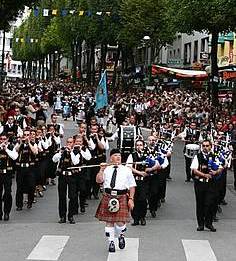
I spent last week in France, at a folk music festival in Brittany (physicists have a life too). Originally a piping festival, the annual Festival Interceltique de Lorient is probably the largest celtic music festival in the world, with parades, concerts and performances from pipe bands, music groups, dance troupes from all the great celtic nations.

Le grand defile, Dimanche

The sheer scale of the celtic world could be seen from the number of delegations – from Asturias (Spain), Galicia (Spain), Brittany (France), Cornwall (England), Scotland, Wales, Ireland, Acadia (Canada), Australia and the Isle of Man. There were concerts every day in the afternoons and evenings, not to mention the Nuit Magiques, chereographed performances on a giant scale in the local football stadium – some say the Lorient Nuit Magiques were the inspiration for Riverdance.

https://i0.wp.com/www.adelaidepipeband.com/images/photographs/lorient001.jpg

Nuit magique at the Stade Moustoir

Some the most enjoyabe events were the smaller gigs in venues representing each celtic nation, from virtuoso Acadian violinist Dominique Dupuy to the local Fest-Noz (you can get a flavour of the Dupuy gigs on youtube here).

Dominique Dupuy in action with her band in the Acadien tent

On top of all this, there were sessions in some of the local pubs, with Irish, Bretons and others swapping tunes into the early hours (where yours truly comes in). The sessions were a treat for any musician, with tunes in Quay St orThe galway Inn, not to mention monster sessions with performers fresh from their gigs at the Pub Glen late into the night. This was the best part for me, as I enjoy playing music with musicians from slightly different traditions. I think folk music has an edge over other types of music when it comes to this sort of jamming – and if there is one thing better than a lively Irish session, it’s a session where there is a mix of cultures and traditions. Also, it’s very moving to hear a tune/song you’ve known your whole life played in a more minor, modal key – an older, deeper version that makes your version seem like a pale modern echo. (It’s less moving if some idiot is playing it on the bombard at 10 o’clock in the morning).

Fast tunes and sad songs with Brian Comb in Quay St

Yours truly has the last tune in the Pub Glen.Thanks to Gerard for the photos -you can see the full collection here

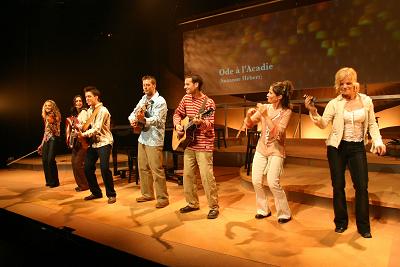
Early on in the week, a few of us were lucky to have a quiet afternoon session with some French Canadian musicians. It was only later we realised they were members of distinguished Acadien band Ode a l’Acadie. Sadly, accordion player Isobel Thierault seriously injured her foot the very next evening so didn’t see much of them for the rest of the week, although they gave a great concert at the Grand Theatre. You can find out more from the Ode a l’Acadie website and download clips of the band

Ode a l’Acadie

Overall, this is a great international music festival – a feeling of an inheritance that is shared, yet different. I’m constantly amazed at the sheer diversity of European culture and its effect on the world…there’s a nice discussion of this on the festival website.

What a great week…and nobody mentioned the problem of the cosmological constant once.

10 Comments

Filed under Uncategorized

Cambridge conference review

On the flight home, I spent some time reflecting on what made the Faraday Institute conference such an enjoyable and educational experience. I think the central point is that in the attempt to investigate whether modern scientific findings are consistent with a religious worldview (or not), theologians and theistic philosophers focus on the interesting findings science has thrown up – more so than many philosophers of science, who seem to spend a lot of time philosophizing about the scientific method and how much we really know, and not enough time trying of making sense of the strange science that we do already ‘know’. (This is the point I’m trying to make in my article on the theology of the Big Bang in this month’s issue of Physics World).

Other more practical reasons for the success of the conference were

1. Fantastic environment – hard to beat Cambridge on this, particularly when everyone is staying in the same college
2. Interdisciplinary nature- since the subject matter spanned science, history of science, philosophy and theology, none of the talks were too specialised – the bugbear of most scientific conferences
3. All the talks were by world class people, well used to giving public talks on their subject – a treat for anyone interested in the communication of science.
4. Each speaker kept good time, leaving 30 minutes of question/answer session after each talk. Ths definitely made for good audience participation, not to mention the panel discussion every evening.
5. All the talks were in the same venue, a nice small conference room, holding about 50.
6. No parallel sessions – since everyone was at the same talk, it made for great discussions over dinner.
7.Good panel discussions every day, after dinner

St Edmund’s college, Cambridge

Coffee-time outside the conference room

L-R: Cosmologist Paul Shellard, particle physicist John Polkinghorne, philosopher Dean Zimmerman and theologian and physicist Rodney Holder responding to questions during a panel discussion

In summary, I’ve decided the best type of conference is a small, residential conference of an interdisciplinary nature! (It helps if it’s in Cambridge – Ed)

Update: apologies to Christoffer, I haven’t figured out how to upload all the photos onto one webpage yet

8 Comments

Filed under Uncategorized

Last day at Cambridge

There were no lectures on departure day, so a few of us went into town. We had already been on a tour of the Cambridge colleges organised by the Faraday Institute (see post below), so now it was time for some shopping! First stop was Cambridge University Press – awesome, what a selection. I finally chose three (Speakable and Unspeakable in Quantum Mechanics by John Bell, A Mathematician’s Apology by Hardy, and Life’s Solution: Inevitable Humans in a Lonely Universe by Simon Conway Morris), only to find I’d left my wallet in college.

Ah well. I was pleased to notice quite a few of the conference speakers represented in that one shop (Conway Morris, Polkinghorne, Harrison), it says a lot about the level of the conference. Further down the street, I came across the new Hawking book on relativity. It’s basically a collection of Einstein’s essays on relativity for a general audience, with a foreword to each by Hawking. I read Hawking’s introduction to the subject in the shop, it’s excellent (although I didn’t see a reference to Galilean relativity)..another must-have.

Incidentally, we nearly bumped into Hawking one evening in town. We were coming around the corner of Gonville and Caius (his college) on our way for a drink in the famous Eagle (the pub where they first announced DNA), when who should be emerge from the college but SH! As it happens, one of us was in a wheelchair (hope the leg’s better soon Hannah!) and I fancy Hawking shot her a sympathetic look as his people were bundling him into a large car…

Comments Off on Last day at Cambridge

Filed under Uncategorized

Day 5 Cambridge: neuroscience

Friday started with the talk ‘Brains and Machines’, by distinguished neurobiologist Peter Clarke of the University of Lausanne. Peter started by outlining the history of the idea of the brain as a neuronal machine (Democrates, Descartes, La Mettrie, d’Holbach etc). Making the point that brain activity seems to underlie all our conscious experience, he went on to describe the effects of recent brain stimulation experiments. This was followed by a discussion of the implications for free will, the soul, religious faith etc.
Prof Clarke expanded on this theme in the second talk,‘Genetics, brain plasticity and personhood’. Emphasizing recent evidence of the effects of damage to the prefrontal lobes, he explored whether we are responsible for our immoral behaviour or simply the victims of inadequate brains. The discussion made reference to the astonishing case of a teacher found guilty of sexual deviation (possession of child pornography, intereference with a young child etc), who was observed to have a serious tumour in his frontal lobes. After succcessful treatment he returned to normal behaviour – only for the tumour to later grow back, accompanied by a recurrance of deviant behaviour …
There was also a discussion as to whether criminality and violence are genetically programmed or arise from environment, in the light of recent evidence (conclusion – mixture of both). This was a terrific lecture, which I think will be downloadable from the Faraday Institute website in a few days..

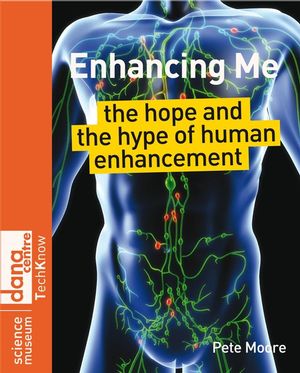
Peter’s talk was followed by a talk on brain enhancement by Pete Moore, the well-known science writer. Pete’s talk concerned the possibility of building an artificial brain by the process of scanning a human brain into a computer, storing all the information…and then allowing it to carry on as normal, including the interaction with other ‘uploaded brains! The aim here would presumably be that one could live forever through the computer. Pretty futuristic stuff – I didn’t really get a clear of the process, or the program that would run such a brain, but it was an intruiging talk. Peter has a recent book on the subject called ‘Enhancing Me’ published by Wiley; you can see a you_tube clip on it here

The last talk of the conference was by Alan Torrance, Professor of systematic theology at the University of St Andrews. Titled ‘Theological and philosophical perspectives on recent developments in neurosceince’, this was a rather more serious affair, with a full discussion of physicalism, dualism and pluralism. I won’t attempt to summarize it (way beyond my knowledge of philosophy), but I think there will be a recording on the Faraday website soon.

The conference wrapped up with a formal drinks and dinner, in the best Cambridge style. It turns out Prof Torrance is also a very good violinist (ex-Scottish Chamber Orchestra) as is his son, a promising soloist, so we had a great discussion about music afterwards. ..

All in all it was a most enjoyable conference….I’m trying to put together a slideshow of photos of speakers and delegates, along with a good snapshots of Cambridge…many thanks to Christoff S hope you got hope safely!

Comments Off on Day 5 Cambridge: neuroscience

Filed under Uncategorized

Day 4 Cambridge: biology

Today was biology day, and it got off to a cracking start with a talk by world-famous paleontologist Simon Conway Morris. In his talk ‘Evolution and Fine-Tuning in Biology’, Simon concentrated on the phenomenon of convergence – the word used by biologists to describe the fact that some things such as the E-coli motor and the camera eye have evolved not once, but several times, by independent paths from different starting points. In fact, Simon has just a published a well-known book on this topic.

This was an astonishing talk for many of us, backed up by irrefutable evidence. The conclusion that biology is far more organized than we suppose seemed inescapable (nothing to do with intelligent design, which Simon strongly criticized in discussion time). Over dinner, I asked him the obvious question from physics – surely nature normally proceeds along the pathway of least energy? His patient answer was ‘Yes, she does indeed, but the starting point was different in each case’. Doh!

Later in the day, we had two interesting talks on evolution, creationism and intelligent design by Prof Darrel Falk. Apparently, there are 100 million evangelical Christains in the U.S., only 28% of whom believe in evolution at all and less than 6% of whom accept natural selection. Prof Falk spoke of the effort to ‘convince from the inside’ – i.e. the challenge for a thinking theoligian or religious biologist to convince the right wing evangelical community that evolution by natural selection is not incompatible with scripture or their beliefs.

Prof Falk spoke eloquently of the importance of ‘reconciliation’ – the alternative being the outright rejection of evolution by that whole community. Like most theists and atheists, he is convinced that if such a community rejects one aspect of science it is a short step away from rejecting all of it , a very frightening prospect in the context of right-wing U.S. politics (think global warming etc). The talk finished with a very nice discussion of the importance of a basic science education for all…

The day finished with a talk by renowned biblical scholar Ernest Lucas.The main point of this talk, from an expert fluent in Sanskrit, Hebrew, Greek and heaven knows what else, was the desperate fallibility of a literal interpretation of Genesis. Should be compulsory viewing for evey creationist if you ask me…

Apologies to Jim Clarage below, I hadn’t realised the videos weren’t on the Faraday Institute website yet. They should be up in the next few days…

2 Comments

Filed under Uncategorized

Day 3 Cambridge: cosmology

This morning started with a talk by Katherine Blundell ‘God and the Big Bang’. Katherine is a Professor of Astrophysics at Oxford and this was definitely an astrophysicist’s view of cosmology, with plenty of shots from the Hubble space telescope and much emphasis on the sheer scale of distance and time of the universe. She gave a brief introductory overview of the evidence for the BB, from Hubble’s Law to the cosmic microwave background, before going on the philosophical side of things.
In the second part, Prof Blundell gave a wonderful defence of the scientific method in the context of the criticisms of the creationist Ham, explaining how truth will eventually out in a community bent on proving each other wrong! However, she then drew an analogy between scientific investigation and interpretation of scripture which I for one found a bit unconvincing…

Interestingly, Katherine seemed quite skeptical about Dark Matter and quite taken with MOND as an alternative (see post on DM last month). I was quite surprised at this as I have always understood the MOND gang to be very much in the minority. Plus, I think many physicists are excited by last year’s ‘galaxy collision’ evidence for DM, while MOND has received a few setbacks in recent years..

Katherine’s talk was succeeded by a full knobs-on review of modern cosmology, inflation and the multiverse by Prof Paul Shellard , a colleague of Stephen Hawking at DAMTP, Cambridge. This was a joy for the physicists, a spectacular overview of today’s cosmology with a thorough review of inflation, eternal inflation, the multiverse and the landscape. Shellard went through the WMAP evidence, explaining that the evidence for some sort of inflation was very strong, but the mechanism under-determined (his word, glorious understatement -he showed a hilarious slide listing all possible flavours of inflation)…

Shellard’s discussion of eternal inflation and the multiverse was thorough but accessible, with emphasis on the viewpoint that this may be the price we have to pay for the success of inflation (in explaining the standard BB riddles), yet emphasising also the speculative nature of the multiverse idea…

Inhomogenieties in the cosmic microwave background (WMAP)

If this weren’t enough, the high point of the day for many was ‘Meta-stories of Fine-tuning ‘ by Sir John Polkinghorne. In typical fashion, Sir John gave a succinct overview of the fine-tuning problem from a philosophical viewpoint. In particular, he focused on a choice between the multiverse explanation and the anthropic principle from a philosophical perspective. He was clearly unimpressed with the theory of the multiverse, describing it as meta-physics and probably contrary to the principle of Occam’s razor. Calling on Leslie’s famous example of the firing squad, he suggested that it was a little excessive to suggest that the firing squad engaged in a gigantic number of shootings in order to explain a miss – suggesting that it was more likely that they simply missed by design…

He was also unimpressed with a third possibility (from me) that an unlikely outcome – however unlikely – can simply occur without the need for an explanation. I can’t do justice to John’s persuasive arguments here, but you can get his views on this, and other subjects on the Polkinghorne webpage

Peter Woit of NOT EVEN WRONG would be pleased to note that, along the way, Sir John gave a very terse overview of the opinion of his generation of particle physicists of string theory – not very high!

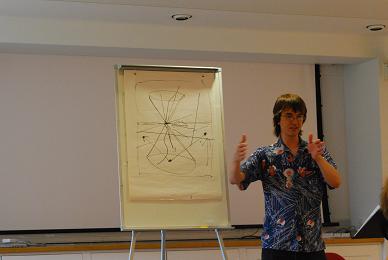
The day finished with a talk on time by the brilliant philosopher Dean Zimmerman, Professor of Systematic Philosophy at Notre Dame. Dean spoke of his A-theory of time, a theory in which the ‘priviliged present’ has  special properties over other tenses, and his work to reconcile it with the special and general theories of relativity. I’m not sure how much I really understood, but it was great to get a glimpse of how modern philosophy is reasoned out in the context of modern physics. Afterwards, it struck me that if he overcomes the apparent conflict with relativity, Dean’s A-theory might have some useful insights to offer concerning the ‘arrow of time’ problem in physics.

Dean in full flight – note the SR cone on the chart!

5 Comments

Filed under Uncategorized