Nobel and DIAS

It’s not every day one finds a connection between a physics Institute in Ireland and the current Noble prize in physics.

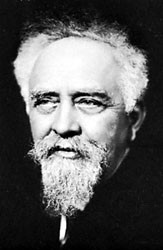
I was delighted to see this year’s Nobel go for gauge symmetry (see post below), not only because it gives recognition to a difficult field that has been so important in the evolution of modern particle physics, but because it is exactly the field Lochlainn used to work in. It was also great to see the prize going to three Japanese physicists (Nambu, Kobayashi and Maskawa) as the contribution of the Japanese to gauge theory has been overlooked in the past (it was not realised until recently that gauge theory developed independently in Japan around the same time as its emergence in the west, see here for a reference ).

Kobayashi, Maskawa and Nambu

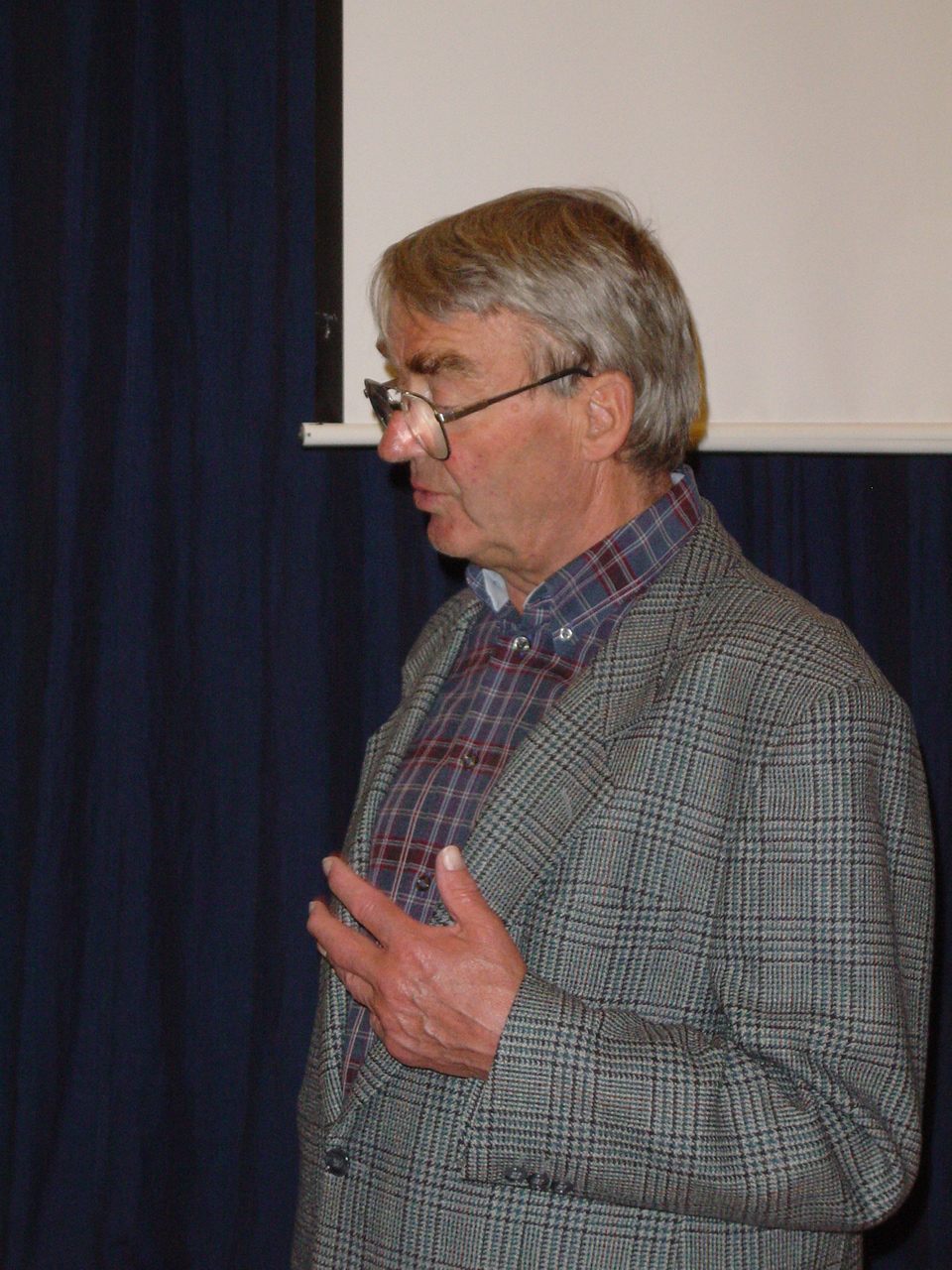
What I didn’t know is that there is a connection – one of the last scholars to work with Dad at the Dublin Institute of Advanced Studies (DIAS) was the brilliant young physicist Izumi Tsutsui, now at KEK (the Japanese CERN), and a colleague of Maskawa. In fact, Izumi was appointed Professor at Tokyo University by Maskawa directly after his stint at DIAS, which gives us a hint that the quality of work at DIAS can’t be too bad. Since then, they have collaborated extensively. It’s lucky Izumi isn’t the type to rest on his laurels…

Izumi Tsutsui: youngets professor in Tokyo U?

Emcouraged by all this, I had a look to see if I could find any Maskawa-Kobayashi-O’Raifeartaigh papers on the web. I couldn’t, but the very first hit on google is a recent paper by Kobayashi that heavily cites the O’Raifeartaigh model. It’s a small world, especially in high energy physics! Who knows, maybe supersmmetry will actually be seen at the LHC, in which case those of us who can’t really understand Lochlainn’s work will at least be able to appreciate its importance….

Correction; Oops, my mistake. Izumi tells me that the author of the paper is a different Kobayashi, a common name in Japan! Still, the DIAS connection with Maskawa via Izumi still stands, and we in Ireland should be proud of this association..

Comments Off on Nobel and DIAS

Filed under Uncategorized

Nobel for symmetry breaking

Great news for particle physics –  the 2008 Nobel Prize in Physics has been awarded for hidden gauge symmetry.

This year’s prize has been awarded to three particle theorists – one half to Yoichiro Nambu“for the discovery of the mechanism of spontaneous broken symmetry in subatomic physics”, and the other half to Makoto Kobayashi and Toshihide Maskawa “for the discovery of the origin of the broken symmetry which predicts the existence of at least three families of quarks in nature”

While I was betting on a prize for neutrino oscillation (experimental), most would agree that the Nambu prize is long overdue. He was the first to introduce the concept of spontaneous symmetry breaking to particle physics, having studied the phenomenon in superconductivity. The idea caught hold rapidly and was a seminal step in the construction of the Standard Model of particle physics (for example, symmetry breaking is an integral part of the theory of the electro-weak interaction, and the process by which particles acquire mass via the Higgs field is thought to be an example of symmetry breaking).

There’s more: among theoreticians, Nambu is most revered for his discovery of the gauge theory of the strong interaction  – in other words as the grandfather of quantum chromodynamics. And if that weren’t enough, he is also a godfather of string theory, so some may see this prize as a nod towards string theory.

Nambu: pioneer of gauge symmetry, QCD and string theory

Spontaneous symmetry breaking : symmetry is broken as the ball rolls down the hill

I know less about the others, but Kobayashi and Maskawa developed the mechanism of CP violation in the weak force, and how CP violation is reflected in the interactions of quarks – this work led to the prediction of  three generations of quarks (the last of the 3rd generation of quarks was found in the 1990s).  CP violation is crucial to our understanding of the asymmetry of matter and antimatter, and was experimentally demonstrated in some famous k -meson experiments in the 1960s (more recent experiments at the BaBar detector at Stanford and the Belle detector at KEK in Japan have also demonstrated CP violation). Next year, matter/antimatter asymmetry and CP violation and will be examined in further detail at the LHCb experiment.

You can find more details and the official announcement on the Nobel site here.

All in all, a good day for particle physics, as spontaneous symmetry breaking is a crucial component of the modern theory of elementary particles. I do have my reservations about Nobel prizes in general, but I’ll leave that discussion for another day..

Postscript

A couple of people hinted darkly at political timing over lunch – is it a coincidence that the prize should be awarded to particle physics in this year, the year of the LHC?

I think it is, and even if not so what. The prize is decades overdue, in all three cases. The importance of hidden gauge symmetry in particle physics may not be as obvious as the latest measurements of the Cosmic Microwave Background (say), but it is a vital piece of our understanding of the subatomic world. Plus, the relevant experiments have been done decades ago.

P.P.S.

For a more technical discussion of the issues above, see today’s postings on blogs such as Symmetry Factor and Not Even Wrong.  An important point being made is that the third (and original) physicist of the Cabibbo-Kobayashi-Maskawa matrix was overlooked – Cabibbo is yet another victim of the silly Nobel rule that the prize can only be awarded to three. This is also true of Goldstone, a gauge theorist who even has a famous particle named after him- in an ideal world one Nobel prize should go to Nambu and Goldstone, and another to C,K and W. There is a good discussion of this on T. Dorigo’s blog  A Quantum Diaries Survivor

Comments Off on Nobel for symmetry breaking

Filed under Uncategorized

100 years of atoms

Quite a few people have pointed out that this month marks the hundreth anniversary of Minkowski space-time (see Backreaction for a good post on this). However, another anniversary occurs this year that has received less attention although it is highly relevant to the LHC.

2008 marks the centenary of the experimental discovery of atoms i.e. Perrin’s seminal work on Brownian motion. This series of experiments verified Einstein’s conjecture that the presence of molecules in a liquid could be demonstrated by a careful study of the ‘random’ motion of small particles suspended in the liquid. Up to this point, many scientists still doubted the reality of atoms, despite pointers from the kinetic behaviour of gases and Dalton’s work in chemical reactions. Einstein’s statistical analysis of the expected ‘random walk’ of suspended particles (1905) coupled with Perrin’s subsequent experiments (1908) effectively settled the debate in favour of the reality of atoms – a seminal moment in science which also pointed to the role of probability in the laws of physics for the first time (since it was realised that the laws of thermodynamics describe large assemblies of molecles and are therefore statistical in nature).

Einstein, Perrin and Brownian motion: settled the atomic debate

Settled the issue for scientists, I should say: to this day, one comes across philosophers who write that ‘no-one has seen an atom’. I find this a bit of a stretch – there are lots of things in nature we observe indirectly. Besides, this viewpoint ignores the advent of technologies such as Scanning Tunneling Microscopy, Atomic Force Microscopy and modern experiments with single atoms!

Below is an extract from an article on Brownian motion I wrote for Spin Science magazine during Einstein year:

******************************************************

….Einstein and the Atomic Theory

Greatly interested in the atomic view of matter, the young Einstein devised a mathematical method of calculating the size of atoms and molecules in early 1905. From an analysis of sugar molecules dissolved in water, he calculated both the diameter of the sugar molecule and Avogadro’s number (the number of molecules per unit volume under standard conditions) from the known viscosity of the liquid and the diffusion rate of sugar. His calculations were in good agreement with previous theoretical estimates and were well-received. However, the very existence of atoms and molecules had still to be demonstrated in convincing fashion, and the 26-year old Einstein applied himself to this task.

Einstein and Statistics

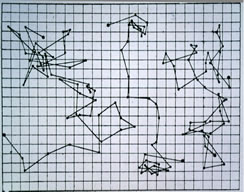
According to the atomic view of matter, a liquid is made up of a huge number of molecules in random, ceaseless motion, the properties of the liquid arising from the average behaviour of its constituent molecules. Working from first principles, Einstein made a careful study of the statistics of such an assembly and, in May 1905, he made a key proposal concerning its behaviour. He proposed that any such system would experience statistical fluctuations, during which random elements depart from their average behaviour (just as a dice player can occasionally throw several sixes in a row). Applying this concept of statistical fluctuation to the case of molecules in liquids, Einstein proposed that a small group of neighbouring molecules could momentarily move in the same direction – a fluctuation that would cause a body immersed in the liquid to experience a tiny push in that direction. Another group of molecules could cause the same body to experience a tiny push in a different direction moments later and the immersed body would therefore experience a zigzag motion in the liquid – a motion that might be observable. Hence, while the molecules of a liquid were far too small to be observed directly by microscope, their motion might be detectable by its effect on a larger particle suspended in the liquid!

Brownian Motion

Excitingly, a zigzag motion of particles suspended in a liquid had long been known to scientists (named ‘Brownian Motion’ after the English botanist who studied the effect in detail). The cause of this motion had been a great mystery – and accurate measurement of the 3-D random motion of an immersed particle had proved extremely difficult. Here, Einstein made a second vital contribution. Starting with the assumption that the motion was indeed due to a buffeting of the immersed particle by the molecules of the liquid, he calculated the average horizontal distance an immersed particle would travel in a given time. Hence, from his own statistical analysis, Einstein delivered a well-defined, measurable estimate that could be easily tested by experimentalists.

The Experiment

The French scientist Jean Perrin rose to Einstein’s challenge with a series of experiments in 1908. Equipped with nothing but a microscope and a stopwatch, Perrin and his team measured the horizontal displacement of gum extract particles suspended in water as a function of time. The data were in exact accord with Einstein’s predictions, giving the world the first unequivocal evidence of the reality of molecules. Einstein was delighted, as was Perrin – the Frenchman was later awarded the Nobel Prize for this work!

Implications

Einstein’s ‘Brownian-motion’ paper facilitated the first real glimpse of the atomic nature of matter, an advance that underpins almost all of modern science. Another consequence of the paper was that, since the properties of matter were now known to be determined by the behaviour of huge numbers of atoms, it was realized that the laws of thermodynamics were valid only in a statistical sense. For the first time, the role of probability in the laws of physics was established, a defining moment in the philosophy of science.

Modern Applications

Today, Einstein’s notion of statistical fluctuations has found application throughout the sciences. From the study of cell membranes to our view of evolution, from the analysis of weather systems to the study of the stock market, it underpins our understanding of all complex systems. Perhaps the ‘Brownian–motion’ paper did not have quite the dramatic impact of the Special Theory of Relativity, or indeed of Einstein’s quantum view of light – but it resulted in a quiet revolution that has had an lasting influence on modern science.

10 Comments

Filed under Uncategorized

LHCb, UCD physics and the last symmetry

This weekend I was back at my Alma Mater, the UCD school of physics, for a conference for physics teachers organised by the Institute of Physics.

I arrived late and sneaked into the back row of Theatre E of the UCD science block, just as I used to all those years ago. Such a strange feeling to be back in that same seat in that same lecture hall (one difference is that the grounds of the college are beautiful now). The feeling increased when I was joined by two of my former professors, the best teachers I ever had; Alex Montwill (who taught courses in formal quantum theory and high energy physics) and Ann Breslin (special relativity and experimental high-energy physics). Alex was Ireland’s foremost experimental particle physicist for many years, but is probably best remembered for a well-known series of public lectures on modern physics on national radio.

There were some very nice talks, including one on the discovery of The Antikythera Mechanism by Mike Edmunds of Cardiff University and one on the work of the UCD high-energy astrophysics group by John Quinn. However, I was mainly there to hear Ronan McNulty, the leader of the new experimental particle physics group at UCD (UCD has always been strong in fundamental areas of physics such as astrophysics and particle physics). Ronan’s group has been involved with the DØ experiment at the Tevatron, the L3 experiment at LEP and now with the LHCb detector at the LHC (they got some nice attention recently when they were one of the few groups able to report some preliminary measurements from the September switch-on). The work of the group is very important not just because of its fundamental nature, but because it is the only group in the Republic of Ireland that has an official involvement with the LHC (thanks to our non-membership of CERN, see post below). I’m sure Alex and Ann are very proud to see this large and very successful experimental particle physics group at UCD as they themselves had a successful particle physics group at UCD many years ago, measuring particle tracks in emulsions sent over from CERN (I did my final-year project with their research group, estimating the mass of the muon from pion decay tracks).

Ronan gave a superb talk, ranging from a basic introducton to particle physics up to the search for asymmetry in matter/antimatter decay and their contribution to the VELO detector of the LHCb experiment – all within the paltry 20 minutes he was allotted on the program. You can find the slides from the talk here. At question time, I asked him his view of the likelihood of seeing supersymmetry at the LHC: like many experimentalists, he seemed pretty sceptical, pointing out that there has been absolutely no hint of supersymmetric particles up until now.

At lunchtime, we all had a great chat, ranging from supersymmetry to ‘progressive’ ideas in university administration, to Ireland’s continued non-membership of CERN. It’s always great to catch up with the people who taught you and to hear their perspective on things as an adult. I particularly enjoy talking to Alex and Ann as they are among the very few people who understand Lochlainn’s work in gauge symmetry and the impact it had at the time. Re CERN, it seems negotiations on the issue are continuing…

In other news, although they are now officially retired, Alex and Ann have just written a book (real academics don’t do retirement): Let there be lightis due to be published by Imperial next month. I got a sneak preview and it looks superb, as you might expect of the culmination of a lifetime’s reflection on physics by two highly respected physicists. The book is pitched at a level somewhere between undergraduate and the layman and is an introduction to pretty much all of modern physics from the perspective of the study of the nature of light – from optics to wave theory, from wave/particle duality to light quanta, from electromagnetism and light to special relativity, etc. The book will be officially launched at UCD next month, so I’ll discuss it in detail then.

************************************

Postscript

Supersymmetry has been in my mind all day today, sparked by a comment Ronan made yesterday. He mentioned that as he understands it, one of the reasons mathematicians are keen on SUSY is that it’s the last remaining symmetry under the Poincare symmetry group. I think that’s right and in fact I once heard Julius Wess comment that he sometimes wished he had used the term ‘ultimate gauge symmetry’ in the original paper (he made the comment at a Memorial Syposium two years ago). Sadly, Julius, one of the last of the supersymmetry pioneers, passed away himself last year.

Julis Wess of the Wess-Zumino model of supersymmetry.

All day I’ve been thinking thatThe Last Symmetry would be a great title for a popular book on particle physics, if supersymmetric particles do turn up – possibly a better title than The Story of Atoms . Either way, I didn’t do too much work on my imaginary book over the summer, must get back to it. On the subject of language, I also wonder about the term super-matter…I’ve never heard the term but it’s a nice word and immediately hints at an analogy with antimatter (if SUSY does exist, it must involve a broken symmetry, just like matter/antimatter decay).

As to whether SUSY really exists, a philosophical point has also been on my mind – as far as I know, there is no path to a unified field theory of the interactions without some sort of symmetry betweenfermions (leptons and quarks, the constituents of matter) and bosons (the force carriers). In the 1960s, the unification program ran into a formidable mathematical wall with the emergence of a series of no-go theorems (McGlynn, O’Raifeartaigh, Coleman and Mandula) that showed that the strong interaction could not be incorporated into a single scheme with the other interactions using the methods that had been so successful in electro-weak theory. Mathematicians were hugely relieved when SUSY, a radical new symmetry between the two most fundamental classes of particles, suggested a possible way around the problem and even hinted at the inclusion of gravity. Without some form of SUSY, it’s not clear whether unification can happen, and without unification, the picture of a single ‘superforce’ in the early universe condensing out into the fundamental interactions we see today can’t happen – a major blow for cosmology as well as for particle physics. So I like to think that either we will see SUSY sometime, or if we don’t, we haven’t got our predictions right because we simply haven’t developed the right model of supersymmetry breaking yet…

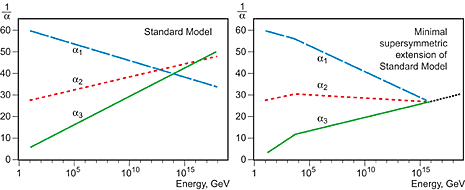
Also, there is one famous mathematical clue. When theoreticians plot the magnitude of the coupling constants of the three strongest fundamental interactions as a function of energy, they converge – but not to a single point. That is, unless SUSY is included in the calculation – in which case they converge very nicely. Hmm…

PPS: . Last week was the hundreth anniversary of Minkowski space-time. I completely forgot about this, but Stefan and Bee have a great post on it on Backreaction

2 Comments

Filed under Institute of Physics

LHC: Hawking v Higgs

As you may have heard, the LHC at CERN has had a technical setback (see here and here). It will take several months to fix, so it’s a good time to do a post on a matter I’ve been meaning to discuss…

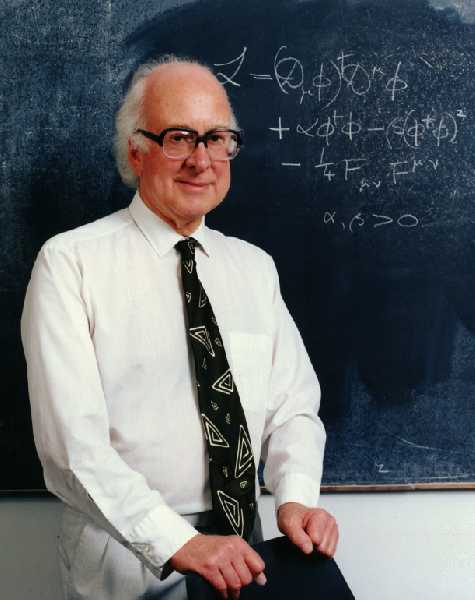
An unexpected aspect of the media coverage of the LHC startup was a public disagreement between two world-famous physicists: cosmologist Stephen Hawking and particle physicist Peter Higgs (the latter first postulated the existence of the Higgs field and the famous Higgs boson).

Stephen Hawking and Peter Higgs: disagree on existence of the Higgs boson

Hawking has renewed his bet of 100$ that the Higgs boson will not be found at the LHC, making the point that it will make for more interesting physics if it isn’t. (The Higgs boson is the one particle of the Standard Model of particle physics that has not ben detected experimentally, and it is is crucial to the theory (see post below) – any evidence that it doesn’t exist at the energies expected would force a radical think of the Standard Model

Not for the first time, Peter Higgs has not responded kindly to Steven Hawking’s remarks, stating that he feels that the Hawking analysis is seriously flawed…this story got great coverage in the press, and you can read the view of physicists on it about it here and here.

I suspect there is more to this story than meets the eye: Peter Higgs is an extremely quiet, self-effacing scientist, long retired, who rarely comments on physics in public or seeks the limelight. His reaction to Hawking’s bet is not attention-seeking, but represents the view of the particle physics community (I have often heard similar views expressed by particle physicists I know). After all, one of the  major reasons for building the LHC in the first place is precisely the detection of the Higgs particle –  in other words, most particle physicists expect it to show up at the energies available.

It’s worth remembering that theoretical particle physics is a very special branch of physics. Concerned primarily with the worlds of quantum physics (because particles are so small) and that of special relativity (because small particles can travel at relativistic speed), it has traditionally been considered to be the most difficult, abtruse and mathematical area of all of physics. Cosmology, by contrast, was considered a fairly speculative science until the 1970s. It’s only in recent years that cosmology has started to attract great theoreticians such as Roger Penrose and Stephen Hawking. However, although Hawking is highly respected as a cosmologist (and as a great populariser of science), he frequently comments on fields far from his area of expertise  – notably on particle physics. It’s unfortunate, as he occasionally makes fairly outlandish statements that really irritate the particle physicists.

Thousands of particles explode from the collision point of two gold ions in the STAR detector of the Relativistic Heavy Ion Collider. Electrically charged particles are discernible by the curves they trace in the detector’s magnetic field.

That said, in the same statement it’s interesting that Hawking says that he thinks there is a good chance that supersymmetry (see post below) might be seen at the LHC – which is nice to hear. Generally, evidence for supersymmetry is expected to be more elusive than evidence for the Higgs – but if found, SUSY will open up a whole new vista in particle physics (while evidence for the Higgs will close a chapter). Hence, I for one suspect Hawking’s bet on the Higgs was taken with tongue firmly in cheek.

Update: there is a very nice (and rare) interview with Peter Higgs in last week’s issue of New Scientist. In the interview, Higgs hints that, as a new generation of mathematicians turned their attention to the Higgs field in the 1970s, he began to feel a little out of his mathematical depth. He turned to the emerging field of supersymmetry, but soon ran into the same problem. Intruiging that even the best minds could have problems with the maths of particle physics!

5 Comments

Filed under Particle physics

LHC: unplugged

Tomorrow should be interesting as I’ve been asked to give an informal talk on the LHC to our physics staff and students. I’m looking forward to it as the only rule is no powerpoint, just whiteboard and marker, i.e. unplugged. I’ve been thinking about how to give such a talk for all levels, I’ll think I’ll break it up as

1 WHAT

Particle colliders, new LHC vs old LEP, energy achievable etc.

Reason for vacuum (UHV), reason for low tempT, physics of focusing etc

Description of detectors

2. WHY

Creation of exotic particles (E = mc2), study of fundamental particles

Study of fundamental interactions and  unified field theory

Cosmology: glimpse of early universe, info on matter/antimatter asymmetry, info on dark matter

3. A BRIEF HISTORY OF PARTICLE PHYSICS

The proton and the periodic table

The nuclear model of the atom

The particle zoo and the quark model

Six quarks and six leptons

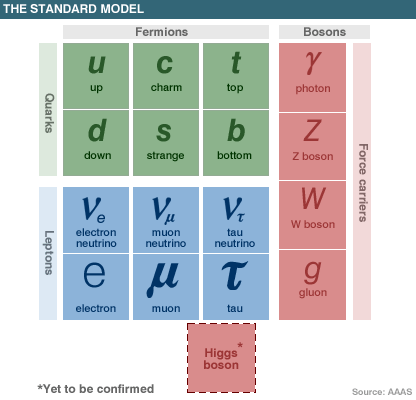
The Standard Model: fermions and bosons, E-W theory, QCD, the Higgs boson

4. LHC EXPECTATIONS: STANDARD MODEL

Higgs boson, explanation for mass, explanation for matter/antimatter asymmetry

5. MORE THEORY: BEYOND the STANDARD MODEL

Grand Unified Theories

Theories of Everything

Supersymmetry: SUSY breaking, SUSY particles: which model of SUSY?

Neutralinos: candidates for dark matter?

6. LHC EXPECTATIONS: BEYOND the STANDARD MODEL

SUSY particles

Neutralinos

WIMPs

7. SUMMARY

HIGGS: could close chapter on Standard Model

SUSY: could open new chapter in particle physics

SUSY: could explain dark matter

OTHER: extra dimensions? mini-black holes? other surprises? evidence for strings?

***************************************************************

Useful pics I might use are:

II The Standard Model

III. Unified Field Theory

Might finish with this great pic and text from the search for Higgs at FERMILAB

In the Standard Model of particles and forces, the masses of the W boson, the top quark and the Higgs boson are connected. If one knows the mass of any two of the three particles, then the mass of the third particle can be calculated. This plot illustrates that relationship. It depicts the mass of the Higgs boson as a function of top quark and W-boson mass. Each diagonal line represents a single Higgs boson mass; examples chosen are MH = 114, 300 and 1000 GeV/c2. Based on theoretical constraints and direct experimental searches, scientists expect the mass of the Higgs boson to lie somewhere in the green-banded region. The new CDF measurement of the W-boson mass (see this press release) indicates that the W-boson mass is heavier than previously measured (worldwide average). Since the top quark mass did not change, a heavier W-boson mass indicates a lighter Higgs Boson. The blue ellipse shows the most likely values for the top quark and W-boson masses, based on all available experimental information, including the CDF result, at the 68 percent confidence level. The intersection of this ellipse with the green band indicates the most likely Higgs boson mass. This result can be compared to an older result (red ellipse), which did little to constrain the Higgs boson mass. Credit: Fermi Lab

**************************************************

Update: Phew, that’s over. I now appreciate slides, powerpoint etc – definitely harder to keep the story linear on the blackboard. I went way overtime which is not like me. Still, it’s great to have an educated audience. Good questions afterwards – and nobody mentioned earth-eating Black Holes.

Now I’m off to the mountains of Mourne for a hill-walking weekend with GLENWALK, the well-known walking club with a  drinking problem…yipee

Update II: A few people have asked me for a hardcopy of the talk. I’ll try and knock something up and stick on the My Seminars page of the blog, but it’ll take some time as I used the whiteboard on the day. I’m giving a simpler talk on the same subject to schools on 12th october for Maths Week 2008, will definitely prepare a powerpoint presentation for that ..

3 Comments

Filed under Particle physics, Public lectures

Ireland, CERN and the LHC

There was more coverage of the opening of the LHC in the Irish media over the weekend. My favourite was Ross O’ Carroll Kelly’s piece on the end of the world in The Irish Times on Saturday.

(Three rugger buggers are cowering behind the sofa: “Any last wishes before they hit the button?” – “Yes, I wish I’d studied physics at UCD instead of Orts”).

R.O.C.K. I wish I’d studied physics at UCD instead of Orts

I personally think this sort of coverage gets science into public consciousness far better than any number of earnest articles and letters. More seriously, there was also an excellent article titled ‘Science fact of fiction’ in the same paper on the reporting of ‘nonscience’ such as earth-eating black holes.

Best of all, The Irish Times devoted their Saturday editorial to the LHC, describing the importance of the experiment and bemoaning the lack of participation of Irish scientists due to the fact that Ireland is not a member of CERN. On the same page, they also published a letter of mine on the same subject – not as good as getting an article published, but it’s not every day one’s letter coincides with the theme of the editorial..

Hopefully, all this coverage will help re-ingnite the debate on Irish membership of CERN once more.. .below is my letter

****************************************************

Madam, – The Irish Times has given exemplary coverage of recent events at Cern, The European Organisation for Nuclear Research, with comprehensive articles, cartoons and other pieces all helping to raise public awareness of this outstanding international scientific centre.

It is a proud moment for Europe, as the experiments at the new particle accelerator will be watched with intense interest by scientists the world over for information on the fundamental structure of matter, and on the evolution of the early universe.

However, as your Science Editor Dick Ahlstrom points out, the participation of Irish scientists in this historic research will be severely limited by the fact that the Republic, almost uniquely among western European nations, is not a member of Cern. This oversight has decimated Irish research in particle physics, despite a proud tradition in the field (Ireland’s only Nobel prize in science was awarded for the splitting of the atomic nucleus by Ernest Walton). More pragmatically, Irish high-tech companies are severely disadvantaged in bidding for the huge contracts available in engineering and information technology at Cern.

So much for our efforts to become a world leader in science and technology. – Yours, etc,

Dr CORMAC O’RAIFEARTAIGH,

Lecturer in Physics, Waterford Institute of Technology

*****************************************************

Update I: it looks like the editorial and my letter have sparked a debate on the topic, there are three letters on the subject in Tuesday’s Irish Times. One of them makes an interesting point:

Madam, – Both you and Dr Cormac O’Raifeartaigh (September 13th) have pointed out that Ireland, almost uniquely among European countries, is not a member of Cern. Surely the reason is simple: the presence of the dreaded word “nuclear” in the organisation’s title…

– Yours, etc,

DAVID SOWBY, Knocksinna Crescent, Dublin 18.

The point here is that Ireland is resolutely anti-nuclear (both power and weapons). Of course, it’s ironic if this is the problem – the name CERN is a misnomer, as it is the physics of elementary particles (not of the nucleus) that is studied at CERN. If you find David Sowby’s suggestion far-fetched consider another letter on the subject in the same paper:

Madam, – Unlike Dr Cormac O’Raifeartaigh (September 13th), I am not at all concerned that Ireland, “almost uniquely among western European nations”, did not pour millions of hard-earned taxpayers’ money into the Cern project.

Whenever I hear the words “nuclear research” other words, such as “Nagasaki” and “Chernobyl” spring to mind and I wish that Ernest Walton and his peers had not “split the atom”. I am sure that if “Irish high-tech companies” have the capability, they will not be “severely disadvantaged in bidding for huge contracts available in engineering and information technology” by our unwillingness to pour millions down the bottomless pit of Cern.

– Yours, etc,

W.J. MURPHY, Malahide, Co Dublin.

I rest my case – perhaps Irish scientists are paying a price for a famous misnomer!

Update II:

Two more letters on the subject in Wednesday’s Irish Times, both of them castigating W.J. Murphy above. Actually, I think they’re a little hard on him – how is Joe Public supposed to guess that the European Organization for Nuclear Research is not involved in nuclear power or weapons? In fairness, it’s a pretty miseading title…here is what one of them said

Madam, – W.J. Murphy (September 16th) says, in a parody of Goering’s remark about Kultur, “Whenever I hear the words ‘nuclear research’ other words, such as ‘Nagasaki’ and ‘Chernobyl’ spring to mind’.

This ridiculous statement demonstrates the widespread ignorance that exists about anything to do with nuclear matters. The words “nuclear research” in Cern’s title refer solely to man’s attempts to discover the basic nature of the matter of which everything in the universe is made. At Cern it has nothing to do with weapons or power.

The comment about Ernest Walton and his peers is merely petty and uneducated. – Yours, etc,

DAVID SOWBY, Knocksinna Crescent, Dublin 18.

True, but a bit harsh, in my opinion

Update III: More letters on the topic in Thursday’s Irish Times. The hapless W. J. Murphy responds to the criticism above by retracting and apologising for the ‘nuclear’ slur, but raises a more difficult issue:

Madam, – David Sowby and George Reynolds (September 17th) are understandably critical of my letter of the previous day, but this is based on a misunderstanding. That is probably my fault: in an attempt to be brief, I grossly over-simplified a complex argument. I would agree with both of their points.

I wonder if they would agree with my substantive point: that the immediate results of the Cern project would not justify the pouring of millions of hard-earned Irish taxpayers money into it and that Irish high-tech companies that have the capability to win contracts in engineering and information technology will not be disadvantaged by this?

I accept that the word “nuclear” means different things to different people. And I should not have referred to Ernest Walton, mea culpa. – Yours, etc,

W J MURPHY, Malahide, Co Dublin

This is the hard question of course: would this money be better spent elsewhere? My own view is that the annual fee (about 10 million) is smaller than some Science Foundation Ireland grants for domestic research – the difference is that CERN is truly world-class work. Just how much it costs to deprive our staff and students the opportunity to work at this level will probably never be known. (We do know for a fact that Irish high-tech companies are seriously disadvantaged in bidding for the most lucrative contracts due to our non-membership, Murphy is quite wrong on this).

Update IV: I have written a new letter to The Irish Times on the above points. They won’t print it, having closed the debate, thus leaving Murphy with the last (incorrect) word. Sigh. I suspect this is why most scientists choose not to get involved in public debate
7 Comments

Filed under CERN, Particle physics

LHC: D-day at last

So the big news: the first proton beam got all the way around the LHC ring this morning without mishap. Cue much celebration in the CERN control room and around the particle physics community.

There is a live webcast available on the CERN website, although some people are having problems viewing it due to the huge interest. There are also some great updates by physicists at the scene describing the day’s events on blogs such such as US LHC Blog, RESONAANCES, Charm&C, Higgs

The redoubtable Lubos Motl has a great discussion on his blog The Reference Frame explaining why he expects supersymmetry to be seen at the LHC, it’s a very nice piece

For more live postings describing the day’s events, see the list on the international particle physics website interactions.org , it’s almost as good as being there.

P.S. No earth-eating black hole so far…surprise surprise.

Update: the Science Gallery at Trinity College Dublin are celebrating with an open day on the topic, with live feeds, talks and commentary by physicists all day…well worth popping in

Update: a second success… a proton beam successfully completed the loop in the opposite direction in the afternoon, this is way ahead of schedule.

2 Comments

Filed under CERN, Particle physics

LHC: it’s not the end of the world

The world is not going to end tomorrow (September 10th) and the LHC startup does not constitute a danger to the public, contrary to claims by one or two scientists (non-physicists) that have been widely reported in the media (see here and here for example). Instead, tomorrow marks the beginning of an exciting new era in particle physics – the start of experiments at the world’s most powerful particle accelerator, the Large Hadron Collider at CERN.

Below is part of an article on the LHC that I wrote for an Irish newspaper (they may not use it, thanks to a large number of articles on the same topic by people who know little about the subject). The two main points I wanted to highlight were the safety of the experiment, and the fact that Ireland, almost uniquely among EU nations, is not a member of CERN – despite the fact that our only Nobel prize in science is in precisely this area.

*************************************************************

September 2008 marks an important month for European science. This month, measurements begin at the new “atom-smasher” at CERN, the European Organization for Nuclear Research. Long the jewel in the crown of European science, CERN truly becomes the NASA of the sub-atomic world with the opening of its Large Hadron Collider (LHC), the world’s newest and most powerful particle accelerator.

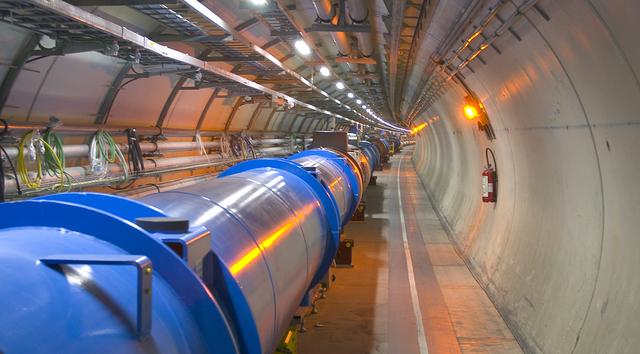
Situated in a vast 27 km-long tunnel deep beneath the Franco-Swiss border, the new machine at CERN is probably the largest scientific experiment on planet earth. The experiments at the facility will be watched with intense interest by scientists the world over for information on the fundamental structure of matter, and on the evolution of the early universe.

How does it work? Beams of the smallest particles of matter travelling almost at the speed of light will be smashed together in head-on collision. Out of the intense energy of collision, exotic short-lived elementary constituents of matter not seen since the Big Bang will be fleetingly created and tracked in giant particle detectors.

Such experiments offer not only a glimpse of the deep structure of matter, but also of the nature of the forces that hold it together. For example, evidence of the existence of the elusive Higgs boson or ‘God particle’ could offer support for the so-called Standard Model of particle physics, confirming that our view of the origin of mass is correct. Glimpses of exotic entities such as ‘supersymmetric’ particles could reveal deep connections between all the fundamental forces of nature. Other experiments might reveal the true nature of space and time.

Cosmologists hope that the experiments at CERN might offer insight into the formation of the early universe, as the giant collider will achieve energies not seen since the Big Bang. In particular, a glimpse of certain particles could shed light on the nature of Dark Matter, one of the great puzzles of the universe at large.

Is the LHC safe? This question has recently received much attention in the world’s media. In fact, the accelerator is simply a more powerful version of previous machines and constitutes no danger to the public. Rumours that it could create a giant earth-eating black hole arise from a misunderstanding of the physics of black holes (although there is an intriguing possibility that harmless mini-black holes could be created in the experiment).

The 27km tunnel at CERN: experiments will not destroy the earth

Such research into the realm of the sub-atomic might seem of dubious practical application in today’s world. However, the technical spin-offs of experiments at facilities such as CERN are legendary. In 1990, the world wide web was created by CERN physicist Tim Berners-Lee in order to provide a platform for scientists to share and analyse experimental data. Accelerator technology developed at CERN is now routinely used in important medical applications. Most recently, CERN scientists have pioneered the use of GRID computing, a new type of computing that involves the networking of thousands of computers, in order to facilitate the analysis of vast amounts of data that will be collected at the LHC.

CERN is regularly cited as an outstanding example of European collaboration. Created in the 1950s to counter the brain-drain of European scientists to the U.S., it now provides a world-class facility for the scientists of over 20 European nations, while a host of non-European nations such as China Japan, India, the U.S. and Russia all enjoy associate membership. In fact, there are more American particle physicists working at CERN today than in the U.S.

Europe has reason to be proud, but Ireland has not. The participation of Irish scientists in the historic experiments will be severely limited by the fact that the Republic, almost uniquely among EU nations, is not a member of CERN. This omission has decimated Irish research in experimental particle physics, one of the most fundamental fields of the sciences (with the honourable exception of one group at UCD). It has also rendered it almost impossible for Irish engineers and scientists to bid for the large international contracts in high-tech software and hardware projects, a fact that sits awkwardly with our efforts to become a world leader in science and technology.

Strangest of all, Ireland has a proud tradition in this field of science. In 1932, the Irish scientist Ernest Walton and his Cambridge colleague John Cockcroft built the world’s first particle accelerator and used it to split the atomic nucleus, an achievement for which they were awarded the Nobel prize. This work opened up the field of sub-atomic physics, and a version of their machine is used today as a preliminary accelerator in the new facility at CERN.
One wonders what Walton would have made of the Irish absence at CERN at this historic time…

**********************************************************************

P.S. Just about every physicist with a blog is writing about the CERN experiments this week, there is a good list of blogs on the topic on the particle physics website interactions.org


10 Comments

Filed under CERN, Particle physics

Hubble solution

There are some very interesting answers to the Hubble puzzle I posed below (see the comments section of the original post). Let’s review the question and then I’ll try a solution in simple language:

Hubble discovered that distant galaxies are moving away from us (or any other point) with a velocity that is proportional to their distance. The law arises from experimental observation and is usually written as

v = Hd

where v is the recessional velocity of a galaxy, d is the displacement of the galaxy from us and H is the Hubble ‘constant’, or the slope of the graph.

Every physicist reads this law as v1/d1 = v2/d2 =v3/d3 = H and it works fine. However, if we consider what Hubble’s Law says about any one particular galaxy, the equation clearly implies that the velocity v of a galaxy A (relative to some point) is proportional to its displacement d (relative to that point). But for non-zero velocity, the displacement d must be changing in time – therefore Hubble implies that the galaxy’s velocity is also changing in time – which is another way of saying that galaxy A is accelerating!

So there’s the puzzle: Doesn’t Hubble’s Law predict that distant galaxies are accelerating away from us? If so why all the fuss/surprise about the recently observed acceleration of the universe?

My solution (simple version): Yes, Hubble’s Law implies that distant galaxies are accelerating away from one another. However, this has nothing to do with the so-called acceleration of the universe. The latter term refers to the recent observation that the universe expansion seems to have speeded up (an acceleration of the acceleration if you like.)

My solution (more sophisticated version): if the solution above sounds a bit cumbersome, it’s because it should really be framed in terms of general relativity. Of course relativity affects the puzzle, contrary to what I said in the original post (teachers!). Relativity tells us that that the expansion of the universe is an expansion of space-time (or space expanding as time unfolds). Hence, the common ‘explosion-picture’ of galaxies rushing away from one fixed point is simply wrong. Instead, space itself is expanding and this expansion has a scale factor. The recent evidence of ‘acceleration’ simply suggests that the scale factor has increased in the last few million years. (This is a surprise because most cosmologists expected the expansion to slow down, if anything, due to gravitational effects). In this context, the idea of a non-constant scale factor is not so way out – for example, the theory of cosmic inflation posits that an exponential expansion of space occurred in the very early universe, before the expansion settled down to the scale factor we see today.

That’s my best explanation in simple language. For a slightly more technical explanation, see the comments by Chris Oakley and SomeRandomGuy in the original Hubble post. Chris, you have won the princely prize of a guest post – let me know when you read this!

7 Comments

Filed under Cosmology (general)