Standard Model at Trinity College

I gave an introductory talk on the Standard Model and the forthcoming LHC experiments to some physics students in Trinity College last night. There wasn’t a huge turnout, but it was great being back in the Schroedinger Theatre – lovely wooden theatre, steep tiered seating, buckets of atmosphere. All mod cons of course but also a good big old fashioned blackboard for back-of-the-envelope calculations to accompany the slides (you can get the slides here).

It was a real trip down memory lane – as a postgrad, I used to give quantum mechanics tutorials in the same theatre to 2nd year theoretical physics. I used to spend hours preparing answers to Denis Weaire’s problem sheets, only to find the students hadn’t opened a book!

Anyway, I think the lecture went well (I heard it was completely incomprehensible  – Ed). The best thing about it was the poster – students really know how to put a poster together.

glendagilson1

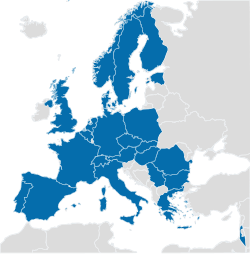
I also found time to point out that Ireland is not a member of CERN, almost uniquely in western Europe (see September posts on this). This denies our best students and researchers the opportunity to work with world-class researchers at a world-class facility – an omission that has had a devasting effect on experimental particle physics in Ireland. The map below says it all really.

The 20 member states of CERN (blue) do not include Ireland. Many non-European States have associate membership (U.S., China, India and Japan), but this does not include Ireland either.

1 Comment

Filed under Particle physics

Steady state theory back

I’m up to my tonsils in teaching this week, so no time for a proper post. However, over at Cosmic Variance there is a very interesting discussion of a recent paper by Geoffrey Burbridge on the Arkiv ;

A Realistic Cosmological Model Based on Observations and Some Theory Developed Over the Last 90 Years

Essentially, the author is defending the steady-state model of the universe (yes, he’s a member of the original Hoyle group). I wasn’t aware that anyone was still pushing this alternative to the Big Bang, I thought everyone had accepted the evidence was overwhelming. Sean Carroll has a very nice discussion of this point, i.e. the difficulty of ever settling a scientific dabate to everyone’s satisfaction. Every reader of this blog should read it carefully.

P.S. The basic idea of the steady-state model is that matter is continuously created – most physicists consider it effectively ruled out by the simple fact that our universe is clearly different now from what it was in the past. Not to mention the small matter of the cosmic microwave background, a clear fossil of the Big Bang

Comments Off on Steady state theory back

Filed under Uncategorized

Zeilinger in Ireland

The highlight of Science Week (see below) was a talk on Monday evening at University College Cork by Anton Zeilinger, the world’s foremost quantum experimentalist. The title of the talk was ‘Quantum puzzles and their applications in future information technologies’ and it was sponsored by Science Foundation Ireland, the Institute of Physics and the Tyndall Institute. (The connection is that Sile Nic Chormaic, the leader of the quantum optics group at the Tyndall Institute, is a former member of the Z. group).

Zeiinger started with a brief introduction to quantum theory, from Planck’s quantum of action to the emergence of wave theory. He then focused on the problem of interpretation, starting with Bohr’s double slit experiment. Having explained the ideas of interference and entanglement, the theme of the talk was set at at the difference between Bohr’s spooky-action at a distance and Einsein’s refusal to yield either locality or realism. Z. then gave a clear depiction of Bell’s theorem and described how the experiments of his own group effectively ruled out hidden variable theory, leaving the question of whether locality or realism was violated. He also mentioned recent tests his group have done that point at the latter, you can read a good account of them here.

ski_interferenz

Quantum interference on the ski slope

In the second part of the talk, Z. gave a masterly overview of the applications of entanglement – teleportation, encryption and quantum computing – and described the astonishing progress of his group on each. Funding agencies should note how experiments concerning the esoteric question of the interpretation of quantum physics turned out to have important practical applications.

Interestingly, Zeilinger returned to the nature of reality in the final part of the talk. After a careful discussion of recent experiments, he discussed the modern philosophy that it is operationally impossible to seprarate reality and information in any meaningful way, finishing with his own view – that information, not reality, is the fundamental aspect of our lives.

At question time, the speaker was as affable as ever. In response to a question from me on the so-called BB problem (who/what was there to observe it), he pointed out that qt does not specify the ordering of space-time – i.e. it doesn’t matter when the observable is observed…

All in all, this was a fabulous talk on cutting edge quantum research and its applications.

The Zeilinger record: entangled photons over the Canary Islands

P.S. Zeilinger has a well-known blog here, but you’ll need to brush up on your German!

P.P.S. There is a super description of the Einstein-Bohr debate and the Zeilinger experiments here, see comment by Zeynel

2 Comments

Filed under Public lectures

Science week, Walton and the LHC

This week is Science Week in Ireland, a week of events designed to get schoolchildren and adults interested in the world of science. There are all sort of events, lectures and activities are going on all over the country – you can see a list on the website. Here in the southeast, CALMAST, the WIT Center for the Advancement of Learning of Maths, Science, and Technology, are doing their usual super job, with exhibitions, science shows and lectures…see the program above.

My own contribution was a lecture on the LHC for secondary schools this morning (you can see the slides here). I’m giving a similar lecture to the public in the neighbouring town of Dungarvan tomorrow evening , with one crucial difference. Dungarvan is the birthplace of Ernest Walton – as in Cockcroft-Walton, the team that built the world’s first successful particle accelerator and used it to split the atomic nucleus. Their accelerator was the precursor modern accelerators and is still used as a pre-amp today (I’m told there is a mock up of the original somewhere in CERN, must check this). Anyway, I intend pitching this particular LHC lecture as Walton’s legacy.

The Cockroft-Walton experiment  was a spectacular success, given that the energy they used was relatively low. Not only did it offer a nice verification of E = mc2, it was also a convincing demonstration of quantum tunelling – George Gamow had visited the Cavendish a few months earlier, and convinced Rutherford that they might succeed at low energy. There is a nice description of this story in the book ‘The Fly in the Cathedral’ by Brian Cathcart.

Ernest Walton: Ireland’s only Nobel in physics

In between these two lectures, I’m driving to Cork to catch the highlight of the week – Anton Zeilinger is giving a talk on quantum entanglement and its applications…wow. More on this tomorrow.

.

Comments Off on Science week, Walton and the LHC

Filed under Uncategorized

The best surfspot in the world

This week I’m back hard at work after a short break with The Surf Experience in Lagos, Portugal. It was certainly worth taking a few days out, staying in a beautiful big house in the Algarve with about 20 other guests. Each day we went to the beach in a convoy of jeeps, west or south coast depending on the wave conditions.

Arrifana beach on the west coast

As usual, the camp was full of Germans – my favourite people to go on holiday with, and a great opportunity to improve my German. There was a lovely atmosphere in the house every evening, as the guests dined together and shared a few beers before collapsing into bed. Defnitely my favourite surfspot in the world.

Surfcamp in Lagos

I got plenty of work done too – I read a chapter of Manjit Kumar’s book on quantum physics every night, as I have been asked to review it for Physics World, the flagship magazine of the Institute of Physics. Today, it’s back to the real world, as I take our third years for a course in the quantum theory of solids.

On the plane home, I had a great thought for their first lecture. I think I’ll do some revision by getting the class to derive de Broglie’s relation from relativity, and to show how it led Schrodinger to his wave equation (they’ve already had a course in qt). It’s a nice starting point for solid state physics, and I had great fun going through the derivations on a napkin on the plane home (ok, they’re not really derivations but such outlines give students a great feel for the quantum world) – really nice physics.

Next week is Science Week in Ireland, and I’m giving several talks on the LHC, so I’m knee deep in that preparation too…sigh. I miss Lagos.

9 Comments

Filed under Surfing, Uncategorized

Teachers, students and graduation

I took time out from exam preparation to catch the end of the college conferring ceremony yesterday and I’m glad I did. As well as the great atmosphere, the beautiful chapel, the students and their proud parents, there was a nice surprise – one of the first students I ever taught at WIT was conferred with a PhD (help I’m getting old).

Venet Osmani arrived at WIT from Kosovo at about the same time I arrived from Trinity – he was among the first of our fulltime students from abroad and I remember there was a certain amount of anxiety as to how the program would roll out! In the event, Venet turned out to be one of the best students we ever had. It’s such a privilege to teach good students – more like a sharing of knowledge than a chore. Venet went on to do his PhD research with the TSSG, the highly respected telecommunications software research group at WIT, and is now continuing research in the same area with renowned international research center CREATE-NET in Italy. Definitely one of our success stories…

Last year’s conferring at WIT

Today, its back to earth and back to work on those pesky exam questions. However, 24 hours from now, I’ll be airborne – en route to Portugal for a few days break with The Surf Experience, hurrah!

Me and my laptop, that is. There’s plenty of work to be done, but it’s as easy to do in the peace and quiet of lazy evenings in the surf lodge as in a busy office in rainy Ireland. Plus, one of the chief instructors at the lodge is doing an Open University course in fundamental physics – we always have great discussions on particle physics, string theory and the mysteries of the universe!

Comments Off on Teachers, students and graduation

Filed under Teaching, Uncategorized

Town, gown and college life

There is a nice atmosphere around the college this week as conferrings get underway. A curious aspect of the Institute of Technology system is that many students get conferred while still at the undergraduate stage! This is due to the stepwise nature of some of our courses, with a Certificate after two years, a Diploma after three and a Degree after four (of course we also have ab initio and postgraduate degrees).

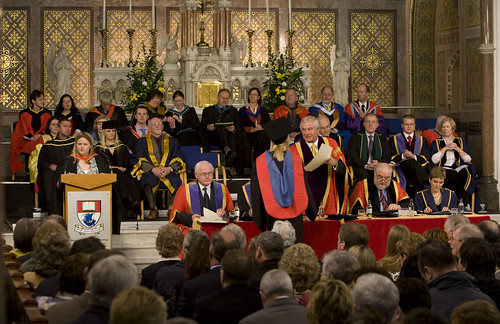
The conferring ceremony is always lovely as it takes place in the beautiful Pugin Chapel in the College St campus, the part of our college that houses the humanities and the performing arts.

The  2007 graduation ceremony at WIT

Some academics dislike the pomp and ceremony of conferrings, but I enjoy them on the rare occasion I get to attend. There is a great sense of achievement among the students and their proud parents, and of the role of the college in the wider community among the staff. Makes it all worthwhile, somehow. There is also a nice atmosphere around town in the evenings as the students and their parents converge on the pubs and cafes – I wouldn’t be surprised if quite a few students decided to go to college as a result of the atmosphere they observed around town during commencements.

Unfortunately, this week is also one of the busiest of the year for lecturers, as it is the midpoint of the semester and exams must be submitted by the end of the week. This can be quite a tough prospect if one is lecturing new modules as it involves setting questions and answers on topics not yet covered. Setting a paper for 1st yr engineering didn’t take long, but I’ve spent all week trying to think up challenging but doable questions in the quantum physics of solids (3rd yr) and the physics of semiconductor devices (4th yr) . Sigh.

Still, no lectures next week yipee!

1 Comment

Filed under Teaching

Lisa Randall and warped passages at Trinity College

The highlight of Maths Week Ireland (see post below) was the Hamilton lecture, a public lecture at Trinity College presented by the Royal Irish Academy in conjunction withThe Irish Times and Depfa Bank. The lecture was Warped Passages: Unraveling the Mysteries of the Universe’s Hidden Dimensions’, by Lisa Randall, Professor of Particle Physics at Harvard. Prof Randall needed no introduction to the physicists in the audience – a particle theorist, comsologist and string theorist, she is currently one of the most cited physicists in the world, not least due to the Randall-Sundrum model of a higher dimensional universe. She has also just published a highly successful book on the RS model for the general public, and this was the topic of the lecture.

It was obvious from the start the lecture was going to be exceptional. The very first point Prof Randall made was her belief in the role of experimental verification in science, citing the role of experimentation in the optics and mechanics of Hamilton as an example (this is an important point for string skeptics, who worry that some aspects of string theory may not be falsifiable/verifiable above the Planck scale). A second point in the introductory remarks concerned her philosophical approach to theoretical physics – that models and theories are avenues to be explored, which may or may not turn out to represent nature.

The lecture proper started with a highly succinct introduction to the world of particle physics (the atom, the nucleus, the proton and the quark were dealt with in one slide). The next slide covered the fundamental forces and the Standard Model. The audience was then treated to an introduction to the rise of string theory as an attempt to reconcile general relativity and quantum physics, with higher dimensions arising naturally from the equations. There was a lovely flashback to the work of Kaluza and his attempt to unify gravity and electromagnetism by writing the equations of general relativity in five dimensions (rather than the four of Minkowski spacetime), and the subsequent proposal of compactification by Einstein and Klein (compactification is the idea that we do not percieve the 5th dimension simply because its rolled up on a tiny scale).

In the second part of the talk, Randall went on to give an outline of modern string theory, from the proposal of eleven dimensions to brane theory. The crux of the talk was a description of how, in her model, branes might provide an a solution to the hierarchy problem (i.e. the relative weakness of gravity relative to the other three fundamental interactions), if we dispense with compactification. As I understand it, the basic idea is that the non-gravitational particles and interactions could be trapped on a 3D brane, with gravity not confined – in which case the familiar particles would experience a reduced gravity due to their separation from it and a warping of that spatial separation by the energy of the universe. In the two-brane model for example, it is proposed that gravity resides on a different brane, its influence on our ‘home’ brane hugely reduced by the warping of space between the two branes.

Image from NYT via Cosmic Variance

The lecture concluded with an overview of testable consequences at the LHC. First, it was suggested that higher dimensions might be detectable as missing energy, as Kaluza-Klein particles produced in high-energy interactions escape into higher dimensions. Even better, KK particles of the RS model should be clearly distinguishable from the compactification model (and from supersymmetric particles) by their decay mechanisms, mass-spectrum and spin. She amplified further on this point in answer to a query of mine – indeed question time was excellent , with clear answers to all questions.

Overall, this was a super talk on an extremely hot topic. The main themes I took out of it were

(i) an emphasis on the possible verification/falsification of modern concepts in string theory at the LHC

(ii) an emphasis on ‘it might be wrong’

(ii) disappointment at the unavailability of energies that could have been seen at the cancelled SCC– often forgotten in Europe.

Two great quotes were

‘I don’t believe in any particular theory – I have often worked simultaneously on theories which are mutually incompatible’

‘When dealing with higher dimensions, a word is worth a thousand pictures’

If you want to more about this topic buy the book. Alternatively, there are some great articles on the topic on the Randall website.

Postscript: On the journey back to Waterford last night, it struck me that the real ‘out-there’ proposal on the dimensions of the universe remains that of Enstein and Minkowski. The idea that time is simply another dimension, equivalent to the three spatial ones was truly extraordinary – evidenced by the interplay between temporal and spatial dimensions for bodies travelling at high speed (special relativity) or in strong gravitational fields (general relativity). I’ve never understood the public amazement at the idea of multi dimensions in space – if anything, I find the idea a bit trivial once compactification is added to the mix. So the RS model is a welcome change from that. But here’s a really shocking proposal – what if we live in a universe with extra dimensions, but the extra dimensions are non-spatial? Imagine if spin (which we don’t really understand) is a dimension rather than a parameter? Or colour, charm, strangeness, parity and all those other quantum properties that are really just labels? Hmm…daft thought for the day
3 Comments

Filed under Public lectures

Hamilton and Maths Week in Ireland

This week is Maths Week in Ireland, an annual celebration of mathematics designed to promote a positive attitude to maths among schoolchildren and adults. All sorts of events are taking place at Universities, Institutes of Technology, museums and schools throughout the country. There are public lectures on topics like maths and magic, the maths in your ipod , statistics in real life, and probability in practice. (Yours truly was down to give a talk on the maths of the LHC experiments, but it didn’t draw a big enough audience…I guess the maths of particle physics isn’t riveting for everyone, I should have chosen a more obvious application of maths in everyday life).

There are also plenty of outside events such as maths in the street and cafe discussions of the maths of betting , not to mention astronomy shows in planetaria. You can find the full program here.

The week will be capped off with the annual Hamilton walk and Hamilton lecture.

William Rowan Hamilton was undoubtably the greatest mathematical genius Ireland has produced – and possibly one of the greatest mathematicians ever. He made many contributions to maths and physics, in optics, dynamics and algebra, but is probably best known in mathematics as the inventor of quaternions. In theoretical physics, his best known (and constantly used) work is of course the Hamiltonian operator – the operator used for energy in quantum physics. As a consequence, the Hamiltonian appears hundreds of times in every textbook on quantum physics!

William Rowan Hamilton: Irish genius

The Hamilton walk, led by Dr. Fiacre O Cairbre of NUI Maynooth, will follow the footsteps of Hamilton from Dunsink Observatory in Dublin along the Royal Canal to Broombridge. On 16th October 1843, Hamilton saw the equations of quaternions in his mind’s eye while out walking with his wife, and scratched them in the wall of the bridge lest he forget them. The markings are still there, and the walk is re-enacted each year by academic staff, students, schoolchildren and the general public.

Broom Bridge: where the quarternion formula was scratched

For me, the highlight of the week will undoubtably be the Hamilton lecture, given this year by Lisa Randall, the renowned cosmologist and particle physicist who is Professor of physics at Harvard. The title and abstract for the lecture are given below:

Warped Passages: Unraveling the Mysteries of the Universe’s Hidden Dimensions

Do we inhabit a three-dimensional universe floating in a four dimensional space? What if the extra dimensions required by string theory were not curled up and unobservably small, but unfurled and vast, extending forever? Could an invisible universe only a tiny fraction of an inch apart in another dimension explain phenomena that we see today in our world?
These are among the questions that we will consider in this lecture about extra dimensions of space.

Defnitely worth a trip up to Dublin, watch this space!

Comments Off on Hamilton and Maths Week in Ireland

Filed under Public lectures

Chamber music and Einstein

This weekend I’m off to play chamber music in Termonfechin, a tiny village on the eastern coast of Ireland. The event is is organised by the Dublin Chamber Music Group, a group of amateur players who organise chamber music weekends twice a year (this particular weekend is the 50th anniversary of the group). They’re great weekends, with up to 20 string quartets and other groups playing away in different rooms in a great country house – with lessons, practice and a concert on the Sunday!

Chamber music in An Grianan, Termonfeckin

I had no plans to be there, but I Got The Call last week…

–  Our violin player is ill, could you lead a piano quartet next weekend ?
– Yes
– It involves an entire weekend’s playing, you may may need to think about it
– No, I’m free
-Sure?
-Yes

It’s not often I get such opportunities these days. The downside is that I’ve had to practice after work every evening this week, trying to coax my fingers out of retirement (I should be practicising now). Two problems have emerged:
1. I don’t like the chosen piece (piano quartet no. 1 by Charles Stanford )
2. I can’t play it for nuts.
So I have a plan – as soon as we meet up, I’ll get the others to play through one of the Mozart piano quartets. They’re both beautiful and I suspect no-one will be bothered looking any  further…

(Technical note for philstines: a paino quartet is not four pianos, it’ s a quartet consisting of piano, violin, viola and cello)

Of course, it’s impossible to discuss violin-playing physicists without thinking of Einstein. One of the things I admire most about E. is that despite his huge contributions to so many areas of physics, his constant travels, and his many changes of job, he found time to keep up his music throughout his life. In fact, he once remarked that the only tangible benefit of fame was that he became much in demand as a chamber musician. Just how good a violin Einstein was is hard to gauge from the biographies (lines such as ‘a better scientist’ or ‘more musical than technically skilled’ can mean just about anything), but my guess is that he must have been pretty good. You don’t get away with much in a chamber group (it’s not like an orchestra) and it takes a certain level to play the lead violin part in groups with musicians like Rubenstein, charity event or not….

Another clue comes from a rare review of one of Einstein’s concerts  – apparently a music critic stated that ” Herr Einstein played very well enough….but hardly world-class”. Of all the plaudits Einstein received during his lifetime, I suspect this was one of his favourites (only a music critic could fail to recognize the world’s most famous scientist).

Comments Off on Chamber music and Einstein

Filed under Uncategorized