In 1998, a totally unexpected result from astronomy caused a dramatic rethink of the Big Bang model. Measurements of the light emitted by a certain supernova suggested that it was further away than predicted by the Hubble constant. In other words, the exploding star did not lie on the straight line of the Hubble graph! This is a startling discovery as it implies that the expansion of the universe is not constant – instead the expansion is currently accelerating (see a description of the experiment here).
Skeptics at first suggested the result might arise from an error in the measurement of stellar distance – however, a similar observation was reported by a different group within two years. Further, independent support for the result soon emerged from measurements of the cosmic microwave background (CMB). In 2002, precision measurements of the CMB by the WMAP satellite suggested a universe with geometry that is flat to within 1%. This result is completely inexplicable in the context of the known density of the matter of the universe (both ordinary and dark). The known density of matter points to a universe with Ω = 0.3, a long way from flatness (Ω =1). Hence the CMB measurements suggest that there is a great deal of matter/energy in the uiverse unaccounted for.
As a result, cosmologists now talk about a new phenomenon; a form of energy that is pushing the universe outward, causing the expansion to accelerate and the geometry to be flat. The phenomenon is labelled Dark Energy : the physical cause for dark energy is thought to be some sort of vacuum energy. However, it should be pointed out that the numbers don’t yet stack up – detailed calculations suggests that the postulated vacuum energy would cause an accelerated expansion many orders of magnitude greater than that observed…this is a major area of research at the moment.
Putting Dark Energy together with Dark Matter, cosmologists postulate that ordinary matter, dark matter and dark energy all add up to the critical density required for the geometry of the universe to be flat (as measured). In other words, the current model of the universe can be summed up by
Density ord matter (4%) + Dens dark matter (22%) + Dens dark energy (74%) = 100%
or ΩM (0.04) + ΩDM (0.22) + ΩDE (0.74) = 1
*************************************************
Technical notes:
1. Is Dark Energy compatible with relativity?
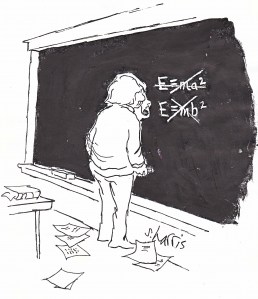
Yes, but note that an accelerating universe is not predicted by the Friedmann equation, i.e. does not feature in any of the Friedmann universes (see post on the expanding universe below). Going back to 1st principles, when one applies the equations of general relativity to the cosmos, an extra term must be added in order to account for the accelerating expansion. This is rather reminiscent of the manner in which Einstein himself , dismayed by the prediction of a dynamic universe, originally added a term to his equations in order to keep the universe static (the positive cosmological constant) . Now we apply a term to the other side of the equation for the opposite reason.

Revised Friedmann graphs of the evolution of the universe
2. Is Dark Energy compatible with inflation?
Yes, for two reasons:
1. The fact that the expansion is accelerating now makes the suggestion of an exponential expansion in the first instants a lot less fanciful.
2. While the current accleration is many orders of magnitude less than that of inflation, it may be that the cause is some energy left over from inflation – more on this later.


 Antimatter