Antimatter at 1

This little blog passed its first birthday a few weeks ago (a few posts go back to March 2008, but they were actually written in May!). It’s been a very useful experiment and the year certainly went by quickly…

The blog was suggested by our head of research as I’d been writing articles on science for the public in newspapers and magazines for some time. It started life as an online science diary, but I found it useful to broaden it to include posts on introductory concepts in cosmology for our students and renamed it Antimatter. During the year, it has become much more widely read than expected with about 200 hits per day. That’s about a thousand readers per post which is probably a good outreach for a teacher…

Most the traffic comes from being listed on well-known websites such as INTERACTIONS. ORG (the international particle physics website), Particle Physics Planet and the American blog NOT EVEN WRONG (thanks Peter!). I recommend all of these websites; the interactions website is a particularly useful resource as it gives a daily list of new posts on particle physics/cosmology on blogs around the world.

I note from WordPress that 112 posts have been posted on Antimatter so far; that’s an average of 2 per week which feels about right. It does take time to write the posts, but there are definite benefits for any science writer. As well as good writing practice, the blog has led to a good few public speaking engagements, newspaper profiles, magazine articles ( in Physics World) and interest from a literary agent (more on this later).

Cover of Print edition Volume 22 Issue 5

I enjoy writing the cosmology articles, but the most challenging posts are probably the lecture reviews; not many bloggers do this but I think it’s a useful service. It’s great practice to try to summarize someone’s lecture, put in appropriate links, pics and slides and send them a copy for approval, all within a matter of hours. It’s also a nice way of establishing contact with other physicists worldwide.

So I think I’ll keep posting for a while. About my only regret is the comments section – apparently a low number of comments is normal for a ‘tech” blog. Instead, readers tend to contact me by email. Which drives me mad…

2 Comments

Filed under Science and society

Antimatter at the Royal Irish Academy

I was at a very interesting event in Dublin yesterday evening; an informal panel discussion for the public on ‘Angels, Demons and Antimatter’ hosted by the Royal Irish Academy and The Irish Times. It’s great to see the Academy hosting this sort of event as it helps to bridge the gap between science and the humanities (the ‘two cultures’ famously described by C.P. Snow).

The event was ably chaired by Dick Ahlstrom, veteran science editor ofThe Irish Times, and the panel boasted four heavy hitters from the world of particles physics: Alex Montwill, Ireland’s best-known particle physicist and renowned communicator of science: Ronan Mc Nulty, leader of the experimental particle physics group at UCD, a group that have a major involvement with the LHCb antimatter experiment at CERN: Tara Shears, lecturer in physics at Liverpool University, also heavily involved in the LHCb experiment: and Paul Bowe, the Irish physicist who is technical director of ALPHA, the anti-Hydrogen experiment at CERN.

In his introduction to the event, Dick Ahlstrom sensibly asked the audience how many had seen the film – only about a third, which confirmed my view that people are interested in particle physics for its own sake, film or no film. Tara Shears then kicked off with a pithy summary of the film, explaining that a ticking bomb made of antimatter provides the timeline of the unfolding story. Then it was over to Alex to give a brief introduction to the phenomenon of antimatter. He did this in exemplary fashion, starting with the prediction of antimatter from the Dirac equation (…“Dirac was not the sort of scientist to brush extra solutions that seemed to have no corresponding physical reality under the carpet“) and proceeding to the experimental discovery of the positron in 1932 (if you want details on the discovery of antimatter, see post here). The discussion then honed in on the nature of antimatter, how it occurs in nature and how it is produced in minicscule amounts in high-energy accelerators.

The panel then turned to one of the great mysteries of physics – why is our universe primarily made of matter and not antimatter? Ronan gave a brief overview of charge symmetry, parity symmetry, charge-parity (CP) violation and the Sakharov conditions ; these are three conditions that theory predicts must have existed in the early universe for the current asymmetry of matter and antimatter to develop.

Charge and parity operations: note that the final quadrant is not identical to the first

This led nicely to a discussion of the relevance of high-energy physics to cosmology. I was very pleased this came up, as it is not always obvious to the public that, as well as studying the fudamental nature of matter, high energy accelerators offer a direct glimpse of the very early universe by recreating the energy conditions that existed shortly after the big bang (a point that is often missed by critics of the big bang model).

Paul Bowe then discussed the production of anti-hydrogen at CERN (an atom of anti-hydrogen simply comprises an anti-electron orbiting an antiproton, see previous post on this). He gave a brief overview of the ALPHA experiment – the production of positrons, the production of antiprotons, the mixing trap etc.

Schematic of hydrogen and anti-hydrogen atom

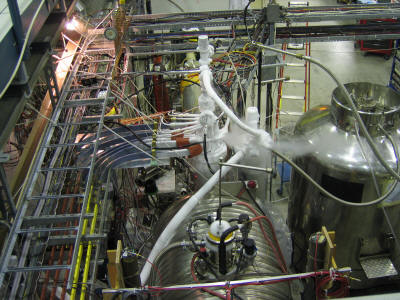
A picture of the experiment reminded me that while I find the discoveries of particle physics fascinating, I’m happy to leave the experiments to others!
IMG_1458

Image of ALPHA experiment

Paul also addressed a question I was asked a while ago – Do we expect the spectrum of anti-H to be the same as that of H? If I have understood correctly, the answer is yes (since the electromagnetic interaction between the anti-proton and the positron should mirror that between the proton and the electron). If not, the spectrum of anti-H will have major implications for our understanding of CP violation.

********************************************

The second part of the discussion dealt with Hollywood’s take on antimatter in Angels and Demons. It started with a clip from the film, the scene where Dr Vetra tries to explain to the destructive potential of the antimatter bomb to the authorities, advising that they evacuate the Vatican city forthwith.

Of course, the panel were quick to point out the unfeasability of the bomb, as mentioned in the post below: because of the difficulties of creating even a few atoms of antimatter in particle accelerators, it is simply not possible to create a bomb made of antimatter (or to use it as an energy source). And if such a bomb could be made, the trap container would be gigantic, not the little package portrayed in the film. However, I was pleased to hear that Tara (and I think the panel as a whole) felt Brown’s plot was acceptable cinematic license and made for a good story.

A small container for an antimatter bomb?

**********************************************

In keeping with the informal nature of the event, there was a lengthy question and answer session after the panel discussion. Some interesting questions were;

1. Is it possible there is plenty of antimatter in our universe today, in the form of distant galaxies made of antimatter?

I think the answer was that this is a real possibilty, but a basic asymmetry between matter and antimatter is still implied.

2. Does the neutron have an antiparticle?

Yes, because the neutron is a composite particle – the anti-neutron is made up of anti-quarks etc). Ronan pointed out that the question Does the neutrino has an antiparticle? is much more interesting and the subject of much debate.

3. What is the relation between antimatter and dark matter?

None – dark matter is the name we give to matter that has a gravitational effect but does not interact with the electromagnetic force. However, whatever particles make up dark matter presumably have anti-particle counterparts!

4. My question: Why did Dan Brown choose to introduce the topic of antimatter to the story at all, wouldn’t TNT have done?

My own view is that he was anxious to include cutting edge science, as the relation between religion and emerging science is a major theme of the novel. However, Tara had a better answer: novelists write about what they find interesting and Brown happens to be interested in particle physics! Apparently, he even visited CERN in 1990. QED.

********************************************************

All in all, this was a very interesting an informative event, a treat for anyone interested in particle physics or indeed are the public perception of physics. If there was one sour note during the evening, it was Dick Ahlstrom’s observation that “ the UCD contribution to the LHCb experiment really occurs through the back door” as Ireland is not a member of CERN. This is a sad situation that we have touched on many times before, so I’ll leave it for now. As for Dan Brown, long may he continue to include science in his bestselling novels.
9 Comments

Filed under Particle physics, Science and society

Angels & Demons: a good film

I was in Dublin yesterday for an Institute of Physics meeting so I took the opportunity to see Angels & Demons in the Savoy afterwards.

Shock news: I found the film reasonably interesting and entertaining, in stark contrast with every review I have seen (see a scathing review inThe Irish Times here). What is with the critics? I am no fan of Hollywood, but as Hollywood blockbusters go, I found A&D well above average.

Granted, the plot is a bit far-fetched, not to mention convoluted (you really need to have read the book to keep track of the story, from the history of the Illuminati to the frantic chase around Rome from cryptic symbol to cryptic symbol). However, the film is an improvement on the book as the storyline is tighter, with many unnecessary scenes removed. The cinematography is good – Ron Howard makes great use of the architecture of Vatican City and of the pomp and ceremony of Church traditions such as Conclave. The fabulous tradition of the Catholic Church in art, architecture and music is also portrayed quite well. There are some nice crowd scenes in St Peter’s square; my favourite was an incidental scene depicting a riot over the rights and wrongs of stem cell research! The key scene of a bomb-laden helicopter ascending into the heavens from St Peter’s was also quite effective.

The cardinals on the way to Conclave

I can’t help wondering whether some critics missed the central point of the film. One problem with this sort of thriller is that the theme is often not revealed until the end. In this case, it only becomes becomes clear in the closing moments that the real topic of the story is the conflict within the Church between those who seek to reconcile religion with science (the elderly cardinals) and those who see science as an implacable enemy that must be overcome by any means (the young Camerlengo). An unusual theme for a blockbuster..

What about the science in the film? Again, it was better than I expected. The opening minutes are set in CERN, with a nice portrayal of an accelerator facility and a decent simulation of proton-proton collisions as the LHC is switched on. There is a reasonable explanation of Professor Vetra’s antimatter experiment and the routing of the proton beam to his lab is portrayed in realistic fashion. Yes, yes, the whole concept of an antimatter bomb is wrong-headed (see post below), but this is fiction, not fact.

However, given the worldwide attempts to use A&D to promote science (see here), I feel bound to point out that the whole antimatter/CERN angle is rather tangential to the plot – that is incidental, as Hannibal Lecter would say. It happens that the bomb is supposedly made of antimatter, but that’s about the extent of the particle physics connection. (There is also the Camerlengo’s objection to the ‘blasphemous’ term God particle). Even the gorgeous young scientist Vetra doesn’t get much of a role. The real theme of the film is the battle between science and religion, now and in the past, a topic it handles quite well (see Camerlengo’s speech and eldest cardinal’s rebuttal).

All in all, I enjoyed the film and would certainly watch it again sometime. I even liked the central character (played by Tom Hanks) – a non-believer who is respectful of the rich tradition of the Church, he was quite convincing in the role…

Comments Off on Angels & Demons: a good film

Filed under Science and society

Angels, demons and antimatter

I’m re-reading Dan Brown’s Angels and Demons in preparation for the film release later this month. I’m quite enjoying it – if you’re going to write a fast-paced thriller, why not have lots of science and religion in it? Not many thrillers feature antimatter as a core part of the plot. Also, it’s great to see CERN feature in a book aimed primarily at an American market. In fact, the first 150 pages or so of the book are set in CERN.

However, it has to be said that much of the science is disappointing. First, there are the usual stereotypes – the CERN director is portrayed as a cold scientific type with few morals or empathy. The lab is full of all sorts of gadgetry incomprehensible to the hero Langton, a Harvard professor of religious iconology. More seriously, some of the science is poorly researched and inaccurate.

For example, a very basic component of the plot makes no sense. An anti-religious group is suspected of murdering a CERN scientist because he has discovered that ‘‘matter can be created out of pure energy, contradicting modern science and giving support for creationism”. Except that the creation of matter from pure energy is a standard prediction of both relativity and quantum physics (E = mc2) and we have been producing it in accelerator experiments for years. There are no implications for religion!

Such misconceptions run throughout the book. Elsewhere, it is explicitly stated that particle physics is about smashing things together in order to see what’s inside. This is completely wrong – in experimental particle physics, exotic new particles are created out of the energy of reaction (e.g. antiquarks do not exist inside protons, they are created out of the energy of proton-proton collisions). Much of the discussion of antimatter also contains errors – for example the ‘antimatter bomb’ of the plot makes little sense. While antimatter can and is created in accelerator experiments, only the tiniest amounts have ever been successfully stored (i.e. atoms of antimatter, not micrograms). Statements like ‘‘the electron is the antiparticle of the proton” don’t help either.

That said, I like the idea of a bestselling novel featuring antimatter heavily. Also, the ‘struggle’ between science and religion, a central theme of the book, is an interesting theme for a bestseller – although it’s a pity that the emphasis is on the extreme views on either side of the debate.

As you know, the film is about to be released, with the usual heavy promotion. Sadly, I hear that the science in the film version is cut quite drastically – the CERN angle is limited to a few shots at the very beginning, Langton never visits the facility, and the CERN director, a central character of the novel, doesn’t feature in the film. Almost all scientists in the film are show wearing white coats, reducing their role to that of lab technicians..oh dear.

In summary, it’s easy to take potshots at science in novels like this. Overall, I’m glad to see science mentioned at all. Pity much of it is left out in the film..

Update: The particle physics community in the US have organised a series of public lectures on the science behind Angels&Demons in order to coincide with the release of the film. You can read more about this here and see the lecture timetable here.

I’m hoping to get involved in a similar lecture at the Science Gallery in Trinity College Dublin. I think it’s a good idea to tap into the anticipated public interest in antimatter. That said, I think such a lecture should also include a certain amount of discussion of science and religion, as this is a major theme of the book. More on this later…

Update II:

I just read that The Irish Times and the Royal Irish Academy are hosting a public a panel discussion on Angels, Demons and Antimatter at the RIA on June 2nd. The panel includes some very good particle physicists like Alex Montwill and Ronan Mc Nulty of UCD, well worth a visit for anyone in Dublin. You can find details of the event and book tickets on the RIA website.

13 Comments

Filed under Public lectures, Science and society

Astronomy Ireland and IYA

Last Saturday, Astronomy Ireland hosted an extraordinary national meeting at the Science Gallery at Trinity College Dublin, in order to draw members’ attention to planned events to mark the UN International Year of Astronomy.

Astronomy Ireland (AI) is Ireland’s premier astronomy club and it promotes astronomy, space interest and science education all over the country. I first became aware of the club when I attended some great cosmology talks they hosted last year (see post on a lecture onThe Cosmological Distance Ladder by Micheal Rowan-Robinson here and on Dark Matter by Tim Sumner here); AI also organise observing sessions and other astronomy events nationwide, not to mention running astronomy classes in various institutions around the country. I attended their astronomy classes in our own college this semester and found them excellent (well done Emmet Mordaunt!).

Saturday’s meeting offered a packed program of talks, short films and discussions. First up was film producer and director Ginita Jimenez of film company Father Films, who described how she came to make a short film about Venetia Phair, the 11-year old Oxford schoolgirl who named the planet Pluto. I missed the beginning of Ginita’s talk, but her description of reading a short newspaper article on the topic and her subsequent discovery that Venetia had never actually seen the planet, was fascinating: with the demotion of Pluto to ‘dwarf planet’ status, she knew she had to make a film about the whole affair.

After Ginita’s introduction, we were treated to the Irish premiere of ‘Naming Pluto’. Sure enough, it was a beautiful little film: the discovery of a new planet from the perturbations in the orbit of Uranus, the naming of the planet by Venetia, granddaughter of Falconer Madan, ex-Head of Oxford University’s Bodleian Library, the subsequent passing of the name to the powers that be in Flagstaff USA, it was all there. (I’m not sure how many of our students would have 11-year old Venetia’s knowledge of both astronomy and classical mythology – planets are generally named after Roman gods and Venetia suggested Pluto as he is the Roman god of the underworld). The second part of the film described an older Venetia’s visit to uber-astronomer Patrick Moore, a failed sighting, and then her first sighting of the planet she named all those years ago at the Science Observatory in Hertsmonceaux at age 89. The film finished with some moving shots of an aged Venetia telling her story to a group of wide-eyed students – straight out of C.S. Lewis, you could see them trying to imagine her as an 11-year old! If you want to know more, there is a summary of the story here and a nice trailer of the film on YouTube here; better still, why don’t you buy the film here.  

Robert Hill of the Armagh Planetarium and Northern Ireland Space Office then gave a lively overview of activities worldwide that are taking place to mark the International Year of Astronomy. The sort of activities involved are:

100 hours of astronomy: a round-the-clock event that features live webcasts from research observatories around the world

The Galileoscope ; the distribution of thousands of easy-to-assemble, easy-to-use telescopes to budding astronomers around the world: each telescope has about the same power as that available to Galileo

Cosmic Diary: an astronomy blog featuring regular posts by diverse professional astronomers

Portal to the universe; a one-stop web portal for astronomy that will feature astronomy content, acting as an index for press, educators and scientists

Dark Skies Awareness: a project promoting the awareness of light pollution

It was a great talk and you can find out more about the various activites on the IYA website.

AI founder and chairman David Moore also gave a talk, describing the activites of Astronomy Ireland for the year that’s in it, in particular the school lecture program and the teacher training program. He also described what individual members could do, from voluntary work to lobbying public representatives. A change of mission was highlighted: instead of confining itself to promoting astronomy, David sees AI as promoting a science culture in Ireland. He pointed out that while Ireland has a great culture in both arts and sports, it has no such culture in science, despite a great heritage in the subject. I think he is absolutely right in this and it strikes me that astronomy is a very good place to start to address the problem..you can find a list of the planned AI activities here or on the AI website.

David Moore (R) in interview at the Young Scientist Exhibition

After David’s talk, we were treated to another short film. 3-d glasses were handed out and Robert Hill presented a short spectroscopic tour of the universe. I won’t attempt to summarize the film, but there were some stunning graphics. You can get a flavour of it by taking the tour on the website of Celestia. As usual, I came away thinking just how insignificant our own little galaxy is in the wider scheme of things.

All in all, the meeting was a lively and informative event, with a serious mission behind it. Afterwards, we left the beautiful Science Gallery for some hot food and drinks at the pub across the road (it was an Irish meeting after all). There, discussions on the promotion of science continued for many hours…

Update:

I just heard from Ginita that Venetia died last week at the age of 90. Sad news, but I’m sure she enjoyed seeing the film in her final days. You can find a nice NYT obituary here. Ar dheis De do raibh a h-anam

3 Comments

Filed under Astronomy

Binary black holes, gravitational waves and numerical relativity

We had an excellent turn-out for yesterday’s superb Institute of Physics seminar even though we are in the last hectic week of the teaching semester (thanks to the organisational skills of the WIT maths/physics seminar group). The talk ‘Binary black holes, gravitational waves and numerical relativity’ was given by Dr Joan Centrella, head of the Gravitational Astrophysics Laboratory at NASA’s Goddard Space Flight Centre. Dr Centrella is a distinguished relativist, well known for her work in the simulation of black hole mergers and she certainly didn’t disappoint.

The lecture started with an overview of massive black holes, intermediate black holes and gravitational waves. Just as general relativity predicts that a large mass will curve spacetime, it predicts that moving mass will cause ripples in the curvature of spacetime – known as gravitational waves. Of course, such disturbances will be extremely difficult to detect due to the weakness of the gravitational interaction. Indeed, while many of the spectacular predictions of general relativity have been verified (the bending of light in a gravitational field, time dilation in a gravitational field, black holes and even the expanding universe) the direct detection of gravitational waves is possibly the last great test of relativity. The speaker explained that the best chance of seeing the phenomenon directly is by studying the most explosive events known: black hole mergers.

There was a brief description of the indirect observation of gravitational waves, in particular the Hulse-Taylor pulsar. This is a binary pulsar found in 1974, whose orbit has been observed to be gradually shrinking due to the radiation of energy by gravitational waves: the two stars will merge in about 300 million years. Interesting that Hulse got the Nobel for work done while still a postgraduate, while Jocelyn Bell was overlooked for her discovery of pulsars – see post on IoP meeting below.

Centrella then gave an overview of direct searches for gravitational waves, both earth-bound (LIGO) and space-based (LISA). LIGO, the Large Interferometer Gravitational Wave Observatory, is basically a huge Michelson interferometer, complete with laser source, beam splitter and mirrors – the arms of the interferometer are several kilometers in length! LISA, the Laser Interferometer Space Antenna, is an astounding project: a joint NASA/ESA mission, it will consist of three separate mini-spacecraft, each with its own laser source, maintained in an equilateral triangle that will form a giant Michelson interferometer in space. Minute disturbances in spacetime by a passing gravitational wave will be measured as tiny changes in relative arm length (having taken all other factors into account). A crucial difference between the two systems is the target: while LIGO searches for intermediate black hole events, LISA will search for massive BH events (a much stronger source in a different region of the spectrum).

LIGO (California)

LISA (artist’s impression)

Dr Centrella then described her own field: the use of numerical methods and algorithims to solve the equations of general relativity for the particular case of relativistic binary systems and their associated gravitational waves. She gave a great overview of historic problems in the area and recent breakthroughs in the field, from the puncture method to the Lazarus approach. I won’t attempt to summarize this part of the talk, but there is a nice overview of the field here and I should have a link to the slides from the talk in a day or two.

Dr Centrella with a scale model of one of the LISA spacecraft

All in all, this was a superb lecture, courtesy of the Institute of Physics. It was clear the audience enjoyed the lecture thoroughly and there were plenty of queries at question time – indeed the lecture would have continued for another hour had we not whisked the speaker off for dinner. In answer to my own question on the detection of gravitational waves from the Big Bang itself, Dr Centrella pointed out that one would certainly to see expect a signal from cosmic inflation – however these waves would be in a very different region of the spectrum from that studied by either LIGO or LISA. ..

Update: Joan has been in contact to say you can get a review article she wrote on the subject for the Scidac Review here; she has also done a podcast for Sky and Telescope with movies of the simulations here. She also has two comments and corrections to the text above; rather than paraphrase them I have put them verbatim in the comments section!

Update II: there is a wonderful article on gravitational waves and the early universe by Craig Hogan in the June 2007 edition of Physics World, which you can access here if you’re a member

3 Comments

Filed under Cosmology (general)

Back in Switzerland

This week I’m back in Switzerland; in fact I’ve been here a bit more than a week and am not leaving until Sunday. I figured I’d be in need of a good holiday after a busy term and the Institute of Physics Spring Meeting (see previous post) so I booked myself 10 days skiing in Zermatt, the famous little town just below the Matterhorn.

The Matterhorn

On piste at the Klein Horn

The snow is fine both on- and off-piste, if a bit icy in the mornings and a bit slushy in the afternoons (I quite like variable conditions).The Ski Club of Great Britain are here in force with two different reps and I’ve been doing plenty of skiing with them on off-piste days. Such a joy to ski with experienced skiers, thanks Alaistair and Chris! (For ski bores out there: I’m trying the K2 Public Enemy twin-tip skis and find them superb for the variable snow, although the plume they kick up in spring snow drives some people nuts). I like the way free-ride technology can work it’s way into the mainstream…

Off-piste at the Stockhorn

Zermatt itself is drop-dead gorgeous, the archetypal Swiss ski resort, with superb restaurants, no cars and unbelievable views. Did I mention the world’s best apres-ski, rockin to an outdoor live band in the serious sun half way up the Matterhorn?

Zermatt Hauptstasse

Update:

It snowed all night on Wednesday. Snow conditions were excellent on Thursday, but visibility was poor.  Today, the sun came out and the conditions were fantastic. Best powder I’ve ever experienced, particularly off-piste. In fact possibly the best skiing I’ve ever had, despite witnessing the best skier of our group take a serious tumble on hidden ice off-piste at Stockhorn – no less than six somersaults on the way to the bottom. Happily, no serious injury resulted…photos to follow!

More ski cronies are arriving late tonight – the Frankfurt Ski Club are due in at midnight on their ski bus (if past trips are anything to go by, most of them will be hammered before they even get off the bus). I have some very good friends in this club; although the actual skiing can be a bit chaotic due to varying levels, the craic is mighty.The Frankfurters are staying until Monday, but yours truly has to finally return to Ireland on Sunday. Ah well, I expect some serious partying on Saturday, my last night in Zer…

And then it’s back to a hysterical week at WIT. The last week of term for the students (and all that entails) + Prof Joan Centrella of NASA’s Goddard Space Centre is giving a talk on Black Hole formation and gravitational waves on Wednesday + Peter Woit of NOT EVEN WRONG is arriving in Ireland on Friday. Jesus. I need a beer…

11 Comments

Filed under Skiing

Institute of Physics Spring Weekend

This weekend I was at the annual spring meeting of the Institute of Physics in Ireland in Wexford. I always enjoy these weekends – more relaxing than a technical conference and a great way of keeping in touch with physicists from all over Ireland. As ever, there were good seminars, a physics pub quiz and discussions of science and philosophy over breakfast, lunch and dinner (not to mention a 32-strong Wexford choir who gave superb after-dinner entertainment). At the same time, there was a serious side to the weekend with committee meetings, the Annual General Meeting and a highly competitive poster competition for postgraduates.

The theme of the seminars on Saturday was ‘Physics for Life’ and it mainly concerned advances in medicine/ biology that have resulted from research in fundamental areas of physics such as atomic and molecular physics (Bob McCullough of Queen’s University Belfast), solar physics (Louise Harra of University College London), nano-photonics (Brian MCraith of DCU) and molecule manipulation using ‘optical tweezers’ (Martin Hegner from Trinity). I won’t attempt to describe each talk, but you can find abstracts of the talks here.

My favourite was a general talk on causality in complex systems by world-famous cosmologist George Ellis: ‘Top-down action in the hierarchy of complexity’. This was a fascinating overview of the subject of causation, focusing on the influence of feedback from top-down processes on bottom-up causes. There were lots of great examples and the speaker was fully convincing in his conclusion that ‘no complex system can have a single cause’. I couldn’t help thinking how true this is of climate change. Some media pundits describe global warming phenomenon in terms that too simple; by citing man-made CO2 as the only factor in climate, they give great ammunition to climate skeptics who point to other factors. (The point is that while CO2 is not the only factor in global climate, it is now clear that the man-made increase in CO2 is a significant driver of warming.)

img_36711

Top-down causality: George Ellis

Sunday saw a new IoP initiative – instead of more seminars, four well-known physicists were given the ‘This is your Life’ treatment in sequence. It was a great success, with the legendary Tony Scott of UCD interviewing Ronan Mc Nulty (on the LHCb experiment), Sile McCormaic (on her path to the world of cold atoms) and Ray Bates (reknowned Irish climatologist who was one of the first in the area of climate modelling).

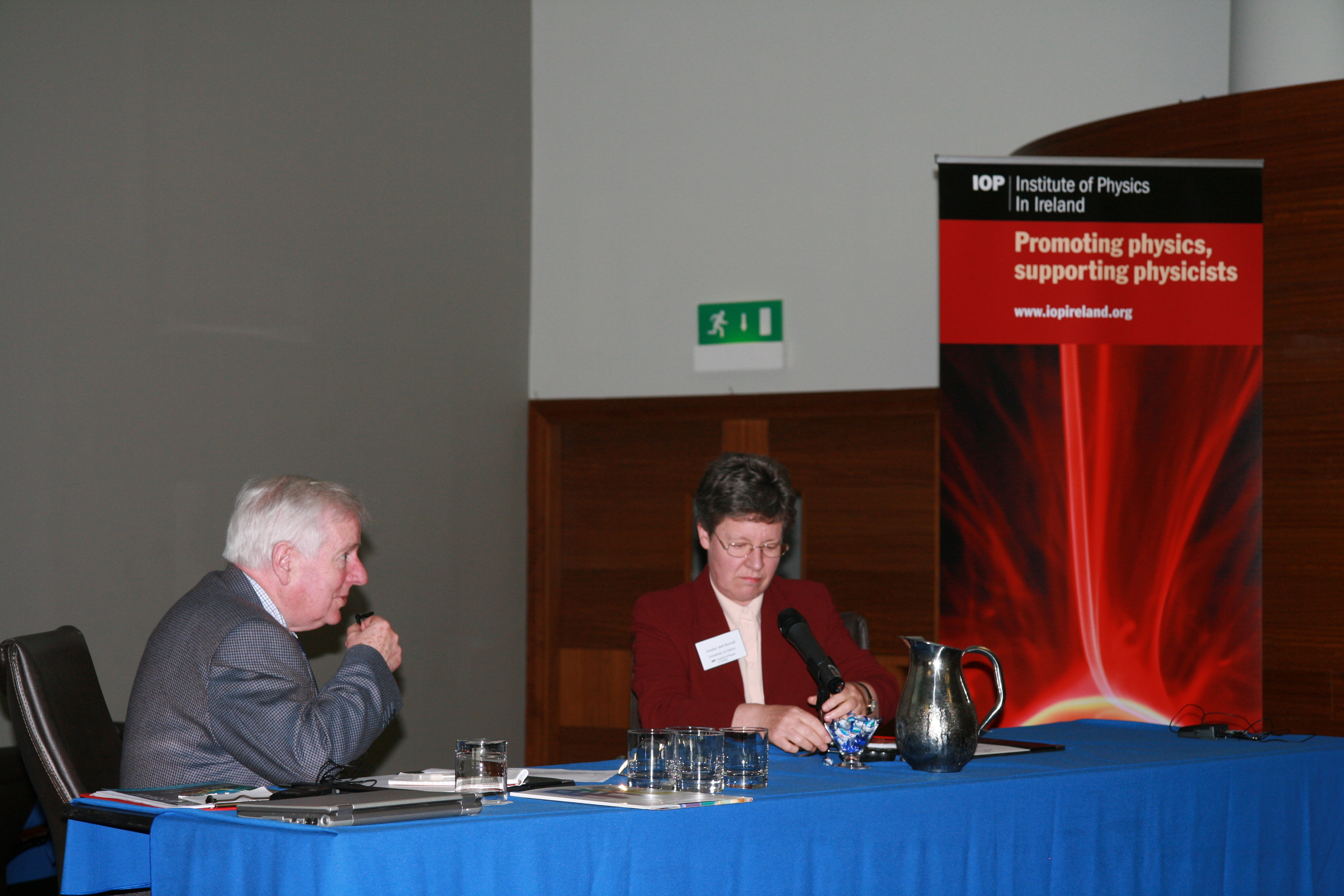
Best of all, the very first interviewee was Dame Jocelyn Bell-Burnell, the Belfast-born astrophysicist famed for her discovery of radio pulsars. (She is also President of the Institute of Physics). Professor Bell gave a fascinating overview of her life in physics, from failing the 11-plus exam to Cambridge. Of particular interest was her description of the postgraduate work leading up to the famous discovery: the long build of the radio-telescope from raw materials, perservering to the end as team members drifted off, the discovery of an unknown source, convincing her supervisor she was onto something, the disappearance of the source and the stress of a possible mistake and lost thesis, the re-appearance of the source, the classification of the first pulsars….terrific stuff.

img_3754

Tony Scott interviewing Jocelyn Bell-Burnell

Professor Bell’s story was reminiscent of the discovery of the microwave background by Penzias and Wilson (see post here), but with one big difference. Bell was a highly trained astrophysicist, who understood clearly that she might have discovered an important phenomenon. For this reason, it is still highly controversial that, while her supervisor Antony Hewish was awarded the Nobel prize for this work, she was not. Was it because she was still a postgraduate? Because she was a woman? Perhaps we will never know. Apparently, there was a very good BBC documentary on the story a few months ago – I misssed it but I’ll try and track it down.

As always, the most humbling part of the weekend was the postgraduate posters. The level of research made one feel seriously inadequate. You can find the results of the competition on the IoP website; choosing the winners must have been very difficult. I particularly enjoyed two posters from UCD on the LHCb experiment (an indirect measurement of luminosity using muon production rates, and the measurement the cross-section of Z boson -muon decay). Even there, Ronan had to explain to me how antiquarks arise in proton-proton collision; must revise my quark physics!

img_3681

Poster session at the meeting

All in all, a super weekend, courtesy of the Institute of Physics. Now it’s back to earth and those corrections…

2 Comments

Filed under Institute of Physics, Teaching, Uncategorized

The standard model of cosmology

The previous 12 posts listed the main discoveries of modern cosmology in chronological order: putting all this information together leads to the Standard Model of cosmology (not to be confused with the Standard Model of particle physics). We conclude our short course with a simple overview of the standard model (also known as the Concordance Model). You will notice that it is also a brief history of time. Keep in mind that what follows is a model: the strength of the evidence for each phenomenon varies (see specific posts on each topic starting here).

1. The Big Bang

  • The universe began approximately 13.7 billion years ago when it began expanding from an almost inconceivably hot, dense state.  Ever since, the cosmos has been expanding and cooling, eventually reaching the cold, sparse state we see today.

  • In the first 10-34 seconds, the universe experiences a brief period of extremely fast expansion known as inflation. This period smooths out initial inhomogeneities, leaving the universe with the homogeneity and isotropy we see today. Quantum mechanical fluctuations during this process are imprinted on the universe as density fluctuations that later seed the formation of structure.

  • The infant universe is a soup of matter and energy in which particle/antiparticle pairs are constantly born and annihilated.  As the universe cools, it becomes too cold to produce heavier particles, while the creation of lighter particles continues until temperatures cool to a few billion Kelvin.  At this point, most of the remaining particle/antiparticle pairs are annihilated.  A small amount of matter survives due to a slight asymmetry in the decay of between matter and antimatter.

  • After a few minutes, nuclei of the light elements (hydrogen, helium and lithium) are formed by the combination of free protons and neutrons, a process known as nucleosynthesis.
  • After about 100,000 years, the universe is cold enough for free nuclei and electrons to to combine into atoms (recombination).  At this point, the universe becomes transparent due to reduced scattering by free electrons.  Radiation now permeates the universe – seen today as the cosmic microwave background. By this time, dark matter (unaffected by the behavior of the baryonic matter) has already begun to collapse into halos.
  • After a few hundred million years, galaxies and stars form, as baryonic gas and dust collapse to the center of the pre-existing dark matter halos.

A brief history of time

2. The Composition of the Universe

  • Baryonic Matter: ~3% of the mass in the universe
    This is ordinary matter composed of protons, neutrons, and electrons.  It comprises gas, dust, stars, planets, people, etc.

  • Cold Dark Matter: ~23%
    This is the “missing mass” of the universe.  It comprises the dark matter halos that surround galaxies and galaxy clusters, and aids in the formation of structure in the universe. Dark matter is believed to be composed of weakly interacting massive particles or WIMPs.

  • Dark Energy: ~73%
  • Observations of distant supernovae suggest that the expansion of the universe is currently accelerating.  This observation is backed up by the flatness of the universe as measured from the cosmic microwave background.  Cosmologists believe that the acceleration may be caused by some kind of energy of the vacuum, possibly left over from inflation.

Matter/energy  composition of the universe

That concludes our short course in cosmology. You can find details on any of the topics above  by scrolling through the last 12 posts of this blog. Alternately, you can find slides from a lecture I gave on the subject (The Big Bang – Theory or Established Fact?) by clicking here

Update

There is a really nice one-page web summary of all of the above on the Talkorigins Archive here, and for readers requiring a slightly more advanced treatment, there is a good review of the current state of play in cosmology on the ARXIV here

25 Comments

Filed under Cosmology (general), Cosmology 101

A brief history of cosmology

The last 12 posts described each of the main topics of modern cosmology: from the predictions of general relativity to the three main planks of evidence for the Big Bang, from the theory of inflation to the most recent measurements of the cosmic microwave background. All of this theory and experiment has been put together to form what is known as the Standard Model of cosmology. Before we describe the Standard Model, let’s briefly review the main discoveries in chronological order (you can read a seperate post on each starting here)

****************************

A Brief History of Cosmology

1.  The general theory of relativity (Einstein, 1916) and the prediction of a dynamic universe (Friedmann, 1919)

2. The observation of the expanding universe (Hubble’s Law, 1929)

3. Rewinding the Hubble graph: the ‘primeval atom’ and the calculation of the age of the universe (Lemaitre, 1929)

4. The Big Bang model and the problem of the singularity

5. The prediction of the abundances of H and He from the BB model (Gamow, 1945)

6. The predicton of the cosmic microwave background (CMB) from the BB model (Alphaer, Heuer and Gamow, 1949)

7. The detection of the cosmic microwave background (Penzias and Wilson, 1965)

8. The CMB puzzles of flatness, homogeneity and galaxy formation (1965 -)

9. The theory of inflation (Guth, Linde and Steinhardt, 1981-82)

10. The COBE study of the CMB –  support for the BB model and inflation (1992)

11. Dark energy – the supernova measurements of an accelerating universe (1998)

12. The WMAP study of the CMB – more support for inflation and dark energy (2005)

**************************************************

I gave a talk on the Big Bang to our astronomy class at WIT last night, describing most of the above topics. It was great fun, with a lengthy question and answer session afterwards, fielded by both me and well-known astronomer Emmet Mordaunt who normally takes the class. You can find the slides for the talk here.

1 Comment

Filed under Cosmology (general), Cosmology 101