Introductory physics: those ol’ gas laws

A nice way to finish our section on heat and temperature is to look at the so-called gas laws. The Ideal Gas Law is a famous equation that relates the pressure P, volume V and temperature T of a given gas by the very neat expression

PV/T = nR

where n is the number of moles of a gas and R is a constant known as the Rydberg constant.

For a physicist, the details of the right hand side of the equation is of little interest. What is important is that it is constant i.e. the product [pressure x volume divided by temperature] of a given gas remains fixed. Hence if any one (or all) of these three variables is changed, the others must adjust such that the total product remains the same.

The ideal gas law embodies three separate gas laws that were discovered by experiment many years ago. For example, you can see from the equation that if the temperature of a gas is held constant (isothermal process), the product of PV must remain constant. Hence the volume of a gas decreases with increasing pressure if the gas is held at a steady temperature – a law known as Boyle’s Law after the Irish scientist who first discovered it in the 17th century.

Boyle’s Law – a favourite 1st year experiment

On the other hand, you can see from the equation that if the pressure of a gas is held constant (isobaric process) the quotient V/T must remain constant. Hence the  volume of a gas must increase linearly with increasing temperature if the pressure is held fixed – a law known as Charle’s law after the English scientist who first observed it  (also known as thermal expansion).

Charle’s Law: volume increases with temp at constant pressure

Finally, if you increase the temperature of a gas while keeping the volume fixed the quotient P/T must remain constant. Here the pressure of a gas must increase linearly with increasing temperature, a process known as an isovoluic process. This process is the most dangerous one of the three, as pressure can build up unobserved and cause a nasty explosion.

Press increases with temp at constant volume: this can be used to estimate the temperature of Absolute Zero

Each of the three laws above were discovered empirically, many years ago.  Later, when the molecular structure of gases was understood,  the ideal gas law, embodying all three laws,  was derived from first principles from the kinetic theory of gases. This was a stunning achievment and marks one of the first unifications of the laws of physics.

Question

When a car is driven at speed, the risk of a tyre blowout is much larger than normal. Can you explain why in the context of the ideal gas law?

5 Comments

Filed under Introductory physics

Introductory physics: radiation

We saw in the last post that energy that can be transferred by conduction and convection, two very different molecular processes. But it is the third mechanism of heat transfer that is the most surprising.

In radiation, the transfer of energy is not a molecular process at all. Instead, the energy is carried as an electromagnetic wave, that is a wave consisting of oscillating electric and magnetic fields. The fields are self-perpetuating (and mutually perpendicular) because the changing electric field induces a magnetic field and the changing magnetic field induces an electric field.

The discovery of electromagnetic radiation emerged late in the 19th century. From Maxwell’s theory of electromagnetism, it was realised that light itself consists of an electromagnetic wave: however, it took Einstein to realise in 1905 that electromagnetic waves travel from the sun to earth through a vacuum i.e. do not need a medium in which to travel (unlike conduction or convection).

The rate of radiation from the sun (or any body hotter than its surroundings) is proportional to the fourth power of its temperature i.e. is extremely sensitive to temperature. Radiation also depends on a property of the body known as emissivity. Emissivity is a measure of how well a material emits radiation and is determined by atomic processes within the body. For this reason, a good emitter is also a good absorber, if it is placed in an environment where it is cooler than its surroundings (a perfect absorber is called a blackbody, because it will absorb all light incident on it). The opposite of a good absorber or emitter is a reflector, an object which can neither absorb nor emit heat. Polished metals and bright materials tend to be goodish reflectors: for this reason white clothes are worn when playing cricket and tennis in hot countries (they reflect both heat and light, keeping the player cool and easy to see).

A hot body does not radiate energy at a particular frequency, but at all frequencies – from waves of high energy and frequency (gamma rays) to low-energy ones (radiowaves). The low energy waves have low frequencies but long wavelengths since the wavelength of a wave is inversely proportional to its frequency. The full range of frequency (or wavelength) of radiation is called the electromagnetic spectrum. One of the great unifying moments in physics occured when it was realised that radiowaves, microwaves, infra-red heat, visible light, ultra-violet light, X-rays and gamma rays are all versions of the same thing – they are simply electromagnetic waves of different frequencies (and wavelengths).

Even a blackbody body dies not radiate equally at all frequencies. The distribution of radiation vs frequency (i.e. the spectrum of radiation) depends on the temperature. A body at extremely high temperatures will radiate predominantly at high frequencies, while a body at very low temperatures will radiate predominantly at much lower frequencies. Below is a picture of the emisson spectrum of a blackbody, measured at several different temperatures.

This spectrum is of great interest in fundamental physics, because it turns out that it cannot be predicted using the laws of classical physics. In the early years of the 20th century, Planck and Einstein showed that the blackbody spectrum could only be explained if it was assumed that light behaves as a stream of discrete particles in some circumstances. This duality i.e. light behaving as wave in some circumstances and as a stream of particles in others forms the basis of the famous quantum theory (and was later found to be true of matter as well as of radiation i.e. the tiniest ‘particles’ of matter such as electrons can exhibit wave behaviour!)

Question

In cosmology, the cosmic background radiation is a faint background radiation that permeates the entire universe.  It is radiation that is almost as old as the universe itself, dating back to the time after the Big Bang when the universe had expanded and cooled just enough for the first atoms to form, allowing radiation to travel freely (up to this point in time radiation was scattered by the different particles) . Do you think the cosmic background radiation will be hot or cold? At what frequency do you think it is observed? What kind of spectrum might be expected?

3 Comments

Filed under Introductory physics, Teaching

Introductory physics: heat transfer

One the great surprises about heat energy is that the transfer of heat can occur by any or all of three very different mechanisms.

In conduction, heat transfer occurs by a process of molecular collision. If you heat up one end of a bar of iron, the energy is transferred from the hot end to the cold by atoms or molecules bumping into one another i.e. while there is a net drift of energy from hot to cold, the molecules do not change their respective positions. This is the primary method of heat transfer in solids and it works best of all in metals (because loosely bound electrons play a role).  It is also an efficient method of conduction in liquids, but occurs hardly at all in gases. In gases, a low density of atoms or molecules inhibits conduction very effectively – hence air is an excellent insulator.

This fact is used to good effect in double glazing; a layer of air between two panes of glass allows one to have good light and views in a house without too much heat loss. Similarily, modern mountaineers keep warm by wearing many thin layers as the air trapped between each set of layers acts as an effective insulator.

Conduction in a solid: the molecules do not change position much

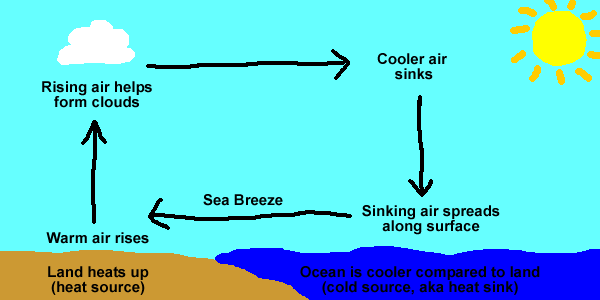
Heat transfer can also occur by the process of convection. In this case, heat energy is transferred by a movement of molecules. The classic example is hot air rising: on a hot day, air close to ground absorbs heat from the earth’s  surface, expands, and rises because it has become less dense than other air. Cooler and denser air then rushes down from above to fill its place, only to be heated in turn and a cycle is set up. As you might expect, this an important method of heat transfer in gases, and convection currents are responsible for everything from sea breezes at shore to major wind patterns around the globe.

Sea breeze close to shore on a hot day

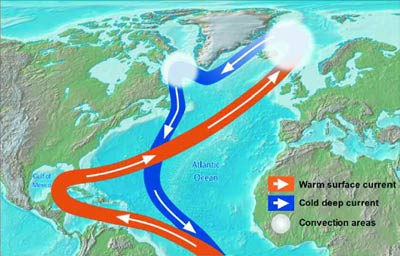
Convection also occurs in liquids: indeed, convection currents are of great importance in the oceans of the world. For example, the seas around Ireland are warmer than might be expected for our latitude. This warming is a result of the famous North Atlantic Drift, a huge ocean current that is part of a giant conveyor belt that delivers heat from the seas off South America all the way up to the seas near Greenland. One of the concerns of global warming is that as the ice caps melt, this current may weaken or even shut down: in which case Ireland and Britain could become very cold indeed!

The North Atlanic Drift keeps Ireland’s climate mild

What is the third process of heat transfer? Well, that is a different story altogether…

3 Comments

Filed under Introductory physics, Teaching

Introductory physics: the fourth state of matter

The relation between heat and temperature (last post) is not always straightforward: in some cases, large quantities of heat can be supplied to a substance without any observable change in its temperature at all!

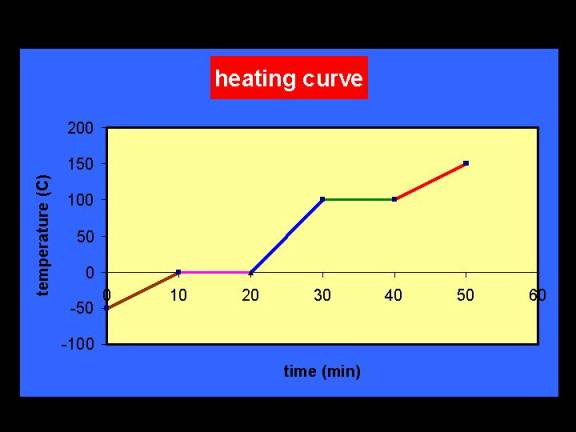
When does this happen? It happens when matter changes state i.e. when a solid melts to liquid, or a liquid changes to gas. In fact, it takes a lot of energy to convert a solid to a liquid even if the solid is at the melting point, and it takes even more energy to convert a liquid to a gas even at the boiling point. Neither of these ‘phase changes’ can happen unless energy is continually supplied and there is no rise in temperature rise during the phase change; for this reason the energy consumed is known as latent heat (from the Latin for hidden). It’s interesting physics and quite fundamental at the same time; for example the liquid/gas phase change requires much more energy than the solid/liquid because the intramolecular forces must be completely broken down (as opposed to being weakened in the solid/liquid case). It’s also fascinating to observe that as a solid gradually melts into liquid, the resulting liquid stays stubbornly at the melting point temperature until all of the solid has undergone the change of state (ditto for gas).

Heating curve for ice: the temperature stops rising at 0 and 100 degrees Celcius during the phase changes

A good example of an application of the physics of phase change can be found in an electric kettle: a sensor detects when the top layer of water begins to bubble and quickly switches off the heating element – as opposed to boiling water in an open saucepan, a wasteful process where a lot of water is converted into useless steam, meanwhile consuming a large amount of energy.

Electric kettle : clever device

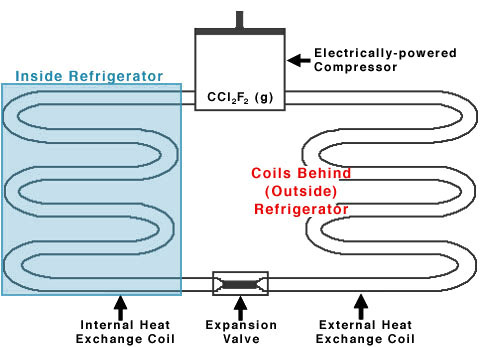
A change of state can also happen in the reverse direction: when a gas changes to liquid, or liquid to solid, energy is released. This process is exploited in the refridgerator, for example.

In a fridge, a gas-to-liquid phase change extracts heat, keeping the fridge cold inside, while a liquid-to-gas change outside the fridge dumps heat

The whole business of state change raises interesting questions about the nature of matter. Why do some substances exist as solids at room temperature and pressure, others as liquid or gas? To answer this requires a discussion of molecular bonding. Another common question is this: if supplying enough heat to a solid gives you a liquid, and eventually a gas, what happens if you keep supplying heat to the gas?

The answer is that if you supply enough energy, you eventually get another phase change as the atoms of the gas become ionized i.e. electrons are stripped off the atoms of the gas. In this case, the gas becomes a plasma, the fourth state of matter. Plasmas are plentiful in nature: a star exists as a plasma, as does lightning and even fire. Plasmas can also be produced in the lab under extreme conditions, for example by laser bombardment or by particle collisions in accelerators.

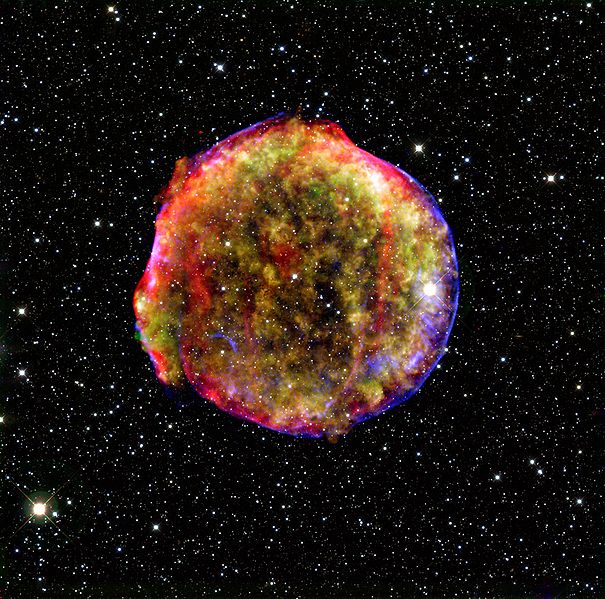
A supernova is not a liquid or a gas but a plasma

Update

Here is a super little YouTube video on plasmas by rock band They Might Be Giants, many thanks MattW


10 Comments

Filed under Introductory physics, Teaching

Introductory physics: heat and temperature

The teaching semester began again at 9.15 this morning. First day back, I’m always struck by how much I enjoy being in the classroom. I think it’s because lecturing is basically a performance, with never a dull moment; anything can go wrong and usually does! I also quite like big classes, it makes for a good atmosphere…

Then there’s the content. This morning 1st Science got to meet Heat and Temperature for the first time. This is my favourite kind of topic – quite simple but of fundamental importance. ‘Heat is a form of energy’, we tell our students, and ‘temperature is a measure of heat’. Actually, the discovery that heat is simply a form of energy was an enormous advance in science, possibly the greatest breakthough of 19th century physics.

And what sort of energy is it? Well, kinetic energy arises due to the motion of molecules (vibration in solids). But there is also potential energy;  since atoms in solids have more-or-less fixed positions in the lattice they have must possess an associated potential energy (so do atoms in liquids for a slightly more subtle reason). So heat is basically a type of internal energy. Except that it’s not always internal; there is also the whole business of heat transfer, a phenomenon that can occur by any or all of three very different mechanisms!

Then there is temperature; a philosopher would have a field day explaining the difference between a quantity that simply is (energy), it’s manifestation (temperature) and human temperature scales. Indeed, the relation between heat and temperature was only quantified with the intoduction of concepts such as specific heat capacity and specific latent heat. Temperature clearly has a fundamental aspect too; for example, what do really mean by absolute zero (or zero Kelvin)? ‘Absolute zero is the temperature at which all molecular motion ceases’, students are told. But what does this mean? Why can’t we reproduce this temperature in the lab? Is -30 Kelvin ( or -303 degrees Celcius) really a nonsense? Fundamental stuff indeed and a nice start to the term…

Achieving the impossible in the lab

Update:

Oops! I thought the dial read zero on the LHS but it doesn’t of course. Also, I’m not sure why it reads degrees Kelvin, there is no such thing.

2 Comments

Filed under History and philosophy of science, Introductory physics, Teaching, Third level

Those pesky exam corrections

It’s nice and quiet around college this week as the students aren’t back yet. However, this is also correction week since the semester exams took place before the Christmas break (one of the by-products of semesterisation is that we now get to correct twice a year). Most academics detest exam correction but actually I don’t really mind that much – it always takes less time than expected (unlike research) and I like a job that has a definite beginning, middle and end with room for targets and treats along the way. I’ve also learnt a few tricks over the years…

Oh joy

First, I like to correct in series i.e. student by student. Some lecturers claim it’s easier to mark objectively if you correct in parallel i.e. correct all the first questions, then all the second questions etc. However, it’s definitely trickier to tot up the marks at the end this way. It seems to me that there is less chance of marks being overlooked (the real worry) if a script is corrected question by question because you get a feel for how a particular student is getting on as you plough through the script…and it’s also more entertaining. Another trick is to sort the scripts alphabetically before you start – it’s fun working your way through the alphabet, planning for lunch between the Gs and the Hs (bonus marks for students with unusual initials!).

In our college, exam scripts are corrected by name and the students often campaign for anonymous marking. Little do they know that from a teacher’s perspective, it’s much harder to fail a person than a number, particularly if you know that student made a decent effort during the semester. Indeed a great deal of correction time goes on trying to squeeze in a few extra marks for the borderliners; if anything, I would expect pass marks to drop if anonymous marking was introduced.

A decent effort?

Right now, there is quite a row going on in the Institute of Technology sector concerning payment for exam correction. It may come as a surprise that IoT lecturers are paid extra for correcting exams (not very much). I suspect the situation originally arose because secondary teachers are paid to mark the Leaving Certificate and  IoT lecturers are represented by the same union.

Anyway, that payment is now under threat and I’m not sure what to make of the debate. What is certainly unfair is that some lecturers have hundreds of exams to correct due to large class sizes, while others get off lightly. Perhaps a sensible solution would be for the Institutes to intoduce payment that starts after the first hundred scripts. However, I suspect that as 3rd level cutbacks bite deeper, payment for exam correction will become a thing of the past..

Comments Off on Those pesky exam corrections

Filed under Teaching, Third level

Retro particle physics at CERN

Passing through Geneva airport on my way skiing last week made me think of the Large Hadron Collider. The recent news from CERN has been very good. Quietly and without fuss, the LHC got back into business last month and in the brief period before the Christmas powerdown,  a great many elementary particles were detected (‘rediscovered’) whose original discovery took years of labour. It’s very satisfying to see science repeat itself like this – a retro tour of the Standard Model before the stage is set for the next step. And the news on the next step is also good as the Collider has already broken several new energy records, finally bringing us into a new regime of high energy physics. Below is a nice summary of what has been achieved so far, taken from Jim Pivarski’s blog The Everything Seminar – I think it gives a really good insight into how particle physics is done.


Earlier today, the LHC finished its 2009 run.  They did everything they said they were going to do: provide physics-quality 900 GeV collisions and break the world record by colliding protons with a combined energy of 2.36 TeV (that happened Monday), as well as many other studies to make sure that everything will work for 7 TeV collisions next year.  We’ve been busily finding the familiar particles of the Standard Model— I wrote two weeks ago about the re-discovery of the π0; since then new particles been dropping in almost daily.  I’ll explain some of the already-public results below the cut, but first I want to point out that there will be another LHC Report this Friday at 12:15 (European Central Time = 6:15 AM Eastern U.S. = 3:15 AM Pacific) on CERN’s webcast site.  This is where all of the LHC experiments will present their results and probably make a few more public. In the past month of LHC running, we’ve seen evidence or hints of the following particles:

Particle Original discovery
Muon 1936
Pion 1950 (π0)
Kaon 1947 (KS)
Lambda 1947 (Λ0)
Quarks and gluons (partons)* 1968 et seq
J/ψ candidate* 1974 “November Revolution”

* The two with asterisks require qualification: see below.

The muon is an easy one: as soon as the tracking detectors were turned on, they saw muons raining down from cosmic rays. CMS collected hundreds of millions of muons in a month-long campaign in 2008, the basis of 23 detector-commissioning papers submitted to JINST (a personal point for me, since I edited one of those papers).  Muons originating from proton collisions are more rare, but were observed.

The neutral pion (π0) was seen in the first 900 GeV LHC collisions this November.  Most of the charged particles produced in proton collisions are also pions (π+ and π), and the tracking detectors saw plenty of tracks originating from the collision point as well.  But the first LHC run required the experiments’ magnetic fields to be turned off to avoid complicating the orbits of the proton beams, and this meant that all of the tracks from charged collision products were straight lines, providing little information about their momenta.  The energy of the two photons (γγ) from neutral pion decays (π0→ γγ), measured by calorimeters, gives us a handle on the mass of the parent particle, and therefore confirm it definitively as a π0.

The December run was conducted with full magnetic fields, allowing for some precision tracking.  Two absolutely beautiful resonance peaks came out of that: KS → π+π and Λ0→ π+p0→ πp+.  (These are the ones that I know have been approved by the collaboration so far: there’s a nice article on them in the CMS Times.)

Much like the π0 peak, the distributions above are the mass of the particle from which the pair of charged pions (top) or proton-pion pair (bottom) were assumed to originate.  The calculation is pretty simple: in special relativity, the relationship between mass (m), energy (E), and momentum \vec{p} is

E^2 = m^2 + |\vec{p}|^2

so

m_{\mbox{\scriptsize invariant}} = \sqrt{(E_1 + E_2)^2 - |\vec{p}_1 + \vec{p}_2|^2}.

The distributions above are histograms of m_{\mbox{\scriptsize invariant}}, calculated for pairs of observed particles (1 and 2).  More charged pion pairs have an invariant mass of 0.497 GeV than would be expected from random combinations, so we see a K-short peak (KS) on top of a low, flat background.  Similarly, pairs of protons and π, and of antiprotons and π+, pile up at 1.116 GeV, the neutral Lambda (Λ0) mass.  Red lines are fits to the distributions and the blue lines are the masses measured from experiments before the LHC.

When I flew home from CERN yesterday, I couldn’t resist and brought a reduced sample from the dataset with me on the plane.  Poking around, finding vertices where pairs of charged particle tracks intersect and calculating their masses, I saw our two friends KS and Λ0 and tried looking for more.  It reminded me of why I became an experimental physicist: these things really are there!  The guy next to me on the plane asked if I was programming, and I had to say, “not exactly,” because even though it looks like computer work, it’s reaching beyond the computer to something physical, if not tangible, that was happening inside a beryllium beampipe in France.  The beam quality was better in some runs than others, and you could see that in the backgrounds.

Quarks and gluons (collectively called “partons”) have a weird history in that they were considered computational devices before the physics community begrudgingly, then whole-heartedly, considered them real particles.  The three “colors” of quarks and three anticolors of antiquarks were a physicist’s mneumonic for the algebra of the Lie group SU(3), with the 8 two-colored gluons being the group generators.  The problem with their interpretation as particles was that single quarks and single gluons were never seen in isolation, a phenomenon today known as confinement: a single quark can’t get away from other quarks without creating more quarks in the processes, and so a high-energy quark or gluon fleeing the proton collision “hadronizes” into a pack of hadronic particles.  It’s important to therefore be able to identify groups of particles originating from the same quark or gluon, called jets.  Here’s a nice candidate for a two-jet event:

The wireframe cylinder shows where the tracking detector is, with the yellow lines being tracks of charged particles from the collision.  On top of that, red and blue bars show where the calorimeters (surrounding the tracking detector) registered energy.  The tracks and calorimeter energy are clustered into two apparent jets, indicated by the yellow cones.  This is as much of a quark or gluon as nature will ever allow us to see.

On Monday, the LHC gave the experiments a few hours of record-breaking 2.36 TeV collisions.  At high collision energies, the production rate of more massive particles increases.  One intriguing event from this run contains not just one muon, but two.  Moreover, the invariant mass of this pair is 3.03 GeV, consistent with J/ψ→μμ, where the J/ψ mass is 3.097 GeV.  This event alone is not a “J/ψ observation” because other processes yield muon pairs— imagine one of the invariant mass plots above with a single event in it.  That event has the right mass to be in the peak of the distribution, though.

This display shows three views of the event, including the muon detector measurements that identify the two long, red tracks as muons.  Of all the stable charged particles that originate in proton collisions, only muons pass through enough steel to reach the muon detectors.  Thus, seeing anything at all in these detectors, matched to a track in the central detector, is a pretty clean muon identification.

Some of the (older) professors I worked with in grad school told stories about the November Revolution, the 1974 discovery of the J/ψ that changed particle physics overnight.  Up to that point, all of the major ideas of the Standard Model had been expressed in one form or another, but had not jelled into the single picture we know today.  One of these ideas was that the strange-flavored quark should have a charm-flavored counterpart— a patch on the quark theory to avoid neutral flavor-changing decays through Z bosons that were not observed (the GIM mechanism).  The dramatic J/ψ resonance discovered months later (thousands of events with little background) could only be explained as a charm-anticharm bound state, which lent a lot of credibility to the quark model for making such a prediction, and made W and Z bosons concievable, as long as there’s also a Higgs boson to generate their masses— one by one, the pieces of the Standard Model fell into place.  According to James Bjorken, the whole theory was complete by 1976, though people tell me that they weren’t convinced until the early 80’s when W, Z, and gluon jets were observed.  It turned the field from a collection of puzzling observations into a Theory of Almost Everything, and a search for hints of physics beyond the Standard Model.

Hopefully, we’ll get back into the business of puzzling observations soon enough.  

Jim Pivarski 


 UpdateYou can find a slightly updated version of this on a more recent post on Jim’s blog 


Comments Off on Retro particle physics at CERN

Filed under Particle physics

Skiing in Tignes

College holidays fell early this year so I’m taking my ski holiday before Christmas. On the web last week, I saw a cheap last-minute chalet offer at Tignes, a well-know ski resort in France that is very high so off I went.

So far it’s worked out really well. The ski conditions are very good and there are few other skiers around. No queues and no crazies. One surprise is that the chalet is not actually in Tignes itself but in a village 20 kms away. There are pros and cons to this; it makes it harder to hook up with friends and guides in the Ski Club of Great Britiain as the lifts open late and close early. On the other hand, the village is a far nicer place than Tignes town and there are plenty of people to ski with in the chalet. Even better, I’m staying in a lovely little house in the woods and go down to the main chalet for meals and socializing…perfect.

The village of Les Brevieres near Tignes

Up until now the weather has been beautiful if very cold. Today, the temperature drooped to -26 degrees up top (3000m) which was a little uncomfortable. We stayed on the slopes facing the sun as much as possible but one of our party very nearly got a mild case of frostbite.

The eye of the needle near Tignes

Meanwhile, the recent news from the CERN is good (passing through Geneva airport made me think of the LHC). Last week the collider broke several new energy records, finally bringing us into a long-awaited new regime of high energy physics. Even in this brief period before the Christmas powerdown. a great many particles were detected (‘rediscovered’) whose discovery originally took years of labour. That’s the thing about science, it’s cumulative – each step affirms the former. This is such a nice story, I’ll do a separate post on it in few days.

In a different life, I would be heading off to CERN at Christmas instead of the slopes!

3 Comments

Filed under Skiing

The last Darwin lecture and the real ‘Origin of Species’

College finished on Friday with what must have been one of the last of this year’s Darwin lectures. (In case you’ve been living in a cave, 2009 was the 150th anniversary of the publication of Darwin’s ‘On the Origin of Species’ and there have been events all over the world to mark the occasion). I caught a few excellent talks on Darwin at the Faraday Institute in Cambridge last summer (see posts here) but it was good to hear one in our own college; ‘The Life and Legacy of Charles Darwin’ by Eoin Gill of WIT’s CALMAST centre for the communication of science. This was a short, informal lunchtime talk but it covered all the main points:

– the life and work of Erasmus Darwin (Charles’s grandfather) including his ideas on evolution

– Charles’s family background, his early career at Cambridge and the influence of Rev Henslow

– the famous Beagle voyage with Capt Fitzroy and the emergence of Darwin the collector

– the return to Britain and the finch exhibition

– the slow dawning of the theory of naural selection

– family tragedies and the long quiet

– the letter from Wallace and the advice of friends at the Royal Society to publish simultaneously

– the publication of the book, the effect on society and the Huxely/Wilberforce debate

– modern genetics and further support for natural selection

You can view the slides from Eoin’s talk here.

Sadly, resistance to the theory of evolution by natural selection remains as strong as ever in some parts of the world, despite the overwhelming supporting evidence for the theory. As Richard Dawkins points out, it seems that those who insist on a literal reading of the Bible cannot and will not be dissuaded by scientific evidence contrary to their views. I heard a lot on this point last summer at the Faraday Institute in Cambridge, it was interesting to hear eminent theologians crticizing creationism just as much as scientists.

Just this week, a curious book was circulated in our own college – an abridged version of ‘On the Origin of Species’ published by creationist group ‘Living Waters Ministries’ that omits several chapters of the original and includes a bizarre religious introduction that attacks Darwin. Sigh…

The Living Waters version …I prefer the original

Comments Off on The last Darwin lecture and the real ‘Origin of Species’

Filed under History and philosophy of science, Science and society

Last week of term and Fulbright

This week was pretty crazy; as well as the last day of the teaching semester in our college, Friday marked the deadline for Ireland-US Fulbright fellowship applications.

All week, I’ve been giving wrap-up lectures in my courses to nervous students, not to mention pep-talks on revision and exam techniques to first years. Next week, the latter will face their first exam after only 12 weeks in third level. This is the downside of modularisation: for students newly arrived in college, that first semester goes very quickly and many of them will falter at the first fence.

At the same time, I myself have been busy with an application for a Fulbright fellowship. This seems to be a very enlightened program, offering academics around the world the chance to take a year out to spend time on a research project at a US institution. In my case, I have applied to spend some time at the BEYOND Centre of Arizona State University. I’ve been working on a book on big bang cosmology aimed at the public for some time now and the fellowship could offer the opportunity to take time out from fulltime teaching to concentrate on the book in a really stimulating environment.  The application process is quite rigourous – I don’t think I would have managed it in time for the deadline without help from our college research office!

The BEYOND Centre for Fundamental Concepts in Science at ASU is a really interesting research centre where foundational research in cosmology is combined with a philosophical approach to the subject. In addition, they have a strong activity in public outreach. Indeed, the centre boasts staff like Paul Davies and Lawrence Krauss, both well-known science writers as well as renowned physicists.  In addition, the centre is located close to several world-famous observatories. I’m not sure there’s a centre anything like BEYOND anywhere in Europe, never mind in Ireland.

Of course, the competition for the fellowships will be stiff as they are very prestigious, so fingers crossed..

President Clinton presents the Presidential Medal of Freedom to Senator  J.William Fulbright

Comments Off on Last week of term and Fulbright

Filed under Science and society