Institute of Physics (Ireland) Spring Weekend

The teaching term ended with the Spring Meeting of the Institute of Physics in Ireland. These annual IoP weekends are quite unique as they are more relaxing than a technical conference and a great way of keeping in touch with physicists from all over Ireland. At the same time, there are usually plenty of good talks on general topics and this year was no exception. As ever, as well as the seminars, there was a physics pub quiz on Friday night, an enjoyable conference dinner on Saturday and a highly competitive postgraduate poster competition throughout the weekend (the winners are listed on the meeting website above).

The theme of the 2010 meeting was particle physics and a strong program of talks was offered on Saturday: a brief history of 20th century particle physics (by Peter Kalmus of UCL), a description of last year’s accident at the LHC (by Steve Myers, director of accelerators at CERN), a description of the upcoming experiments at the LHC (by Ronan McNulty of UCD and the LHCb experiment), an overview of recent developments in measurements of the cosmic microwave background (by Hiranya Peiris of UCL), and a brief summary of applications of particle physics in medicine (by Lynn Gaynor of the Mater Misercordiae University Hospital). You can see the full programme on the IoP website.

Lecture Summaries

I thought it was a really good idea to start with a general overview of particle physics and Peter Kalmus didn’t certainly didn’t disappoint. Starting with a slide on Rutherford’s discovery of the nucleus, Peter traced the evolution of particle physics from 1911 to the 1970s. From the beginning, he placed great emphasis on the relation between theory and experiment, and between the fundamental forces and particles, explaining how neutrinos were ‘invented’ (predicted) by Pauli and pions by Yukawa, and describing the subsequent experimental discovery of these particles. Then it was on to the particle zoo of the 1950s, where unexpected and unwanted new particles were suddenly being discovered regularly and experimentalists ‘faced the prospect of paying a fine”! The simplification of the new particle physics by the development of quark theory by Gellman and Zweig was explained and the discovery of evidence for quarks in the famous scattering experiments at SLAC described. Finally, Peter explained the prediction of new heavy particles (W and Z bosons) from the elecro-weak unificaton program of Salaam, Glashow and Weinberg and went on to decribe his own role in the discovery of these particles in the famous CERN experiments.

Steve Myers stared his talk with one of my favourite slides (below), explaining succintly the importance of the TeV energy range for both particle physics and cosmology. He gave a brief overview of the engineering challenges involved in achieving beam collisions at that energy, touching on almost every aspect of engineering technology imaginable, from the civil engineering projects in the tunnel build to the use of superconducting magnets for beam bending, and the challenges of maintaining the extremely low temperatures and extremely high vacuum necessary for the experiments. He then gave an overview of last year’s accident and the steps taken to repair the damage and ensure such an event does not re-occur  (and yes, it did come down to one joint that was simply not soldered, although other faults were subsequently found). All in all, Steve’s talk was a salutary reminder that the LHC is not just a large scale experiment, but a whole industry.

BB time/energy line: note how the LHC energy is only slightly higher than the Tevatron, while cosmic ray collisions are much more energetic

Ronan Mc Nulty then gave a brief overview of the how and why of the experiments that will be done at the LHC. Central to this talk was an explanation of the role of symmetry in particle physics. By slid three, Ronan was talking about Noether’s theorem – a theorem of fundamental importance in physics that states that for every observed symmetry in physics, there is a corresponding law of conservation. He then moved on to the difference between local and global symmetries and how the masses of the W and Z bosons suggest an extra field in nature – the famous Higgs field. In the second part of his talk, Ronan explained the experimental approach of the four experiments at the LHC and how the LHCb experiment differs by talking a tangential slice of the beam rather than the cross-sectional ”cathedral’ approach of the larger detectors. He finished with an overview of possible discoveries at the LHC, including candidates for dark matter. I couldn’t do justice to Ronan’s succinct talk,  but you can find the slides on the IoP website.

Dr Hiranya Peiris then gave a talk on current measurements of the cosmic background radiation and how they constrain models of cosmic inflation. This was a timely reminder of the connection between cosmology and the world of particle physics. As particle accelerators reach higher and higher energies, we can create and study particles that have not existed since shortly after the Big Bang; similarily, there is much information for particle physicists in the study of the cosmic background radiation. It is often forgotten that the basic idea of inflation was first postulated by particle physicist Alan Guth in order to address a problem in grand unified theory (the lack of obsevation of magnetic monopoles). Dr Hiranya’s talk was extremely clear and to the point;I won’t say more on it here but you can find the slides on the IoP website.

The final talk of the day was a seminar on applications of particle physics in medicine. Medical application is often quoted as one of the major spinoffs of particle physics, so it was good to hear a full talk on the subject. Dr Lynn Gaynor brought us up to date with a description of advances in X-ray imaging, radiotherapy, nuclear medicine and positron emission tomography. She finished the talk by pointing out that medical physics is a very exciting career opportunity for a physicist, with a workload including the administration of physics-based therapies for patients, the teaching of radiation physics courses to medics and the involvement in innovative research projects.

Physicist in the Chair

On Sunday morning, the ‘Physicist in the Chair‘ session featured Prof Alex Montwill, Ireland’s best known particle physicist. It was a highly appropriate choice as Alex was one of the very first Irish scientists to work at CERN and led a particle physics group at UCD for many years. It was a fascinating interview, with the legendary Tony Scott of UCD giving Alex the ‘This Is Your Life’ treatment, from his flight from Latvia after the war to Ireland, to his career at UCD. This was also another mini-talk on the history of particle physics, as Alex described the role of his group in the discovery of kaons. [The direct successor of that UCD particle group is the current group led by Ronan Mc Nulty that has a major involvement in the LHCb experiment, see above]. Alex taught legendendary 4th year courses in quantum theory and particle physics at UCD for many years and his thoughful approach spawned a whole generation of students interested in the philosophy of quantum physics. The interview also touched on Alex’s activities in the communication of science; an expert chess and international bridge player, he became very well known as a communicator of science through the radio series ‘The Laboratory of the Mind’ on RTE Radio 1. Alex also recently published the popular science book ‘Let there be light’ with Anne Breslin (more on this here).

Panel discussion

The weekend finished with a panel discussion on Irish membership of large scale scientific instruments, chaired by IoP President Dame Jocelyn Bell-Burnell (Ireland is not a member of CERN or of the ESO). The panel comprised four physicists: Dr Sheila Gilheany of the IoP, Dr Paul Callanan of University College Cork, Dr Kevin McGuigan of the Royal College of Surgeons and myself. Each of us gave a 5 min presentation of reasons for and against and questions were then taken from the floor. Of course, you might expect a roomful of physicists to be broadly supportive of the idea and so it transpired (although Kevin made some cogent arguments against, which I won’t describe here). My own argument was that Ireland cannot afford not to join such facilities for four reasons:

1. Experimental – small countries simply don’t have the facilities for big science, so this is our only way to do it

2. People – it is very important that our best young scientists get to train and work with the very best

3. Knowledge industry – large scale contracts in advanced technology (software and hardware) are awarded primarily to members

4. Politics – CERN and ESO are examples of historic and successful co-operation between different European nations that Ireland should not snub

All in all, it was a super weekend, courtesy of the Institute of Physics. Next day, I flew to Geneva for a ski holiday: on the same flight were Ronan and Tara of the UCD group and Steve Myers (above), all on their way back to CERN for Tuesday’s switch-on! I was delighted to see the event got frontpage coverage in the French, Swiss and German press the next day (if not the British, see post below).

Comments Off on Institute of Physics (Ireland) Spring Weekend

Filed under Institute of Physics, Particle physics

Switzerland

This week I’m back in Zermatt, Switzerland, one of my favourite ski resorts. Teaching term ended on March 29th and then it was straight into the Spring Weekend Meeting of the Institute of Physics in Ireland (more on this in next post). I figured I’d be in need of a good holiday after all that so I booked myself a week’s skiing in Zermatt, the famous little town just below the Matterhorn.

On the Dublin-Geneva flight on Monday morning, I found myself sitting next to ‘Lord of the Rings’ Steve Myers! Steve is the director of accelerators at the Large Hadron Collider at CERN; he gave us a fascinating overview talk of the LHC operation at the weekend IoP meeting, so it was certainly an interesting flight..

Gornergrat station and observatory with the Matterhorn in the background

Here in Zermatt, the snow is fine both on- and off-piste, if a bit icy in the mornings and a bit slushy in the afternoons.The Ski Club of Great Britain are here in force as ever, with two different reps, and I’ve been doing plenty of off-piste powder skiing with them  in safe conditions.  It really is a unique service they offer, perfect for the skier who arrives out solo. Not to mention a ready-made gang of fellow skiers to hang out with after skiing..

Off-piste at Stockhorn

Re skis, this year I’ve deserted twin-tips for the Rossignol ‘funski’ – however although they’re lovely and light on the moguls, they’re not really heavy enough for the deeper snow off-piste. Tomorrow I’ll change to a heavier, allround ski by Atomic, best for variable conditions on and off piste.

Zermatt Hauptstrasse

Zermatt itself is as gorgeous as ever, the archetypal Swiss ski resort, with superb restaurants, no cars and unbelievable views. I often come down off the mountain quite early, just to stroll up and down the Hauptsrasse and look at the sights.

News

Tuesday’s LHC switch-on got very good coverage in the French, German and Swiss newspapers on Wednesday. All the big nationals had a picture of the LHC control room on the front page, backed by well written, informed articles. The Irish Times also had a front page picture and some nice articles (including one quoting me on the question of Irish membership of CERN: apparently I’m an eminent scientist) but there was very little coverage in the British papers. As for the Americans, the International Herald Tribune had quite a jaundiced article, emphasising all the faults and delays, explaining none of the science and questioning the rational of the experiments…hmm.

Update

The conditions in Zermatt are so good I’ve stayed on an extra week. Between powder snow, sun and clear skies, it’s hard to leave. Even my hotel is closing for the season today and they’re moving us dedicated skiers to a different place for the rest of the week! I never did change the Rossignol 8O funskis, they just got better an better. Sadly, one of our party twisted a knee in a mogul field yesterday and got helicoptered off; I’m pretty sure that wouldn’t have happened on a softski. Ah well, them’s the risks..

4 Comments

Filed under Skiing

Introductory physics: refraction

Light can be refracted as well as reflected: in refraction, light is transmitted, but changes direction as it passes from one medium to another. This familiar phenomenon occurs because light has different velocities in different media. The behaviour can be explained using wave theory but luckily the main results can be described using simple geometrical optics.

The tube appears bent because of the refraction of light

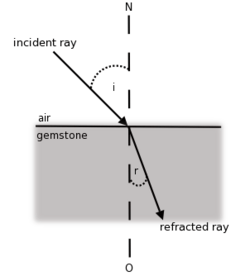
It can be shown that when a ray passes from one medium (1) to another (2) that is denser, the ray of light is bent towards the normal to the interface – and when a ray passes from a medium to a less optically dense one the ray is bent away from the normal. More quantitatively, the angle of incidence i (the angle between an incident ray and the normal) and the angle of refraction r (the angle between the refracted ray and the normal) are related by the simple equation

sin i/sin r = n2/n1

where n is a property of a medium known as its refractive index (related to the velocity of light in the medium)

Sell’s law: sin i/sinr = n2/n1

Note the reversibility of light: if a ray bends closer to the normal upon entering water, it bends further from the normal upon leaving it i.e. all the diagrams work in either direction.

Some typical values for the index of refraction are:

Substance n
Air 1.00
Water 1.33
Glass 1.50±
Plastic 1.40±
Diamond 2.42

Apparent depth

One consequence of refraction is the phenomenon of apparent depth; essentially, this means that a pool of water is deeper than it appears. From the simple diagram below, you can see why (remember the observer sees the image as the intersection of the two diverging beams).

The apparent depth is always shallower than the real thing, so perhaps it should be renamed apparent shallowness! It is just as well nature works this way round – if water was shallower than it appears, children would crack their heads every time they dived into a swimming pool.

Total Internal Reflection

A curious phenomenon can occur when light travels from a dense medium to a less dense one. Since a ray of light is bent away from the normal as it enters a less dense medium, it follows that at some critical angle of incidence, the refracted ray can be 90 degrees to the normal, i.e. travel along the boundary between the media. Further, rays at angles of incidence larger than the critical angle will not transmitted at all, but reflected back into the first medium. This phenomen is known as total internal reflection; the phenomenon is exploited heavily in telecommunications, where waves are transmitted undiminished over large distances in optical fibres.

TIR: at large angles of incidence, the light is simply reflected back into the medium

PROBLEMS

1. If a ray of light enters water from air at an angle of incidence of 60o, calculate the angle of refraction from the table above.

2. If a person looking down vertically into a pond sees a fish apparently 18 cm below the surface, calculate the actual depth of the fish in the pond.

3 Comments

Filed under Introductory physics

Introductory physics: focusing mirrors

Focusing mirrors are mirrors cut from a parabola of reflecting material; the parabola is fabricated in such a way that distant rays will be bent through a single point i.e. the focus of the mirror. In fact, there are two types of curved mirrors; converging mirrors made from parabolas that are concave in shape , and diverging mirrors that are made from parabolas that are convex. In either case, the focal length of the mirror is half the radius of the sphere from which it is cut.

From the diagram below, you can see that in the case of a converging (concave) mirror, parallel rays are focused down to an image at the focal point (this is the point of such a mirror). In this type of mirror the rays reflected by the mirror actually pass through F and it is therefore a real focus.

Converging (concave) mirror

By contrast, parallel rays appear to come from a focal point behind the mirror in the case of a diverging mirror. i.e. the focus is virtual.

Diverging (convex) mirror

There is a simple set of rules to follow when finding the position of an image in curved mirrors:

1. Rays parallel to principal axis are reflected through the principal focus

2. Rays through the principal focus are reflected parallel to the principal axis

3. Rays passing through the centre of curvature are reflected back along their own path

These rules are not mysterious but smply a result of how the mirrors are fabricated.

In the diagram above, note that the object is close to the converging mirror, but outside of the focal length. Using the first 2 rules above, the intersection of the reflected rays gives the position of the image. You can see the image is inverted and diminished.

Image tracing in a diverging mirror

More quantiatively, for any object a distance u from the mirror of focal length f, the location v of the image can be found from the ‘mirror’ equation

1/u +   1/v =   1/f

Note that there are only 2 variables in this equation since f is fixed for a given mirror. Typically, one uses the formula to find the location of the image of an object a given distance from the lens. One can also calculate the height of the image; this is because the magnification m of the mirror is given by the equation

m =   –v/u

Note: in using both the above formulae, we use the convention that any distance that is real object is taken as a positive.

Correction

Actually, focusing mirrors are cut from parabolic surfaces, not spherical ones – I forgot this. See comment below by Norman.

Problems

1. An astronomer is observing a distant star with a reflecting telescope: use the mirror formula above to calculate where the photographic plate should be positioned. What kind of magnification can one expect?

2. If an object 5 cm high is placed 40 cm in front of a converging mirror of focal length 20 cm, calculate the position and height of the image.  Is the image real or virtual?

2 Comments

Filed under Introductory physics

Introductory physics: reflection

As we saw in a previous post, visible light is simply one portion of the electromagnetic spectrum i.e. visible light consists of electromagnetic waves of a certain frequency travelling at a speed of 3 x 10⁸ m/s (recall also that light can exhibit properties of both waves and particles, a property referred to as quantum wave–particle duality.)

The macroscopic properties of light had been studied for many years before its quantum properties were known. Such properties include transmission, reflection and refraction; the study of these phenomena is known as geometrical optics.

For example, it was realised centuries ago that light travels in straight lines (unlike sound): this can be demonstrated by placing a few pieces of cardboard with pinholes in their centres in a line. On placing a light source in front of A, the light will only be transmitted if the three pinholes are in a straight line.

The light can be seen by the observer if and only if the holes are in a straight line

Using one pinhole, one can form an image of a distant object as shown below: this is the basis of the famous camera obscura.

Rays of light can be convergent, divergent, or parallel. Rays emerging from a source diverge (think of a child’s drawing of the sun); on the other hand, rays arriving at an observer from a distance arrive parallel. Most useful of all, it was soon realised that a good image of an object could be got by causing incoming rays to converge using optical instruments – more on this later.

Reflection

When light falls on a smooth highly polished surface it is reflected i.e. turned back on its path.   A piece of polished metal, or indeed any shiny object makes a good reflector. [One reflecting material that is very much in the news at the moment is ice. The arctic is currently experiencing a global warming more pronounced than anywhere else in the world; this is thought to be caused by the fact that, as the polar ice cap gradually melts to water, it causes a reduction in the reflection of sunlight (water does not relect heat and light very well). This in turn causes further warming, an effect known as a positive feedback loop].

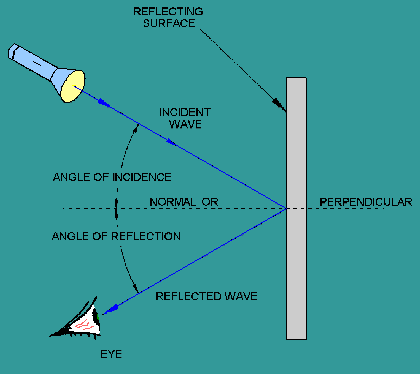
In reflection, a ray of light emerges at the same angle it went in (technically we say the angle of incidence equals the angle of reflection, where both angles are measured relative to the normal to the surface at the point of contact); this makes reflection images rather easy to draw (see below).

Plane Mirror

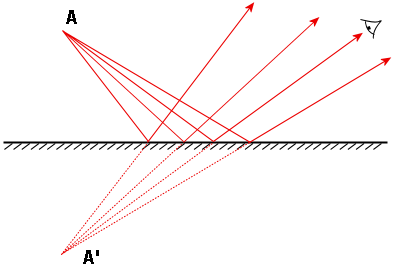
Glass mirrors have a thin layer of silvering deposited on the back of the glass which is protected.   An IMAGE is produced in the mirror.  The location of the image is got by simply the intersection of the reflected rays. A few trials soon show that the image in a plane mirror is always

– the same size as the object and the same way up

– as far behind the mirror as the object is in front

– laterally inverted

– virtual

Virtual images are images which are formed in locations where light does not actually reach. Light does not actually pass through the location on the other side of the mirror; it only appears to an observer as though the light is coming from this location. (The opposite is a real image; a real image can be focused on a screen, whereas a virtual image can not). In the case of the plane mirror the image is virtual because the rays APPEAR to be diverging from a point behind the mirror.

The reflected rays form a diverging beam which APPEAR to come from A’

1 Comment

Filed under Introductory physics

Introductory physics: resistivity

We have seen that if a voltage V is applied to a device, the current I that flows is limited by the resistance R of the device according to I = V/R. Hence a material with high resistance will pass little current (insulator), while a material with low resistance will pass a large current (conductor).

In order to make a meaningful comparison of the resistances of different materials, we need to allow for the fact that resistance depends on how much of the material is present. Hence, we define the resitivity ρ of a material as its resistance per unit length L and cross-sectional area A e.g.

ρ = RA/L

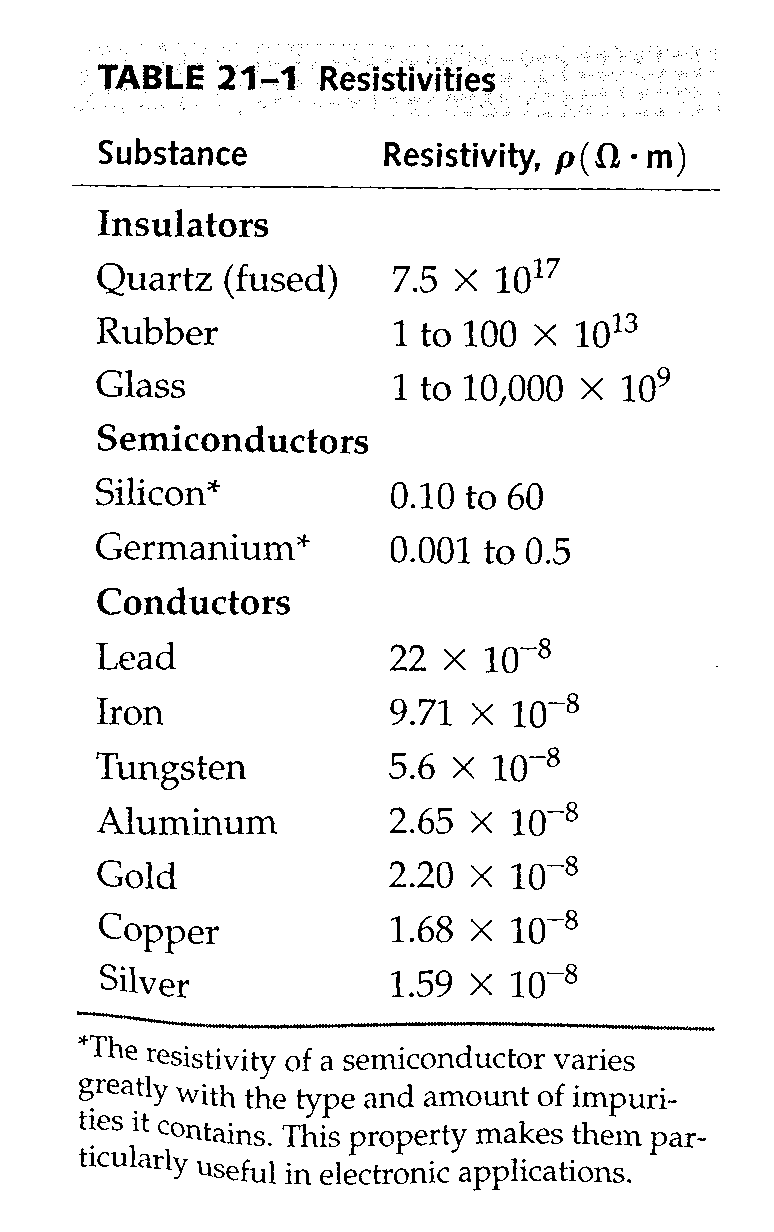
Note that resistivity is a fundamental property of a material, like density. The room-temperature resistivites of some common conductors and insulators are listed below (just click on the table to see it properly)

What is most noticeable is that the resisitivities shown vary over a huge range, from 10+17 Ωm for quartz  to 10-8 Ωm for silver. Amongst solids, metals like silver have by far the lowest resistivities i.e. are the best electrical conductors – this is because the atoms of a metal have many electrons that are somewhat shielded from the nucleus and relatively free to move around. Hence, if a voltage is applied to a metal you have a steady supply of extremely light, charged particles to carry the current from one end to the other. Quartz, on the other hand, is an extremely good insulator because the electrons are tightly bound to individual atoms and there are almost no free charge carriers available for the conduction of electricity.

In between the conductors and insulators on the table lies a very interesting type of material called a semiconductor: these are materials that are normally insulators, but whose resistivity can be dramatically altered by the addition of impurities (doping). Semiconducting materials are extremely important in the manufacture of electronic devices and circuits and lie at the heart of the microelectronic revolution.

***************************************************************************

How is resisitivity measured in the lab? First, you measure the resistance of a material by monitoring the current through it as a function of applied voltage (see previous post). Then you measure the length and cross-sectional area of the material and calculate its resistivity from the formula above.

The slope of the graph V/I gives the resistance and a measurement of length and cross-sectional area is then used to calculate the resistivity

Note

The inverse of resistivity is conductivity, measured in (Ωm)-1. Many tables list the conductivity of materials rather than the resistivity.

3 Comments

Filed under Introductory physics

Introductory physics: circuits

Electrical devices (TVs, stereos etc.) are connected to a voltage supply by an electrical circuit. The only difficult thing about circuits is that devices can be connected either in series or in parallel.

If connected in series, the same current runs through each device since there is no alternative path. However, the voltage across each device is different: from V = IR, the largest voltage drop will be across the largest resistance (just as the largest energy drop occurs across the largest waterfall in a river). As you might expect, the total resistance (or load) of the circuit is the sum of the individual resistances.

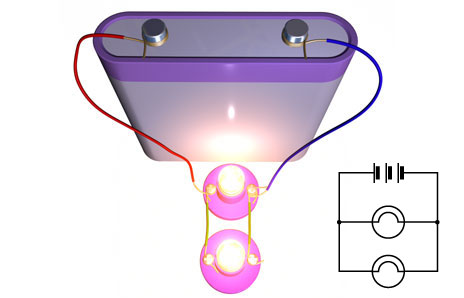
On the other hand, electrical devices can also be connected in parallel. In this case, each device is connected directly to the terminals of the voltage source and hence experiences the same voltage. Here, there will be a different current through each device since I = V/R. A counter-intuitive aspect of parallel circuits is that the total resistance of the circuit is lowered as you add in more devices (the physical reason is that you are increasing the number of alternate paths the current can take).

Parallel circuit: each device is connected directly to the battery terminals

Which is more useful? Household electrical devices are connected in parallel because it is easier (for the manufacturer) if every device sees the same voltage and it also turns out to be more efficient from the point of view of power consumption.

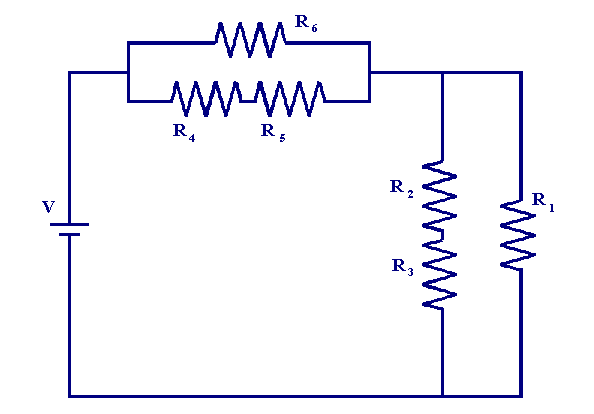
A more complicated type of circuit is the combination circuit: here some resistors are connected in series, others in parallel. In order to calculate the current through a given device, the trick is to replace any resistors in parallel with the equivalent resistance in series and analyse the resulting series circuit.

Combination circuit

Problem

Assuming a resistance of 100 Ohms for each of the resistors in the combination circuit above, calculate the current through each if a voltage of 12 V is applied.

10 Comments

Filed under Introductory physics, Teaching

Introductory physics: the relation between voltage and current

We have established that voltage is simply energy per unit charge (see last post). What then is current and how does it relate to voltage?

Electric current is a flow of charge, just as a river current is a flow of water. By definition, an electric current I is the amount of charge q flowing per second, hence I = q/t . Current is measured in Colombs per second (also called Amperes, see below). However, we noted last day that the charge on the electron is only a tiny fraction of a Coulomb – hence a current of 1 Coulomb per second corresponds to an awful lot of electrons running around. (How many?)

The lamp lights because the current goes through it to complete the circuit

Since charge will only flow if there is a voltage difference between the terminals of a circuit (last day), you might expect that there is a simple relation between voltage and current. In fact, the German scientist Georg Ohm was the first to discover that there is a linear relationship between the two in many materials. Ohm’s law states that the current I passing through a material connected to an energy source V is given by the equation I = V/R. Here, R is the constant of proportionality and is called electrical resistance and you can see why from the equation: a material with a very large value of R will pass almost no current (electrical insulator), while another material with very small R will yield a large current for the same voltage (good electrical conductor).

Many materials have a linear relation between voltage and current – the slope of the graph is the material’s resistance

Notes

1. Ohm’s law is a bit of a misnomer – it is not a universal law of physics but simply a property of some materials (many materials have a nonlinear response to voltage, including your cat)

2. Current can be considered a fundamental physical quantity in its own right and indeed the ampere is defined as a fundmental unit (see here). However, it’s much better to define it in terms of electric charge, since this is more fundamental.

3. Some unfortunate people quote Ohm’s law as V = IR and play silly games with triangles. In my opinion, I = V/R conveys the physics of the situation much more clearly.

4. It seems from Ohm’s law that a material with zero resistance could pass infinite current! No such materials are known, but some materials have extremely low resistance at very low temperatures – known as superconductors. A good application of superconductivity can be found at the Large Hadron Collider, where protons are guided around the ring by magnets made of superconducting material: this reduces power consumption enormously but the snag is that the experiments have to be done at at extremely low temperatures.

23 Comments

Filed under Introductory physics

Introductory physics: voltage

What exactly is voltage? If you ask an engineer, she will probably tell you that voltage drives electric current. And so it does – but what is it? What is its nature? ‘Some sort of energy‘, you might expect. And so it is, although the technical answer is that voltage is electric potential energy per unit charge.

In physics, energy is simply the capacity to do work. Potential energy is the expression we use to convey the fact that an object can have energy simply due to its position or configuration;  a stretched rubber band will do work if released (snap back), as will a compressed spring (spring out), or a brick held aloft (fall on someone’s toe). Indeed, students usually encounter potential energy first in the latter context; any object lifted to a height in the earth’s gravitational field acquires potential energy equal to the amount of work done to get it to that point.  Plus, if you remove the restraint holding it in place, the object will fall and do precisely this amount of work on the ground as it lands (all of its original potential energy is converted to kinetic energy). So you can think of potential energy as work waiting to happen.

A lifted object has potential energy because work was done to get it there; this energy is converted back to work if it is released

Last week, we saw that any electric charge sets up an electric field which will repel like charges and attract unlike ones. Hence it takes work to bring a test charge into the field of a like charge so if we do this we give it electric potential energy ( if you remove the restraint, the charge will rush away). The amount of work done and hence the potential energy acquired will depend on the size of the charge you bring up, so we define instead the electric potential energy per unit charge, also known as the potential. To be strictly correct, potential should be measured relative to something, so physicists talk of potential difference, defined as the difference in potential between the point in question and zero field. Since energy is measured in joules, potential is measured in joules per coulomb or volts and hence potential also became known as voltage. So voltage, potential and potential difference are all the same thing.

In a battery, a potential difference is maintained between the terminals. Charge cannot flow from one terminal to the other because they are not connected. However, if a conducting path between the terminals is provided (by connecting them by wire), a current will flow in the circuit.

A battery and circuit (tnote that the direction of current is defined as the direction +ve charge would move for historical reasons)

More

Since voltage is defined as energy per unit charge, it should be obvious that the product of voltage and charge is energy (or work)  i.e.  W = qV. Thus if a charge of 1 Coulomb is moved through a potential difference of 1volt, 1 joule of work is done.

However, the charge on a single electron is not 1 Coulomb, but a minute 1.6E-16 Coulombs. Hence in the world of particle physics, one typically deals in tiny, tiny amounts of energy. For convenience, we define the unit electron-volt (eV) as the work that is done when a single electron moves through a potential difference of 1 volt.

Question

How many eVs  there are in 1 Joule of energy? The maximum energy achievable at the Large Hadron Collider (LHC) in Switzerland is 14 TeV – show that this corresponds to only 2.2 microjoules of energy. (Note that although this is a small amount of energy, the energy density is enormous because the cross-sectional area of the colliding particle beams is extremely small).

4 Comments

Filed under Introductory physics

Introductory physics: the concept of field

In a first course in physics, it is usually in electrostatics that one first encounters the concept of a field.

Everybody knows that like charges repel, while unlike charges attract. The quantitative version of this rule is Colomb’s law, which is the observation that the force between two electric charges A and B is given by F  =  k.q(A).q(B)/r2 where q represents electric charge and r is the separation of the charges (k is is a constant determined by the medium in which the charges are situated). Note that if the charges are like, the force comes out positive, so a repulsive force is positive in sign, which is what you might expect since work must be done to bring the charges together. On the other hand, if the charges are unlike, the force comes out negative (which also makes sense as the charges want to be together anyway).

However, the concept of force isn’t all that useful if one wants to know the effect of a given electric charge (A) on the world. It is clear from Coulomb’s law above that the force experienced by any charge B due to A will also depend on the magnitude of B i.e. each charge you bring up to A will experience a different force! Physicists get around this problem by defining the field due to charge A as the force a test charge brought up to A will experience divided by the magnitude of that test charge. Hence, while  every charge brought up to A will experience a different force, they will all experience the same field (F  =  k.q(A)/r2) – clever huh?

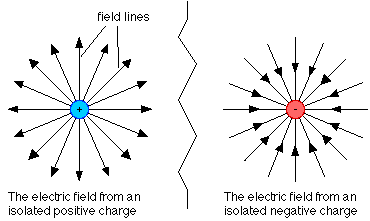
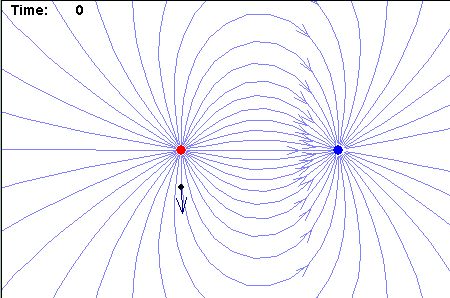
We can even draw pictures of the field due to A, simply by drawing lines representing the direction in which an electric charge will move. Unfortunately, the convention is that we draw the direction a positive charge will move (unfortunate because we now know that it is the negatively charged electron that’s doing the moving: the convention is historical)

Electric field between two unlike charges (red is +ve)

The concept of a field is not limited to electricity; it is used throughout physics. For example, you and I experience slightly different forces due to the earth’s gravity. This is because the gravitational force depends on the product of both the earth’s mass M and personal mass m (F = GMm/r2 where G is a constant). However we all experience exactly the same field: dividing by personal mass, the gravitational field due to the earth is given by GM/r2.


The earth’s gravitational field is directed towards its centre

Note

You may have noticed that the equation for gravitational force above looks very like that for the electric force, with charge replaced by mass (both forces decrease with the square of increasing distance). However, gravity is a much, much weaker force; the gravitation constant G is orders and orders of magnitude smaller than the electric constant k and you only notice a body’s gravitational field if it has the mass of a planet!

That said, it is now believed that there is a deep connection between electricity and gravity; indeed, particle physicists and cosmologists believe that all four of the fundamental forces of nature (gravity, electromagnetism and two nuclear forces) originally formed one superforce, which gradually split off into four separate forces as the uiverse expanded and cooled. We already have strong theoretical and experimental verification that two of the fundamental forces originally comprised one force, and it is one of the great ambitions of theoretical physics to describe all four forces in a single mathematical framework (unified field theory). Within that program, one of the great puzzles is why the gravitational force is so much weaker than all the others.

6 Comments

Filed under Introductory physics