This week, RTE (the national broadcasting authority of Ireland) aired a program on climate change. ‘A burning question‘ was an hour-long TV documentary on climate science, climate scepticism and the role of the media in this debate. The program was produced by Earth Horizon Productions, directed by Paula Kehoe and edited by Dónal Ó Céilleachair. I watched the program out of general interest and was intrigued to see my name listed in the credits (I think this arose from several discussions I had with Dónal).
I thought the program very good overall, with some reservations. It’s hard to cover such a topic in an hour, so the producers employed some media tricks that few scientists enjoy. I’m not sure cutting to a vox pop every few minutes throughout the program casts much light on the subject matter (besides, are the opinions of random individuals stopped on the street a reliable gauge of the view of the general poulation?). Secondly, the constant switching from expert to expert in a cyclic merry-go-round of byte-sized interviews tends to confuse rather than elucidate. Thirdly, I thought the program could have had more on climate skepticism (see below).
That said, the core of the program was solid. The main presenter was Duncan Stewart, an award-winning architect and environmentalist well-known for his excellent TV series Eco-Eye. There were some very good interviews, notably with heavy hitters such as former UN High Commision Mary Robinson, UN Secretary General Ban Ki-Moon and IPCC Chairman RK Pachauri.
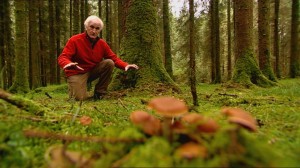
Duncan Stewart of Earth Horizon Productions
The key scientist of the program was superb; Peter Lynch, a leading climatologist at University College Dublin, gave the lie to the old media adage that experts make poor communicators. Professor Lynch explained the basic principles of the enhanced greenhouse effect in exemplary fashion, starting with the work of pioneers such as Fourier, Tyndall and Arrhenius, and finishing with modern measurements of carbon dioxide emissions and surface temperatures. Interesting that the best way to explain science is often to describe it in chronological order of discovery!


Prof Peter Lynch of UCD
There were many other good contributions in the program; in particular from the environmental writer John Gibbons (on the societal impacts of climate), from Professor John Sweeney (Professor of Geography at UC Maynooth and member of the IPCC) and from economist and boadcaster David McWilliams (on the economics of climate change). One of the most lucid summaries was given by former UN High Commisioner Mary Robinson – describing the expected impacts of climate change on the poorest societies in the world, and the importance but difficulty of concerted international action, she left one wishing other politicians had as good a grasp of the subject.

Prof Mary Robinson, former UN High Comissioner
Justin Lewis, a Professor of Journalism and Media Studies at Cardiff University, talked a little about the role of the media in the public perception of climate science. He explained the basic problem clearly; that in the media’s attempt to present a balanced debate view, the observer is left with the impression of a great 50/50 debate between experts, rather than the overwhelming consensus that exists. This is the familiar problem of a ‘balanced debate’ in the media that pays no attention to weightings. Lewis also touched on ‘climategate’, contrasting the great publicity afforded to the hacked East Anglia emails with the minimal media attention given to the results of the subsequent enquiry (the ‘perpetrators’ have since been exonerated).

Prof Justin Lewis of Cardiff University
I thought this section very interesting, but there could have been more: for example, there was no mention of the obvious point that “Scientists Right!” is not much of a media story, while “Scientists Wrong!” is. By definition, the minority viewpoint will always get more publicity, a fact the public should be made aware of. I also thought that more time could have been spent on the analysis of the role of journalists. Given the dominance of the media in our lives, this is a key issue in the pubic perception of science (and of anything else). In particular, there was no mention of the issue of political bias. Much of the climate scepticism in the US media is driven not by business interests, but by journalists of a particular political viewpoint: the viewpoint of right-wing conservatives who oppose government regulation and taxation in all forms.
In general, I thought the program could have had more on climate skepticism, rather than simply dismissing it as ‘vested interest’. In my opinion, there are at least five distinct categories of skepticism (with many overlaps):
(i) A tiny minority of genuine scientists with no links to industry or politics (such as Freeman Dyson or Richard Lindzen), who remain unconvinced of the scale or extent of man-made warming. Such minority opinion is important, but exists for almost every scientific theory (an obvious fact that is almost never stated in the media).
(ii) A larger group of economists, political scientists and intellectuals such as Bjorn Lomborg who remain unconvinced. This community are strong on economics but they are not scientists and rarely understand the reliability (and limitations) of experimental measurements – another fact that is rarely highlighted in the media.
(iii)A huge community of commentators, journalists and bloggers who seem to have almost no appreciation of the difference between random, informed, and expert opinion. A great deal of these reject the opinion of the majority of scientists as biased and subscribe to all sorts of ‘rent-seeker’ conspiracy theories.
(iv)The vested interests of big business; as in the case of the tobacco lobby, there are still climate scientists who are paid to believe what they believe
(v)The political viewpoint of conservatives and anti-regulation interests; I suspect this last sector is much more influential than is generally realised.
Overall, I enjoyed the program very much – it’s hard to cover everything in one hour. I nearly fell off the couch when I saw my name in the credits!
Update
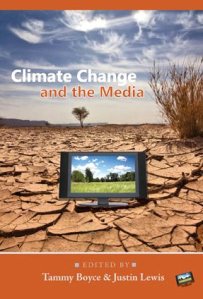
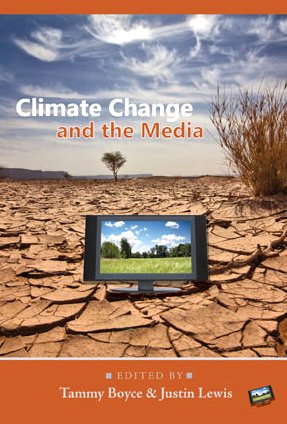
Justin Lewis has a book out on climate science and the media – ‘Climate Change and the Media’ looks well worth a read











 Antimatter