No man-made global warming in Ireland, thank you

My letter on global warming in The Irish Times (see post below) got a response from an Irish lobby group called Turn 180. The sub-title of their blog is ‘Humans are not causing global warming’, top marks for clarity there. You can read their objections in their own words here.

The Turn 180 blog got me thinking about why there is so much resistance to the whole idea of an enhanced greenhouse effect. Below are some favourite points:

******************************************************

Q1. Why do climate scientists keep banging on about recent changes over the last few decades, when everyone knows that, by definition, it is only meaningful to talk about climate over extremely long timeframes?

A. Studies of past climate changes (yes, climate has certainly changed in the past) suggest that once started, climate change tends to happen quite quickly due to feedbacks – with noticeable effects over decades rather than hundreds of years.

Q2. If climate change has occurred in the past, clearly not linked to human activity, why are the boffins so sure it’s different this time?

A. The fact that climate change has had natural causes in the past doesn’t mean it can’t have a man-made cause now. We know greenhouse gases (GHGs) in the atmosphere such as C02 play a major role in regulating the heat of the earth and we know we have increased the GHG concentration by over 40%. It would be very nice to show that this has had no effect on climate, but the evidence points the other way. In particular, measurements of infra-red radiation emerging from the atmosphere into space show it has been steadily decreasing over recent decades. This matches the rise in temp measurements, ice melt and sea-level rise measured worldwide. At the same time, there is no matchup between the recent temp rise and natural cycles  (e.g. studies of sun cycles, earth orbit cycles etc suggest we should be in a cooling cycle).

Q3. Isn’t it true that C02 rise has followed temp rise in past climate change, not vice versa?

A. Yes, but the data also show that once started, a rise in C02 leads in turn to further temp rise. Ouch.

Q4. What’s all this about consensus, hasn’t scientific consensus been wrong in the past?

A. Yes; Scientists like evidence, not ‘he said, she said’. However, if a serious threat to society is perceived (think meteor or alien invasion) the first thing is to find out if the experts are agreed amongst themselves. The IPCC was set up for precisely this purpose, to collate and make sense of the many hundreds of diverse scientific studies of various aspects of global warming. The most striking aspect of the IPCC reports is how closely the studies agree – all this from scientists who like nothing better than proving each other wrong.

On consensus in science, it’s quite hard to find examples in modern science where the consensus was wrong, from the dangers of tobacco to the ozone layer. Examples quoted usually predate the rise of the scientific method.

Q5.Ok, so what is the principle at work in the current climate change?

A. The physics of the greenhouse effect is quite straightforward. The earth’s heat balance is regulated by certain gases in the atmosphere that trap emerging heat, known as greenhouse gases. Given the sensitivity of the earth’s heat balance to greenhouse gases, and given that we have increased their concentration by 40%, one would expect a gradual increase in trapped heat and temperature. This is exactly what we measure, in many different ways.

Q6. Any good news?

A: There’a a Nobel prize waiting for anyone who can show that carbon emissions don’t matter i.e. that greenhouse gases created by human activity quietly disappear instead of clogging up the atmosphere (about 50% currently gets absorbed by the oceans, but that is also causing problems and cannot last). Drinks on me if you do prove this.

Update

There is a reference to a really interesting paper in the comments section, thanks Justin! The paper, by Tony Dorlas of the Dublin Institute of Advanced Studies, takes a most unusual and simple approach; in the complex system that is climate, take the one parameter that is varying in a systematic way  (C02), explore from first principles what variation in average temperature this parameter could lead to, and compare the results to the measured warming. The result is pretty thought-provoking, see here

7 Comments

Filed under Global warming, Science and society

Where is the global warming?

A few days ago, the letter below was published in The Irish Times, Ireland’s most respected newspaper:

Sir, – I’ll believe in global warming when I don’t have to turn on my central heating in mid-June. – Yours, etc,

PETER STAPLETON,

Drumshanbo,

Co Leitrim.

As the short statement contains three common misunderstandings, I thought it worthwhile to respond. My response is published in The Irish Times today :

Sir, – Peter Stapleton writes “I’ll believe in global warming when I don’t have to turn on my central heating in mid-June” (June 16th). This short statement contains three classic errors:

1. Weather is not climate. Mr Stapleton has confused a wet summer in Ireland with longterm trends in global climate.

2. There is now a great deal of evidence pointing towards a gradual increase in the average surface temperature of the earth and its oceans, an increase that is strongly linked to carbon emissions. Recent data from MET Éireann show a warming in Ireland in line with this global trend.

3. Climate change is not a question of belief, it is a question of science. The overwhelming consensus among climate scientists is that global warming has the potential to affect the lives of many millions of people, from widespread flooding in some countries to permanent drought in others.

Sadly, one suspects Mr Stapleton’s misapprehensions are shared by a great many political leaders worldwide. – Yours, etc,

CORMAC O’RAIFEARTAIGH,

Lecturer in Physics,

Waterford Institute of Technology.


All in all, I think the two letters sum up the challenges of communicating climate science. Could it be that mankind will one day face devastating cimate change, all because we couldn’t distinguish between weather and climate?

Flooding in Bangladesh: soon to be permanent?

Drought in Africa: more frequent and severe?

13 Comments

Filed under Global warming, Science and society

You must be on your holidays now

You must be on your holidays now? I’m confronted with this question/accusation every time I go shopping in my village these days. Almost everyone I know assumes that lecturers merely teach and the summer holidays are ours to enjoy at our leisure.

I never know how to correct this misapprehension. Usually, I just nod amiably – after all, the main thing is that I have a job I really enjoy doing. However, it worries me that there is such widespread misunderstanding of academia. Occasionally, I try to explain that ‘holiday-time’ is in fact the only time I get to do any research. However, I usually get the feeling the questioner either doesn’t believe me or thinks I’m a fool for not putting our generous holidays to good use.

And the official holidays are generous, there’s no question. In the Institutes of Technology, staff do not have to report formally for work from June 20th to September 1st. It sounds great, doesn’t it? But for those engaged in research at any level (and it’s very difficult to get a job teaching to degree or master’s level if you are not engaged in some sort of research), this is the only time such work gets done.

In my case, I used to head back to my alma mater Trinity College as soon as term ended, doing experimental work in the magnetic resonance lab. These days, I’m more involved in writing science. This summer, I’m working on a book on cosmology, aimed at a popular audience. I started it last summer at Harvard and have been tipping away whenever I can during a very busy semester. Now I have a good opportunity to finish. I don’t think of this as a chore; like most academics, I see this sort of work as an important part of my job and it’s very satisfying. I really like working in the college over the summer months, it’s a very nice environment of quiet academic activity.

I also have two conferences in August and next month I’m giving a public talk on Irish astronomy and the big bang. So it’ll be a busy summer, which doesn’t bother me in the slightest as long as I get away for the odd weekend. As for travel, I’m coming round to the view that most countries are simply too hot for me in the summer and I like the variability of Irish weather. I’ll take a few weekends in the west coast of Ireland, playing tunes in the pubs at night and surfing during the day, that’ll do nicely…

It’s a tough life – Ed

Update

This blog has been nominated for an award, the Three Quarks Daily 2012 Awards. If you like the blog, why not throw in a vote here.  That said, there are some great blogs on the nominee page, I’m having fun browsing them all

5 Comments

Filed under Teaching, Third level

Book review: Neutrino

This week I’m reading ‘Neutrino’ by Frank Close, published by Oxford University Press in 2010.  It’s a real treat; a short, succinct account of the history of neutrino physics, from Pauli’s ‘difficult hypothesis’ of a particle that might never be detectable to Fermi’s theory of beta decay, from the successful detection of neutrinos by Cowan and Reines to the famous conflict of theory and experiment in the case of solar neutrinos.

The story is brought up to date with a superb overview of modern advances such as the detection of supernova neutrinos, the discovery of neutrino oscillation, the resolution of the puzzle of the missing solar neutrinos and the great promise of neutrino astronomy.

Neutrino (Frank Close , OUP)

I must say I think books like this do an enormous service to physics. Like John Gribbin and Paul Davies, Close is an expert in his field who presents his material as a simple, chronological story that is extremely readable. Neutrino physics is also a worthy topic as it is one of the few areas of major progress in particle physics in recent years. It’s often forgotten that the discovery of neutrino oscillation caused the first re-writing of the Standard Model for decades.

I particularly enjoyed the historical sections on Pauli and Fermi as the relative contributions of the two are often confused. I also enjoyed the description of the astonishing work of Bruno Pontecorvo and the early experiments of Ray Davis. As for John Bachall, I came away from the book feeling that he was very badly treated by the physics community; even when his calculations of solar neutrino flux were finally vindicated (having endured suspicion for many years) he was denied a Nobel prize, hard to understand why.

The book was published before this year’s ‘faster-than-light’ neutrino controversy. I’m glad for this as I always felt that story was a bit of a distraction. That said, I wish I had read Close’s book before the many talks I gave on neutrinos this year!

Update

There is a very important international conference on neutrinos happening this week in Kyoto, Japan, see here for details of Neutrino 2012.

3 Comments

Filed under Particle physics, Science and society

Exam corrections

I’ve just finished correcting the last exam script of summer 2012.  No more corrections until August, yipee. That said, I don’t really mind correcting the semester exams, unlike most of my colleagues. One reason is that I see it as a form of feedback, if pretty shocking sometimes!

Oh joy

It’s probably true that correcting maths or physics exams is somewhat easier than fighting your way through hundreds of poorly-written essays. (I suspect it’s also less depressing – I often think the standard of literacy amongst our students is more worrying than their lack of mathematical ability). By the time I have corrected the first ten physics scripts of any course, I have usually committed every possible answer to memory, so the job goes quite quickly. Also,  I like a task that has a definite beginning, middle and end with room for targets and treats along the way…

In our college, exam scripts are corrected by name and the students sometimes campaign for anonymous marking. Little do they know that from a teacher’s perspective, it’s much harder to fail a person than a number, particularly if you know that student made a decent effort during the semester. Indeed, a great deal of correction time goes into trying to trying to find a few extra marks for the borderliners; if anything, I would expect pass marks to drop if anonymous marking was introduced.

The main downside of examinations is the administration. Combining exam results with attendance and continuous assessment marks, and getting the totals to the department in time for the course board meetings is no trivial task if one is teaching several different courses . Worse, there are always one or two students who seem to have appeared out of nowhere, with an ensuing search for their educational record and assessment results.

By the end of this week, the innumerable departmental meetings will be over, and we will be ready to meet the externs next week. After all that, the results become official and I will finally, finally get back to research…


2 Comments

Filed under Teaching, Third level

A letter to the Minister for Education

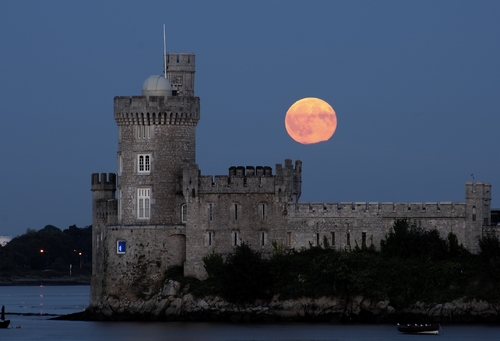
On Friday evening, I gave a public talk on the big bang at Blackrock Castle in Cork. I always enjoy giving public science talks, but this one was special (slides here). The venue was a beautiful castle overlooking the sea and I was enormously impressed with the science outreach work being done there by Dr Niall Smith, director of research at Cork Institute of Technology. I was equally impressed with the new observatory at the castle and the astronomy program of Niall and his postgraduate students. Superb work in a fantastic location, surely an inspiration for generations of young students.

Blackrock Castle in Cork: the white dome above the tower is the observatory

I left Cork early on Saturday morning in order to travel to Dublin to catch the High Flyers conference of the Institute of Physics (this is what physicists get up to on bank holiday weekends!). On my way to the meeting, I heard the Irish Minister for Education interviewed on RTE Radio One (Marian Finucane show, May 5th). The Minister had many interesting things to say on subjects such as RTE, the Catholic Church, a recent libel case in Ireland and the near-paralysis of political process in the United States (the latter is a most unusual topic for a politician over here). However, I was taken aback to hear him refer to “problems of productivity in the third level sector, particularly in the Institutes of Technology”, and disappointed that the interviewer didn’t seek some clarification on the comment.

I would very much like to know what the Minister meant by this comment. What do we understand by ‘productivity’ in the context of the third level education? How is it measured? Is it the number of students taught? Number of Noble prizes for research?  Perhaps some Soviet-style quota of engineers graduated? Like all Institute lecturers, I have a heavy teaching load; we produce legions of exactly the sort of science, computing and engineering graduates that Ireland so desperately needs. I must say I grow weary of generalizations like this about third level academics from journalists and politicians, and such a comment from the top man in education is pretty serious. Not a scintilla of evidence was offered by the Minister in support of his remark, just a casually delivered public insult to my colleagues and I.

Here’s the thing, Minister Quinn: like almost all lecturers in the Institutes of Technology (IoTs), I teach between four and five different courses per semester to degree level, a larger teaching load than any third level college in the world as far as I know; add research and outreach activity to this and it is no surprise I am in the office until 9 pm at least four days a week. In terms of prep, each semester typically presents at least one new module to teach, involving months of preparation over the summer, where I would hope to be concentrating on research, finishing my book and attending conferences. (I teach diverse courses in mathematics and physics to students in the departments of computing, engineering and science, not to mention more specialized modules in quantum physics, cosmology and particle physics – how many Harvard professors can boast such a wide teaching portfolio?).

‘Yes, but what about other IoT lecturers?’, the Minister will ask. I imagine I have a more accurate view of the work of my colleagues than the Minister’s advisors and I have no complaints. Indeed, the limited time I have for research arises because other lecturers take on the bulk of student administration (the large number of classes in the IoTs necessitates a great deal of admin; Year Tutors and Course Leaders spend a great deal of time keeping track of attendance, assessments, lab performance  and exam results). There are no easy lecturing jobs.

I love my job and stopped counting the overtime years ago. However, it is frustrating to hear the work of lecturers in the institutes and the universities denigrated by politicians who know nothing of what we do. The tragedy is, I suspect the binary system of universities and institutes has served Ireland very well, although few in charge of education seem to realize it. As they consider the future of the third level sector, I hope politicians and their advisors will make an effort to understand the current system, rather than indulge in unsupported generalizations.

7 Comments

Filed under Astronomy, Teaching, Third level

Astronomy and cosmology at Birr Castle

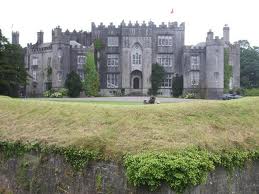
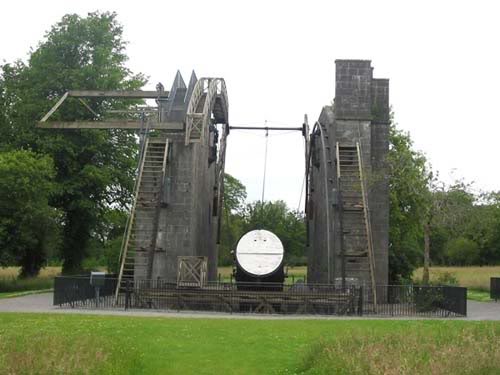
Yesterday, I travelled to historic Birr Castle in the centre of Ireland in order to catch the end of the annual meeting of the Astronomical Science Group of Ireland. Birr Castle is a great setting for an astronomy meeting –  not only is it a beautiful castle with fantastic grounds, it is also an important landmark in the history of astronomy. The castle was the home of the famous Leviathan, a reflecting telescope that was the largest instrument of its kind in the world for many years. The telescope was built in the 1840s by Lord Parsons, the third Earl of Rosse, and featured  a 72-inch mirror, a marvel of engineering at the time.  He made many important discoveries with the instrument, not least the first observation of the spiral structure of some of the distant nebulae and the detection of stars within the nebulae. Indeed, the Earl was one of the first to propose that the nebulae were entire galaxies distinct from our own, a hypothesis that was not definitely established until Hubble’s measurements with the 100-inch Hooker telescope at Mt Wilson in California.

Birr Castle in Co.Offaly

The Leviathan telescope at Birr castle

There were a great many interesting talks over the two days of the meeting (see program here), but I was there to catch ‘The Search for Polarization Fluctuations in the Cosmic Microwave Background’ by Creidhe O’Sullivan of NUI Maynooth. Creidhe started with a basic overview of the cosmic microwave background (CMB), explaining its importance as evidence in support of the big bang model and describing the measurements of temperature fluctuations in the radiation by the COBE and WMAP satellites. (The CMB is the primordial radiation left over from the time that atoms first began to form. Cosmologists and astronomers spend a great deal of time studying the tiny temperature fluctuations imprinted in the CMB, as this gives information on the density and geometry of the early universe, see the Cosmology 101 section of this blog.)

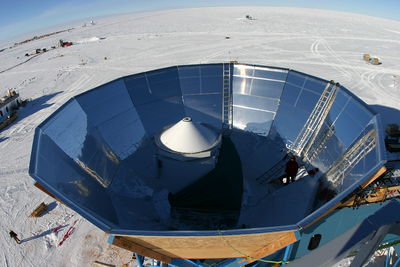
Creidhe then moved on to explain the study of polarization in the background radiation. The CMB radiation is expected to be polarized because it comprises light that has been scattered by many particles; when light is scattered, it gets polarized into different planes of vibration. (Polaroid sunglasses operate on the same principle; they cut down on light by allowing only light polarised in one plane to pass through). Hence cosmologists search for fluctuations in polarization as well as temperature in the CMB, although the polarization fluctuations are much smaller. Mathematically speaking, the polarization is divided into two modes: electric (E –mode) and magnetic (B-mode) polarisation. E-modes have been detected since 2003; the analysis of these modes has become a major area of research in cosmology. Creidhe gave a superb overview of the instruments used to analyse the E- modes, including the work of her own group with the QuaD experiment at the South Pole.

The QUaD experiment at the South Pole

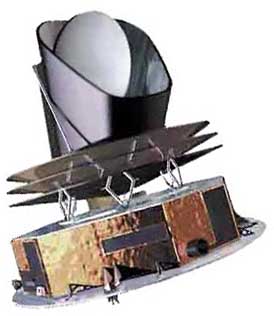
She finished the talk by explaining that the next big challenge in cosmology is the detection of B–mode polarization in the background radiation. B-modes present a great challenge as they are yet more difficult to detect. The great hope here is that the PlANCK satellite telescope, with its improved resolution. Just as the COBE satellite results were a watershed in our view of the early universe, the resolution of B-mode polarization in the CMB by PLANCK would give yet more support for the big bang model and cosmic inflation, and even offer evidence for the existence of gravity waves.

The Planck satellite telescope

That is not to say terrestrial experiments will not have their place. After Creidhe’s talk, another member of the Maynooth group, Stephen Scully, gave a brief overview of the team’s work on the QUBIC experiment. This is a new type of the bolometric interferometer that will be used in the next generation of terrestrial measurements at the South Pole.

All in all, a most informative afternoon. After the talks, we were shown the site in the castle grounds where a new radiotelescope is to be situated. This will form the Irish node of the international LOFAR astronomy project, bringing Birr castle up to date with modern astronomy – more on this in the next post.

Comments Off on Astronomy and cosmology at Birr Castle

Filed under Astronomy, Cosmology (general)

The Royal College of Surgeons and the Institute of Physics

I attended a very enjoyable blacktie dinner at the posh Royal College of Surgeons in Dublin on Friday. The occasion was the annual meeting of the Institute of Physics in Ireland, the Irish branch of the umbrella group for physics in the UK in Ireland. I always enjoy these occasions, it’s a great way to catch up with colleagues from schools and colleges around the country. This year was no exception and the evening also featured a very enjoyable pre-dinner lecture by Nobel laureate Bill Phillips.

The Royal College of Surgeons on Stephen’s Green in Dublin

In previous years, the IoP meeting stretched over a weekend but we decided to try a single-day meeting this year. Events included an overview of current research in the different colleges, the Rosse poster competition for postgraduate students, and a ‘physicist in the chair’ interview with Bill Phillips. The meeting went on all day but I only caught the dinner and talk due to teaching commitments.

Bill’s lecture was very entertaining. Entitled ‘Time, Einstein and the coolest stuff in the universe’, he gave a simple overview of the hows and whys of laser cooling (the cooling of atoms to extremely low temperature in order to study them in slow motion). From a description of the Heisenberg Uncertainty Principle to Bose -Einstein condensates, the talk was clearly accessible to students yet worked well with a roomful of professionals. I have often noticed this before; people love being told what they already know (and we are all on the lookout for tips in science communication). My only complaint was that the lights were too bright during the during the lecture and too dim during the meal, wrong way round!

Cool atoms: a Bose-Einstein condensate

At dinner, my nearest neighbour turned out to be a climate skeptic. I was intrigued as one rarely encounters skeptics of the theory of man-made global warming amongst professional physicists nowadays. However, I didn’t hear any new arguments, merely a discussion of our ignorance of the role of cloud formation in weather. (A valid point, but hardly a reason to disregard the well-established correlation between greenhouse gas emissions and temperature rise). Indeed, my neighbour seemed unaware of the excellent research being done in this area by several physicists in his own department.

After dinner, a few of us retired to a nearby hotel bar to catch up on the latest in physics, not least, the breaking news of the resignation of the head of the OPERA neutrino experiment. All in all, an interesting night out for a nerdy physicist..

2 Comments

Filed under Institute of Physics

The Irish Times and the God particle

Today, The Irish Times has an article of mine on its weekly science page. In the piece, I describe the tentative results from CERN and Fermilab on the famous Higgs boson, amidst some explanatory background on particle physics. I put some thought into the piece, but I suspect what will be remembered is the headline ‘Nearer, my God particle, to thee’. This was not the title I submitted, to put it mildly.

I have no particular problem with the nickname ‘God particle’ for the Higgs boson (unlike many of my colleagues). I admit the moniker is both catchy and reasonably apt as the Higgs field is thought to endow all other particles with mass. It is also appropriate because the Higgs is an important keystone of our model of particle physics, yet it has proved remarkably elusive – so something of a Holy Grail.

However, I’m not comfortable with the Irish Times headline. The hymn ‘Nearer, my God, to Thee’ has a lot of resonance for people who have lost loved ones (think Titanic). A pun based on such a hymn isn’t very clever in my view; it manages to trivialise both science and religion, all in my name.

This keeps happening to me. I put time and thought into expressing science clearly, and what eventually appears does so under a headline I dislike. Journalist friends tell me not to be precious but I think language is important.

This morning, I suspect my name is mud in the coffee room of every physics department in Ireland. As for the humanities, we can expect some outraged letters to the editor from professors of theology or philosophy – to the delight of The Irish Times. Sigh.

The article is here.

Caution: silly puns trivialise both science and religion and may cause offence

5 Comments

Filed under Particle physics, Science and society

Neutrino lecture at University College Cork

I gave another talk on the OPERA ‘faster-than-light’ neutrino experiment on Wednesday evening at University College Cork (UCC). I was booked months ago to give the talk as part of the UCC Public Lecture Series and it’s always a pleasure to visit the beautiful campus at UCC.

University College Cork – the nicest campus in Ireland?

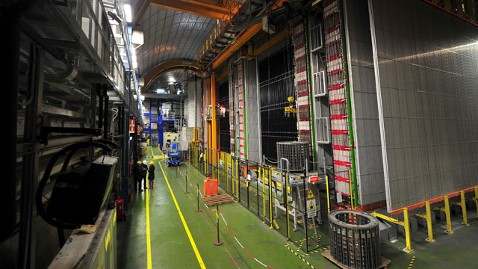
Of course, I was concerned the topic might be a bit of damp squib. As everyone in physics knows, a technical fault associated with the OPERA experiment was recently uncovered. Specifically, a connector cable for GPS clock synchronisation was found to be faulty. Between this and other problems, the ‘faster-than-light’ result has been withdrawn (see here for details).

The neutrino detector at Gran Sasso

In fact, the lecture was great fun. We got a good turnout and I made a point of using exactly the same slides I used when the OPERA result was first announced (see here for details). I thought the parts of the talk where I explained the grounds for scepticism from the viewpoint of both special and general relativity (theory and experiment) looked well in retrospect, though I tried hard not to say We told you so. In conclusion, I introduced a few new slides where I discussed what lessons could be learnt from the incident e.g.

1. If your result is in conflict with well-known theory, check, check and check again before you publish (anywhere).

2. If your result is in conflict with decades of experiments, check even more carefully.

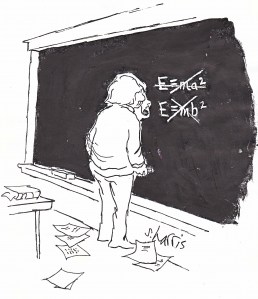
3. Never underestimate the media appetite for  ‘Einstein wrong’  stories. Everyone has heard of Einstein and everyone has heard of the speed of light –  this story was always going to be huge.

4. ‘Einstein not wrong after all’ is not such a great media story. In consequence, many members of the public will never get to hear of the correction. Bear this in mind before you go public with a result that may later have to be corrected.

Check your cables – all of them!

The slides I used for the UCC talk are here and I will upload the video in a day or two.

Update

This just in: a group working on an extremely similar neutrino experiment at Gran Sasso have announced the observation of neutrinos obeying the speed limit, as normal. This pretty much refutes the OPERA result completely. See here for details.

Update II

April 3: The head of the OPERA collaboration has resigned over the weekend, see here for details

6 Comments

Filed under Public lectures, Science and society