Category Archives: Teaching

A letter to the Minister for Education

On Friday evening, I gave a public talk on the big bang at Blackrock Castle in Cork. I always enjoy giving public science talks, but this one was special (slides here). The venue was a beautiful castle overlooking the sea and I was enormously impressed with the science outreach work being done there by Dr Niall Smith, director of research at Cork Institute of Technology. I was equally impressed with the new observatory at the castle and the astronomy program of Niall and his postgraduate students. Superb work in a fantastic location, surely an inspiration for generations of young students.
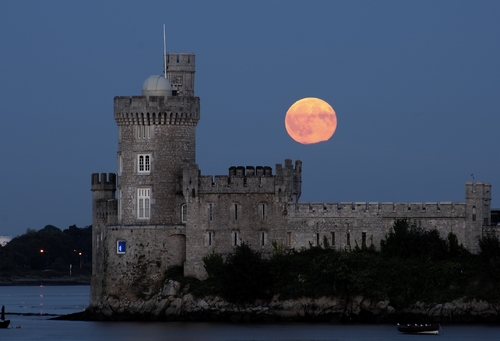
Blackrock Castle in Cork: the white dome above the tower is the observatory

I left Cork early on Saturday morning in order to travel to Dublin to catch the High Flyers conference of the Institute of Physics (this is what physicists get up to on bank holiday weekends!). On my way to the meeting, I heard the Irish Minister for Education interviewed on RTE Radio One (Marian Finucane show, May 5th). The Minister had many interesting things to say on subjects such as RTE, the Catholic Church, a recent libel case in Ireland and the near-paralysis of political process in the United States (the latter is a most unusual topic for a politician over here). However, I was taken aback to hear him refer to “problems of productivity in the third level sector, particularly in the Institutes of Technology”, and disappointed that the interviewer didn’t seek some clarification on the comment.

I would very much like to know what the Minister meant by this comment. What do we understand by ‘productivity’ in the context of the third level education? How is it measured? Is it the number of students taught? Number of Noble prizes for research?  Perhaps some Soviet-style quota of engineers graduated? Like all Institute lecturers, I have a heavy teaching load; we produce legions of exactly the sort of science, computing and engineering graduates that Ireland so desperately needs. I must say I grow weary of generalizations like this about third level academics from journalists and politicians, and such a comment from the top man in education is pretty serious. Not a scintilla of evidence was offered by the Minister in support of his remark, just a casually delivered public insult to my colleagues and I.

Here’s the thing, Minister Quinn: like almost all lecturers in the Institutes of Technology (IoTs), I teach between four and five different courses per semester to degree level, a larger teaching load than any third level college in the world as far as I know; add research and outreach activity to this and it is no surprise I am in the office until 9 pm at least four days a week. In terms of prep, each semester typically presents at least one new module to teach, involving months of preparation over the summer, where I would hope to be concentrating on research, finishing my book and attending conferences. (I teach diverse courses in mathematics and physics to students in the departments of computing, engineering and science, not to mention more specialized modules in quantum physics, cosmology and particle physics – how many Harvard professors can boast such a wide teaching portfolio?).

‘Yes, but what about other IoT lecturers?’, the Minister will ask. I imagine I have a more accurate view of the work of my colleagues than the Minister’s advisors and I have no complaints. Indeed, the limited time I have for research arises because other lecturers take on the bulk of student administration (the large number of classes in the IoTs necessitates a great deal of admin; Year Tutors and Course Leaders spend a great deal of time keeping track of attendance, assessments, lab performance  and exam results). There are no easy lecturing jobs.

I love my job and stopped counting the overtime years ago. However, it is frustrating to hear the work of lecturers in the institutes and the universities denigrated by politicians who know nothing of what we do. The tragedy is, I suspect the binary system of universities and institutes has served Ireland very well, although few in charge of education seem to realize it. As they consider the future of the third level sector, I hope politicians and their advisors will make an effort to understand the current system, rather than indulge in unsupported generalizations.

7 Comments

Filed under Astronomy, Teaching, Third level

Last day of semester

Today was the last day of lectures in the first semester, hurrah. There’s something very satisfying about emptying out the teaching briefcase and filing the notes and overheads back on the bookcase until next year. (Yes, we have computers and data projectors in Waterford, but I still use overheads quite a bit). The students now have a study week followed by exams but for lecturers, it’s an ideal time to get back to research.

I’m frequently asked if WIT is a let down after Harvard, but I must say I enjoyed this semester no end. I taught maths (to 1st science), physics (to 1st engineering) and my ‘concepts in cosmology’ course to our physics students. I’m writing a book based on the latter so it was fun summarizing a chapter each week and presenting it in class as bullet points. After each lecture, I found myself rushing back to the office to rewrite a paragraph or re-jig an explanation – very satisfying!

Motivated students

Then there was the neutrino experiment; a superb opportunity for public lectures on relativity. Like almost all physicists, I expect this result is an anomaly because neutrinos are known to have a finite rest mass. I really enjoy explaining this in outreach lectures so long may the anomaly survive! The Trinity lecture was very satisfying, we got a great crowd including some very eminent physicists.

Now I have four weeks to work quietly on the book, uninterrupted by classes – what a job!

Update

Meanwhile, rumours continue to circulate in the media about a possible sighting of the Higgs boson. I haven’t heard anything in physics circles so I’m betting it’s a false alarm based on a misunderstanding of the purpose of next week’s roundup meeting at CERN (see here for more on the rumours). Still, I’ll be keeping an eye on the news on Tuesday!

23 Comments

Filed under Teaching, Third level

Back to school in Ireland

I finally left Harvard in the last week of August, having had a wonderful summer working quietly on The Book during the day and sailing on the Charles in the long summer evenings.

It’s nice to be back home too – no more going around in silly shorts, suncream and shades. Back at Waterford Institute of Technology in the southeast of Ireland, we are already in the second week of teaching term. The bad news is that thanks to the recession, teaching loads have been increased (increased productivity!) leaving almost no time at all for frivolous activities such as research. On the other hand, there is much discussion of the college being upgraded to full university status, mainly because the government thinks that an upgrade ay help attract industry to a region badly hit by the recession. So after all the valiant efforts of WIT researchers, it seems an upgrade may occur for political reasons…

How does the college seem after Harvard? Colleagues keep asking me this. Yes, I miss the beautiful Harvard campus, the incredible libraries and the superb seminars. However, the main day-to-day difference is one of organization. There seems to be a problem of chaotic timetabling in WIT for the first few weeks of every semester, at least in my department. It’s very stressful and leaves no time over for prep or research. I’ve never understood why this happens every year, as our staff and courses change relatively little. One reason might be that lecturers are left to decide who teaches what amongst themselves, pitting Alice against Bob. Give me a didactic Head of Department any day…

Waterford Institute of Technology

On the other hand, it’s great to be in a job with an influx of Hopeful Young People every year. I always think that academics are v lucky in this regard, it doesn’t really matter which college you are in. Another change is that I am moving to a smaller, quieter office yipee. There is a special place in hell reserved for managers who believe that academics work well in large open-plan offices. With students coming to the door and phones continually ringing, it’s impossible to get any work done between classes. Hopefully I’ll have some quiet evenings in my nice new office….

9 Comments

Filed under Teaching, Third level

Introductory physics: the lens

A spectacular application of the phenomenon of refraction (see previous post) is the lens. Just as a focusing mirror is used to obtain an image of a distant object (see post on mirrors), a lens is used to focus light by refraction. The difference is that the light is transmitted through a lens – it is refracted once entering the lens and again as it passes out again. Lenses are cut from parabolic surfaces in such a way that distant rays are brought to a focus at the focal point.

As with mirrors, there are two types of lenses, depending on the curvature of cut: a convex lens causes parallel rays of light to converge to a real focus, while a concave lens cause the light to appear to diverge from a virtual focus.

As with mirrors, the position of an image will depend on the distance of the object from the lens (but the image of a distant object will of course be at the focal point of the lens). Amazingly, the same equation applies: for an object a distance u from a lens of focal length f, the location v of the image can be found from the relation

1/u1/v =   1/f

(Note that for a distant object u = and hence v = f ). The magnification m of the image can be calcuated from the equation m =  –v/u, as before.

Applications

Lenses are used extensively in everyday life. The most common example is of course spectacles. No one knows when spectacles were first invented (12th century?), but they have been used throughout the ages to improve defective human eyesight.

Typically, spectacle lenses are concave (diverging) lenses are made from glass or plastic. This is because the most common eyesight defect is myopia (shortsightedness), a condition where the natural lens of the eye focuses too strongly i.e. an image is formed short of the retina. A diverging lens of the right strength placed in front of the eye will cause the image to be projected back on the retina as normal.

Concave (diverging) lens used to correct myopia

In the case of hyperopia (the longsightedness that occurs commonly in older people), the eye muscles are weakened and an image is formed beyond the retina; this is corrected by placing a convex (converging) lens in front of the eye in order to strengthen it i.e. shorten the focal length of the eye’s natural lens.

Converging lens used to correct longsightedness

A modern application is the contact lens: this operates on the same principle as above, but the lens is made of a soft fabric that can be worn directly on the pupil. A third option nowadays is laser surgery; in this case the focal length of the eye’s natural lens is adjusted directly (and permanently) by laser treatment.

Lenses and science

Lenses played a pivotal role in the development of science. In the 17th century, advances in lens technology led directly to the invention of the microscope, a device that revolutionized our view of the world of the very small: and to the development of the telescope, an invention that revolutionized our view of the solar system and ultimately the entire universe.

Exercises

1. If an object 5 cm high is placed 30 cm in front of a convex (converging) lens of focal length 20 cm, calculate the position and height of the image.  Is the image real or virtual?

2. As a shortsighted person ages, can the onset of longsightedness cancel myopia?

6 Comments

Filed under Introductory physics, Teaching

Introductory physics: circuits

Electrical devices (TVs, stereos etc.) are connected to a voltage supply by an electrical circuit. The only difficult thing about circuits is that devices can be connected either in series or in parallel.

If connected in series, the same current runs through each device since there is no alternative path. However, the voltage across each device is different: from V = IR, the largest voltage drop will be across the largest resistance (just as the largest energy drop occurs across the largest waterfall in a river). As you might expect, the total resistance (or load) of the circuit is the sum of the individual resistances.

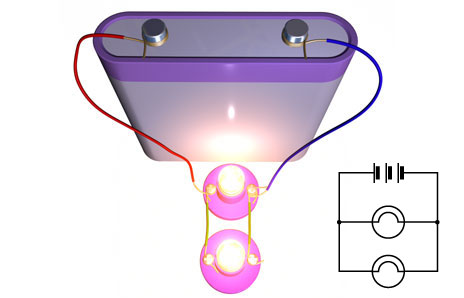
On the other hand, electrical devices can also be connected in parallel. In this case, each device is connected directly to the terminals of the voltage source and hence experiences the same voltage. Here, there will be a different current through each device since I = V/R. A counter-intuitive aspect of parallel circuits is that the total resistance of the circuit is lowered as you add in more devices (the physical reason is that you are increasing the number of alternate paths the current can take).

Parallel circuit: each device is connected directly to the battery terminals

Which is more useful? Household electrical devices are connected in parallel because it is easier (for the manufacturer) if every device sees the same voltage and it also turns out to be more efficient from the point of view of power consumption.

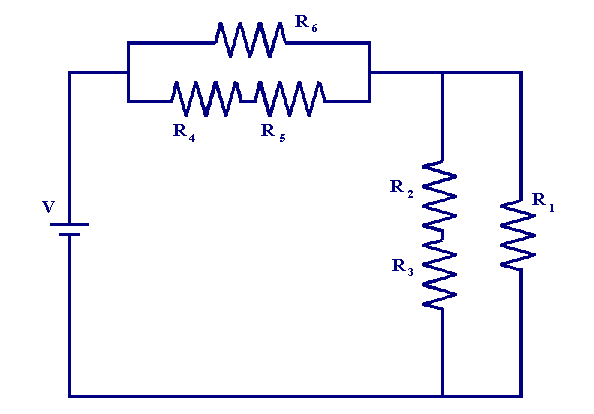
A more complicated type of circuit is the combination circuit: here some resistors are connected in series, others in parallel. In order to calculate the current through a given device, the trick is to replace any resistors in parallel with the equivalent resistance in series and analyse the resulting series circuit.

Combination circuit

Problem

Assuming a resistance of 100 Ohms for each of the resistors in the combination circuit above, calculate the current through each if a voltage of 12 V is applied.

10 Comments

Filed under Introductory physics, Teaching

Introductory physics: radiation

We saw in the last post that energy that can be transferred by conduction and convection, two very different molecular processes. But it is the third mechanism of heat transfer that is the most surprising.

In radiation, the transfer of energy is not a molecular process at all. Instead, the energy is carried as an electromagnetic wave, that is a wave consisting of oscillating electric and magnetic fields. The fields are self-perpetuating (and mutually perpendicular) because the changing electric field induces a magnetic field and the changing magnetic field induces an electric field.

The discovery of electromagnetic radiation emerged late in the 19th century. From Maxwell’s theory of electromagnetism, it was realised that light itself consists of an electromagnetic wave: however, it took Einstein to realise in 1905 that electromagnetic waves travel from the sun to earth through a vacuum i.e. do not need a medium in which to travel (unlike conduction or convection).

The rate of radiation from the sun (or any body hotter than its surroundings) is proportional to the fourth power of its temperature i.e. is extremely sensitive to temperature. Radiation also depends on a property of the body known as emissivity. Emissivity is a measure of how well a material emits radiation and is determined by atomic processes within the body. For this reason, a good emitter is also a good absorber, if it is placed in an environment where it is cooler than its surroundings (a perfect absorber is called a blackbody, because it will absorb all light incident on it). The opposite of a good absorber or emitter is a reflector, an object which can neither absorb nor emit heat. Polished metals and bright materials tend to be goodish reflectors: for this reason white clothes are worn when playing cricket and tennis in hot countries (they reflect both heat and light, keeping the player cool and easy to see).

A hot body does not radiate energy at a particular frequency, but at all frequencies – from waves of high energy and frequency (gamma rays) to low-energy ones (radiowaves). The low energy waves have low frequencies but long wavelengths since the wavelength of a wave is inversely proportional to its frequency. The full range of frequency (or wavelength) of radiation is called the electromagnetic spectrum. One of the great unifying moments in physics occured when it was realised that radiowaves, microwaves, infra-red heat, visible light, ultra-violet light, X-rays and gamma rays are all versions of the same thing – they are simply electromagnetic waves of different frequencies (and wavelengths).

Even a blackbody body dies not radiate equally at all frequencies. The distribution of radiation vs frequency (i.e. the spectrum of radiation) depends on the temperature. A body at extremely high temperatures will radiate predominantly at high frequencies, while a body at very low temperatures will radiate predominantly at much lower frequencies. Below is a picture of the emisson spectrum of a blackbody, measured at several different temperatures.

This spectrum is of great interest in fundamental physics, because it turns out that it cannot be predicted using the laws of classical physics. In the early years of the 20th century, Planck and Einstein showed that the blackbody spectrum could only be explained if it was assumed that light behaves as a stream of discrete particles in some circumstances. This duality i.e. light behaving as wave in some circumstances and as a stream of particles in others forms the basis of the famous quantum theory (and was later found to be true of matter as well as of radiation i.e. the tiniest ‘particles’ of matter such as electrons can exhibit wave behaviour!)

Question

In cosmology, the cosmic background radiation is a faint background radiation that permeates the entire universe.  It is radiation that is almost as old as the universe itself, dating back to the time after the Big Bang when the universe had expanded and cooled just enough for the first atoms to form, allowing radiation to travel freely (up to this point in time radiation was scattered by the different particles) . Do you think the cosmic background radiation will be hot or cold? At what frequency do you think it is observed? What kind of spectrum might be expected?

3 Comments

Filed under Introductory physics, Teaching

Introductory physics: heat transfer

One the great surprises about heat energy is that the transfer of heat can occur by any or all of three very different mechanisms.

In conduction, heat transfer occurs by a process of molecular collision. If you heat up one end of a bar of iron, the energy is transferred from the hot end to the cold by atoms or molecules bumping into one another i.e. while there is a net drift of energy from hot to cold, the molecules do not change their respective positions. This is the primary method of heat transfer in solids and it works best of all in metals (because loosely bound electrons play a role).  It is also an efficient method of conduction in liquids, but occurs hardly at all in gases. In gases, a low density of atoms or molecules inhibits conduction very effectively – hence air is an excellent insulator.

This fact is used to good effect in double glazing; a layer of air between two panes of glass allows one to have good light and views in a house without too much heat loss. Similarily, modern mountaineers keep warm by wearing many thin layers as the air trapped between each set of layers acts as an effective insulator.

Conduction in a solid: the molecules do not change position much

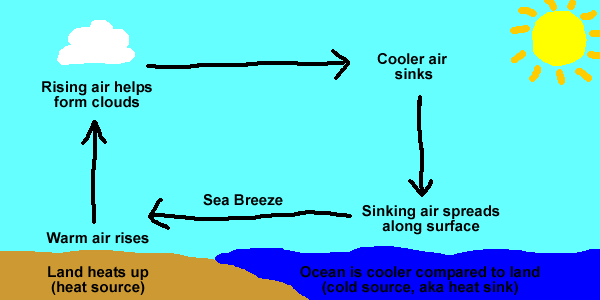
Heat transfer can also occur by the process of convection. In this case, heat energy is transferred by a movement of molecules. The classic example is hot air rising: on a hot day, air close to ground absorbs heat from the earth’s  surface, expands, and rises because it has become less dense than other air. Cooler and denser air then rushes down from above to fill its place, only to be heated in turn and a cycle is set up. As you might expect, this an important method of heat transfer in gases, and convection currents are responsible for everything from sea breezes at shore to major wind patterns around the globe.

Sea breeze close to shore on a hot day

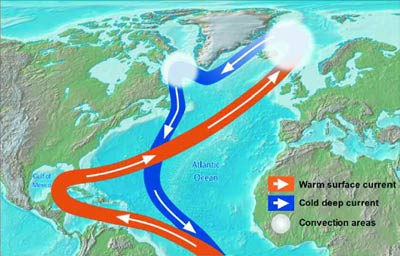
Convection also occurs in liquids: indeed, convection currents are of great importance in the oceans of the world. For example, the seas around Ireland are warmer than might be expected for our latitude. This warming is a result of the famous North Atlantic Drift, a huge ocean current that is part of a giant conveyor belt that delivers heat from the seas off South America all the way up to the seas near Greenland. One of the concerns of global warming is that as the ice caps melt, this current may weaken or even shut down: in which case Ireland and Britain could become very cold indeed!

The North Atlanic Drift keeps Ireland’s climate mild

What is the third process of heat transfer? Well, that is a different story altogether…

3 Comments

Filed under Introductory physics, Teaching

Introductory physics: the fourth state of matter

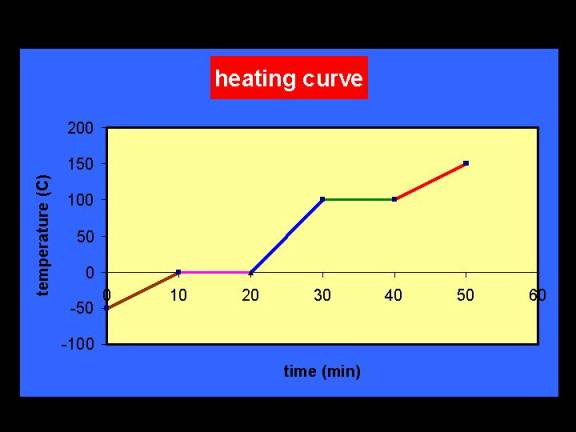
The relation between heat and temperature (last post) is not always straightforward: in some cases, large quantities of heat can be supplied to a substance without any observable change in its temperature at all!

When does this happen? It happens when matter changes state i.e. when a solid melts to liquid, or a liquid changes to gas. In fact, it takes a lot of energy to convert a solid to a liquid even if the solid is at the melting point, and it takes even more energy to convert a liquid to a gas even at the boiling point. Neither of these ‘phase changes’ can happen unless energy is continually supplied and there is no rise in temperature rise during the phase change; for this reason the energy consumed is known as latent heat (from the Latin for hidden). It’s interesting physics and quite fundamental at the same time; for example the liquid/gas phase change requires much more energy than the solid/liquid because the intramolecular forces must be completely broken down (as opposed to being weakened in the solid/liquid case). It’s also fascinating to observe that as a solid gradually melts into liquid, the resulting liquid stays stubbornly at the melting point temperature until all of the solid has undergone the change of state (ditto for gas).

Heating curve for ice: the temperature stops rising at 0 and 100 degrees Celcius during the phase changes

A good example of an application of the physics of phase change can be found in an electric kettle: a sensor detects when the top layer of water begins to bubble and quickly switches off the heating element – as opposed to boiling water in an open saucepan, a wasteful process where a lot of water is converted into useless steam, meanwhile consuming a large amount of energy.

Electric kettle : clever device

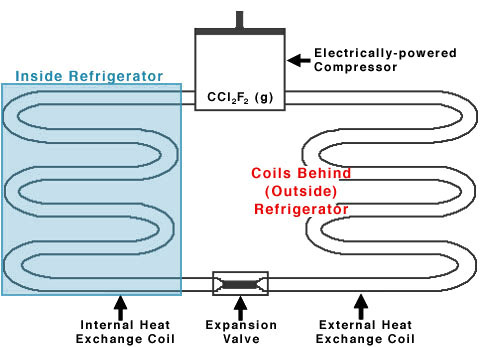
A change of state can also happen in the reverse direction: when a gas changes to liquid, or liquid to solid, energy is released. This process is exploited in the refridgerator, for example.

In a fridge, a gas-to-liquid phase change extracts heat, keeping the fridge cold inside, while a liquid-to-gas change outside the fridge dumps heat

The whole business of state change raises interesting questions about the nature of matter. Why do some substances exist as solids at room temperature and pressure, others as liquid or gas? To answer this requires a discussion of molecular bonding. Another common question is this: if supplying enough heat to a solid gives you a liquid, and eventually a gas, what happens if you keep supplying heat to the gas?

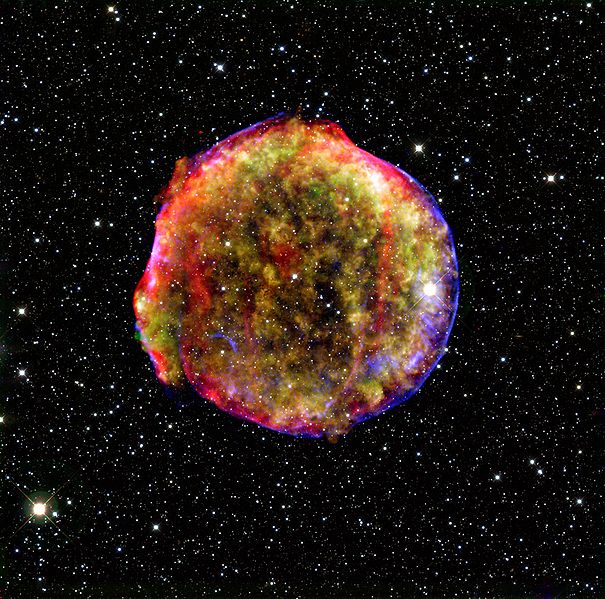
The answer is that if you supply enough energy, you eventually get another phase change as the atoms of the gas become ionized i.e. electrons are stripped off the atoms of the gas. In this case, the gas becomes a plasma, the fourth state of matter. Plasmas are plentiful in nature: a star exists as a plasma, as does lightning and even fire. Plasmas can also be produced in the lab under extreme conditions, for example by laser bombardment or by particle collisions in accelerators.

A supernova is not a liquid or a gas but a plasma

Update

Here is a super little YouTube video on plasmas by rock band They Might Be Giants, many thanks MattW


10 Comments

Filed under Introductory physics, Teaching

Introductory physics: heat and temperature

The teaching semester began again at 9.15 this morning. First day back, I’m always struck by how much I enjoy being in the classroom. I think it’s because lecturing is basically a performance, with never a dull moment; anything can go wrong and usually does! I also quite like big classes, it makes for a good atmosphere…

Then there’s the content. This morning 1st Science got to meet Heat and Temperature for the first time. This is my favourite kind of topic – quite simple but of fundamental importance. ‘Heat is a form of energy’, we tell our students, and ‘temperature is a measure of heat’. Actually, the discovery that heat is simply a form of energy was an enormous advance in science, possibly the greatest breakthough of 19th century physics.

And what sort of energy is it? Well, kinetic energy arises due to the motion of molecules (vibration in solids). But there is also potential energy;  since atoms in solids have more-or-less fixed positions in the lattice they have must possess an associated potential energy (so do atoms in liquids for a slightly more subtle reason). So heat is basically a type of internal energy. Except that it’s not always internal; there is also the whole business of heat transfer, a phenomenon that can occur by any or all of three very different mechanisms!

Then there is temperature; a philosopher would have a field day explaining the difference between a quantity that simply is (energy), it’s manifestation (temperature) and human temperature scales. Indeed, the relation between heat and temperature was only quantified with the intoduction of concepts such as specific heat capacity and specific latent heat. Temperature clearly has a fundamental aspect too; for example, what do really mean by absolute zero (or zero Kelvin)? ‘Absolute zero is the temperature at which all molecular motion ceases’, students are told. But what does this mean? Why can’t we reproduce this temperature in the lab? Is -30 Kelvin ( or -303 degrees Celcius) really a nonsense? Fundamental stuff indeed and a nice start to the term…

Achieving the impossible in the lab

Update:

Oops! I thought the dial read zero on the LHS but it doesn’t of course. Also, I’m not sure why it reads degrees Kelvin, there is no such thing.

2 Comments

Filed under History and philosophy of science, Introductory physics, Teaching, Third level

Those pesky exam corrections

It’s nice and quiet around college this week as the students aren’t back yet. However, this is also correction week since the semester exams took place before the Christmas break (one of the by-products of semesterisation is that we now get to correct twice a year). Most academics detest exam correction but actually I don’t really mind that much – it always takes less time than expected (unlike research) and I like a job that has a definite beginning, middle and end with room for targets and treats along the way. I’ve also learnt a few tricks over the years…

Oh joy

First, I like to correct in series i.e. student by student. Some lecturers claim it’s easier to mark objectively if you correct in parallel i.e. correct all the first questions, then all the second questions etc. However, it’s definitely trickier to tot up the marks at the end this way. It seems to me that there is less chance of marks being overlooked (the real worry) if a script is corrected question by question because you get a feel for how a particular student is getting on as you plough through the script…and it’s also more entertaining. Another trick is to sort the scripts alphabetically before you start – it’s fun working your way through the alphabet, planning for lunch between the Gs and the Hs (bonus marks for students with unusual initials!).

In our college, exam scripts are corrected by name and the students often campaign for anonymous marking. Little do they know that from a teacher’s perspective, it’s much harder to fail a person than a number, particularly if you know that student made a decent effort during the semester. Indeed a great deal of correction time goes on trying to squeeze in a few extra marks for the borderliners; if anything, I would expect pass marks to drop if anonymous marking was introduced.

A decent effort?

Right now, there is quite a row going on in the Institute of Technology sector concerning payment for exam correction. It may come as a surprise that IoT lecturers are paid extra for correcting exams (not very much). I suspect the situation originally arose because secondary teachers are paid to mark the Leaving Certificate and  IoT lecturers are represented by the same union.

Anyway, that payment is now under threat and I’m not sure what to make of the debate. What is certainly unfair is that some lecturers have hundreds of exams to correct due to large class sizes, while others get off lightly. Perhaps a sensible solution would be for the Institutes to intoduce payment that starts after the first hundred scripts. However, I suspect that as 3rd level cutbacks bite deeper, payment for exam correction will become a thing of the past..

Comments Off on Those pesky exam corrections

Filed under Teaching, Third level