Category Archives: Science and society

Science week in Ireland: was Einstein wrong?

This week is Science Week in Ireland, with science events taking place all over the country. There are talks and demonstrations on every aspect of science you can think of, from a demonstration of animal magic at Killaloe in County Limerick to astronomy at the Crawford Observatory of University College Cork.

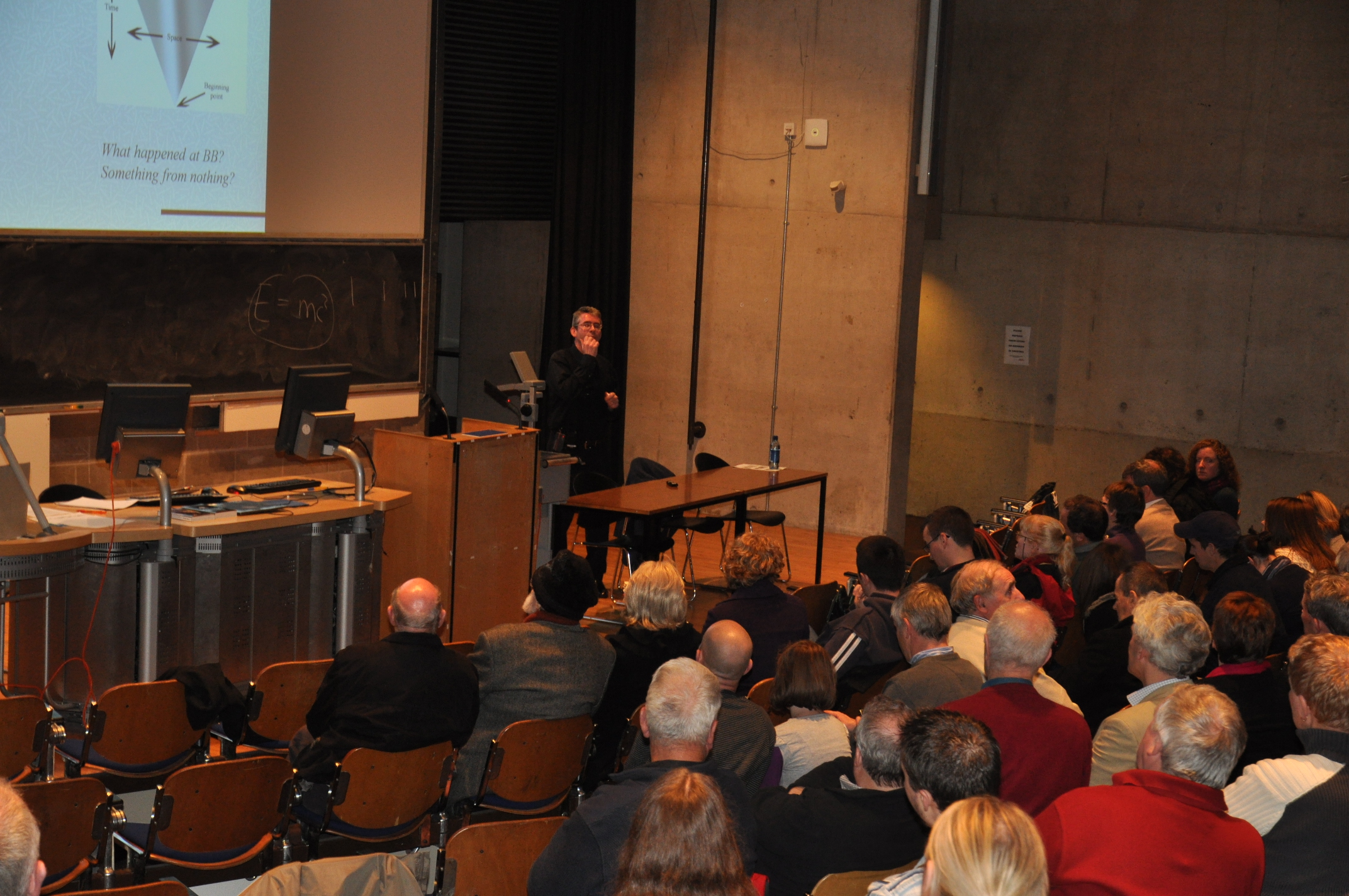
This evening, I will give a public lecture on the Big Bang in Trinity College, hosted by Astronomy Ireland. We’re still in the International Year of Astronomy, celebrating the 400th anniversary of Galileo’s use of the telescope to establish the heliocentric model of the solar system, so it’s highly appropriate to have a lecture describing another paradigm shift in science brought to us by astronomy: the discovery of the expanding universe and the big bang model that followed. I’m delighted to be giving the lecture as Astronomy Ireland do a fantastic job of promoting astronomy and science around the country, with night-classes in astronomy, public viewings of astronomical events and regular public science lectures. It’s also fun to tell the story of the discovery of the big bang model to people with an interest in astronomy, as many of them already know most of the facts, but from a slightly different perspective. Indeed, much of what we know of cosmology really comes from astronomical observation. You can find a poster, a summary of the lecture and the slides I will use here.

As I write this post, I’m sitting in the RTE canteen having done an interview promoting the lecture on Today with Pat Kenny, the flagship radio show of RTE, the Irish broadcasting corporation. (The last time I was at RTE I was auditioning for deputy work with the  Concert Orchestra but that’s another story!). I think the interview went well, it was certainly good fun. Unlike a lot of scientists I quite enjoy talking to the media, it’s a challenge getting deep ideas across in a short interview without sounding completely incomprehensible! I also find this particular radio show very good and listen in whenever I can.

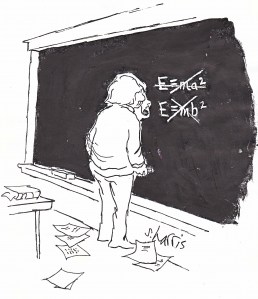
Astronomy Ireland marketed the lecture as ‘The Big Bang: Was Einstein Wrong? which is quite a good hook, so the interview touched on this quite a bit. Of course the answer is YES, it refers to a famous Einstein gaffe. When E. applied the general theory of relativity, his new theory of space, time and gravity, to the entire universe, it predicted a universe that was changing in time (space and time expanding). No evidence for such a thing existed at the time, so Einstein then introduced an extra term into the equations of relativity to force the universe to be static. Such fudge-factors are always risky in science and sure enough it turned out to be a big mistake. In 1929, the American astronomer Edwin Hubble established unequivocally that faraway galaxies are rushing away from one another and mathematicians realised that the universe is indeed expanding. Einstein immediately dropped the spurious term (known as the cosmological constant), declaring it his ‘greatest blunder’. You can listen to a podcast of the interview here, I hope I got the point across!
einstein

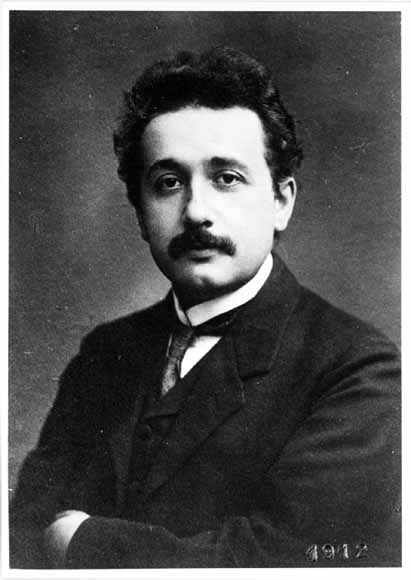
Einstein: right about relativity, but missed the prediction of the expanding universe

On Tuesday evening, I’ll give a repeat of the lecture in Waterford,in the main Auditorium of our college. On Wednesday, there is a talk on on the legacy of Charles Darwin at Waterford City Hall, which should be very good, I hope to attend myself. Both these lectures have been organised by CALMAST, the science communication group at WIT. All in all, it’s going be a busy week.

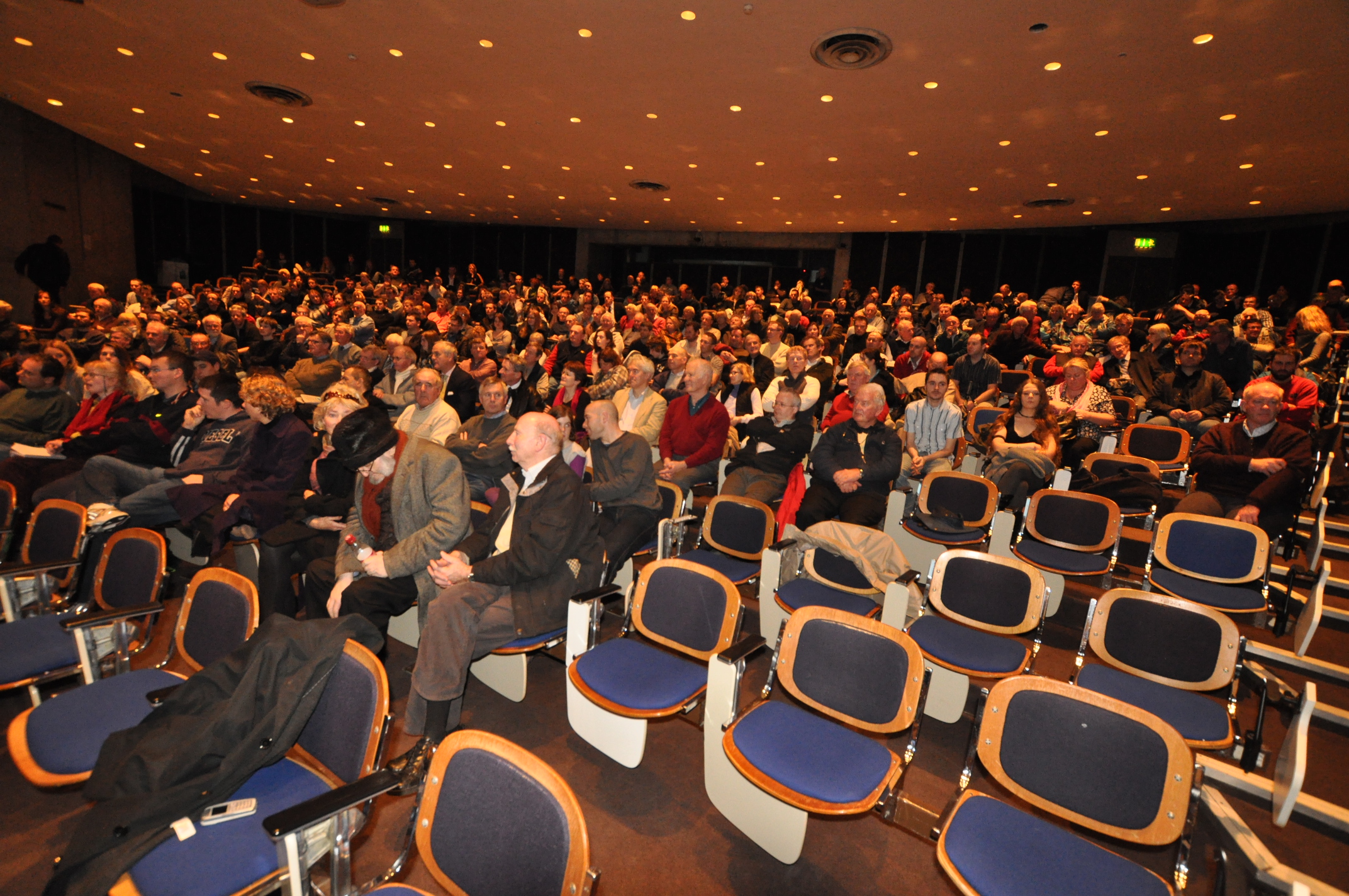
Update: I can see why media interviews are important, we had to change venue to the largest lecture theatre in trinity last night as we got a turnout of about 500! I think the lecture went well, I certainly enjoyed it.
DSC_4753

DSC_4751

DSC_4666

DSC_4728

DSC_9376

17 Comments

Filed under Cosmology (general), Public lectures, Science and society

A day in the life

Update: WIT has just been declared Institute of Technology of the Year in the annual Sunday Times league table. This is the second time we have been awarded this and the  criteria include research funding, graduate employment and staff/ student ratios. I rest my case!

*********************************************************

We’re already in the second week of the teaching semester at WIT and life is settling back to normal after some timetabling problems. University colleagues are often curious about life in an Institute of Technology, so I’ll try and describe a typical day…

I start most days with a 9.15 lecture to 1st science (after parking some distance away as the college simply can’t cater for 6,000 cars but is strangely reluctant to introduce permit parking). Teaching first year physics is a bit of a chore after all these years and the class is large at 75 students. That said, it’s nice to be present for their first introduction to physics and I try to keep them interested by linking the elementary stuff to deep ideas in cosmology and particle physics (How big is the universe? Is time a vector or a scalar?).  Also, the vibe in 1st science is always good as the students are delighted to be in college, studying a host of new subjects.

images

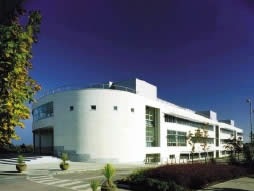
Waterford Institute of Technology, Ireland

Most days, I’ll give a second lecture before lunch, to electronic engineers, with a morning break to catch up on email in the office. After lunch, I generally take a practical class, or else more advanced classes like 3rd and 4th year quantum physics. All in all, it is quite a heavy teaching load (16 h/w) in comparison with university lecturing. I enjoy the teaching, but the lectures, labs and staff meetings required for four different courses can take up 100% of your academic life if you let it. Still, it’s not too bad if you don’t have too many new modules in any given semester! Ironically, the new modules are often the most interesting, from cosmology 101 (see categories)  to the science of climate climate change next semester.

p3-2

The college library

After the day’s teaching, I try to get some research done in the office from 4–6 or 5-7. One big difference with university life is that research in the IoT sector is self-driven, i.e. there is nothing specific in our contract about research. In some ways, this makes for a more relaxed life and indeed some staff confine themselves to teaching and preparation. On the other hand, there can be problems of motivation for those who do choose the research path, particularly as there is no reduction in teaching hours, or a definite career path linked to research. Despite all this, there are some highly competitive research groups in the college, attracting serious funding at national and international level. Recently, the college authorities decided to award nominal professorships for outstanding researchers and I think this will be helpful.

Another issue in the IoT sector is office space. Because the Institutes started out as teaching-only institutions, staff often share quite large offices. I myself share an office with seven other lecturers; with students coming to the door and phones continually ringing, not much real academic work gets done between classes during the day, hence the evening shift.

Overall, there is a very good atmosphere in the college,with a fairly young, well-motivated staff. There is plenty of interaction between staff of different disciplines at coffee time, more than in any other college where I have worked (3). It helps that the college is the only third level college in this part of Ireland and enjoys a reputation of being effectively university-level in both teaching and research. Sadly, it may never actually get the deserved upgrade for reasons of realpolitik; in the parish pump world of Irish politics, there is a very real danger of all of the Institutes being subsequently upgraded, resulting in 13 new universities!

*********************************************************************

After work, I might catch a wave in Tramore Bay on the way home if conditions are good, otherwise it’s off to the pool or gym. Failing, that, there is always something going on in college, from an excellent film club to concerts, from public lectures to evening classes – this year I’ve enrolled for Creative Writing, can’t wait.

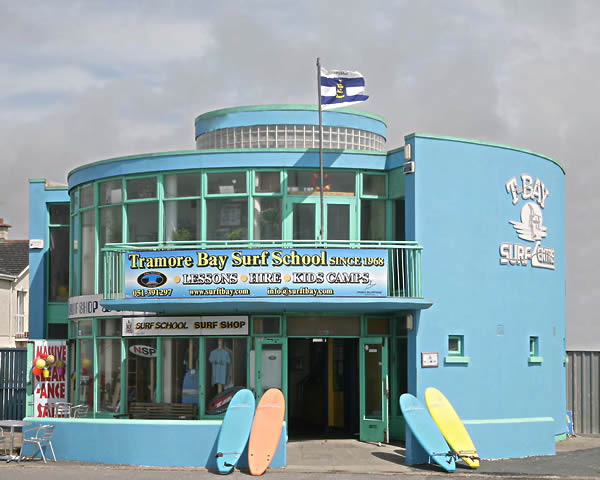
tbaysurfcentre

T-bay surf centre

*********************************

As regards my own research, I took a break from technical research two years ago in order to concentrate on science communication. I’ve been interested in the whole area of the public perception of science for some time and it’s an area that’s becoming more and more important as society faces challenges such as global warming and energy supply. My particular area of interest is that of public information vs misinformation. There seems to be a great deal of misinformation around on matters scientific in the US and Ireland; sometimes it arises from journalistic ignorance and sometimes from vested interests.

It’s not an easy field to break into but I’ve been lucky so far, with regular pieces in newspapers like The Irish Times and magazines like Physics World (see My Articles).  The blog doesn’t hurt either; I’m currently in negotiations for a pop book on cosmology and I often get asked to give public lectures (this month, I’m giving a talk on the Large Hadron Collider at the Institute of Physics teacher’s conference and next month I’ll give a talk on the Big Bang to Astronomy Ireland at Trinity College, see Public Lectures).

In the longer term, I guess it’d be nice to get back to the university sector eventually, ideally as a Professor for the Public Understanding of Science. Writing articles is fine, but I’d relish the chance to be involved in public science debates in the media with prominent doubters and skeptics (wouldn’t say no to a quiet office, either). Although there are many PUS positions in the UK and the US, there are currently none in Ireland, hopefully this will change in the future.

In the meantime, I enjoy both the teaching and research in different ways. I can summarise a typical day’s work with a famous quote – if you find a job you enjoy, you’ll never have to do a real day’s work in your life!

10 Comments

Filed under Science and society, Teaching

150th anniversary of Tyndall’s greenhouse effect

Every scientist knows that this year marks the 150th anniversary of the publication of Darwin’s ‘On the Origin of Species’, but not so many may be aware that another scientific breakthrough occurred that year. In 1859, the Irish physicist John Tyndall discovered that certain gases – carbon dioxide and water vapour in particular – absorb infra-red radiation. The discovery was established over a few short weeks, but it provided an explanation for the greenhouse effect, one of the great puzzles of science.

The Irish Times have accepted a piece I have written on Tyndall for their Irishman’s Diary slot next month. I like this column- it is a unique feature of The Irish Times, comprising an 800-word essay prominently displayed on the op-ed page, written by the house journalist 3 days a week and by a freelance writer on other days. I have written a few diaries on various Irish scientists in the past (see My Articles) and I hope one day to publish the ‘Science Diaries’ as a collection of essays.  Below is a draft of what I intend to say on Tyndall:

**********************************

John Tyndall: celebrated Irish scientist who discovered the greenhouse effect

Many readers will know that this year marks the 150th anniversary of the publication of Darwin’s ‘On the Origin of Species’. Another breakthrough occurred in science that fateful year, this one with an Irish connection. The discovery attracted much less attention than Darwin’s theory of evolution at the time, but it has become one of the hottest topics in science today (literally).

In July 1859, the Irish physicist John Tyndall, one of the great scientists of the 19th century, established that certain atmospheric gases absorb heat quite strongly. This innocuous-sounding discovery was established over a few short weeks, but it provided the solution to one of the great riddles of science: the famous ‘greenhouse effect’.

The greenhouse effect was first proposed by the French polymath Joseph Fourier, almost a century before Tyndall’s experiments. Fourier had wondered how the earth maintains its warm temperature, and he speculated that while heat from the sun passes easily through our atmosphere on the way to earth, heat radiated outwards by the warm earth must somehow be trapped in the atmosphere. The hypothesis was highly controversial, as it was widely assumed that gases are transparent to heat.

Tyndall, a fierce proponent of the new experimental method of science, devised a series of simple experiments to test Fourier’s hypothesis.  Working in the dusty basement of the Royal Institution in London in the summer of 1859, he soon established that, while most gases are indeed transparent to light and heat, some gases – carbon dioxide and water vapour in particular – can absorb heat energy at certain wavelengths. As traces of each gas were known to exist in the earth’s atmosphere, the puzzle of the earth’s temperature was solved.

How did an Irish scientist come to make such an important discovery? John Tyndall was born in Leighlinbridge, County Carlow in 1820, the son of an RIC officer and land agent. On completing his schooling under renowned local teacher John Conwill, he started his professional career as a surveyor for the Ordinance Survey of Ireland.  He was soon transferred to a position with the Ordinance Survey in Lancashire, England, but became interested in the new experimental sciences of physics and chemistry emerging in Germany. He moved to Germany in 1848 to study under the famous experimentalist Robert Bunsen at the University of Marburg, returning to England with a PhD in experimental science in 1851. By 1853, he had been appointed Professor of Natural Philosophy at the Royal Institution, a position previously held by the renowned scientist Micheal Faraday.

Tyndall remained at the Royal Institution for the rest of his career, making important discoveries in diverse areas of science, from magnetism to optics, from the physics of sound to the behaviour of bacteria. He is probably best known for ‘Tyndall scattering’, the scientific explanation for why the sky is blue. A keen mountaineer, he became interested in the science of glaciers and made several important discoveries concerning their behaviour. He became extremely well-known in Victorian England as a public communicator of science and was a prominent member of the ‘X Club’, an influential group of prominent scientists who defended evolution and other new scientific theories from religious dogma.

Tyndall’s verification of the greenhouse effect was accepted by the scientific establishment, but not regarded as a matter of vital importance. He and his colleagues were aware of the output of Victorian England’s factory chimneys, but no-one drew a link between this pollution and the greenhouse effect.

Nowadays, evidence has emerged that the average temperature of the earth and its oceans has been gradually rising since the industrial revolution. Despite many uncertainties, the scientific consensus is that this global warming is associated with an increase in carbon dioxide in the atmosphere, an increase that has been produced by human activities such as industry and transport. The discovery has led to concerted international efforts to agree on targets for reducing carbon emissions worldwide, a process that is only just beginning.

What would Tyndall make of today’s climate problems? Like most scientists of his era, he would probably find it difficult to grasp that humans could have such a global effect on nature. On the other hand, he would be greatly depressed by the shrinking of his beloved glaciers. Above all, he would be astonished to find that, of all the scientific discoveries he made, the work he did in the summer of 1859 has become a major preoccupation of 21st century science.

Today, the work of this great Irish scientist is commemorated by the annual Tyndall lecture of the Institute of Physics, the Tyndall Centre for Climate Change Research in the UK, the Tyndall National Institute in Cork, Mount Tyndall in California and the Tyndall glacier in Chile.

*********************************

John Tyndall: celebrated Irish scientist who discovered the greenhouse effect

Many readers will know that this year marks the 150th anniversary of the publication of Darwin’s ‘On the Origin of Species’. Another breakthrough occurred in science that fateful year, this one with an Irish connection. The discovery attracted much less attention than Darwin’s theory of evolution at the time, but it has become one of the hottest topics in science today (literally).

In July 1859, the Irish physicist John Tyndall, one of the great scientists of the 19th century, established that certain atmospheric gases absorb heat quite strongly. This innocuous-sounding discovery was established over a few short weeks, but it provided the solution to one of the great riddles of science: the famous ‘greenhouse effect’.

The greenhouse effect was first proposed by the French polymath Joseph Fourier, almost a century before Tyndall’s experiments. Fourier had wondered how the earth maintains its warm temperature, and he speculated that while heat from the sun passes easily through our atmosphere on the way to earth, heat radiated outwards by the warm earth must somehow be trapped in the atmosphere. The hypothesis was highly controversial, as it was widely assumed that gases are transparent to heat.

Tyndall, a fierce proponent of the new experimental method of science, devised a series of simple experiments to test Fourier’s hypothesis. Working in the dusty basement of the Royal Institution in London in the summer of 1859, he soon established that, while most gases are indeed transparent to light and heat, some gases – carbon dioxide and water vapour in particular – can absorb heat energy at certain wavelengths. As traces of each gas were known to exist in the earth’s atmosphere, the puzzle of the earth’s temperature was solved.

How did an Irish scientist come to make such an important discovery? John Tyndall was born in Leighlinbridge, County Carlow in 1820, the son of an RIC officer and land agent. On completing his schooling under renowned local teacher John Conwill, he started his professional career as a surveyor for the Ordinance Survey of Ireland. He was soon transferred to a position with the Ordinance Survey in Lancashire, England, but became interested in the new experimental sciences of physics and chemistry emerging in Germany. He moved to Germany in 1848 to study under the famous experimentalist Robert Bunsen at the University of Marburg, returning to England with a PhD in experimental science in 1851. By 1853, he had been appointed Professor of Natural Philosophy at the Royal Institution, a position previously held by the renowned scientist Micheal Faraday.

Tyndall remained at the Royal Institution for the rest of his career, making important discoveries in diverse areas of science, from magnetism to optics, from the physics of sound to the behaviour of bacteria. He is probably best known for ‘Tyndall scattering’, the scientific explanation for why the sky is blue. A keen mountaineer, he became interested in the science of glaciers and made several important discoveries concerning their behaviour. He became extremely well-known in Victorian England as a public communicator of science and was a prominent member of the ‘X Club’, an influential group of prominent scientists who defended evolution and other new scientific theories from religious dogma.

Tyndall’s verification of the greenhouse effect was accepted by the scientific establishment, but not regarded as a matter of vital importance. He and his colleagues were aware of the output of Victorian England’s factory chimneys, but no-one drew a link between this pollution and the greenhouse effect.

Nowadays, evidence has emerged that the average temperature of the earth and its oceans has been gradually rising since the industrial revolution. Despite many uncertainties, the scientific consensus is that this global warming is associated with an increase in carbon dioxide in the atmosphere, an increase that has been produced by human activities such as industry and transport. The discovery has led to concerted international efforts to agree on targets for reducing carbon emissions worldwide, a process that is only just beginning.

What would Tyndall make of today’s climate problems? Like most scientists of his era, he would probably find it difficult to grasp that humans could have such a global effect on nature. On the other hand, he would be greatly depressed by the shrinking of his beloved glaciers. Above all, he would be astonished to find that, of all the scientific discoveries he made, the work he did in the summer of 1859 has become a major preoccupation of 21st century science.

Today, the work of this great Irish scientist is commemorated by the annual Tyndall lecture of the Institute of Physics, the Tyndall Centre for Climate Change Research in the UK, the Tyndall National Institute in Cork, Mount Tyndall in California and the Tyndall glacier in Chile.

Dr Cormac O’Raifeartaigh is the author of the science blog ANTIMATTER

9 Comments

Filed under History and philosophy of science, Science and society

Free speech, AIDS and the HIV virus

Johnny Steinberg has a depressing article on skepticism and the HIV virus in this week’s edition of New Scientist.

The article starts with the story of Christine Maggiore, a 52-year old who died in 2008 from infections typical of AIDS. Apparently, she had tested positive for HIV 16 years ealier, but shunned anti-retroviral therapy (ART), the therapy that is known to hinder AIDS developing from the virus. Her choice, you  might say; until you read that she also denied the treatment to her infant daughter, who died of AIDs-related illnesses at age 3.

Steinberg then goes on to describe the HIV denial movement, starting with arch-skeptic Peter Duesberg. Duesberg’s work with retroviruses – the class to which HIV belongs – led him to conclude that all such viruses are essentially harmless. In fact, many scientists shared Duesberg’s skepticism of the HIV- AIDS link in the late 1980s, but support rapidly fell away as clinical evidence linking HIV to AIDs mounted. In Duesberg’s case, rather than revise his views in the face of emerging epidemiological evidence, he chose to hang on to his old theory – a position he has stuck to ever since.

Professor Peter Duesberg of the University of Berkeley

The publicity afforded to Duesberg and other skeptics has had serious consequences for society. According to the New Scientist, a recent survey suggested that 25% of the US population currently question the link between HIV and AIDS. Even more seriously, NS cites the case of South Africa, a country where AIDS has made devastating inroads. Because President Mkebe chose to believe the skeptics, he strongly resisted the use of ART therapy in South Africa – it is now estimated that over 300,000 AIDS victims died unnecessarily there.

So what is at the root of this sort of skepticism? I have to agree with Steinberg when he states that “no amount of evidence will overturn the entrenched beliefs of some”. Combine this with the tendency of the media to highlight studies that show unorthodox results and you are well on the road to the public misunderstanding of science.

Perhaps we scientists are partially to blame. It seems to me that we do a poor job of communicating the consensus position – and how it is achieved – on important issues, from global warming to the MMR vacinne. There will always be scientists who question the mainstream, even in the face of overwhelming evidence; such is human nature and we cannot censor such views in a free society. Not to mention the fact that science progresses by asking the unthinkable. Perhaps the solution is to convince the media not to allow ‘maverick’ scientists disproportionate publicity – and for the elders of science to take the communication of science to the public more seriously. In Ireland, there isn’t a single university that has a Professorship for the Public Understanding of Science..

Update

In the same issue, New Scientist have an excellent editorial on the importance of scientific heresy. There is no contradiction here – the questioning of ‘accepted science’ from within is a vital part of scientific discovery and long may it continue. It is the misrepresentation in the media of the scientific consensus on a given topic that is of concern..you can find more information on this topic on Seth Kalichman’s ‘s blog denyingaids.blogspot.com

4 Comments

Filed under Science and society, Uncategorized

The Alchemist Cafe

I gave a talk on Wednesday evening at the Science Gallery in Trinity College Dublin, as part of the Alchemist Cafe series. It was great to be back at the Gallery, I’ve fond memories of participating in the RAW debates there last year (see blog posts on the debates here).

The Alchemist Cafe is the Irish branch of the international Cafe Scientifique movement: the idea is to get a scientist or engineer to give an informal talk on a scientific topic in a cafe/bar setting, with plenty of questions and discussion afterwards. You can find abstracts and videos of previous talks on their website above.

I gave a short spiel titled ‘The Big Bang: Fact or Fiction?”. I thought it would be fun to go over the three basic planks of evidence for the model and then discuss some modern results (from the accelerating universe to WMAP measurements of the cosmicrowave background). The rest of the session was given over to questions and discussion.

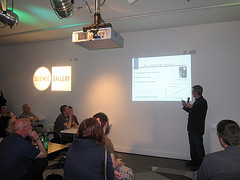
It seemed to work well, I thought the Science Gallery cafe a particularly good setting. One whole side of the cafe is a glass window onto the street and we projected the images I used onto the opposite wall, with the audience in between. It made for a nice relaxed atmosphere.

The Naughton Institute and the Science Gallery at Trinity College Dublin

al caf 1

Photos courtesy of The Alchemist Cafe


There were plenty of good questions, on topics as diverse as unified field theory and dark energy. I wish I’d taken note of the questions, must check with the organisers if someone did. Turnout was a big surprise – a few friends turned up at 8.05 and couldn’t get in! It’s amazing the public interest in cosmology, I guess everyone has heard of the Big Bang and Hawking’s A Brief History of Time.

All in all, it was a great experience. There will be a video of the event on the Alchemist Cafe site in a few days and I’ve uploaded the slides I used on the My Seminars page.

P.S. The Gallery is currently exhibiting INFECTIOUS, an excellent show on the spread of infectious diseases: well worth seeing and highly relevant given the news on swine flu…

7 Comments

Filed under Public lectures, Science and society

Antimatter at 1

This little blog passed its first birthday a few weeks ago (a few posts go back to March 2008, but they were actually written in May!). It’s been a very useful experiment and the year certainly went by quickly…

The blog was suggested by our head of research as I’d been writing articles on science for the public in newspapers and magazines for some time. It started life as an online science diary, but I found it useful to broaden it to include posts on introductory concepts in cosmology for our students and renamed it Antimatter. During the year, it has become much more widely read than expected with about 200 hits per day. That’s about a thousand readers per post which is probably a good outreach for a teacher…

Most the traffic comes from being listed on well-known websites such as INTERACTIONS. ORG (the international particle physics website), Particle Physics Planet and the American blog NOT EVEN WRONG (thanks Peter!). I recommend all of these websites; the interactions website is a particularly useful resource as it gives a daily list of new posts on particle physics/cosmology on blogs around the world.

I note from WordPress that 112 posts have been posted on Antimatter so far; that’s an average of 2 per week which feels about right. It does take time to write the posts, but there are definite benefits for any science writer. As well as good writing practice, the blog has led to a good few public speaking engagements, newspaper profiles, magazine articles ( in Physics World) and interest from a literary agent (more on this later).

Cover of Print edition Volume 22 Issue 5

I enjoy writing the cosmology articles, but the most challenging posts are probably the lecture reviews; not many bloggers do this but I think it’s a useful service. It’s great practice to try to summarize someone’s lecture, put in appropriate links, pics and slides and send them a copy for approval, all within a matter of hours. It’s also a nice way of establishing contact with other physicists worldwide.

So I think I’ll keep posting for a while. About my only regret is the comments section – apparently a low number of comments is normal for a ‘tech” blog. Instead, readers tend to contact me by email. Which drives me mad…

2 Comments

Filed under Science and society

Antimatter at the Royal Irish Academy

I was at a very interesting event in Dublin yesterday evening; an informal panel discussion for the public on ‘Angels, Demons and Antimatter’ hosted by the Royal Irish Academy and The Irish Times. It’s great to see the Academy hosting this sort of event as it helps to bridge the gap between science and the humanities (the ‘two cultures’ famously described by C.P. Snow).

The event was ably chaired by Dick Ahlstrom, veteran science editor ofThe Irish Times, and the panel boasted four heavy hitters from the world of particles physics: Alex Montwill, Ireland’s best-known particle physicist and renowned communicator of science: Ronan Mc Nulty, leader of the experimental particle physics group at UCD, a group that have a major involvement with the LHCb antimatter experiment at CERN: Tara Shears, lecturer in physics at Liverpool University, also heavily involved in the LHCb experiment: and Paul Bowe, the Irish physicist who is technical director of ALPHA, the anti-Hydrogen experiment at CERN.

In his introduction to the event, Dick Ahlstrom sensibly asked the audience how many had seen the film – only about a third, which confirmed my view that people are interested in particle physics for its own sake, film or no film. Tara Shears then kicked off with a pithy summary of the film, explaining that a ticking bomb made of antimatter provides the timeline of the unfolding story. Then it was over to Alex to give a brief introduction to the phenomenon of antimatter. He did this in exemplary fashion, starting with the prediction of antimatter from the Dirac equation (…“Dirac was not the sort of scientist to brush extra solutions that seemed to have no corresponding physical reality under the carpet“) and proceeding to the experimental discovery of the positron in 1932 (if you want details on the discovery of antimatter, see post here). The discussion then honed in on the nature of antimatter, how it occurs in nature and how it is produced in minicscule amounts in high-energy accelerators.

The panel then turned to one of the great mysteries of physics – why is our universe primarily made of matter and not antimatter? Ronan gave a brief overview of charge symmetry, parity symmetry, charge-parity (CP) violation and the Sakharov conditions ; these are three conditions that theory predicts must have existed in the early universe for the current asymmetry of matter and antimatter to develop.

Charge and parity operations: note that the final quadrant is not identical to the first

This led nicely to a discussion of the relevance of high-energy physics to cosmology. I was very pleased this came up, as it is not always obvious to the public that, as well as studying the fudamental nature of matter, high energy accelerators offer a direct glimpse of the very early universe by recreating the energy conditions that existed shortly after the big bang (a point that is often missed by critics of the big bang model).

Paul Bowe then discussed the production of anti-hydrogen at CERN (an atom of anti-hydrogen simply comprises an anti-electron orbiting an antiproton, see previous post on this). He gave a brief overview of the ALPHA experiment – the production of positrons, the production of antiprotons, the mixing trap etc.

Schematic of hydrogen and anti-hydrogen atom

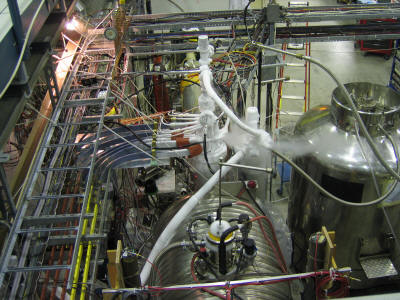
A picture of the experiment reminded me that while I find the discoveries of particle physics fascinating, I’m happy to leave the experiments to others!

IMG_1458

Image of ALPHA experiment

Paul also addressed a question I was asked a while ago – Do we expect the spectrum of anti-H to be the same as that of H? If I have understood correctly, the answer is yes (since the electromagnetic interaction between the anti-proton and the positron should mirror that between the proton and the electron). If not, the spectrum of anti-H will have major implications for our understanding of CP violation.

********************************************

The second part of the discussion dealt with Hollywood’s take on antimatter in Angels and Demons. It started with a clip from the film, the scene where Dr Vetra tries to explain to the destructive potential of the antimatter bomb to the authorities, advising that they evacuate the Vatican city forthwith.

Of course, the panel were quick to point out the unfeasability of the bomb, as mentioned in the post below: because of the difficulties of creating even a few atoms of antimatter in particle accelerators, it is simply not possible to create a bomb made of antimatter (or to use it as an energy source). And if such a bomb could be made, the trap container would be gigantic, not the little package portrayed in the film. However, I was pleased to hear that Tara (and I think the panel as a whole) felt Brown’s plot was acceptable cinematic license and made for a good story.

A small container for an antimatter bomb?

**********************************************

In keeping with the informal nature of the event, there was a lengthy question and answer session after the panel discussion. Some interesting questions were;

1. Is it possible there is plenty of antimatter in our universe today, in the form of distant galaxies made of antimatter?

I think the answer was that this is a real possibilty, but a basic asymmetry between matter and antimatter is still implied.

2. Does the neutron have an antiparticle?

Yes, because the neutron is a composite particle – the anti-neutron is made up of anti-quarks etc). Ronan pointed out that the question Does the neutrino has an antiparticle? is much more interesting and the subject of much debate.

3. What is the relation between antimatter and dark matter?

None – dark matter is the name we give to matter that has a gravitational effect but does not interact with the electromagnetic force. However, whatever particles make up dark matter presumably have anti-particle counterparts!

4. My question: Why did Dan Brown choose to introduce the topic of antimatter to the story at all, wouldn’t TNT have done?

My own view is that he was anxious to include cutting edge science, as the relation between religion and emerging science is a major theme of the novel. However, Tara had a better answer: novelists write about what they find interesting and Brown happens to be interested in particle physics! Apparently, he even visited CERN in 1990. QED.

********************************************************

All in all, this was a very interesting an informative event, a treat for anyone interested in particle physics or indeed are the public perception of physics. If there was one sour note during the evening, it was Dick Ahlstrom’s observation that “ the UCD contribution to the LHCb experiment really occurs through the back door” as Ireland is not a member of CERN. This is a sad situation that we have touched on many times before, so I’ll leave it for now. As for Dan Brown, long may he continue to include science in his bestselling novels.

9 Comments

Filed under Particle physics, Science and society

Angels & Demons: a good film

I was in Dublin yesterday for an Institute of Physics meeting so I took the opportunity to see Angels & Demons in the Savoy afterwards.

Shock news: I found the film reasonably interesting and entertaining, in stark contrast with every review I have seen (see a scathing review inThe Irish Times here). What is with the critics? I am no fan of Hollywood, but as Hollywood blockbusters go, I found A&D well above average.

Granted, the plot is a bit far-fetched, not to mention convoluted (you really need to have read the book to keep track of the story, from the history of the Illuminati to the frantic chase around Rome from cryptic symbol to cryptic symbol). However, the film is an improvement on the book as the storyline is tighter, with many unnecessary scenes removed. The cinematography is good – Ron Howard makes great use of the architecture of Vatican City and of the pomp and ceremony of Church traditions such as Conclave. The fabulous tradition of the Catholic Church in art, architecture and music is also portrayed quite well. There are some nice crowd scenes in St Peter’s square; my favourite was an incidental scene depicting a riot over the rights and wrongs of stem cell research! The key scene of a bomb-laden helicopter ascending into the heavens from St Peter’s was also quite effective.

The cardinals on the way to Conclave

I can’t help wondering whether some critics missed the central point of the film. One problem with this sort of thriller is that the theme is often not revealed until the end. In this case, it only becomes becomes clear in the closing moments that the real topic of the story is the conflict within the Church between those who seek to reconcile religion with science (the elderly cardinals) and those who see science as an implacable enemy that must be overcome by any means (the young Camerlengo). An unusual theme for a blockbuster..

What about the science in the film? Again, it was better than I expected. The opening minutes are set in CERN, with a nice portrayal of an accelerator facility and a decent simulation of proton-proton collisions as the LHC is switched on. There is a reasonable explanation of Professor Vetra’s antimatter experiment and the routing of the proton beam to his lab is portrayed in realistic fashion. Yes, yes, the whole concept of an antimatter bomb is wrong-headed (see post below), but this is fiction, not fact.

However, given the worldwide attempts to use A&D to promote science (see here), I feel bound to point out that the whole antimatter/CERN angle is rather tangential to the plot – that is incidental, as Hannibal Lecter would say. It happens that the bomb is supposedly made of antimatter, but that’s about the extent of the particle physics connection. (There is also the Camerlengo’s objection to the ‘blasphemous’ term God particle). Even the gorgeous young scientist Vetra doesn’t get much of a role. The real theme of the film is the battle between science and religion, now and in the past, a topic it handles quite well (see Camerlengo’s speech and eldest cardinal’s rebuttal).

All in all, I enjoyed the film and would certainly watch it again sometime. I even liked the central character (played by Tom Hanks) – a non-believer who is respectful of the rich tradition of the Church, he was quite convincing in the role…

Comments Off on Angels & Demons: a good film

Filed under Science and society

Angels, demons and antimatter

I’m re-reading Dan Brown’s Angels and Demons in preparation for the film release later this month. I’m quite enjoying it – if you’re going to write a fast-paced thriller, why not have lots of science and religion in it? Not many thrillers feature antimatter as a core part of the plot. Also, it’s great to see CERN feature in a book aimed primarily at an American market. In fact, the first 150 pages or so of the book are set in CERN.

However, it has to be said that much of the science is disappointing. First, there are the usual stereotypes – the CERN director is portrayed as a cold scientific type with few morals or empathy. The lab is full of all sorts of gadgetry incomprehensible to the hero Langton, a Harvard professor of religious iconology. More seriously, some of the science is poorly researched and inaccurate.

For example, a very basic component of the plot makes no sense. An anti-religious group is suspected of murdering a CERN scientist because he has discovered that ‘‘matter can be created out of pure energy, contradicting modern science and giving support for creationism”. Except that the creation of matter from pure energy is a standard prediction of both relativity and quantum physics (E = mc2) and we have been producing it in accelerator experiments for years. There are no implications for religion!

Such misconceptions run throughout the book. Elsewhere, it is explicitly stated that particle physics is about smashing things together in order to see what’s inside. This is completely wrong – in experimental particle physics, exotic new particles are created out of the energy of reaction (e.g. antiquarks do not exist inside protons, they are created out of the energy of proton-proton collisions). Much of the discussion of antimatter also contains errors – for example the ‘antimatter bomb’ of the plot makes little sense. While antimatter can and is created in accelerator experiments, only the tiniest amounts have ever been successfully stored (i.e. atoms of antimatter, not micrograms). Statements like ‘‘the electron is the antiparticle of the proton” don’t help either.

That said, I like the idea of a bestselling novel featuring antimatter heavily. Also, the ‘struggle’ between science and religion, a central theme of the book, is an interesting theme for a bestseller – although it’s a pity that the emphasis is on the extreme views on either side of the debate.

As you know, the film is about to be released, with the usual heavy promotion. Sadly, I hear that the science in the film version is cut quite drastically – the CERN angle is limited to a few shots at the very beginning, Langton never visits the facility, and the CERN director, a central character of the novel, doesn’t feature in the film. Almost all scientists in the film are show wearing white coats, reducing their role to that of lab technicians..oh dear.

In summary, it’s easy to take potshots at science in novels like this. Overall, I’m glad to see science mentioned at all. Pity much of it is left out in the film..

Update: The particle physics community in the US have organised a series of public lectures on the science behind Angels&Demons in order to coincide with the release of the film. You can read more about this here and see the lecture timetable here.

I’m hoping to get involved in a similar lecture at the Science Gallery in Trinity College Dublin. I think it’s a good idea to tap into the anticipated public interest in antimatter. That said, I think such a lecture should also include a certain amount of discussion of science and religion, as this is a major theme of the book. More on this later…

Update II:

I just read that The Irish Times and the Royal Irish Academy are hosting a public a panel discussion on Angels, Demons and Antimatter at the RIA on June 2nd. The panel includes some very good particle physicists like Alex Montwill and Ronan Mc Nulty of UCD, well worth a visit for anyone in Dublin. You can find details of the event and book tickets on the RIA website.

13 Comments

Filed under Public lectures, Science and society