Category Archives: Cosmology (general)

A tribute to Stephen Hawking

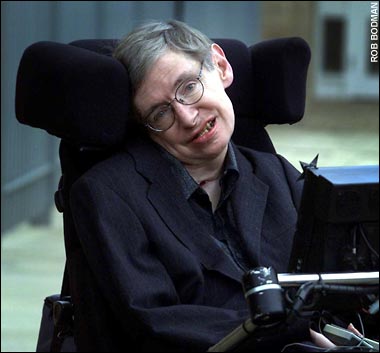
RTE radio recorded an interview with me today on the subject of Stephen Hawking. I’m told it’s to have on file so I trust they don’t know something I don’t! Whatever the reason, it’s nice to have the opportunity to pay tribute to a living legend. Below is a script I prepared the interview; we only used a small part.

******************************************************************************

Q: Who is he?

Stephen Hawking is a famous English physicist at Cambridge University known for his work in cosmology, the study of the universe. In particular, he is admired for his work on black holes and on the big bang model of the origin of the universe.

Q: Why is he so famous?

Einstein used to be the only famous scientist of modern times, but Stephen Hawking has inherited that role. I like to think that one reason is his field of study; there seems to be a public fascination with scientific concepts such as the big bang and the nature of space and time (it’s hardly a coincidence that much of Einstein’s work was in this field).

Another reason may be Hawking’s disability. He was diagnosed with motor neuron disease (ALS) in his early 20s and given two years to live. The story of a brilliant mind trapped in a crippled body has universal appeal, and the wheelchair-bound figure communicating deep ideas by voice synthesizer has become an icon of science.

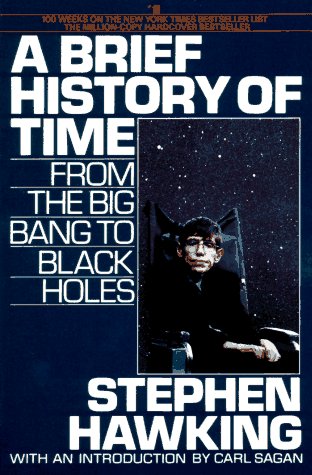
Then there’s the book. In the 1980s, Hawking published A Brief History of Time, a book on the big bang aimed at the general public  – it quickly became an unprecedented science bestseller and made him a household name. Since then, he has devoted a great deal of time to science outreach, unusual for a scientist at this level.
Q: Where is he from?

He was born in London in 1942, the son of two academics, and studied physics at Oxford. He wasn’t outstanding as an undergraduate but he did well enough to be accepted for postgraduate research in Cambridge. There, he became interested in cosmology, in particular in the battle being waged at Cambridge between the ‘big bang’ and ‘eternal universe’ theories. He showed early promise as a postgraduate when he demonstrated that Fred Hoyle, a famous cosmologist and prominent exponent of the eternal universe, had made a mathematical error in his work.

Q: Can you say a little about Hawking’s science?

His work is focused mainly on phenomena such as black holes and the big bang. Such phenomena are described by Einstein’s theory of relativity, which predicts that space and time are not fixed but affected by gravity. (In the case of black holes, relativity predicts that space is so distorted by gravity that energy,even light, cannot escape. In the case of the universe at large, relativity predicts that our universe started in a tiny, extremely hot state and has been expanding and cooling ever since; the so-called big bang model).

However, relativity does not work well on very small scales; this is the realm of quantum physics. Hawking’s lifelong work concerns the attempt to obtain a better picture of the universe by combining relativity (used to describe space and time) with quantum physics (used to describe the world of the very small).

He first established his reputation by defining the problem; with the mathematician Roger Penrose, he showed that relativity predicts that, under almost all conditions, an expanding universe such as our own must begin in a singularity i.e. a point of infinite density and temperature. This is not physically realistic and suggests that relativity on its own does not provide a true picture of the universe.

In later work, Hawking focused on black holes (a black hole is something like a big bang in reverse and may therefore offer clues to the puzzle of the origin of the universe). Successfully combining general relativity with quantum physics for this special case, Hawking was able to predict that black holes are not entirely black; instead they emit some energy in the form of radiation, now known as HawkingBekenstein radiation.  Most physicists are convinced by the logic and beauty of this result but Hawking radiation will be difficult to measure experimentally as it is predicted to be extremely weak.

My favourite Hawking contribution is the no-boundary universe. Working with James Hartle, he used a combination of relativity and quantum physics to predict that our universe may not have had a definite point of beginning because time itself may not be well-defined in the intense gravitational field of the infant universe!
Q: Is Hawking another Einstein?

No. Einstein made a great many contributions to diverse areas of physics. Also, relativity fundamentally changed our understanding of space and time, with profound implications for all of science and philosophy.(For example, the big bang model is merely one prediction of relativity). It’s hard for any scientist to compete with this.

Q: Why has Hawking not been awarded a Nobel prize?

He has received many prestigious awards, but not a Nobel. It’s quite difficult for a modern theoretician to win the prize because Nobel committees put great emphasis on experimental evidence. While we now have strong evidence that black holes exist, Hawking radiation will be very difficult to detect as it is predicted to be extremely weak.

Q; What is he working on these days?

At a conference in Dublin a few years ago, Hawking suggested a possible solution to the information paradox, a controversy over whether information is lost in black holes. The jury is still out on his solution. He is also involved with the theory of the cyclic universe, a theory that suggests there many have been many bangs.

Q: What lies in the future for Hawking?

Who knows. Last month, he celebrated his 70th birthday with a prestigious conference at Cambridge, 50 years after his terminal diagnosis. However, he was too ill to attend in person, reviving fears about his health. For now, he continues to work as ever, defying the predictions of modern medicine…

P.S. What’s all this about Hawking and God?

A Brief History of Time famously concludes with the phrase ‘‘..and then we would know the mind of God’’. At the time, many commentators interpreted this statement to mean that Hawking was religious. However, he was being mischievous – it is clear from other writings that he is not a believer in the normal sense. Indeed, his most recent book, The Grand Design, provoked controversy by stating that ‘‘It is not necessary to invoke God to set the universe going.” This statement was interpreted widely as a dismissal of God – in fact, it reflects standard cosmology (something can indeed arise from ‘nothing’) and says nothing about the existence of God.
10 Comments

Filed under Cosmology (general), Science and society

The big bang: is it true?

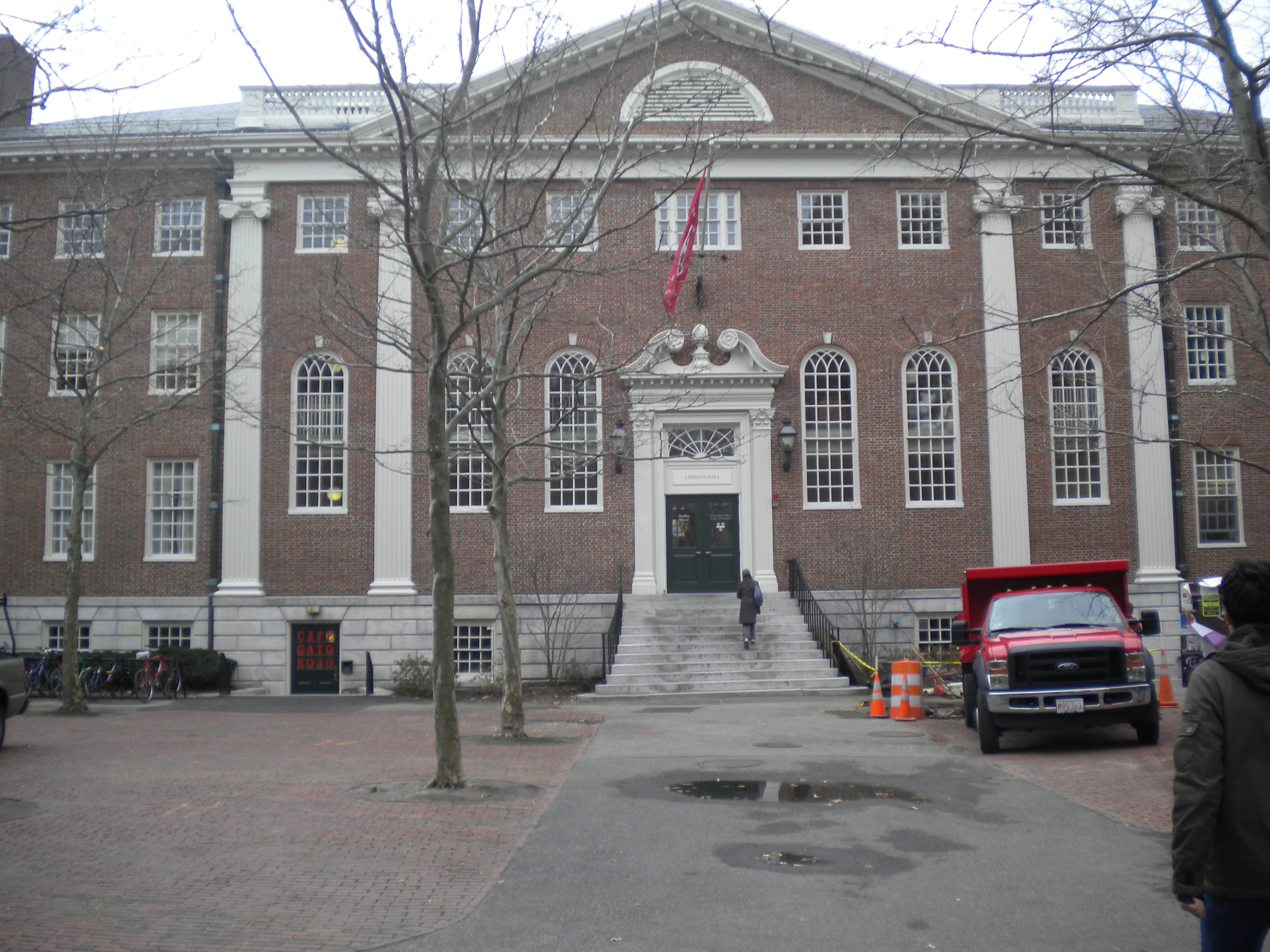
On Monday evening, I gave a big bang talk to the Harvard Graduate School of Arts and Sciences. I really like the way there is a single graduate school for both arts and science at Harvard, what a great interdisciplinary mix. The school has its own activity center, Dudley House ; the house is non-residential but modeled on the residential houses at Harvard, with its own building (Lehman Hall) complete with coffee shop, canteen, senior common room, games room, and a beautiful and quiet library with a fantastic view of Harvard Square.  It is served by two faculty masters, an administrative staff and graduate student fellows who organize activities for the School’s 4,000 Masters and PhD candidates. In truth, I spend a good deal of time at Dudley House – perhaps it’s the wide variety of disciplines that makes for such interesting conversations.

Dudley House, home of the Harvard Graduate School of Arts and Sciences

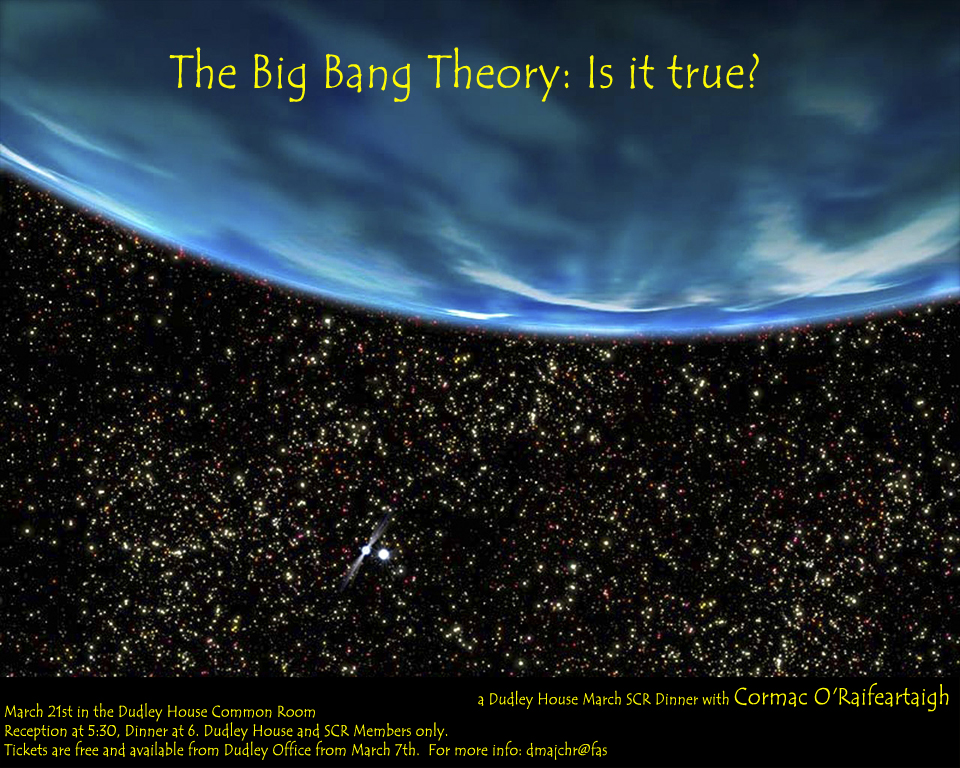
The talk was titled The Big Bang; Is It True? and it was great fun, with a drinks reception, a really nice dinner, a 40-min spiel from me and then almost an hour of questions from the audience. There were postgrads there from history, literature, psychology, philosophy, astronomy and other fields. Apparently, tickets sold out within hours of the posters going up, it shows the interest in the subject.

Of course, no scientist can give a definitive answer to the question I posed. Instead, I laid out a brief history of the discovery of the evidence supporting the big bang model (the expanding universe, the composition of the elements and the cosmic microwave background), followed by an outline of recent puzzles that have arisen from modern studies of the microwave background. I like a quasi-chronological approach to such talks, I think it makes the discoveries and concepts easier to understand, and at the same time it gives the audience a great feel for the surprises nature has in store for scientists. As for truth, the audience can decide for themselves.

You can see the full slideshow at https://coraifeartaigh.wordpress.com/my-seminars/

I really enjoyed the questions and discussion afterward; not for the first time, it struck me that you get very interesting questions and comments from a wide interdisciplinary audience (it doesn’t hurt if they are Harvard PhD candidates). There was also plenty of time to touch on one of my favourite themes; that a great many scientific discoveries come as a complete surprise to the discoverers. Far from being ‘constructed’ in order to support pet theories, scientific findings are often undesirable, unexpected data that no-one knows what to make of  at first – an aspect of science that proponents of the social construction of scientific knowledge often fail to address, in my view.

All in all, it was great to interact with postgrads from so many different disciplines, I wish I could do this more often.

Questions

One of the most challenging questions came from Prof Sam Schweber, a well-known Harvard physicist and historian of science. Sam couldn’t make the talk, but he emailed me his question: What happened before the bang?

I think the answer is twofold:
1. The standard answer is that the big bang model is situated within the context of general relativity, the modern theory of gravity. Since relativity predicts that space and time form part of the universe (and are affected by motion and by mass for example), we expect that time is born at the bang along with everything else – there is no ‘before’ just as there is no north of the north pole.

2. However, cosmologists are less cocksure of this answer nowadays. This is because fundamental problems in describing the moment of the bang (the singularity) have, far from going away, got worse. The problem is due to the inapplicability of the modern theory of gravity to phenomena on the atomic or quantum scale i.e. due to the absence of a successful theory of quantum gravity. Since we have no real way of modeling the singularity, we cannot rule out the prospect of exotic phenomena such as multiple bangs. The problem is compounded by the fact that, while recent observational evidence offers support for some type of cosmic inflation close to the birth of the universe, there is (so far) no way of selecting a particular model of inflation – which leaves the door open for models such as the cyclic universe. In other words, we cannot rule out the possibility of a ‘before’ until we have a clearer picture of what happened at the bang itself.

25 Comments

Filed under Cosmology (general), Public lectures

Antimatter trapped at CERN

The Daily Telegraph has a story today with the headline

Antimatter captured by CERN scientists in dramatic physics breakthrough

accompanied by the picture below and the usual razzmatrazz of antimatter-powered spaceships, antimatter bombs, Angels and Demons etc.

I first came across this strange story on Facebook early this morning and the Daily Telegraph headline iis equally puzzling. As every schoolgirl knows, antimatter is an exotic form of matter made up of particles of opposite electric charge to that of everyday matter (see post on this here). What is puzzling about the story is that physicists have been producing antiparticles in high-energy accelerator experiments since the 1950s and have been able to manufacture whole atoms of antimatter for over a decade now. (Atoms of anti-hydrogen are manufactured in accelerators by allowing anti-protons to capture anti-electons, see here).

About a third of the way down the article in the Telegraph, one discovers the real nature of the breakthrough –  the ALPHA experiment at CERN have reported that they have managed to produce atoms of anti-hydrogen that are relatively longlived (see paper in Nature here). Up to now anti-atoms were extremely shortlived because antimatter is instantly annihilated when it encounters matter (e.g. the container walls). What the Alpha group has done is to trap anti-hydrogen atoms in complex magnetic fields for up to a tenth of a second. Hence the word ‘capture‘ in media headlines, I guess.  It is certainly an important breakthrough as it should enable a detailed study of subtle differences between atoms of hydrogen and anti-hydrogen. (For example, in what way does the spectrum of anti-hydrogen differ from that of ordinary hydrogen?)

The Alpha experiment – don’t try this at home

This is an important area of study because any differences in the spectrum of anti-hydrogen vs ordinary hydrogen could shed light on one of the greatest mysteries of particle physics and cosmology; why is our universe made of matter? What subtle imbalance occurred in the early universe that led to the survival of ordinary matter over antimatter? From the point of view of particle physics, it wll be very interesting to see if CPT symmetry is conserved in the case of anti-hydrogen: if not this has implications for the standard model of particle physics.

Almost everybody in the particle physics universe is blogging on this breakthrough today so I won’t comment further – there is an excellent summary of the experiment on the Symmetry Breaking blog

Update

Kate McAlpine (author of the great LHC rap) has an excellent article on the above in this week’s edition of New Scientist . It’s well worth a look, especially her explanation of how neutral anti-atoms can be trapped in a magnetic field.

Update II

When the film Angels and Demons came out, Dan Brown was widely criticized for suggesting that enough antimatter could be trapped long enough to form a stable bomb (see post and review of A&D here). Looks like Brown wasn’t quite so far off the mark after all – at least about entrapment, if not about a feasible amount of antimatter for a bomb. My guess is that he had some serious discussions with the CERN group, just as he claimed at the time..

Not quite so daft

6 Comments

Filed under CERN, Cosmology (general), Particle physics

Wednesdays, WIMPs and super-WIMPs

Wednesday is my favourite day this year. The weekly STS seminar is over and discussed, the fellows group meeting is done and it’s too early to start next week’s readings. At 12.15, I give a solid-state physics class over the web to my hapless students in Ireland and then I’m finally free to catch up on what’s going on in the world…

One of the things going on this week is a terrific cover story in Scientific American on dark matter by particle cosmologists Jonathan Feng and Mark Trodden. As every schoolgirl knows, particle cosmology is one of the most exciting areas of physics today; the convergence of the study of the extremely small (particle physics) and the study of the extremely large (cosmology) has had some spectacular successes in recent years. For example, the theory of cosmic inflation arose from considerations of particle physics, see post on inflation here.

The article gives a great overview of the concept of dark matter, from a postulate in particle physics (Fermi’s beta decay – bit of a stretch here), to the postulate of dark matter in galaxy formation in the 1930s (Fritz Zwicki). Of course, the W and Z particles of ‘ordinary matter’ are now associated with the former, but it is thought that dark matter may play a role in their masses. Similarily, Zwicki’s proposal has now been extended to explain galaxy formation all scales, from galaxy clusters to halos. (Essentially, dark matter is thought to provide the inert scaffolding on which ordinary matter clustered to form galaxies during the expansion of the universe). The article goes on to describe the standard candidate for dark matter; hypothetical particles that feel only the gravitational and weak nuclear force (i.e. do not interact with the electromagnetic force, hence ‘dark’) they are known as known as weakly interacting massive particles or WIMPs. The authors do a great job of carefully describing the WIMP coincidence; the fact that the density of WIMPs postulated by particle physicists closely matches that postulated by cosmologists for the scaffolding necessary for the galaxy formation. The article also gives a useful overview of current searches for WIMPs in particle physics experiments.

What is unusual about the piece is that the authors then go on to explain the newer concept of super-WIMPs; the idea that the original WIMPs may have decayed into particles that do not feel even the weak nuclear force. Thus is a fascinating idea and leaves open the possibility that such particles may interact with ‘dark forces’ we are completely unaware of.

It’s a great overview, well worth reading – and unlike many such articles, it also includes a clear description of the famous bullet cluster i.e. the first tangible cosmological evidence for dark matter.

Galaxy collision:  x-rays (pink) are emitted when the interstellar gas clouds collide, while the dark matter (blue) remains aligned with distant stars because it is unreactive .

Update

The first comment below makes me realise that I should have  mentioned the counter-argument. Some physics groups suggest that dark matter does not exist – instead our current understanding of gravity is incomplete. This is a perfectly respectable area of research, known as MOND; however,  sophisticated experimental tests of our law of gravity (GR) have come out strongly in favour of the current theory..so far. Meanwhile, there have been tantalizing hints of particles that could be candidates for dark matter in at least two of the particle experiments mentioned in the article.

I should also mention that dark matter is a favourite target of science skeptics. However, it is often overlooked that the central thesis of the postulate is about not making an assumption i.e.  just because the ordinary matter that we are familiar with can be seen, we should not assume  that all matter can be seen..and science is very much a game of making as few assumptions as possible

8 Comments

Filed under Cosmology (general), Science and society

Science week in Ireland: was Einstein wrong?

This week is Science Week in Ireland, with science events taking place all over the country. There are talks and demonstrations on every aspect of science you can think of, from a demonstration of animal magic at Killaloe in County Limerick to astronomy at the Crawford Observatory of University College Cork.

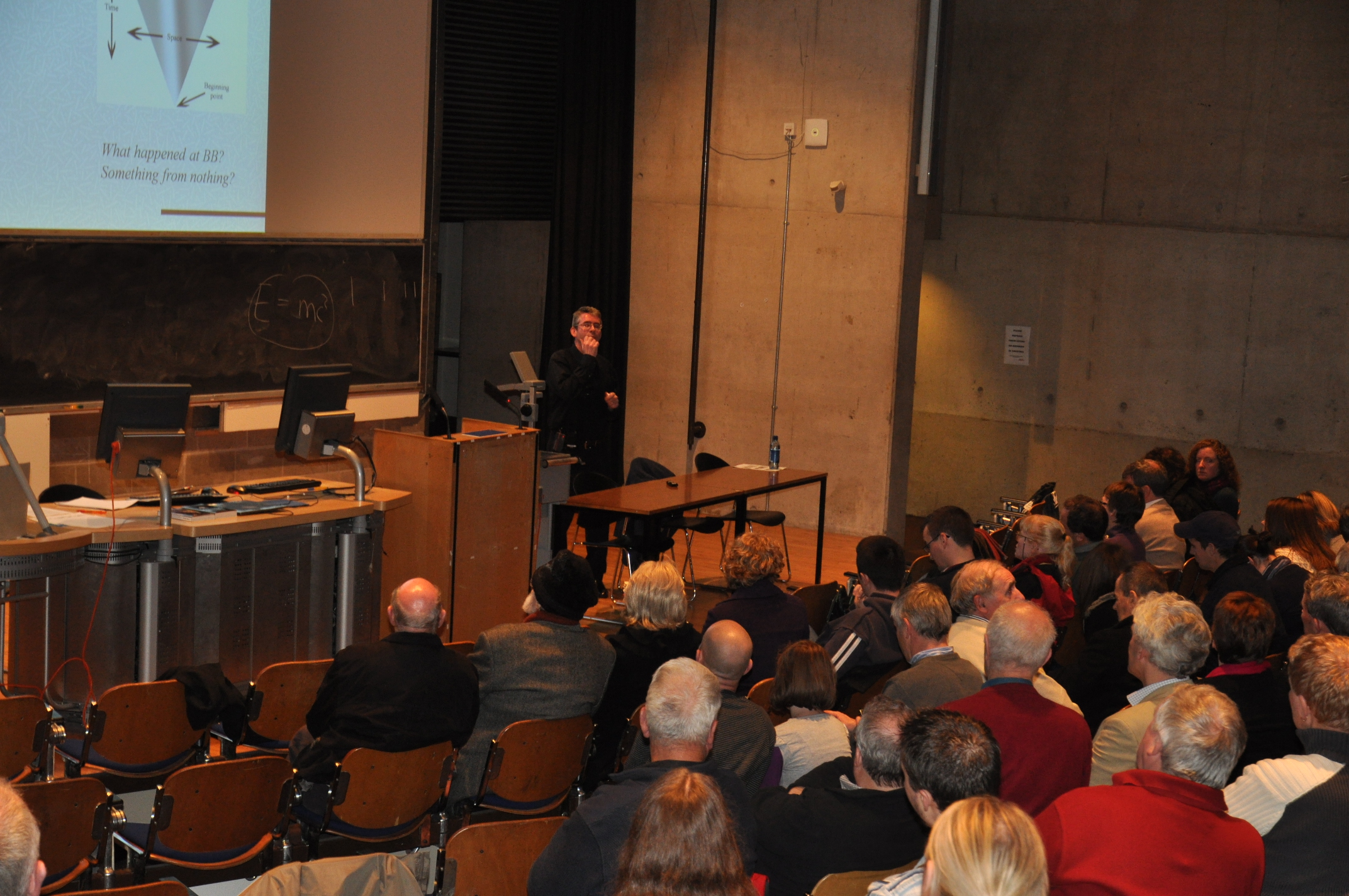
This evening, I will give a public lecture on the Big Bang in Trinity College, hosted by Astronomy Ireland. We’re still in the International Year of Astronomy, celebrating the 400th anniversary of Galileo’s use of the telescope to establish the heliocentric model of the solar system, so it’s highly appropriate to have a lecture describing another paradigm shift in science brought to us by astronomy: the discovery of the expanding universe and the big bang model that followed. I’m delighted to be giving the lecture as Astronomy Ireland do a fantastic job of promoting astronomy and science around the country, with night-classes in astronomy, public viewings of astronomical events and regular public science lectures. It’s also fun to tell the story of the discovery of the big bang model to people with an interest in astronomy, as many of them already know most of the facts, but from a slightly different perspective. Indeed, much of what we know of cosmology really comes from astronomical observation. You can find a poster, a summary of the lecture and the slides I will use here.

As I write this post, I’m sitting in the RTE canteen having done an interview promoting the lecture on Today with Pat Kenny, the flagship radio show of RTE, the Irish broadcasting corporation. (The last time I was at RTE I was auditioning for deputy work with the  Concert Orchestra but that’s another story!). I think the interview went well, it was certainly good fun. Unlike a lot of scientists I quite enjoy talking to the media, it’s a challenge getting deep ideas across in a short interview without sounding completely incomprehensible! I also find this particular radio show very good and listen in whenever I can.

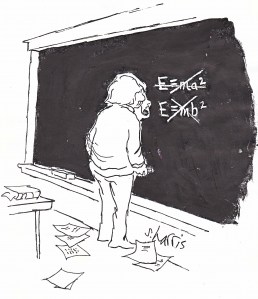
Astronomy Ireland marketed the lecture as ‘The Big Bang: Was Einstein Wrong? which is quite a good hook, so the interview touched on this quite a bit. Of course the answer is YES, it refers to a famous Einstein gaffe. When E. applied the general theory of relativity, his new theory of space, time and gravity, to the entire universe, it predicted a universe that was changing in time (space and time expanding). No evidence for such a thing existed at the time, so Einstein then introduced an extra term into the equations of relativity to force the universe to be static. Such fudge-factors are always risky in science and sure enough it turned out to be a big mistake. In 1929, the American astronomer Edwin Hubble established unequivocally that faraway galaxies are rushing away from one another and mathematicians realised that the universe is indeed expanding. Einstein immediately dropped the spurious term (known as the cosmological constant), declaring it his ‘greatest blunder’. You can listen to a podcast of the interview here, I hope I got the point across!

einstein

Einstein: right about relativity, but missed the prediction of the expanding universe

On Tuesday evening, I’ll give a repeat of the lecture in Waterford,in the main Auditorium of our college. On Wednesday, there is a talk on on the legacy of Charles Darwin at Waterford City Hall, which should be very good, I hope to attend myself. Both these lectures have been organised by CALMAST, the science communication group at WIT. All in all, it’s going be a busy week.

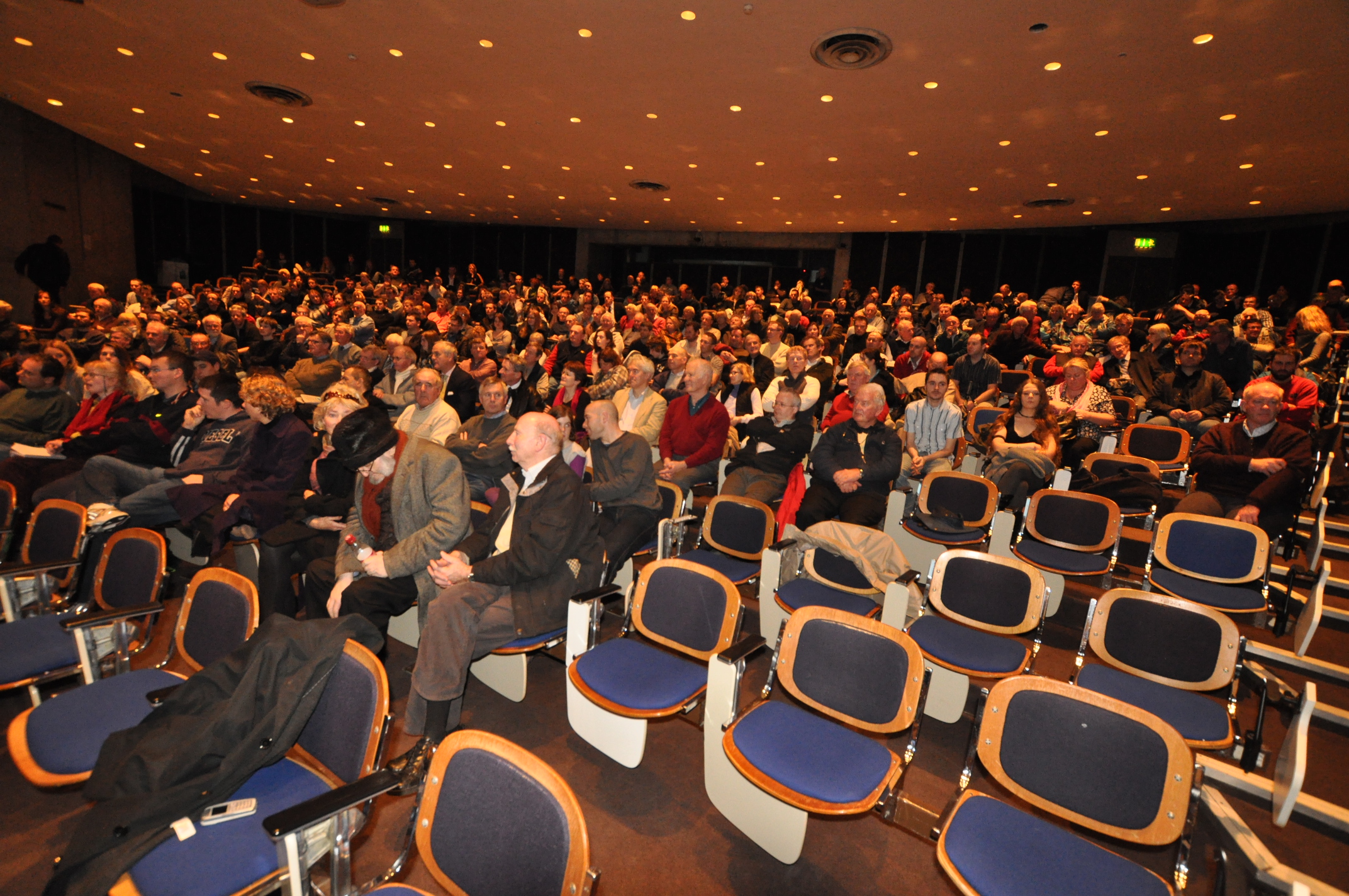
Update: I can see why media interviews are important, we had to change venue to the largest lecture theatre in trinity last night as we got a turnout of about 500! I think the lecture went well, I certainly enjoyed it.

DSC_4753

DSC_4751

DSC_4666

DSC_4728

DSC_9376

17 Comments

Filed under Cosmology (general), Public lectures, Science and society

Current status of the concordance model

This week I’m studying a very nice article on the ArXiv by L.Perivolaropoulos on recent observational challenges to the ΛCDM model (thanks Bee).

The ΛCDM model is the technical name given to the concordance model of Big Bang cosmology (see final post in cosmology 101 series). Essentially, the model is the best attempt to account for the three main strands of observational evidence: the measurements of the cosmic microwave background, the measurements of the large scale structure of the universe by gravitational lensing, and the supernova measurements of the accelerated expansion of the universe. CDM stands for Cold Dark Matter, the postulate that much of the matter holding the galaxies and galaxy clusters together is unseen – i.e. does not couple with the electromagnetic interaction (see previous post on Dark Matter). Λ refers to the so-called cosmological constant –  i.e.  the ‘dark energy’ term thought to be responsible for the current acceleration of the universe expansion (see previous post on dark energy here).

_dark_energy_dark_matter

The matter-energy composition of the universe according to ΛCDM

However, cosmologists are well aware that there is an alternative: the ΛCDM model could simply be wrong, and the postulates of dark matter and dark energy completely spurious, if our underlying theory of gravity – general relativity – does not apply at the largest scales. Both postulates arise from the attempt to shoehorn the observational data into gravitational theory, and it is always possible that the underlying theory is incomplete (after all, we know GR breaks down at the smallest scales). There is a very nice discussion of this in Perivolaropoulos’ s paper, in the context of six experimental observations that have emerged in the last few years that don’t seem to fit easily into the ΛCDM model.

Of course, given the spectacular success of general relativity in explaining so many aspects of our universe so far, the betting money is on relativity being correct, while the new observational data may modified as more measurements are made (this has happened countless times before). Either way, it’s a really nice update on the current state of play and shows how good science is done – not to mention the usefulness of the ArXiv database.

Update

Over on the DiscoverScience blog, Sean Carroll also has very nice post on a specific challenge to the concordance model from measurements of the large scale structure of the universe by weak gravitational lensing. Again, both the post and the discussion afterwards are excellent and give a good idea of how this sort of science is done.

It”s worth mentioning that both dark matter and dark energy are favourite targets of skeptics, philosophers of science and other commentators. To be sure, they both probably seem like an obvious fix to an outsider, particularly given their postulated prevalence relative to ordinary matter (our universe is estimated to comprise 73% dark energy, 23%  dark matter and only 4% ordinary matter!). However, in this sort of debate, it’s important to listen to the experts. While keeping an open mind, most cosmologists seem convinced that dark matter almost certainly exists. The general line is that you can see it – by its gravitational effect, not electromagnetic. This is perfectly feasible if dark matter is made up of WIMPS (weakly interacting massive particles), a not unreasonable proposition. Such particles may even be detected at the LHC, which would be very exciting. It should also be remembered that the existence of dark matter is also invoked to account for the nucleosynthesis of the elements, a seperate plank of the big bang model. Finally, there are now strong experimental hints of the existence of dark matter from studies of galaxy collisions

Bullet_cluster

Evidence for dark matter in the bullet cluster

As for dark energy, it is certainly true that this is a lot more speculative, and could turn out to be one of many different things  (see wiki for a good summary). However, it’s important to note that the postulate does not arise solely from the supernova measurements – there are also indirect evuidence of dark energy from measurements of the cosmic microwave background.

5 Comments

Filed under Cosmology (general)

Binary black holes, gravitational waves and numerical relativity

We had an excellent turn-out for yesterday’s superb Institute of Physics seminar even though we are in the last hectic week of the teaching semester (thanks to the organisational skills of the WIT maths/physics seminar group). The talk ‘Binary black holes, gravitational waves and numerical relativity’ was given by Dr Joan Centrella, head of the Gravitational Astrophysics Laboratory at NASA’s Goddard Space Flight Centre. Dr Centrella is a distinguished relativist, well known for her work in the simulation of black hole mergers and she certainly didn’t disappoint.

The lecture started with an overview of massive black holes, intermediate black holes and gravitational waves. Just as general relativity predicts that a large mass will curve spacetime, it predicts that moving mass will cause ripples in the curvature of spacetime – known as gravitational waves. Of course, such disturbances will be extremely difficult to detect due to the weakness of the gravitational interaction. Indeed, while many of the spectacular predictions of general relativity have been verified (the bending of light in a gravitational field, time dilation in a gravitational field, black holes and even the expanding universe) the direct detection of gravitational waves is possibly the last great test of relativity. The speaker explained that the best chance of seeing the phenomenon directly is by studying the most explosive events known: black hole mergers.

There was a brief description of the indirect observation of gravitational waves, in particular the Hulse-Taylor pulsar. This is a binary pulsar found in 1974, whose orbit has been observed to be gradually shrinking due to the radiation of energy by gravitational waves: the two stars will merge in about 300 million years. Interesting that Hulse got the Nobel for work done while still a postgraduate, while Jocelyn Bell was overlooked for her discovery of pulsars – see post on IoP meeting below.

Centrella then gave an overview of direct searches for gravitational waves, both earth-bound (LIGO) and space-based (LISA). LIGO, the Large Interferometer Gravitational Wave Observatory, is basically a huge Michelson interferometer, complete with laser source, beam splitter and mirrors – the arms of the interferometer are several kilometers in length! LISA, the Laser Interferometer Space Antenna, is an astounding project: a joint NASA/ESA mission, it will consist of three separate mini-spacecraft, each with its own laser source, maintained in an equilateral triangle that will form a giant Michelson interferometer in space. Minute disturbances in spacetime by a passing gravitational wave will be measured as tiny changes in relative arm length (having taken all other factors into account). A crucial difference between the two systems is the target: while LIGO searches for intermediate black hole events, LISA will search for massive BH events (a much stronger source in a different region of the spectrum).

LIGO (California)

LISA (artist’s impression)

Dr Centrella then described her own field: the use of numerical methods and algorithims to solve the equations of general relativity for the particular case of relativistic binary systems and their associated gravitational waves. She gave a great overview of historic problems in the area and recent breakthroughs in the field, from the puncture method to the Lazarus approach. I won’t attempt to summarize this part of the talk, but there is a nice overview of the field here and I should have a link to the slides from the talk in a day or two.

Dr Centrella with a scale model of one of the LISA spacecraft

All in all, this was a superb lecture, courtesy of the Institute of Physics. It was clear the audience enjoyed the lecture thoroughly and there were plenty of queries at question time – indeed the lecture would have continued for another hour had we not whisked the speaker off for dinner. In answer to my own question on the detection of gravitational waves from the Big Bang itself, Dr Centrella pointed out that one would certainly to see expect a signal from cosmic inflation – however these waves would be in a very different region of the spectrum from that studied by either LIGO or LISA. ..

Update: Joan has been in contact to say you can get a review article she wrote on the subject for the Scidac Review here; she has also done a podcast for Sky and Telescope with movies of the simulations here. She also has two comments and corrections to the text above; rather than paraphrase them I have put them verbatim in the comments section!

Update II: there is a wonderful article on gravitational waves and the early universe by Craig Hogan in the June 2007 edition of Physics World, which you can access here if you’re a member

3 Comments

Filed under Cosmology (general)

The standard model of cosmology

The previous 12 posts listed the main discoveries of modern cosmology in chronological order: putting all this information together leads to the Standard Model of cosmology (not to be confused with the Standard Model of particle physics). We conclude our short course with a simple overview of the standard model (also known as the Concordance Model). You will notice that it is also a brief history of time. Keep in mind that what follows is a model: the strength of the evidence for each phenomenon varies (see specific posts on each topic starting here).

1. The Big Bang

  • The universe began approximately 13.7 billion years ago when it began expanding from an almost inconceivably hot, dense state.  Ever since, the cosmos has been expanding and cooling, eventually reaching the cold, sparse state we see today.

  • In the first 10-34 seconds, the universe experiences a brief period of extremely fast expansion known as inflation. This period smooths out initial inhomogeneities, leaving the universe with the homogeneity and isotropy we see today. Quantum mechanical fluctuations during this process are imprinted on the universe as density fluctuations that later seed the formation of structure.

  • The infant universe is a soup of matter and energy in which particle/antiparticle pairs are constantly born and annihilated.  As the universe cools, it becomes too cold to produce heavier particles, while the creation of lighter particles continues until temperatures cool to a few billion Kelvin.  At this point, most of the remaining particle/antiparticle pairs are annihilated.  A small amount of matter survives due to a slight asymmetry in the decay of between matter and antimatter.

  • After a few minutes, nuclei of the light elements (hydrogen, helium and lithium) are formed by the combination of free protons and neutrons, a process known as nucleosynthesis.
  • After about 100,000 years, the universe is cold enough for free nuclei and electrons to to combine into atoms (recombination).  At this point, the universe becomes transparent due to reduced scattering by free electrons.  Radiation now permeates the universe – seen today as the cosmic microwave background. By this time, dark matter (unaffected by the behavior of the baryonic matter) has already begun to collapse into halos.
  • After a few hundred million years, galaxies and stars form, as baryonic gas and dust collapse to the center of the pre-existing dark matter halos.

A brief history of time

2. The Composition of the Universe

  • Baryonic Matter: ~3% of the mass in the universe
    This is ordinary matter composed of protons, neutrons, and electrons.  It comprises gas, dust, stars, planets, people, etc.

  • Cold Dark Matter: ~23%
    This is the “missing mass” of the universe.  It comprises the dark matter halos that surround galaxies and galaxy clusters, and aids in the formation of structure in the universe. Dark matter is believed to be composed of weakly interacting massive particles or WIMPs.

  • Dark Energy: ~73%
  • Observations of distant supernovae suggest that the expansion of the universe is currently accelerating.  This observation is backed up by the flatness of the universe as measured from the cosmic microwave background.  Cosmologists believe that the acceleration may be caused by some kind of energy of the vacuum, possibly left over from inflation.

Matter/energy  composition of the universe

That concludes our short course in cosmology. You can find details on any of the topics above  by scrolling through the last 12 posts of this blog. Alternately, you can find slides from a lecture I gave on the subject (The Big Bang – Theory or Established Fact?) by clicking here

Update

There is a really nice one-page web summary of all of the above on the Talkorigins Archive here, and for readers requiring a slightly more advanced treatment, there is a good review of the current state of play in cosmology on the ARXIV here

25 Comments

Filed under Cosmology (general), Cosmology 101

A brief history of cosmology

The last 12 posts described each of the main topics of modern cosmology: from the predictions of general relativity to the three main planks of evidence for the Big Bang, from the theory of inflation to the most recent measurements of the cosmic microwave background. All of this theory and experiment has been put together to form what is known as the Standard Model of cosmology. Before we describe the Standard Model, let’s briefly review the main discoveries in chronological order (you can read a seperate post on each starting here)

****************************

A Brief History of Cosmology

1.  The general theory of relativity (Einstein, 1916) and the prediction of a dynamic universe (Friedmann, 1919)

2. The observation of the expanding universe (Hubble’s Law, 1929)

3. Rewinding the Hubble graph: the ‘primeval atom’ and the calculation of the age of the universe (Lemaitre, 1929)

4. The Big Bang model and the problem of the singularity

5. The prediction of the abundances of H and He from the BB model (Gamow, 1945)

6. The predicton of the cosmic microwave background (CMB) from the BB model (Alphaer, Heuer and Gamow, 1949)

7. The detection of the cosmic microwave background (Penzias and Wilson, 1965)

8. The CMB puzzles of flatness, homogeneity and galaxy formation (1965 -)

9. The theory of inflation (Guth, Linde and Steinhardt, 1981-82)

10. The COBE study of the CMB –  support for the BB model and inflation (1992)

11. Dark energy – the supernova measurements of an accelerating universe (1998)

12. The WMAP study of the CMB – more support for inflation and dark energy (2005)

**************************************************

I gave a talk on the Big Bang to our astronomy class at WIT last night, describing most of the above topics. It was great fun, with a lengthy question and answer session afterwards, fielded by both me and well-known astronomer Emmet Mordaunt who normally takes the class. You can find the slides for the talk here.

1 Comment

Filed under Cosmology (general), Cosmology 101

Dark Energy

In 1998, a totally unexpected result from astronomy caused a dramatic rethink of the Big Bang model. Measurements of the light emitted by a certain supernova suggested that it was further away than predicted by the Hubble constant. In other words, the exploding star did not lie on the straight line of the Hubble graph! This is a startling discovery as it implies that the expansion of the universe is not constant – instead the expansion is currently accelerating (see a description of the experiment here).

Skeptics at first suggested the result might arise from an error in the measurement of stellar distance – however, a similar observation was reported by a different group within two years. Further, independent support for the result soon emerged from measurements of the cosmic microwave background (CMB). In 2002, precision measurements of the CMB by the WMAP satellite suggested a universe with geometry that is flat to within 1%. This result is completely inexplicable in the context of the known density of the matter of the universe (both ordinary and dark). The known density of matter points to a universe with = 0.3, a long way from flatness ( =1). Hence the CMB measurements suggest that there is a great deal of matter/energy in the uiverse unaccounted for.

As a result, cosmologists now talk about a new phenomenon; a form of energy that is pushing the universe outward, causing the expansion to accelerate and the geometry to be flat. The phenomenon is labelled Dark Energy : the physical cause for dark energy is thought to be some sort of vacuum energy. However, it should be pointed out that the numbers don’t yet stack up – detailed calculations suggests that the postulated vacuum energy would cause an accelerated expansion many orders of magnitude greater than that observed…this is a major area of research at the moment.

Putting Dark Energy together with Dark Matter, cosmologists postulate that ordinary matter, dark matter and dark energy all add up to the critical density required for the geometry of the universe to be flat (as measured). In other words, the current model of the universe can be summed up by

Density ord matter (4%) + Dens dark matter (22%) + Dens dark energy (74%) = 100%

or M (0.04) + DM (0.22) + ΩDE (0.74) = 1

*************************************************

Technical notes:

1. Is Dark Energy compatible with relativity?

Yes, but note that an accelerating universe is not predicted by the Friedmann equation, i.e. does not feature in any of the Friedmann universes (see post on the expanding universe below). Going back to 1st principles, when one applies the equations of general relativity to the cosmos, an extra term must be added in order to account for the accelerating expansion. This is rather reminiscent of the manner in which Einstein himself , dismayed by the prediction of a dynamic universe, originally added a term to his equations in order to keep the universe static (the positive cosmological constant) . Now we apply a term to the other side of the equation for the opposite reason.

Revised Friedmann graphs of the evolution of the universe

2. Is Dark Energy compatible with inflation?

Yes, for two reasons:

1. The fact that the expansion is accelerating now makes the suggestion of an exponential expansion in the first instants a lot less fanciful.

2. While the current accleration is many orders of magnitude less than that of inflation, it may be that the cause is some energy left over from inflation – more on this later.

10 Comments

Filed under Cosmology (general), Cosmology 101