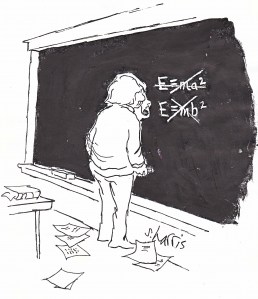
Yesterday evening, I gave a public lecture in Dublin on the Gran Sasso neutrino experiment, hosted by the Irish Skeptics Society. The event formed part of Maths Week Ireland, an initiative co-ordinated by CALMAST, the science outreach group at our college. We had a great audience turnout and I enjoyed the Q&A afterwards immensely. Below is the abstract and you can find the slides for the talk here.
**********************************************************
In September 2011, a group of scientists announced that they had detected subatomic particles travelling at speeds greater than the speed of light in vacuum. The finding is in conflict with Einstein’s theory of relativity and has been met with great skepticism by mathematicians and physicists around the world. This lecture will examine the grounds for that skepticism and consider the role of skepticism in general in science and mathematics
********************************************************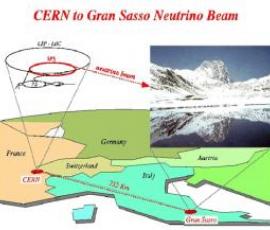
The Gran Sasso experiment
I suspect I was invited to speak because of a letter I had published on the subject in The Irish Times (below). Although the Gran Sasso experiment has certainly raised awareness of physics, I think the way the media are portraying this experiment as an ‘Einstein wrong’ story is most unfortunate. It is far too soon to reach that conclusion and the overall effect is to make science seem very uncertain. It is more Public Misunderstanding of Science than PUS, in my view.
*************************************************
Sir, – Margaret Moore (September 29th) asks what word will be used to describe a speed faster than the speed of light. The technical term is superluminal speed. However, much of the media coverage of recent experiments at Gran Sasso has been very misleading. Almost all professional physicists (including the experimenters) consider the Gran Sasso result a curious anomaly almost certainly due to some unknown error in measurement, for several reasons:
1. Light is carried by particles of zero mass and it follows that there are fundamental theoretical reasons for supposing that the speed of light in vacuum represents a natural speed limit for particles of non-zero mass.
2. Thousands of experiments have verified that the tiniest particles of matter can be accelerated up to speeds close to, but not equal to, this limiting speed.
3. The recent Gran Sasso experiment involves measurements of time and distance of unprecedented precision, yet it was not designed for this specific purpose; thus there are many potential sources of systematic error.
It’s true that science sometimes progresses by upsetting the status quo, but scientists are a sceptical lot and extraordinary claims require extraordinary evidence! –Yours, etc,
**************************************************************
Does it matter how the experiment has been portrayed in the media? I think it does. A few years from now, journalists will be say ‘ but didn’t you guys think in 2011 that Einstein was wrong’? In fact, there has already been one editorial in the Wall St Journal urging inaction on climate change, on the basis that science is never certain, given the neutrino result (see point 5 of this article ). Exactly the wrong conclusion to draw…
Update
I see my lecture got a short review in today’s Irish Times. It’s not a bad overview, considering the writer wasn’t at the lecture. The last sentence doesn’t make sense, however – I suspect she meant supernovae instead of black holes!
Udate II
Just caught BBC program on the experiment (Marcus du Sautoy). Superb, superb program. Nothing like the players themselves for conveying the concepts of science..
 Antimatter
i think that the backgeound can to be altered.a stonger violation of cp(CPT) still pt( spacetime continuos) is normal.the 4 dimension has several aspects much stranges,as discontinuities,so as a non-commtative geometry can to be the background for STR AND GTR.
the physiscs is not ended in einstein.and superdtrings theories?
the big problem of STR,in special,is the fact that physically as mathematically the relation of space and time are obscures,so the speed of light mesuring the space and time,oonly one is very strange,i believe that the speed of light obtained as constant and limit to the universe must be derived of a symmetry breaking,as the symmetry of pt.being so the speed of light be invariant and limit to determined frequencies of energies,and thiese be linked to the spacetime through an entity called velocity.
the spacetime continuum in 4-dimensions is associated to breakdown of pt.and to differents curvatures of spacetimes,associated to descontinuies generated by the 4-dimension manifolds-where instantons are generateds.
I THINK THAT THE SPEED OF LIGHT IS NOT INVARIANT FOR ALL THE DIRECTIONS,AND NOR LIMIT.THERE ARE PATHWAY WHERE THE SPEED OF LIGHT MEASURED IS NOT THE SAME IN OPPOSED DIRECTIONS.I BELIEVE THAT STRONGEST ELECTROMAGNETIC FIELDS ALTERE THE SPEED OF LIGHT.
I THINK THAT HELICITY OF PARTICLES AND ANTIPARTICLES EXPLAIN THE METRICS OF SPACETIME,AS SPSCE CONTRACTIONS AND TIME DILATATIONS,EXPLAINED IN THE CONSERVATION OF CP,THENCE
VIOLATION OF PT( EXPLAINING THE APPEARING OF SPEED OF LIGHT AS CONSTANT,AND THE CONECTION OF SPACE AND TIME IN SPSCETIME CONTINUOS IN 4-DIMENSION INTO SEMI-RIEMANNIAN MANIIFOLD).THEN THE SPEED OF LIGHT IS SUPRESSED IN OTHERS SPSCETIME CONTINUOS).THENCE NEUTRINOS AND ANTINEUTRINOS MUST HAVE A CHIRAL MODEL).THEN THE ASYMMETRY OF SPACE AND TIME IN STR MUST BE ASOCIATED TO VIOLATION OF PT-BUT CONSERVE GLOBALLY CPT-EXPLAIN THE CONTRACTION OF SPACE AND TIME DILATATION ,THIS IS THE DIFFERENCES BETWEEN LEFT-RIGHT HANDED ROTATION SYSTEMS,TRANSFORMING ONE INTO OTHER.THESE DIFFERENCES
CALCULE THE DIFFERENTS CURVATURES OF SPACETIMES TO THE NONEUCLIDEAN GEOMETRIES AND TOPOLOGY CHANGES,SO AS THE NONCOMUTATIVE GEOMETRY,AND BIQUATERNIONS ARE THE GENS
OF STR.THE DIFFERENCES IN CHIRAL MODEL IN 5 DIMENSIONS -TIME WITH TWO DIMENSIONS DO DISAPPEAR THE axions,AND THE CONSERVATION OF ENERGY IS ASSOCIATED BY THE METRICS OF SPACETIME CONTINUOS.
There is an interesting (and funny) image in this post on the public’s misunderstanding of words used in scientific articles and an overview of the problem communicating science clearly (which the Bad Astronomy blog is usually good at clearing up) – http://blogs.discovermagazine.com/badastronomy/2011/10/19/scientists-are-from-mars-the-public-is-from-earth/
I believe that only the neutrinos and proposal tachyons( that must exist) as the proper speed of light is not constant-must be altered by strongest electromagnetic fields,as due the violation of helicities or better ona chiral model.where pt is broken,and the speed of light is seen as isotropic,through of lorentz’s invariance group,and does appear the transformation antiorthocrous of lorents-or diagram of feynman-stuckeberg
I THINK THAT THE NONCOMMUTATIVE GEOMETRY (CONES) DERIVED OF MATRICIAL AND BIQUATERNIONS ALGEBRAS ARE SEEN AS FUNDAMENTAL ENTITIES SPACETIME OF WORLD SHEETS( NO MORE POINTS.LINES.SURFACES) THAT ARE SUPERSTRINGS,THAT IN THEIRS PROPRTIES AND OPPERATIONS GENERATE THE SUPERSYMMETRY,EXTRADIMENSIONS CURLED UP(AS DIFFERENTS DIMENSIONS OF SPACETIMESCONTINUOS).THEN THE PARTICLES AND ANTIPARTICLES IN ITS DIFFERENTS HELICITIES AND MOTIONS GENERATES THE SPSCETIME CONTINUOS THAT ARE SUPERSTRINGS-EACH “PARTICLES” VIBRATE IN AN ONLY ONE FREQUENCY´– this SPACETIME CONTINUUM,lINKED TO ENERGY SPECTRUM_THAT IS CONTAINED IN SPINS IN TJEIRS “HANDNESS”
ending my commentaries,i believe what the mathematical garb to special theory of relativity are BIQUATERNIONS,through property noncommuative that does the connection of space and time in spacetime
continuos in the 4-dimensional universe with hyperelliptics geometry( riemannian manifold with ricci metric tensor) in chiral model.the spacetime R^8 into in spacetime C^4 with hyperkahler scalar curvature.The complex
variety contain 4-dimensions of spsce and ttwo dimension of time.In 4-dim two orientations of time appear as
only one and 3-dim.of space.then the projective spacetime would have 12-dimension.
Has the OPERA team merely blundered? They spent 6 months attempting to eliminate experimental error and they are highly reputable as a group. Does the OPERA neutrino anomaly confirm the Rañada-Milgrom effect? Does overwhelming empirical evidence demonstrate that the Rañada-Milgrom effect is empirically valid? By carefully studying the paper by P. Kroupa, B. Famaey, K.S. de Boer, J. Dabringhausen, M. Pawlowski, C.M. Boily, H. Jerjen, D. Forbes, G. Hensler, M. Metz, called “Local-Group tests of dark-matter concordance cosmology. Towards a new paradigm for structure formation”, http://adsabs.harvard.edu/abs/2010A%26A…523A..32K A&A 523, 32 (2010), one can learn that something is seriously wrong with the standard model of cosmology.
Is there overwhelming empirical evidence for dark matter (DM)?
http://en.wikipedia.org/wiki/Dark_matter
“There is a tremendous amount of evidence for dark matter. Yet all this evidence is based on the assumption that Newton’s theory can be safely applied to the scales of galaxies.” — Stacy McGaugh
http://www.astro.umd.edu/~ssm/mond/MOND_sub.pdf “Mond over matter”, 2002
“I think few people appreciate that the main difficulty for DM is that the host of regularities pointed out by MOND, if taken as just a summary of how DM behaves and interacts with normal matter, suggests that these two matter components are coupled and correlated very strongly in many ways. … if MOND does turn out to have some truth to it, the fact that it has encountered so much opposition will just show how nontrivial a thought it was.” — Mordehai Milgrom, interview entitled “Dark-matter heretic”, American Scientist, Jan.-Feb. 2003, Vol. 91, #1, p. 1
http://www.americanscientist.org/issues/pub/dark-matter-heretic
Consider the following argument:
Premise 1. There is overwhelming empirical evidence in favor of Milgrom’s non-relativistic MOND, according to the work of Milgrom, McGaugh, and Kroupa.
Premise 2. For low gravitational accelerations, non-relativistic MOND is approximately equivalent to the Rañada-Milgrom effect, because the approximate equivalence is easily shown by a scaling argument.
Premise 3. The approximate value of the dark-matter-compensation-constant is given by the Pioneer anomaly, and this value is approximately confirmed by the OPERA neutrino anomaly.
Conclusion. The Rañada-Milgrom effect is approximately valid, at least for low gravitational accelerations and non-relativistic velocities.
Hi David, I don’t think it’s a question of a ‘mere blunder’, much more a question of unchartered territory of unprecedented accuracy – we may well find the OPERA experiment has shown up a hitherto unsuspected error in GPS.
That said, it’ll be interesting to see the result of the curent experiments with differentproton pulse shapes
these study to milgrom are very iinteresting because place a scalar field and antisymmetrics metric tensor as fundamental to explain the anomalies to einstennian gravitational fields-with snallest variations to the
equivalence to inertial and gravitational fields.then these diferences implies anomalies to neutrinos and antimeutrinos when exchange theirs hellicities(spins),demostranting discreteness in the relativistic base when the neutrinos exceeding the speed of light;demonstranting than the speed of light depending of strongest
electromagnetic fields has it value modified in the vacuum.
we have that cpt is broken in stronger gravitational fields-with stronger curvatures in spacetime,doing the invariance of lorentz is booken,restaured by the anticchrous lorentz invariance.then the proper speed of light is variavel by determinided regions of spacetime metric curvatures-this then the antisymmetric metric tensor that does the equivalence to all the past and future is violated.
escuse me for the excess of commentaries.but that matter is fascinatin
Ends in the physics Einstein ? There is physics beyond Einstein’s ?
Slutar i fysiken Einstein ? Det finns fysik bortom Einsteins?
A fisica termina em Einstein? Existe Fisica alem de Einstein ?
Of course. From many years ago. A WHOLE NEW PARADIGM that proved, without any doubt, that the Special and Genwral Realtivity are absolutely wrong and the Actual Paradigm, as a WHOLE, is PURE FANTASIA.
See please: http://autodynamicslborg.blogspot.com/
Lucy Haye Ph. D.
SAA’s representative
lucyhaye22@gmail.com
dear lucy i think that you be correct.
what are the yours thoughts about of str and gtr ?
greetings
Pure fantasies, which were classified as non-sense by Richard Feynman, the Nobel laureate. Please see:
String and Super-String Theory
http://autodynamicslborg.blogspot.com/2011/06/string-and-superstring-theory.html
Lucy Haye.
lucy
i think that deformations of the curvatures of spacetime-time dilatation and contraction of space- with the non-invariance of cpt,permit us to encounter regions of the universe where the speed of light is not constat.each region would has a speed of light,constant( a defined values to the vacuum).these differents speed of light
are linked to the differents intensity to the electromagnetic fields-this is to the different direction in the space-associated to a scalar field given by spins and polarization to the light.
how you obtain the quantum mechanical fields with newtonnian mechanics?
Dear Carmatt:
Yes. It permit to invent the most fantastic fantasies, but this is NOT Science, it is Scientific Science Fiction.
Doesn’t exist any Space-Time-Curvature; it is a simple Delirium Tremens by Einstein in his General Relativity and it is NOT working in Gravitation,
It is possible to invent more fantasies as the speed of Light is different in the Universe different regions. This, BTW, is absolutely flawed because the observational proofs show an absolutely FLAT Universe, absolutely homogenous.
What follow is another Delirium Tremens inventing more fantastic fantasies that has NOT any coherent logic, coming from what is called the “””Scientific Community.”””
Please, go back to the Common Sense of Galileo-Newton-Scientist of the 19 Century, which is the Carezani New Paradigm of the 21 century and beyond.
http://autodynamicslborg.blogspot.com/
Autodynamics (AD) doesn’t get the Quantum Mechanics from the Newton’s Mechanics. Has not the concept of “”””field”””” because it has NOT ABSOLUTELY any meaning, The quantum is the Planck‘s quantum. The Le Sage’s mundane particle, the Graviton championed by Luis de Broglie at the beginning of the 20 century and accepted by Carezani as Pico-Graviton. His Quantum Universal Gravitation (Mechanics) create a New Celestial Mechanic that corrected Newton in the 8th decimal position and explaining all that Newton-Einstein CANNOT, as the Pioneer Slowdown, the Moon Receding from Earth, The Allais’ Anomaly, the increasing Gravitation during Eclipses, the Motion Creation and etc.
Quantum Universal Gravitation
http://autodynamicslborg.blogspot.com/2011/05/quantun-universal-gravitation_06.html
Go to AD if you want to know the New World. But, of course, you need to KILL FANTASIA inside your BRAIN.
Regards.
Lucy Haye Ph. D.
SAA’s representative
all the einstennian theory is wrong.is it ?
newton is correct,still ? How?
if all is phantasy..what is not phantasy?
neutrinos with speed faster than the speed of light is normal in the nature,then speed of light is not constant,nor limit for the universe.is it?
greetings
Ends in the physics Einstein ? There is physics beyond Einstein’s ?
Slutar i fysiken Einstein ? Det finns fysik bortom Einsteins?
A fisica termina em Einstein? Existe Fisica alem de Einstein ?
Today nov. 18, 2011 it is reported that the OPERA team has confirmed 20 neutrinos in the superluminal range. What do you think of this work and do you think the MINOS experiment will address the accuracy or lack thereof of this result ? The Nature News article quoted the MINOS head as saying that their experiment will address, I think, one aspect of the timing dimension of these results.
I BELIEVE THAT THOSE ARE CORRECTS.ONLY NOT THE NEUTRINOS TRAVEL WIH SPEED OF LIGHT MEASURED BY MICHELSON-MORLEY,BUT THE PROPER IS NOT CONSTANT,APPEARING TO BE FOU OURS INERTIAL REFERENTIALS.BEING THE SPEED OF LIGHT APPEAR US CONSTANT AND ISOTROPIC DUE SYMETRY BREAKING BY LEFT-RIGHT HANDED ROTATIONAL SYSTEM S TRANSFORMATING ONE INTO OTHER-IN THE QUANTUM WORLD-APPEAR AS SPINORS THAT THE ROTATIONAL SYSTEM THAT IF TRANFORM FROM LEFT-HANDED INTO RIGHT-HANDED ONE INTO OTHERS AND VICEVERSA GENARATING THE SPACETIME CONTINUOS IN THE 4-DIMENSIONAL UNIVERSE WHERE THE CURVATURES IF INTERCEPT TRANSFORMING IN THE SPACETIME LEFT-HANDED SPINS INTO RIGHT HANDE SPINS AND VICEVERSA THROUGH VIOLATION OF CP,AND MAXIMALLY THERE IS THE PT BREAKDOWN THAT CONNECT SPACE AND TIME IN SPACETIME CONTINUOS,THOUGH OF BIQUATERNIONS
AND PROPERTY ANTICOMMUTATIVITY-ANTICOMUTATIVE TOPOLOGY AND GEOMETRY-
THAT IMPLY RETARRDED AND ADVANCED POTENTIAL WAVEFUNCTIONS THAT IMPLIES
THAT THAT DOES WITH ANTINEUTRINOS TRAVELING WITH SPEED OF LIGHT,AND APPEAR AS NEUTRINOS,CHANGING THE HELICITY IN THE SPACETIME OF 4-DIMENNSIONAL RIEMANNIAN MANIFOLDS DUE MATHEMATICALLY TO NONCOMMUTATIVE PROPERTY.THIS IMPLIES THAT SPACETIME CONTINUOS( FUTURE AND PAST ARE INCOMPLETE,AND BOTH IF CONNECT THROUGH HIDDEN VARIABLES
IN THE FUTURE AND PAST THAT ARE CURVATURES OF SPACETIME THAT WILL GO IF CLOSING ONE INTO OTHER.ANTISYMETRIC METRIC TENSOR OF EINSTEIN CONFIRM
CONCLUSION;THE EXPERIENCE OF NEUTRINOS AND OF THE CHARM MESON CONFIRM THAT THE UNIVERSE IS ASYMMETRIC,VIOLATING CP,THE ANTIPARTICLES ARE SUBSTRATUM OF ENERGY THAT EXPLAIN THE INCREASE OF ENERGY WITH INCREASE OF VELOCITY AND THEREFORE THE TIME DILATATION AND CONTRACTION OF SPACE LINKED TO LEFT-RIGHT HANDED ASYMETRY THAT MEASURE THE SPACETIME OF PARTICLES AND ANTIPARTICLES-WITH THE SPINS THAT IS ROTATIONAL ENERGY IN
CHIRAL MODEL
BOTH EXPERIENCE IMPLIES THE SPACETIME WITH DISCRETENESS AND CONTINUITY,SO AS THE SPEED OF LIGHT IS NOT LIMIT MEASURED IN OUR INERTIAL REFERENTIAL SYSTEMS.THE UNIVERSE IS NONEUCLIDEAN-HIGHLY HYPERBOLIC AND NON COMMUTATIVE THAT IMPLY BE TIME AND SPACE TO BE VARIABLES AND SPEED OF LIGHT IN THAESE CURVATURES APEAR AS INVARIANT THROUGH OF MOTIONMS “BACKWARD” AND “FORWARD” THAT ARE GENERATED BY THE VARIATIONS OF HELICITIES WITH THE INCREASEMENT OF VELOCITY.
I AWAIT THE EXPERIMENT DESCOBVERING THE VIOLATION OF PT THAT WOULD
IMPLY THE EXISTENCE OF MULTIPLES DIMESIONS OF SPACETIME,ONLY ARE NOT
OF EXTRADIMENSIONS AND SUPERSYMMETRY
I THINK THAT BY THE THOUGHTS MENTIONED ABOVE THE SUPERLUMINAL SIGNALS
DO NOT VIOLATE CAUSALITY,BECAUSE THE SPACETIME CONTINUOS HAS DISCRENESS IN THE SPACETIME,BY VIOLATION OF CP AND PT,THE CHARGES ARE
GIVEN BY SPINS TRANFORMATIONS IN THE SPACETIME 4-DIMENSIONAL FLUXES.THEN THE CHARGES OF PARTICLES DO NOT EXIST ARE JUST PROPERY OF FIELDS OR BETTER OF THE SPINS-THAT ARE ROTATIONS-THAT TOPOLOGICAL CHANGE-BY THE
HELICITY.THEN THE STR THAT HAS MATHEMATICAL GARB OF BIQUATERNIONS WITH
NONCOMMUTATIVE PROPERTY,PRESENT THE NONCOMMUTATIVE TOPOLOGY AND GEOMETRY TO THE QUANTUM FIELD THEORY,VARIATIONS OF SUPERSTRINGS THEORY
This experiment and various reports by media confused me a lot.Thank you very much for clearing things up.
Pingback: Those pesky neutrinos again « Antimatter